Today is the first day of Adar, the happiest month on the Jewish calendar. The Talmud (Ta’anit 29a-b) famously states that “when Adar enters, we increase in joy” and that this is the month when a Jew’s fortune is especially “healthy” and good. However, no clear explanation is given as to why this is the case. Presumably it is because the holiday of Purim is in Adar, with Purim being particularly joyous, and associated with luck (Purim means “lotteries”). Yet, the same Talmudic tractate suggests that Tu b’Av and Yom Kippur were the most joyous days of the Jewish calendar, not Purim. How did Adar become so happy and lucky?
Tag Archives: Chessed
How Long is a Long Life?
This week’s parasha, Mishpatim, presents the first extensive set of Torah laws. The list concludes with a blessing:
And you shall serve Hashem your God, and I will bless your bread and your water; and I will take sickness away from your midst; none shall miscarry or be barren in your land, and the number of your days I will fill. (Exodus 23:24-25)
God promises that He will fill the lifespan of one who observes His laws properly and sincerely. What does this mean? How long is a “full” lifespan? The Ba’al HaTurim (Rabbi Yakov ben Asher, 1269-1343) comments that the gematria of amal’e (אמלא), “I will fill”, is 72, suggesting that a full life span is 72 years. He then quotes Psalms 90:10 as support: “The days of our years are seventy years, or in strength, eighty years…” The Ba’al HaTurim reconciles the figure of 72 years in the parasha with 70 years in Psalms by stating that the year of one’s birth and the year of one’s death don’t count. A newborn is essentially unable to do anything, much like a frail and presumably ill elder in their last year of life. Therefore, one who has reached the age of 72 should be satisfied with having had a “fulfilled” lifespan.
The 24 Ornaments of a Bride and Tikkun Leil Shavuot
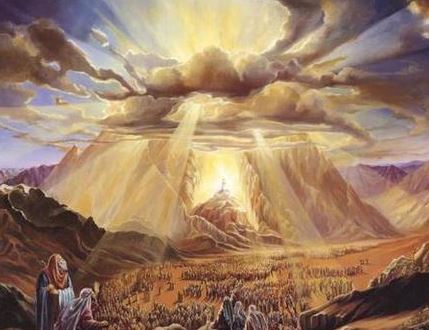 In this week’s parasha, Emor, we read the command to count the days between Pesach and Shavuot. The Torah doesn’t explicitly say why we should do this. The Zohar (III, 97b) comments on the parasha that when the Torah says to count sheva shabbatot temimot (“seven complete [or pure] weeks”) there is a hint in there that we are supposed to become tamim, “pure”. The point is to purify ourselves over these seven weeks in preparation for the great revelation at Sinai which took place on Shavuot. The Sages always describe the Sinai Revelation as a wedding between God and His people. In fact, the Zohar compares the counting of the seven weeks to a woman’s counting of seven “clean days” following menstruation and before immersing in the mikveh, after which she can reunite with her husband.
On the next page, the Zohar goes on to describe the “wedding”, where God is the “groom” and the Jewish people are the “bride”. The Zohar alludes to an ancient teaching that a bride should be adorned with 24 ornaments on her wedding day. This actually goes back to the Garden of Eden, where God made Eve and adorned her with 24 ornaments before her marriage to Adam. The Midrash (Beresheet Rabbah 18:1) brings Scriptural proof for this, citing Ezekiel 28:13, which says:
You were in Eden, the garden of God; every precious stone was your covering: the ruby [odem], the topaz [pitdah], and the diamond [yahalom], the beryl [tarshish], the onyx [shoham], and the jasper [yashfe], the sapphire [sapir], the carbuncle [nofech], and the emerald [varkat or bareket], and gold [zahav]; the workmanship of your settings and of your sockets was in you, in the day that you were created they were prepared.
If we count the precious stones and metals in the verse, we find only ten, not 24. However, one of the minor principles of Torah interpretation is when a general statement is introduced followed by a specific list, the general statement both includes the specific list, and adds to it (כְּלַל וּפְרַט, עָשָׂה אֶת הַכְּלַל מוֹסֶפֶת לַפְּרַט). So, since the verse begins with a general statement (“every precious stone”) and then goes on to list ten precious materials, we actually learn from this that there was a total of twenty precious materials. Rabbi Shimon ben Lakish held that one should also add “every precious stone” as a special stone of its own, meaning there were eleven stones, and since we double that, we have a total of 22. Plus, the verse goes on to speak of “your settings and your sockets”, bringing us to a total of 24 ornaments!
Alternatively, there is another Scriptural verse which brings us the 24 ornaments more simply and directly (though without mentioning Eden), listing explicitly what each specific piece of jewellery was. This is Isaiah 3:17-23, which says how the daughters of Zion were adorned with
…the anklets [‘achasim], and the ribbons [shvisim], and the crescents [saharonim]; the pendants [netifot], and the bracelets [sheyrot], and the veils [ra’alot]; the headdresses [pe’erim], and the armlets [tza’adot], and the sashes [kishurim], and the corselettes [batei hanefesh], and the amulets [lehashim]; the rings [taba’ot], and the nose-rings [nizmei ha’af]; the aprons [mahalatzot], and the shawls [ma’atafot], and the hair-coverings [mitpachot], and the girdles [charitim]; and the robes [gilyonim], and the fine linen [sadinim], and the headscarves [tzenifot], and the mantles [redimim]…
A count of these brings us 21. In addition, the verse that follows speaks of perfume [bosem], a belt [chagorah], and hair curls [petigil], giving us a total of 24 ornaments. Rashi references these 24 ornaments in his commentary on Exodus 31:18, which says how God concluded speaking with Moses on Sinai using the term k’khalloto, which can also be read as “like His bride”.
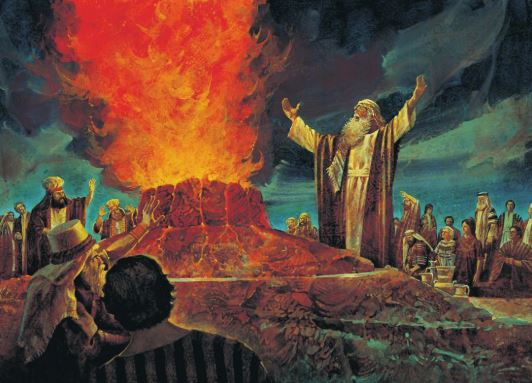
Elijah confronts the priests on Mount Carmel
Kabbalistically, these 24 ornaments have tremendous meaning. The sefirah of Chessed, which represents love and kindness, has three inner states, each of which is made up of 24 parts. (The gematria of Chessed [חסד] is 72, and dividing that number by three gives us 24.) This is why Eliyahu poured an extra three measures of water (water being Chessed) on his altar when he went head-to-head with the idolatrous priests (see I Kings 18). The altar which he built was actually made up of precious stones, too (I Kings 18:31-32), and then he had water poured from a jug called a kad (18:34). The gematria of kad (כד) is, as we might expect, 24.
That word is the exact same used when the Torah introduces Rebecca: “And it came to pass, before [Eliezer] had done speaking, that, behold, Rebecca came out… with her jug [kadah] upon her shoulder.” (Genesis 24:15). Kabbalistically, Rebecca is the embodiment of Chessed (see Zohar I, 137a) and she graciously provides water for Eliezer and all of his camels. Eliezer realizes that she is the perfect one for Isaac, and immediately proceeds to adorn her with all kinds of jewellery: “And it came to pass, as the camels had done drinking, that the man took a golden nose-ring of half a shekel weight, and two bracelets for her hands, of ten shekels weight of gold…” (Genesis 24:22) After the marriage was arranged, Eliezer gave the soon-to-be bride even more jewellery: “And the servant brought forth jewels of silver, and jewels of gold, and raiment, and gave them to Rebecca…”
If one looks carefully at these verses in Genesis 24 (not a coincidental number), and applies the classic rules of interpretation, they will find that Eliezer also brought for Rebecca 24 ornaments in preparation for her wedding! Rebecca went on to marry Isaac, and they had the purest love of all the forefathers and figures in the Torah. In fact, the first time that the Torah describes a husband loving his wife is with Isaac and Rebecca (Genesis 24:67). This is one reason why there was an old custom to adorn a Jewish bride with 24 ornaments. Alternatively, a husband may fulfil this special segulah by purchasing 24 adornments or pieces of jewellery for his wife—not necessarily all at once! (It is especially good to get white gold, since it is symbolic of Chessed, while yellow gold is the opposite, Gevurah.)
24 Ornaments of the Jewish People
If a bride is adorned with 24 ornaments, and the Jewish people were God’s “bride” at Sinai on Shavuot, what were our 24 ornaments? They are the 24 books of the Tanakh! The Ba’al HaTurim (Rabbi Yakov ben Asher, 1269-1343, on Exodus 31:18) comments that every Torah scholar is adorned with these 24 books just as a bride is adorned with 24 ornaments. And this is why, the Zohar states, one should stay up all night on Shavuot and study Torah, especially the 24 books of the Tanakh (Zohar I, 8a; though in Zohar III, 98a there is an alternate suggestion to study the Oral Torah at night and the Tanakh in the day). In so doing, one is spiritually adorning himself in preparation for the wedding (as well as adorning the Shekhinah herself).
Today, it has become the norm in all synagogues and yeshivas around the world for everyone to stay up all night and learn Torah, as the Zohar instructs. This practice was initially popularized by the kabbalists of Tzfat in the 16th century. The earliest reference to a tikkun leil Shavuot, a fixed text of study for the night of Shavuot, comes from a letter of Rabbi Shlomo HaLevy Alkabetz (c. 1500-1576), most famous for composing Lecha Dodi. He was born to a Sephardic family in Thessaloniki, or Salonica (then in the Ottoman Empire, now the second largest city in Greece).
In 1533, Rabbi Yosef Karo (1488-1575) settled in Salonica (he was born in Toledo, Spain before the Expulsion), and the two became close. One Shavuot night, they stayed up together studying Torah as the Zohar states. (In addition to Tanakh, they learned a little bit of Mishnah). Suddenly, the Shekhinah filled Rabbi Karo and spoke out of his mouth! Such revelations would continue for most of his life, and are recorded in his book, Maggid Mesharim. On that Shavuot night, the Shekhinah revealed many secrets and instructions. Among other things, She instructed the pair to move to Israel. In 1535, they did so and settled in Tzfat, the centre of Jewish mysticism.
In Tzfat, the pair would meet the Ramak (Rabbi Moshe Cordovero, 1522-1570), who later married the sister of Rabbi Alkabetz. When he was twenty years old, the Ramak heard a Heavenly Voice instructing him to seek out Rabbi Alkabetz and learn Kabbalah with him. He did so, and went on to become the preeminent Kabbalist of Tzfat. He was succeeded in the position by the Arizal (Rabbi Isaac Luria, 1534-1572).
Meanwhile, Rabbi Yosef Karo (1488-1575) went on to publish the Shulchan Arukh, still the central code of Jewish Law. Interestingly, he did not write anything about a tikkun leil Shavuot in the Code. He believed that it was a practice for Jewish mystics, not for the average Jew. Nonetheless, the custom spread very quickly, first in Tzfat, then across all of Israel. When the Shelah HaKadosh (Rabbi Isaiah Horowitz, 1555-1630), who was born in Prague, moved to Israel in 1626 he wrote how all the Jews living in the Holy Land stay up all night on Shavuot. The Shelah put together a text of study of his own for the night of Shavuot. In addition to portions from the 24 books of the Tanakh, he added the first and last verse of every Mishnaic tractate, and the first and last verse of Sefer Yetzirah, along with the Zohar passage from this week’s parasha with which we began, and a recitation of the 613 mitzvot.
In the ensuing centuries, the custom spread further across the entire Jewish world. Various other tikkun texts have arisen over that time. Today, it is normal for many synagogues not to follow any tikkun at all, but simply to have lectures on different topics by multiple speakers, or to learn whatever Torah text people wish, and this is appropriate as well. Having said that, the original Kabbalistic way—as suggested in the Zohar, practiced by the early Tzfat mystics, and affixed by the Arizal—is to study specific portions from the 24 books of the Tanakh, together with mystical commentaries on them. (This is the version used in our Tikkun Leil Shavuot, which has the proper text of study in both Hebrew and English, along with commentaries from the Zohar and Arizal.)
Rectifying Sinai and Purifying Our Souls
On a simple level, the word tikkun may refer to a “fixed” text of Torah, such as that which a ba’al kore uses to study the weekly parasha before reading it publicly in the synagogue. On a mystical level, “tikkun” refers to a spiritual rectification. When it comes to tikkun leil Shavuot, it is commonly taught that staying up all night in study is a spiritual rectification for what happened at Sinai over three millennia ago. At that time, the people had fallen asleep before God’s great revelation. Though some say they slept so that they would have energy to witness the tremendous event, others state that they were wrong to fall asleep so casually the night before the biggest day of their lives. Would a bride sleep so soundly the night before her wedding? Therefore, when we stay up all night on Shavuot, we are spiritually rectifying the mistake that the Jewish people made.
If we delve a little deeper, we might find an even greater tikkun on the night of Shavuot. The Talmud (Shabbat 146a) tells us: “When the Serpent came upon Eve, it infused in her a spiritual contamination [zuhama]. When Israel stood at Mount Sinai, the zuhama was removed.” Eve was the first to be decorated with 24 ornaments in the Garden of Eden, but then fell from grace and was spiritually contaminated. In a cosmic rectification, the Jewish people were “decorated” with 24 books of the Tanakh on Shavuot, and that impurity was removed. Each year since, we have a tremendous opportunity to cleanse ourselves of our own spiritual impurities on this special night, by immersing ourselves in the purifying words of our holy books.
The above is adapted from Garments of Light, Volume Two. Get the book here!