Tag Archives: Jerusalem

The Problem With Kapparot

In the early morning hours before Yom Kippur, many Jews will seek to perform the custom of kapparot, which involves taking a live rooster (or chicken), swinging it over one’s head, and then having it slaughtered. In the process, the person states how the rooster will be their “atonement”, and while the rooster will die, the person will go on to live a good life. The rooster’s meat is typically donated. Others swing money over their heads instead of a rooster, and then donate the money to charity. Of course, this strange-sounding custom is not mentioned anywhere in the Torah or Talmud. In fact, throughout history many Jewish Sages tried hard to extinguish this custom, for a number of important reasons.
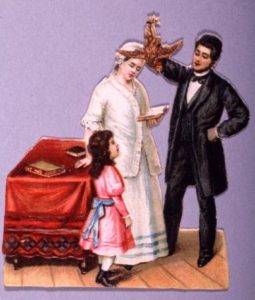
19th Century Lithograph of Kapparot

19th Century Lithograph of Kapparot

First of all, kapparot sounds much too similar to a korban, a sacrificial offering. In the days of the Temple, the kohanim sacrificed animals in order to atone for the people. The kapparot ritual explicitly states that the rooster serves as atonement, and the rooster is then killed. Despite some people’s claims that kapparot is not a true sacrifice, it clearly mimics the Temple’s sacrificial procedures, and intends to accomplish the same goal. The Mishnah Berurah (605:2) openly admits this, saying that kapparot is basically like a sacrifice. Indeed, an outsider would hardly be able to tell the difference. The problem is that the Torah forbids bringing sacrifices anywhere other than the place that God specifically designates (Deut. 12:5-6), which was the Temple Mount in Jerusalem. The Torah also commands that only kohanim are allowed to oversee sacrificial procedures. From this perspective alone, kapparot is contrary to the Torah.

Thirteen Years of Pain

Secondly, kapparot fits squarely under the category of unnecessary cruelty to animals. Commenting on the verse in Psalms (145:9) which states that God has mercy and compassion upon all of His creations, Rav Shimshon Raphael Hirsch wrote:

Here you are faced with God’s teaching which obliges you not only to refrain from inflicting unnecessary pain on any animal, but to help and, when you can, to lessen the pain whenever you see an animal suffering, even through no fault of yours.
(Horeb, Chapter 60, Section 416)

The Jewish Sages have always been concerned about animal welfare. The Talmud considers it a Torah mitzvah to treat animals with respect and prevent any harm to them (Bava Metzia 32b), so much so that one is allowed to violate various Shabbat prohibitions to help a suffering animal (Shabbat 128b). Let us not forget the story of Rabbi Yehuda HaNasi, who suffered excruciating pains for thirteen years. Why was he afflicted with such pain?

A calf was being taken to the slaughter when it broke away, hid its head under [Rabbi Yehuda’s] clothes, and lowed [in terror]. “Go”, he said, “for this you were created.” Thereupon it was said [in Heaven], “Since he has no pity, let us bring suffering upon him.”
(Bava Metzia 85a)

The great Rabbi Yehuda – the compiler of the Mishnah – made one uncompassionate remark to a fearful calf that was about to be slaughtered. For this, Heaven rained upon him tremendous pain – six years of kidney stones, and seven of scurvy, so unbearable that his cries could be heard over three miles away. When did his suffering end?

One day [Rabbi Yehuda’s] maidservant was sweeping the house; [seeing] some young weasels lying there, she made to sweep them away. “Let them be,” he said to her; “It is written, ‘And his tender mercies are over all his works.’” It was said [in Heaven], “Since he is compassionate, let us be compassionate to him.”

Rabbi Yehuda quotes the same verse (Psalms 145:9) that Rav Hirsch expounded upon, and has mercy on the young animals in his home. For this, his suffering is finally taken away. If even one little remark to an animal is worth thirteen years of suffering, how much more so if an animal is swung around wildly, then slaughtered needlessly – which is precisely what happens with kapparot. (It has also been pointed out that chickens used in kapparot are usually starving and thirsty, and often have their limbs dislocated or bones broken during the procedure.)

Idolatrous Practices

Lastly, kapparot appears to be connected with various idolatrous practices and non-Jewish customs. The Ramban, among others, considered it darkei emori, the way of idolaters. The Shulchan Arukh, the central halachic text of Judaism, is also staunchly opposed to kapparot, and its author, Rabbi Yosef Karo, called it a “foolish custom”.

Many modern-day authorities, too, from across the Torah-observant world, have been vocally against kapparot. Rabbi Joseph B. Soloveitchik and the entire Brisker rabbinic lineage before him opposed the custom, considering it irrational. The rabbi of Beit El and rosh yeshiva of Ateret Yerushalaim, Shlomo Chaim Aviner, a prominent authority within the Dati Leumi community, has described it as a “superstition”. And the former Sephardic Chief Rabbi of Tel Aviv, Chaim David HaLevy, beautifully wrote in his Aseh Lekha Rav:

Why should we, specifically on the eve of the holy day of Yom Kippur, be cruel to animals for no reason, and slaughter them without mercy, just as we are about to request compassion for ourselves from the living God?

Kapparot with Money

While it is clearly evident that one should completely avoid kapparot with chickens, some might argue that it is still worth doing kapparot with money. The problem is that the procedure and text are still the same: waving coins or bills over one’s head, stating that the money serves as an atonement, and that donating it will save one’s life.

The truth is that there is no need to do this at all, since any giving to charity automatically fulfils a mitzvah, assists in one’s repentance and atonement, and is said to be life-saving. The Talmud famously tells us (Bava Batra 10a) that charity is the greatest of all forces, and quotes the verse in Proverbs that “charity saves from death” (10:2).

Thus, any charitable contribution, at any time of the year, already does what kapparot claims to do. And so, awkwardly waving money around one’s head and reciting the kapparot verses is nothing more than a funny-looking waste of time, associated with a cruel, idolatrous, nonsensical, and nonJewish custom.

In his list of the 613 Torah mitzvot, the Rambam (who was also opposed to kapparot) lists the 185th positive commandment of the Torah as eradicating any traces of idolatry from Israel. Since many great Sages held the view that kapparot is associated with idolatrous ways, including the Ramban, Rashba, and the authoritative Shulchan Arukh, it is undoubtedly a mitzvah to not only avoid kapparot, but to encourage others to abandon this practice, and to expunge it from Judaism.


The article above is adapted from Garments of Light – 70 Illuminating Essays on the Weekly Torah Portion and Holidays. Click here to get the book!

1909: End of the “Jewish Curse” and Fulfilment of Prophecy

Towards the end of this week’s parasha, Ki Tavo, we read a long list of horrifying curses with which God threatens the Jewish people if they stray from the path of righteousness. What’s more shocking than reading this terrible list is realizing that the Jewish people have experienced just about every one of these curses in our long history: oppression, destruction, injustice, fear, poverty, starvation, exile, genocide, desperation, forced conversion, captivity, expulsion, and utter annihilation. The Torah says that these travails will be so extensive that the Jewish people “will become an astonishment, an example, a byword among all the peoples to whom Hashem will lead you.” (Deut. 28:37) Israel will become the very epitome of curses and suffering. Indeed, history has confirmed this unfortunate prophecy.

Thankfully, the prophecies don’t end there. The haftarah for this parasha is a passage from the prophet Isaiah. Isaiah prophesies the very opposite, and says that a time will come when all of these curses will be reversed into blessings. Whereas Moses says God “will scatter you among all the nations, from one end of the earth to the other,” (28:64), Isaiah says that “all have gathered, they have come to you; your sons shall come from afar, and your daughters shall be raised…” (60:4). While Moses warns that “your skies above you will be copper, and the earth below you iron” (28:23), Isaiah says that “Instead of the copper I will bring gold, and instead of the iron I will bring silver.” (60:17) God confirms that He has put us through many trials in the past, and while this was long in duration, it was nonetheless only temporary, for “in My wrath I struck you, and in My grace I have had mercy on you.” (60:10)

Amazingly, we are living the fulfilment of Isaiah’s prophecies. The Jewish people have returned en masse to the Promised Land, have made the barren deserts bloom once more, and have miraculously defended their borders time and again. In the span of just several decades, the State of Israel has transformed into an agricultural, technological, and military powerhouse – despite very few natural resources, a small landmass, and a tiny population. As Isaiah predicted “…the abundance of the west shall be turned over to you, the wealth of the nations will come to you.” (60:5) Now, all that remains to be seen is the last part of Isaiah’s promises:

Violence shall no longer be heard in your land, neither robbery nor destruction within your borders, and you shall call your walls “salvation”, and your gates “praise”… And your people, all of them righteous, shall inherit the land forever, a scion of My planting, the work of My hands in which I will glory. The smallest shall become a thousand and the least a mighty nation; I am Hashem, in its time I will hasten it. (60:18, 21-22)

Israel will finally have true peace, with the world no longer questioning the indigenous Jewish people’s legitimacy to inhabit their Holy Land. The very last verse of this prophecy then says that when that time finally comes, God will “hasten” its arrival. This is quite the perplexing statement, and one that has kept rabbis and scholars thinking for millennia. The problem is as follows: If something is being hastened, then it is obviously coming before its time, and if it is coming on time, then it hasn’t been hastened!

Another way of looking at it is that one makes haste when they are already late. Few would disagree that this final redemption is long overdue. Since it is so late in coming, God will make haste to bring it about. An even simpler explanation is that when the time comes, God will hasten the series of events to bring about that happy ending. Recent history has shown that this is exactly what has happened.

In the late 1800s, the thought of an independent Jewish state in the Holy Land was still a very distant dream. The “first aliyah” began in 1882, and though as many as 35,000 Jews migrated to Israel by 1903, some scholars estimate that up to 90% of them left Israel soon after because of unfavourable conditions.

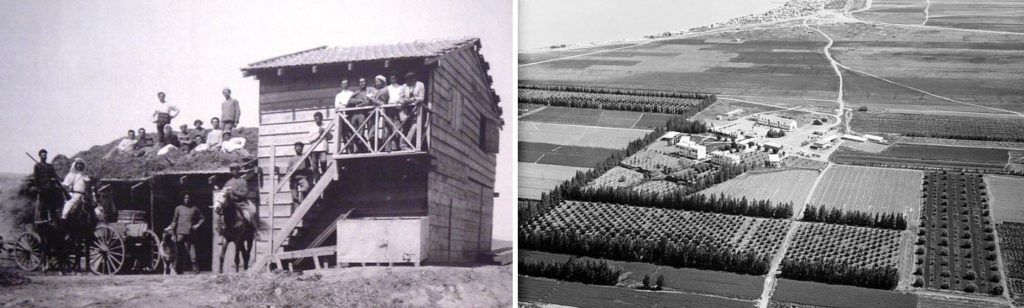
Then came 1909. In that year, a group of ten men and two women established a unique collective near the Galilee which would become the first kibbutz. The model of the kibbutz proved successful, and expanded from twelve people in 1909 to four thousand people living in thirty kibbutzim across the country by 1929. The kibbutz became one of the most significant factors in the rebirth of Israel, playing a key role in defending the land, driving agricultural innovation, and inspiring the “Israeli dream”.

Degania Alef, the first kibbutz, in 1910 (Left), and in 1931 (Right)

Degania Alef, the first kibbutz, in 1910 (Left), and in 1931 (Right)

Around the same time in 1909, a group of 66 families parceled out a plot of land outside of Jaffa (which was previously purchased by a wealthy Dutch Jew named Jacobus Kann). By 1922, this little settlement had become the bustling city of Tel-Aviv, with a population hitting 34,000 just a few years later. It would only take two more decades for the declaration of independence to be proclaimed from that city, and two more to liberate all of Jerusalem.

66 Families Parcel Out Tel-Aviv in 1909 (Left), the city in 1922 (Middle), and Tel-Aviv today (Right)

66 Families Parcel Out Tel-Aviv in 1909 (Left); the city in 1922 (Centre); and Tel-Aviv today (Right)

Events have certainly progressed very quickly, and a glance at today’s geopolitical situation shows that they continue to rapidly accelerate. The spark for it all appears to have been lit in 1909 by those two seminal events – the first kibbutz and the first city – which propelled the rebirth of Israel and the fulfilment of Biblical prophecy. What’s most interesting is that this special number – 1909 – is precisely the gematria (numerical value) of that final cryptic verse of Isaiah: “The smallest shall become a thousand and the least a mighty nation; I am Hashem, in its time I will hasten it.”


The above is adapted from Garments of Light: 70 Illuminating Essays on the Weekly Torah Portion and Holidays. Click here to get the book! 
Tisha B’Av: Why Are We Still Mourning?

This week’s Torah portion is Devarim, which begins the fifth and final book of the Torah. This book (Deuteronomy), is written from the perspective of Moses, and summarizes much of what the Torah discussed earlier. At the same time, it also introduces many new mitzvot, and reveals deeper insights into the Torah’s previous narratives. For example, while the book of Numbers told us that Moses was forbidden to enter the Holy Land because he disobeyed God in striking the rock, here we are told that Moses was forbidden to enter the Land because of the incident of the Spies! (1:22-38) How do we reconcile these differences? The answer can actually be found in next week’s parasha, Va’etchanan.

Va’etchanan (literally “and I beseeched”) describes how Moses begged God to allow him to enter the Holy Land. The Talmud (Berachot 32b) states that Moses prayed so much that God actually relented and forgave him for striking the rock. However, it would have been wrong for Moses to enter the Holy Land at that time, considering that the rest of the men were condemned to perish in the Wilderness because of the sin of the spies. After all, Moses was their leader. Could a shepherd abandon his flock? Would a captain abandon his sinking ship? So, Moses didn’t enter the land not because of the rock, but because of the spies.

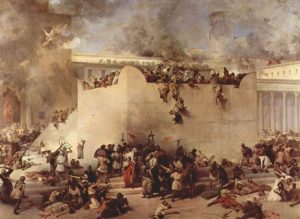
'Destruction of the Temple of Jerusalem' by Francesco Hayez (1867)

‘Destruction of the Temple of Jerusalem’ by Francesco Hayez (1867)

This is all the more pertinent now with Tisha B’Av right around the corner. Tisha B’Av commemorates the destruction of both Holy Temples in Jerusalem, along with a handful of other tragedies said to have happened on, or around, that date – the ninth of the month of Av. According to tradition, the origins of Tisha B’Av lie in the incident of the spies. It was on that day that the spies returned from the land of Israel, and reported negatively about the people’s chances of conquering the land. The faithless nation feared and cried needlessly on that day so, it is said, God subsequently gave the nation many good reasons to truly fear and cry on that day throughout history.

The Problem with the 9th of Av

There are many problems with this classic narrative. First of all, why would God punish generations far in the future for the sins of that one generation long ago? Deuteronomy 24:16 itself states clearly that “Parents shall not be put to death because of their children, nor children because of their parents. Each person shall be put to death for their own crime.” While the Torah does also mention a number of times that God “carries over the iniquity of the fathers onto the children to the third and fourth generations”, the phrase concludes by saying this is only true to those that “hate Him”. In any case, it is only to the third and fourth generations, not millennia into the future! Even so, the Talmud (Makkot 24a) says the prophet Ezekiel came and repealed this divine decree anyway:

Said Rabbi Yose bar Chanina, “Moses pronounced four decrees upon Israel, which four prophets came and cancelled.”
…Moses said, “carries over the iniquity of the fathers onto the children…” (Exodus 34:7) Ezekiel came and cancelled it: “The one who sins will die.” (Ezekiel 18:14)

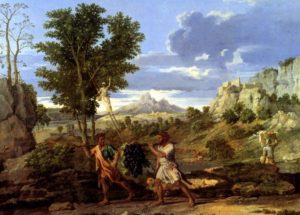
'The Spies With The Grapes Of The Promised Land' by Nicolas Poussin (1664)

‘The Spies With The Grapes Of The Promised Land’ by Nicolas Poussin (1664)

Second of all, did the spies really return on the 9th of Av? The Talmud (Ta’anit 29a) calculates that the spies went forth on the 29th of Sivan and returned forty days later on the 9th of Av. However, the Torah tells us that the spies went to Israel at the start of the grape harvest (Numbers 13:20) and the same tractate of Talmud (Ta’anit 30b) states that the grape harvest season lasted from the 15th of Av until Yom Kippur! How could the spies have returned on the 9th of Av when the grape harvest only began on the 15th? (A simple Google search reveals that the ideal time for grape harvest is September-October, which is right between the 15th of Av and Yom Kippur.)

On the same note, when exactly were the Temples destroyed? The Tanakh tells us that “in the fifth month, on the seventh day of the month, which was the nineteenth year of King Nebuchadnezzar, king of Babylon, came Nebuzaradan, the captain of the guard, a servant of the king of Babylon, to Jerusalem. And he burned the house of Hashem, and the king’s house…” (II Kings 25:8-9) This verse suggests the First Temple was destroyed on the 7th of Av.

Another verse in the Tanakh tells us that “in the fifth month, in the tenth day of the month, which was the nineteenth year of King Nebuchadnezzar, king of Babylon, came Nebuzaradan, the captain of the guard, who stood before the king of Babylon, to Jerusalem; and he burned the house of Hashem, and the king’s house…” (Jeremiah 52:12-13) The verse is nearly identical, except that this one says Nebuzaradan came on the 10th and destroyed the Temple.

We have the 7th of Av and the 10th of Av, but no 9th! The Talmud (Ta’anit 29a) notes this contradiction and tries to reconcile it this way: “On the seventh the heathens entered the Temple and ate therein and desecrated it throughout the seventh and eighth, and towards dusk of the ninth they set fire to it and it continued to burn the whole of that day [the tenth].” Rabbi Yochanan goes on to say that if it were up to him, the mourning day would be the 10th of Av, not the 9th, since this is when the Temple was mostly destroyed.

And what about the Second Temple? Josephus lived through its destruction, and later wrote about it in detail. He says that it was destroyed on the 10th of Av, and writes that the Jews mourn its destruction on the same day that they mourn the destruction of the First Temple. However, he seems to admit that he is uncertain about the exact dates that the Temples fell.

What does the Talmud say? It, too, is uncertain, but concludes that since “good things tend to happen on good days, and bad things on bad days,” it is assumed that the Second Temple was destroyed on the same day as the First Temple!

Postponing, Abolishing, or Redefining?

This year, Tisha B’Av falls on Shabbat, so the fast is postponed, appropriately, to the 10th. While Rabbi Yochanan felt that the 10th is the correct day to fast anyway, Rabbi Yehudah HaNasi – the great redactor of the Mishnah – wanted to have the fast of Tisha B’Av abolished completely! Some say this was only when Tisha B’Av falls on Shabbat and needs to be postponed, while others say he wanted it gone entirely (Megillah 5b).

This idea has been echoed in modern times. The primary reason for mourning on Tisha B’Av is because of Jerusalem’s destruction and the Jewish people’s exile. Today, the Jewish people have returned to the Holy Land and have rebuilt Jerusalem. While there’s no Temple just yet, we are free to travel to, and settle in, the Holy City whenever we wish. Why are we still mourning?

Perhaps Rabbi Yehudah felt the same way. In his day, Jews had also returned to Jerusalem and enjoyed relatively good terms with the Romans. Rabbi Yehudah himself was friends with the Caesar known in the Talmud as ‘Antoninus’ (possibly the Emperor Marcus Aurelius, or maybe a local Roman governor).

Meanwhile, far worse tragedies have befallen the Jewish people since then: crusades, inquisitions, pogroms, the Holocaust, and the list goes on. Why focus on the temples and Jerusalem when there are more recent, greater tragedies? Indeed, former Israeli Prime Minister Menachem Begin intended to combine all the days of commemoration, and move Holocaust Remembrance Day and Israel’s Memorial Day to Tisha B’Av.

Perhaps this is what Tisha B’Av should be: one day to remember all of the suffering that has troubled the Jewish people, and all the suffering that continues to plague the world. A day to remind us that Mashiach has not come yet, the Temple is not yet rebuilt, and the world is not yet whole. A day to ask ourselves: what exactly are we doing to hasten the arrival of that magnificent, forthcoming time? What are we doing that will finally put an end to all the mourning? Tisha B’Av should be a day not about drowning in the sad tears of the past, but about actively working towards the happy tears of the future.

And this is precisely what Rabbi Akiva told his colleagues when they saw the ruins of the Temple. While Rabban Gamliel, Rabbi Elazar ben Azariah, and Rabbi Yehoshua ben Chananiah immediately fell into a bout of weeping, Rabbi Akiva was laughing. Surprised, they asked him to explain himself. He told them that while they were dwelling on the destruction of the first and second temples, he was dwelling on the vision of the coming Third Temple. The rabbis responded – and with this the tractate ends – “Akiva, you have consoled us! Akiva, you have consoled us!”