
This week’s parasha, Ki Tetze, begins by describing the procedure when Israelite men “go out to war” and encounter a beautiful woman behind enemy lines. The Torah permits taking this woman for a wife, but on condition that the soldier waits for one month. He is to bring her to his home, where she shaves her head and cuts her nails while mourning for a month for the loss of her family. Only then, if the soldier still wants her, he can take her as a wife. If he no longer wants her, then she is to be set free unconditionally. The Torah cautions that she must not be treated as a slave or sold. A big question here is: is the soldier permitted to have relations with the “beautiful captive” immediately, or must he wait one month until she is eligible to be his wife? Continue reading
Tag Archives: Lubavitcher Rebbe
Erev Rav, Part 3: Conspiracy Theory
How did the Erev Rav become so powerful in recent times? Was there a conspiracy in the 18th century by a small group of heretics to destroy Judaism? And how has it manifest itself in the world today? Plus: exploring Samson as a model for current events, pinpointing the exact number of Erev Rav souls, and what exactly happened in the aftermath of the Golden Calf incident?
For more on the significance of the year 1648 and the aftermath of Shabbateanism, see here.
Constellations and the Jewish Calendar
Yesterday marked the start of the new month of Nisan, first of the Jewish calendar. According to our ancient mystical texts, like Sefer Yetzirah, each of the twelve months of the Jewish year corresponds to one of the twelve Zodiac constellations (mazalot). The month of Nisan corresponds to Aries, or tal’e in Hebrew. Aries is depicted as a sheep or ram and, of course, the highlight of Nisan is the holiday of Pesach, referring to the korban pesach, the “paschal lamb”—a sheep!
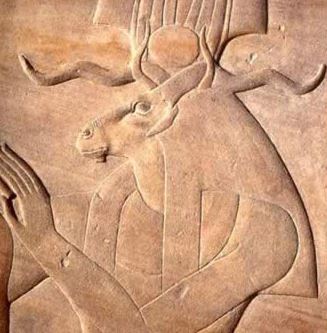
The Ram-headed idol Ra
Our Sages pointed out that God specifically commanded this species to be sacrificed because it was what the Egyptians worshipped at the time. This is likely referring to the ram-headed deity Ra. Amazingly, Ra is actually mentioned in the Torah when Pharaoh tells Moses that Ra neged pneichem (Exodus 10:10), typically translated as “evil [ra] will be before you”. Rashi comments here that Ra is an Egyptian idol and Pharaoh was warning the Israelites that they would perish under the wrath of his god Ra. Of course, the entire Exodus narrative was about showing God’s mastery over all aspects of Creation, and His destruction of Egypt’s false idols, Ra chief among them.
In astrology, Aries is a “fire” sign, which is quite appropriate for the Exodus connection. The fire alludes to the fire of the sacrificial altar for the korban pesach, as well as the pillar of fire that led the Israelites out of Egypt and through the Wilderness. Furthermore, at the Pesach seder, the Haggadah reminds us to say “blood, and fire, and columns of smoke”, dam v’esh v’timrot ashan, in memory of the Ten Plagues and the Exodus. (Actually, this phrase originally comes from Joel 3:3, straight from the prophet’s vision of the End of Days!) Continue reading