Category Archives: Jewish Law & Life Cycle

The Jewish View on Cards and Gambling

In this week’s parasha, Matot-Massei, we read how the Israelites were supposed to divide up the Holy Land between the Twelve Tribes:

And you shall inherit the land by lot according to your families; to the more [numerous] you shall give the more inheritance, and to the fewer you shall give the lesser inheritance; wherever the lot falls to any man, that shall be his…

We learn that the land of Israel was apportioned based on family size, with larger families logically receiving a larger share. Now, to determine which chunk of land a family would receive, the Israelites cast lots. The Talmud (Bava Batra 122a) describes how this was done: two urns were prepared, one containing the names of the Twelve Tribes, and the other containing the names of the various allotments of land. Elazar the High Priest would pick one name from each urn, thus designating a piece of land for a particular tribe.

Casting lots was very common in Biblical times, and is mentioned frequently in the Tanakh. For example, the Torah commands casting lots to determine which goat is sent to Azazel on Yom Kippur (Leviticus 16:8). In the Book of Jonah (1:7), the sailors on Jonah’s ship cast lots to determine who was guilty of causing the storm. In the time of King David, the kohanim were thus divided into 24 groups (I Chronicles 24). Haman cast lots to determine the best day to attack the Jews, and this is why the holiday is called “Purim”, since purim was the Persian word for “lots” (Esther 3:7).

Casting lots suggests a large degree of chance or randomness in the process. Yet, people of faith are naturally quite averse to the concept of random chance, for isn’t everything determined by God? Not surprisingly, the word “lot” (goral) also takes on the meaning of “fate” in the Tanakh. For instance, Isaiah (17:14) prophesies: “At evening there will be terror, and before morning they are not. This is the portion of them that spoil us, and the goral of them that rob us.” The ultimate fate of those that harm the Jewish people will be utter destruction. The Sages, too, were uncomfortable with the idea of dividing the Holy Land by seemingly random lots. They therefore stated (ibid.) that the lots were really just a show for the people to see what God intended. In reality:

Elazar was wearing the Urim and Tumim, while Joshua and all Israel stood before him… Animated by the Holy Spirit, he gave directions, exclaiming: “Zevulun” is coming up and the boundary lines of Acco are coming up with it. [Thereupon], he shook well the urn of the tribes and Zevulun came up in his hand. [Likewise] he shook well the urn of the boundaries and the boundary lines of Acco came up in his hand…

Elazar would prophetically see which tribe needed which land, and when he then shook the urns those exact pairs that he foresaw would emerge! So, the process was not random at all, but simply a materialization of the Divine Will. Still, the Sages insist that in the messianic era the Holy Land will not be apportioned through this method of casting lots, but rather “The Holy One, blessed be He, Himself, will divide it among them; for it is said [Ezekiel 48:29], ‘And these are their portions, says the Lord God.’”

If the Sages were not fond of casting random lots by chance, how would they feel about playing games of chance and gambling?

Gambling in the Talmud
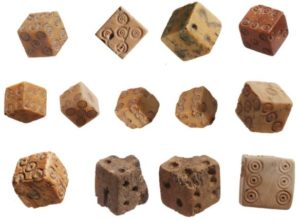
In 1999 and 2000, the Muslim Waqf (Temple Mount authority) dug up 9000 tons of Temple Mount soil and unceremoniously dumped it in the Kidron Valley, creating one of the largest archaeological catastrophes in history. Thankfully, archaeologists did not give up on this precious soil, and began the “Temple Mount Sifting Project”. Among the many incredible finds are these Second Temple-era playing dice.

In a list of people that are ineligible to serve as witnesses or as judges, the Mishnah includes a mesachek b’kubia, a person who plays with dice, and mafrichei yonim, “pigeon flyers”. According to the Talmud, the latter most likely refers to people who bet on pigeon races, which were apparently common in those days. We know from historical sources that gambling with various dice games was very popular in Greek and Roman times. The Talmud (Sanhedrin 24b) goes on to discuss what the problem with such people is.

Rami bar Hama teaches that the issue with gambling is that it is essentially built on a lie: each player agrees to pay a certain sum of money if they lose, yet they hope (and fully intend) not to lose at all! That means the initial agreement made by the players is not even valid. The losing gambler is entirely dejected, and gives up their money reluctantly, often with a nagging feeling of being robbed or cheated out of their money.

Rav Sheshet disagrees. After all, there may be some people who are not so sad to part with their money, or are simply addicted to the game itself. Whatever the case, Rav Sheshet holds that gambling is inappropriate because it is a terribly unproductive waste of time, and the gambler contributes nothing to “the welfare of the world”. This is why, Rav Sheshet says, the Mishnah above concludes by saying that only a full-time gambler is prohibited, but one who has an actual job and just plays for fun on the side is permitted.

Nonetheless, Rav Yehudah holds that regardless of whether the gambler has an occupation or not, or whether he is a full-time player or not, a gambler is disqualified from being a kosher witness or judge. Rav Yehudah bases his statement on a related teaching of Rabbi Tarfon, and on this Rashi comments that a gambler is likened to a thief. The Midrash is even more vocal, saying that gamblers “calculate with their left hand, and press with their right, and rob and wrong one another” (Midrash Tehillim on Psalm 26:10).

The Talmud (Sanhedrin 25b) goes on to state that the prohibitions above don’t only refer to a literal dice-player, but any kind of gambler, including one who plays with pebbles (or checkers), and even with nuts. The Sages state that such a person is only readmitted when they do a complete repentance, and refuse to play the game even just for fun without any money!

Halachically-speaking, the Shulchan Arukh (Choshen Mishpat 370:2-3) first states that any kind of gambling is like theft and is forbidden, but then suggests that while it may not exactly be theft it is certainly a waste of time and not something anyone should engage in.

A Ban on Gambling

While the Talmud does not explicitly forbid gambling, later rabbis recognized its addictive nature and sought to ban the practice entirely. In 1628, for example, the rabbis of Venice issued a decree (to last six years) excommunicating any Jew who gambled. Part of the motivation for this decree was the case of Leon da Modena (Rabbi Yehudah Aryeh of Modena, 1571-1648).
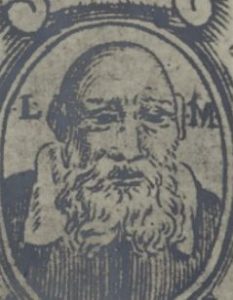
Rabbi Leon Yehudah Aryeh da Modena

Born in Venice to a family of Sephardic exiles, da Modena went on to become a respected rabbi and the hazzan of Venice’s main synagogue for forty years. A noted scholar, he wrote about a dozen important treatises. In Magen v’Herev, he systematically tore down the major tenets of Christianity, while in Ari Nohem he sought to discredit Kabbalah and prove that the Zohar has no ancient or divine origin. (The latter is probably why he isn’t as well-known in Jewish circles today as he should be.)

In 1637, he published Historia de’riti hebraici, an overview of Judaism for the European world, meant to dispel myths about Judaism and quell anti-Semitism. Historians credit this with being the first Jewish text written for the non-Jewish world in over a millennium, since the time of Josephus. The book was incredibly popular, and played a key role in England’s readmitting Jews to the country in the 1650s (after having being expelled in 1290).

More pertinent to the present discussion, Rabbi da Modena wrote Sur miRa (“Desist from Evil”), outlining the problems with gambling. He would know, since he was horribly addicted to gambling himself. He wrote of this problem in his own autobiography, Chayei Yehudah. And because such a high-profile sage was a gambler, his rabbinic colleagues in Venice issued that decree to ban any form of gambling.

Rabbi da Modena’s game of choice was cards. At that point in time, playing cards had become wildly popular in Europe. First invented in China in the 9th century, playing cards slowly made their way across Asia, and reached Europe around 1365. They have remained popular ever since, both for gambling and non-gambling games. While it is clear from an halachic standpoint that card games involving money (like Poker or Blackjack) should not be played, is it permissible to play non-gambling card games (like Crazy Eights or Go Fish)?

At first glance, it may not seem like there should be a problem with this. Yet, some rabbis have recently spoken out against all playing cards. Usually, this prohibition is connected not to gambling or wasting time, but rather to cards’ apparent origins in idolatry or the dark arts. Although it is true that some types of cards are used in divination and fortune-telling, it is important to examine the matter in depth and determine whether cards really are associated with forbidden practices.

The History of Playing Cards
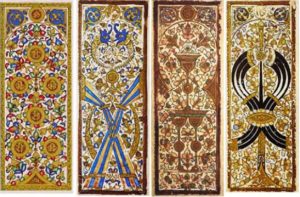
Mamluk Cards

The exact origins of cards are unclear. We do know that they come from China, where paper and printing were invented. Card games are attested to in Chinese texts as early as 868 CE. In the 12th and 13th centuries, the Muslims brought cards across Asia. They were particularly popular in Egypt during the Mamluk Sultanate (1250-1517). The Mamluks created the first modern-style deck of 52 cards with 4 suits. The suits were sticks, coins, swords, and cups. In the 15th century, Italians started to make cards of their own, with the suits being leaves, hearts, bells, and acorns. The French had three-leaf clovers for leaves, square tiles (or diamonds) for bells, and pikes for acorns. Although these suit symbols remained, the English names reflect the earlier suits of sticks (“clubs”) and swords (“spades”).

The Muslim Mamluks did not draw any faces on their court cards (since depicting faces in art is forbidden in Islam). The Europeans did not have this issue, and adapted the Muslim court cards of malik (king), malik na’ib (deputy king), and thani na’ib (second deputy) to king, queen, and prince or knight (“jack”). In 16th century France, the four kings were depicted as particular historical figures: the King of Spades was King David, the King of Clubs was Alexander the Great, the King of Hearts was Charlemagne, and the King of Diamonds was Julius (or Augustus) Caesar.

We see that playing cards have no origins in idolatry. The style of cards we know today were developed by staunchly monotheistic Muslims. They were further developed by mostly non-religious European renaissance printers, against the wishes of the Church which sought to ban cards on a number of occasions. Neither are playing cards known for being used in fortune-telling. However, a related type of card is used in divination today.

Tarot Cards and Kabbalah

In 15th century Italy, a different type of playing card developed. These were called trionfi, later tarocchi, and finally “tarot cards”. They, too, have four suits, but with 56 cards. These were, and still are, used for a number of different games, just like regular playing cards are. Outside of Europe, tarot cards are not well-known, and are generally associated with fortune-tellers.

In reality, the earliest mention of tarot cards being used in divination is only from 1750, and it was essentially unheard of until the late 19th century. Besides, most diviners actually use a different deck of 78 cards. Of course, such divination is entirely forbidden according to the Torah. So, it seems like some well-meaning rabbis have confused these tarot cards with regular playing cards. Ironically, many occultists actually claim that tarot cards come from Kabbalah!
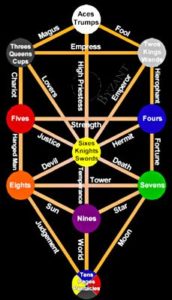
The Tarot “Tree of Life” (Credit: Byzant.com)

These occultists tie the 22 additional divination cards to the 22 letters of the Hebrew alphabet and the 22 paths on the mystical “Tree of Life”. The ten numeral cards (naturally) correspond to the Ten Sefirot, while the four suits correspond to the four olamot, or universes. Finally, the four court cards and the ace represent the five partzufim (with the king and queen appropriately being Aba and Ima). While these parallels are neat, there is absolutely no known historical or textual basis to support these claims. Tarot cards have nothing to do with traditional Kabbalah or Jewish mysticism. (There is a concept in Kabbalah of a negative set of Ten Sefirot belonging to the Sitra Achra, so perhaps there is some connection between these tarot cards and certain evil spiritual forces.)

Having said all that, to forbid playing with cards (or even standard tarot cards) just because some people recently started using them in divination is like forbidding drinking coffee because some people recently started divining with coffee (a practice called “tassology” or “tasseography”). While playing cards copiously is certainly a waste of time, there is nothing wrong with the occasional—no gambling—game.
Ba’al HaTurim

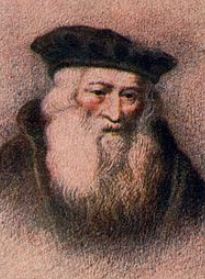
It is fitting to end with the words of the Ba’al HaTurim (Rabbi Yakov ben Asher, c. 1269-1343) who writes in his commentary on the Torah (Tur HaAroch on Deuteronomy 1:1) that Moses himself cautioned Israel about gambling in his final speech before passing away:

Before Moses got ready to relate all these various commandments, he used the present opportunity, a few weeks before his death, to admonish the people, and to remind them of past sins, and how they had caused Hashem a lot of grief during these years. He reminded them how God had treated them by invoking His attribute of mercy and loving kindness time and again. He warned them not to become corrupt again by gambling… They should not rely on the fact that because they were human they were bound to err and sin from time to time and that God, knowing this, would overlook their trespasses.


The above is adapted from Garments of Light, Volume Two. Get the book here

The Right Way to Observe the “Three Weeks”

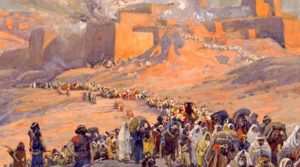
‘The Flight of the Prisoners’ by James Tissot, depicting the Jewish people’s exile after the destruction of the First Temple.

The “Three Weeks” refers to the period between the fast days of the seventeenth of Tamuz and the ninth of Av. The Talmud describes five tragedies that happened on each of these fast days, culminating with the destruction of both Holy Temples in Jerusalem on Tisha b’Av. Over the centuries, many customs have emerged with regards to this time bein hameitzarim, “between the straits”. Today, it has essentially become a three-week mourning period—even though the Talmud and other early texts say nothing about it. Furthermore, many have come to believe that this is an “unlucky” or “dangerous” time for the Jewish people, and thus abstain from various activities. What is the origin of these customs and how should they be followed?

Surprises in the Talmud

Throughout the Three Weeks period it is customary to abstain from shaving and haircuts, as well as listening to music. Generally, weddings are not held (with minor exceptions), and saying the blessing of shehecheyanu (on new clothes, fruits, or other) is discouraged. The mourning intensifies once the month of Av begins. Henceforth, the consumption of meat and wine is restricted, as is bathing for pleasure, doing laundry, or purchasing valuable new things. The source for most of these prohibitions is in the Talmud (Ta’anit 26b-30a), where we read:

With the beginning of [the month of] Av, rejoicing is curtailed. During the week in which the ninth of Av falls, it is forbidden to cut hair and to wash clothes, but on Thursday it is permissible in honour of the Sabbath. On the eve of the ninth of Av, one may not partake of a meal of two courses, nor eat meat, nor drink wine.

The Mishnaic statement above simply states that once the month of Av begins, one must lessen their joy. This would presumably include going to parties and weddings, and listening to music (which, in those days, could only be enjoyed live). Still, it is only speaking of the first days of Av, not of a three week period from the seventeenth of Tamuz. The Mishnah then states that in the actual week in which Tisha b’Av falls, one should abstain from haircuts and laundry (of course, this is permissible if preparing for Shabbat, the honour of which is greater than any mourning custom). The Talmud then debates this Mishnah:

…it is forbidden to cut the hair and to wash clothes from the beginning of the month until after the fast—this is the opinion of Rabbi Meir. Rabbi Yehudah says: It is forbidden the whole month. Rabban Shimon ben Gamaliel says: It is forbidden only on that particular week. … Rava said: The halachah is according to Rabban Shimon ben Gamaliel. And Rava further said: The halachah is according to Rabbi Meir. And both decisions are in favour of the more lenient practice, and both are needed [to be stated]. For had it only been stated that the halachah is according to Rabbi Meir, I might have said that the restriction is in force from the beginning of the month, therefore it is also clearly stated that the halachah is according to Rabban Shimon ben Gamaliel. And had it only been stated that the halachah is according to Rabban Shimon ben Gamaliel, I would have said that the restriction continues even on the days after [Tisha b’Av], therefore it is clearly stated that the halachah is according to Rabbi Meir.

There were three schools of thought in those days: Rabbi Meir held that we mourn from the start of Av until the fast; Rabban Shimon that we only mourn during the week of Tisha b’Av itself; and Rabbi Yehudah was the most stringent, holding that the entire month of Av is mournful. The halacha originally favoured Rabban Shimon, however this presented an ambiguity: If we are meant to mourn in the week of Tisha b’Av, does that mean we must continue to mourn for the remainder of the week after the fast is over? To clarify, Rava combines the view of Rabban Shimon and Rabbi Meir, and concludes that we mourn until the fast, and not after. For this reason, today’s custom is to intensify the mourning practices in the week of Tisha b’Av itself.

Finally, the Mishnah states that in the very last meal one eats before the fast begins, they should avoid meat and wine. The Talmud once more elaborates:

Rav Yehudah said: This restriction applies to any time after midday, but not to any time before midday. Rav Yehudah further said: It applies only to the concluding meal [before the fast] but not to any other meal… One who has a meal on the eve of Tisha b’Av with the intention to have another meal [later], he may eat meat and drink wine; but if not, he may not eat meat nor drink wine.

The Talmud makes it clear that one need only abstain from meat and wine in the very last meal before the fast begins. There is no Talmudic basis for avoiding meat and wine from Rosh Chodesh Av. In fact, the Talmud goes on to state that while Rabbi Meir said one should avoid meat and wine in that final meal, the rest of the Sages said one should only lessen his consumption of meat and wine:

How should one restrict? If he was in the habit of eating one pound of meat he should eat one half only; if it is his usual practice to drink one log of wine he should drink one half log only…

The Talmud later clarifies that salted meat and new wine is always permitted. It is only fresh meat and the finer, aged wine that shouldn’t be consumed! Despite this, many Jewish communities became more and more stringent over the centuries, and took upon themselves to avoid all meat and wine from the start of the month. Rav Ovadia Yosef held that since it is already an ancient custom, it should be continued. Interestingly, the Yemenite Jews had no such custom, and only abstained from meat and wine in that final meal before the fast, as the Talmud requires. Nonetheless, Rav Ovadia encouraged them to take on the more stringent custom, especially because now they were living in Israel where destruction of the Temple is felt more pressingly.

The Talmud also mentions the custom of bathing:

At the meal intended to be the concluding one before Tisha b’Av, it is forbidden to eat meat or to drink wine, or to bathe after the meal. At the meal which is not intended to be a concluding meal prior to Tisha b’Av, it is permissible to eat meat and to drink wine, but not to bathe. Rabbi Ishmael bar Yose said in the name of his father: So long as it is permissible to eat meat it is also permissible to bathe.

The Talmud at first suggests that bathing may be one of those things one shouldn’t do the week of Tisha b’Av. Rabbi Ishmael comes to conclude that as long as eating meat is allowed, so is bathing. Thus, from a Talmudic perspective alone, bathing is permitted right up until the final meal of Tisha b’Av.

Laying Down the Law

The Rambam, aka. Maimonides

In the 12th century, the Rambam (Rabbi Moshe ben Maimon, 1135-1204) produced his monumental Mishneh Torah, the first complete, comprehensive, and conclusive Jewish book of laws. While many more law books have been laid out since then, the Mishneh Torah is seen by many as the gold standard. Some hold that it is the greatest law code in Judaism (with the Rambam regularly compared to Moses himself), and there are those today who consider themselves “Rambamists” that strictly follow the dictates of the Mishneh Torah.

There are many reasons why the Mishneh Torah is so great. For one, the Rambam wrote it succinctly, clearly, with no grey areas, and covering every aspect of Judaism. (In fact, he himself writes in the introduction that one need only read Scripture and his Mishneh Torah to know essentially everything about Judaism!) Secondly, the Rambam did not include any customs of non-Jewish origin or of an irrational nature, of which there are unfortunately quite a lot today. He was precisely logical and practical in his halacha. On a related note, the Rambam completely avoided anything Kabbalistic, mystical, or magical. He utterly rejected the belief in evil spirits and demons that would later become more popular (partly due to Christian and Muslim influence). Thus, the Rambam’s law code may be described as a pure, unadulterated compendium of authentic Judaism. (For more on the Mishneh Torah’s supremacy, see here.)

With that in mind, this is what the Mishneh Torah (Hilkhot Ta’aniot, 5:6-8) says about the Three Weeks:

When the month of Av enters, we reduce our joy. During the week of Tisha b’Av, it is forbidden to cut one’s hair, to do laundry, or to wear a pressed garment—even one of linen—until after the fast.

It has already been accepted as a Jewish custom not to eat meat or enter a bathhouse during this week until after the fast… One should not eat meat or drink wine at the meal before the fast. One may, however, drink grape juice that has not been left [to ferment] for three days. One may eat salted meat that was slaughtered more than three days previously. One should not eat two cooked dishes.

When does the above apply? When one ate in the afternoon on the day preceding Tisha b’Av. If, however, one eats a meal before noon, although this is the last meal one eats before the fast, one may eat all that one desires.

When the day before Tisha b’Av falls on the Sabbath, one may eat and drink to the full extent of one’s needs, and one may serve even a meal resembling Solomon’s feasts at one’s table. Similarly, when Tisha b’Av falls on the Sabbath, one need not withhold anything at all.

We see from the Rambam that all of the prohibitions really only kick in the week of Tisha b’Av itself. He rules that one is only forbidden from partaking meat and wine in the afternoon of the day preceding Tisha b’Av, though there is an established custom to avoid meat the entire week. And if Tisha b’Av falls on Shabbat (as it does this year), then there is essentially no mourning at all. This last statement likely reflects the position of Rabbi Yehudah haNasi (the redactor of the Mishnah), who said that the fast of Tisha b’Av should be cancelled if it falls on Shabbat. (Others say he wanted to abolish the fast entirely!)

If that’s the case, how did we go from minimal mourning in the time of the Talmud—and even in the time of the Rambam just over 800 years ago—to today’s extensive three week period?

The Influence of Midrash and Kabbalah

On Tisha b’Av it is customary to read Megillat Eichah, the Book of Lamentations. This is the prophet Jeremiah’s gruesome account of Jerusalem’s destruction. Jeremiah writes: “Judah went into exile because of affliction and great servitude; she settled among the nations, [and] found no rest; all her pursuers overtook her bein hameitzarim [between the straits].” (Lamentations 1:3) Rashi cites two meanings for the term “between the straits” or “between the boundaries”. The simple meaning is that it refers to the borders of the Jewish people’s former farms and vineyards which have been destroyed. He then cites the Midrash by stating that “between the straits” also refers to the three week period between the seventeenth of Tamuz and Tisha b’Av.

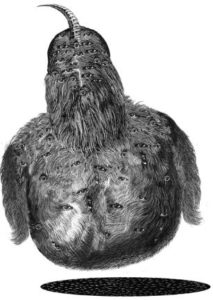
An artist’s rendition of the hairy and ocular “Ketev Meriri”

Going directly to the source, the Midrash (Eichah Rabbah 1:29) suggests that “her pursuers overtook her bein hameitzarim” means that there is an evil spirit that is particularly strong during the Three Weeks, and has the power to pursue and hurt the Jewish people. The Midrash calls this evil spirit Ketev Meriri (קֶטֶב מְרִירִי), which is mentioned just a single time in the Torah (Deuteronomy 32:24), in parashat Ha’azinu: “The wasting of hunger, and the devouring of the fiery bolt, and Ketev Meriri; and the teeth of beasts will I send upon them, with the venom of crawling things of the dust.” Although usually translated as “bitter destruction”, or a “plague”, or “bad vapour”, some hold that Ketev Meriri is some kind of evil entity or demon out to hurt the Jewish people.

The Midrash in question says it is a demon entirely covered with eyes and hair, and anyone who looks upon it immediately dies. While it is allowed to roam free during the Three Weeks, it is only active “between the end of the fourth hour and the start of the ninth hour of the day, and it goes neither in the sun nor in the shade, but right along the border between a sunny and shaded area.” So, this Ketev Meriri is only found for several hours in the day during the Three Weeks, and can only cause damage if a person is standing or walking, alone, right between a sunny and shaded area! This sounds like plain old superstition, which is precisely why the Rambam rejects it outright.

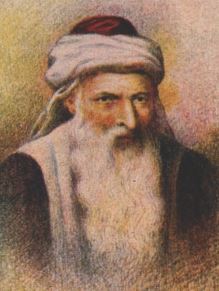
Maran Yosef Karo, aka. the “Mechaber”

Nonetheless, it is mentioned in the Shulchan Arukh (Orach Chaim, 551:18), which warns to beware of Ketev Meriri during the Three Weeks, between the fourth and ninth hour of the day. It is important to remember that the Shulchan Arukh was composed by Rabbi Yosef Karo (“Maran”, 1488-1575), one of the great Tzfat Kabbalists. Although generally speaking he, too, sought to keep his updated law code free of Kabbalah, one who reads the Shulchan Arukh will undoubtedly see how mystical concepts and practices permeate it. This is one key difference between the Rambam’s Mishneh Torah and Maran’s Shulchan Arukh. Of course, the latter went on to become the authoritative law code of Judaism.

In recent centuries, even more superstitious fear developed among certain Jews, worrying that something horrible will happen during the Three Weeks. And over time it became customary to avoid going swimming, partaking in any kind of “risky” activity, or even flying in an airplane. Under such conditions, it is only natural that the entire Three Week period became one of pretty intense mourning.

Yet, even the Shulchan Arukh does not speak of such intense mourning. It, too, begins by speaking of mourning from the start of Av. And it is only in the week in which Tisha b’Av itself falls that haircuts and laundry are prohibited (Orach Chaim, 551:3). The same is true for consuming meat and wine, although Maran mentions other customs to abstain from meat and wine from Rosh Chodesh, or even from the seventeenth of Tamuz. He concludes that one who eats meat when his community does not is a sinner and will be—to borrow a Talmudic term—“bitten by a snake”.

The Shulchan Arukh also lists two different customs for bathing: some abstain from Rosh Chodesh, and others only in the week of Tisha b’Av. And then we are told that some fast every single day during the Three Weeks! (551:16) We see how, unlike the Rambam’s Mishneh Torah, which is clear as to precisely how a Jew should act, the Shulchan Arukh lists numerous varying customs. This is another critical difference between the two law codes.

Summarizing the Law

To conclude, if one wants to observe the mourning period strictly as mandated by the Talmud, Mishneh Torah, and even the Shulchan Arukh, one need only abstain from music and festivities from the start of Av, and abstain from bathing, cutting hair, and laundering in the week of Tisha b’Av itself. With regards to meat and wine, although the letter of the law is only to abstain in the last meal before the fast, it is now nearly universal to abstain the entire week of Tisha b’Av, and the Shulchan Arukh holds that a person should not deviate from whatever is their local established custom.

On the note of bathing and cutting hair or shaving, it is important to remember how great the honour of Shabbat is: While mourning may be an important custom, looking presentable and dignified on Shabbat is actually an halachic requirement. The Talmud makes it clear that one must bathe and cut their hair for Shabbat—even on a Thursday immediately preceding a Tisha b’Av which falls on a Friday. (This is technically not possible in our fixed calendar, but was possible in those days). The Sephardic custom reflects this halachic necessity, while the Ashkenazi custom strangely does not. Rav David Bar-Hayim, despite being of Ashkenazi background himself, holds that the Ashkenazi custom of abstaining from haircuts for the entire Three Weeks—which he traces to about 600 years ago—is really contrary to halacha.

Finally, there is no need to fear of calamities during the Three Weeks, unless one conducts themselves according to Kabbalah, in which case they may need to beware of Ketev Meriri between the fourth and ninth hour of the day, especially if walking alone between sunny and shaded areas.


The above essay is adapted from Garments of Light, Volume Three.
Get the book here! 

The Mysterious Custom of Upsherin

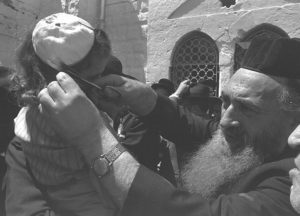
In this week’s double Torah portion (Acharei-Kedoshim) we read that “when you will have planted all manner of trees for food, its fruit shall be forbidden; three years shall it be forbidden to you, it shall not be eaten.” (Leviticus 19:23) This refers to the mitzvah of orlah, where a newly-planted tree must be left unharvested for its first three years. Seemingly based on this, a custom has developed to leave the hair of newborn boys uncut until age three. On or around the boy’s third birthday, a special celebration is held (called upsherin or halakeh), often with family and friends taking turns to cut a bit of the boy’s hair. Henceforth, the boy is encouraged to wear a kippah and tzitzit, and his formal Jewish education will begin. It is said that just as a tree needs the first three years to establish itself firmly in the ground before it can flourish and its fruit be used in divine service, so too does a child.

Lag B’Omer 1970 in Meron. Photo from Israel’s National Photo Collection

Indeed, the Torah makes a comparison between trees and humans in other places. Most famously, Deuteronomy 20:19 states that fruit trees should not be harmed during battle, “for is the tree of the field a man?” The tree is not an enemy combatant, so it should be left alone. Although the plain meaning of the verse is that the tree is not a man, an alternate way of reading it is that “man is a tree of the field”. Elsewhere, God compares the righteous man to a tree firmly rooted in the ground (Jeremiah 17:8), and in another place compares the entire Jewish nation to a tree (Isaiah 65:22).

Having said that, the custom of upsherin is essentially unknown in ancient Jewish sources. It is not mentioned anywhere in the Talmud, nor in any early halakhic codes, including the authoritative Shulchan Arukh of the 16th century. Where did this very recent practice originate?

Lag b’Omer and the Arizal

The first Jews to take up this custom were those living in Israel and surrounding lands under Arab Muslim dominion in the Middle Ages. We see that Sephardic Jews in Spain and Morocco did not have such a custom, nor did the Yemenite Jews. (In fact, Yemenite Jews did not even have a custom to abstain from haircuts during Sefirat HaOmer at all.) This is particularly relevant because the upsherin ceremony is often connected with the Sefirat HaOmer period, with many waiting until Lag b’Omer for their child’s first haircut, and taking the boy to the grave of Rashbi (Rabbi Shimon bar Yochai) in Meron for the special ceremony.

It appears that the earliest textual reference to upsherin is from Rabbi Chaim Vital (1543-1620), the primary disciple of the Arizal (Rabbi Isaac Luria, 1534-1572). Because of this, many believe that upsherin is a proper Kabbalistic custom that was instituted by, or at least sanctioned by, the great Arizal. In reality, the text in question says no such thing. The passage (Sha’ar HaKavanot, Inyan HaPesach, Derush 12) states the following:

ענין מנהג שנהגו ישראל ללכת ביום ל”ג לעומר על קברי רשב”י ור”א בנו אשר קבורים בעיר מירון כנודע ואוכלים ושותי’ ושמחים שם אני ראיתי למוז”ל שהלך לשם פ”א ביום ל”ג לעומר הוא וכל אנשי ביתו וישב שם שלשה ימים ראשו’ של השבוע ההו’ וזה היה פעם הא’ שבא ממצרים אבל אין אני יודע אם אז היה בקי ויודע בחכמה הזו הנפלאה שהשיג אח”כ. והה”ר יונתן שאגי”ש העיד לי שבשנה הא’ קודם שהלכתי אני אצלו ללמוד עם מוז”ל שהוליך את בנו הקטן שם עם כל אנשי ביתו ושם גילחו את ראשו כמנהג הידוע ועשה שם יום משתה ושמחה

On the custom of Israel going on Lag b’Omer to the grave of Rabbi Shimon bar Yochai and Rabbi Elazar his son (who are buried in the town of Meron as is known) and to eat and drink and rejoice there—I saw that my teacher, of blessed memory [the Arizal], that he went there once on Lag b’Omer with his whole family and remained there for three days, until the start of the sixth week [of the Omer]. And this was that one time, when he came from Egypt, but I do not know if he was then knowledgeable in this wisdom that he would later attain. And Rav Yonatan Sagis related to me that in the first year before I went to him to learn with my teacher of blessed memory, he took his small son with his whole family and there they cut his hair according to the known custom, and he held a feast and celebration there.

First, what we see in this passage is that the Arizal apparently only visited Meron on Lag b’Omer once, when he just made aliyah from Egypt, and before he had become the pre-eminent Kabbalist in Tzfat. (Some say this was actually before he made aliyah, and was simply on a trip to Israel.) Lag b’Omer is the 5th day of the 5th week of the Omer, and the Arizal stayed there for the remainder of the fifth week. Rav Chaim Vital wonders whether the Arizal was already an expert mystic at the time or not. Once he became the leader of the Tzfat Kabbalists, the Arizal apparently never made it a point to pilgrimage to Meron on Lag b’Omer. Rabbi Vital notes just that one time in the past, and it almost seems like once the Arizal was a master mystic, he understood there was nothing particularly mystical about it. In any case, nothing is said here of cutting hair.

The next part of the passage is more problematic. To start, it is unclear whether Rabbi Vital means that he and the Arizal went to study with Rav Yonatan Sagis, or that he and Rav Sagis went to study with the Arizal. We know that Rabbis Sagis and Vital were later both students of the Ari. However, when the Ari first came to Tzfat he was essentially unknown, and was briefly a disciple of other Kabbalists, namely the Ramak (Rabbi Moshe Cordovero, 1522-1570). In fact, the Arizal only spent a couple of years in Tzfat before suddenly passing away at a very young age. Whatever the case, it is unclear from the passage whether it was the Arizal or Rav Sagis who was the one to take his son for a haircut on Lag b’Omer. Based on the context, it would appear that it was Rav Sagis who did so, not the Arizal, since we already learned that the Arizal did not make it a point to pilgrimage to Meron.

The nail on the coffin may come from an earlier passage in the same section of Sha’ar HaKavanot, where we read:

ענין הגילוח במ”ט ימים אלו לא היה מוז”ל מגלח ראשו אלא בערב פסח ובערב חג השבועות ולא היה מגלח לא ביום ר”ח אייר ולא ביום ל”ג לעומר בשום אופן

On the matter of shaving during these forty-nine days [of the Omer], my teacher of blessed memory did not shave his head [hair], except for the evening of Passover and the evening of Shavuot, and would not shave his hair at all [in between], not on Rosh Chodesh Iyar, and not on Lag b’Omer.

According to the Arizal, one should not shave at all during the entire Omer period, including Lag b’Omer! If that’s the case, then the Ari certainly wouldn’t take his child to Meron for a haircutting on Lag b’Omer. It must be that the previous passage is referring to Rav Sagis. Nowhere else in the vast teachings of the Arizal is the custom of waiting until a boy’s third birthday (whether on Lag b’Omer or not) mentioned. Thus, the Arizal was not the custom’s originator, did not expound upon it, and most likely did not even observe it.

So where did it come from?

A Far-Eastern Custom

While no ancient Jewish mystical or halakhic text before the 17th century appears to mention upsherin, a similar custom is discussed in much older non-Jewish sources. The Kalpa Sutras of the ancient Hindu Vedic schools speak of a ceremony called Chudakarana or Mundana, literally “haircutting”. It is supposed to be done before a child turns three, usually at a Hindu temple. It is explained that the hair a child is born with it connected to their past life, and all the negative things which that may entail. Removing this hair is symbolic of leaving the past life behind and starting anew. Interestingly, a small lock of hair is usually left behind, called a sikha, “flame” or “ray of light”, as a sign of devotion to the divine. This is surprisingly similar to the Chassidic custom of leaving behind the long peyos at the upsherin.

Hindu Sikha and Chassidic Peyos

From India, the custom seemingly moved across Asia to Arabia. One Muslim tradition called Aqiqah requires shaving the head of a newborn. Of this practice, Muhammad had apparently stated that “sacrifice is made for him on the seventh day, his head is shaved, and a name is given him.” An alternate practice had Muslims take their boys to the graves of various holy people for their first haircut. The Arabic for “haircut” is halaqah, which is precisely what the Mizrachi Jews of Israel called upsherin. Thus, it appears that Jews in Muslim lands adopted the custom from their neighbours. However, many of them waited not until the child is three, but five, which is when the Mishnah (Avot 5:22) says a child must start learning Torah. (In this case, the practice has nothing to do with the mitzvah of orlah or any connection to a sapling.)

In the early 19th century, Rabbi Yehudah Leibush Horenstein made aliyah to Israel and first encountered this practice of “the Sephardim in Jerusalem… something unknown to the Jews in Europe.” He was a Hasid, and in that time period many more Hasidim were migrating to Israel—a trend instigated by Rabbi Menachem Mendel of Vitebsk (c. 1730-1788), the foremost student of the Maggid of Mezeritch (Rabbi Dov Ber, d. 1772), who in turn was the foremost student of the Baal Shem Tov (Rabbi Israel ben Eliezer, 1698-1760) the founder of Hasidism. These hasidim in Israel adopted the practice from the local Sephardim, and spread it to the rest of the Hasidic world over the past century and a half.

While it has become more popular in recent decades, and has been adopted by other streams within Orthodoxy, and even many secular Israelis and Jews, upsherin is far from universally accepted. The Steipler (Rabbi Yaakov Yisrael Kanievsky, 1899-1985) was particularly upset about this practice (see Orchos Rabbeinu, Vol. I, pg. 233). When a child was brought before Rav Yitzchok Zev Soloveitchik of Brisk (1886-1959) for an upsherin, he frustratingly replied: “I am not a barber.” Other than the fact that it is not an established or widespread Jewish custom, there is a serious issue of it being in the category of darkei Emori, referring to various non-Jewish (and potentially idolatrous) practices.

Not So Fast

While there is no mention of the upsherin that we know today in ancient Jewish mystical or halakhic texts, there is mention of something very much related. In one of his responsa, the great Radbaz (Rabbi David ibn Zimra, c. 1479-1573) speaks of a practice where some people take upon themselves a “vow to shave their son in the resting place of Samuel the Prophet” (see She’elot v’Teshuvot haRadbaz, siman 608).

Recall that Samuel was born after the heartfelt prayer of his mother Hannah who was barren for many years. She came to the Holy Tabernacle in Shiloh and vowed that if God gave her a son, she would dedicate him to divine service from his very birth, and he would be a nazir his entire life (I Samuel 1:11). This means that he would never be allowed to shave or trim the hair of his head, just as the Torah instructs for anyone taking on a nazirite vow. There is something particularly holy about this, and we see earlier in Scripture how an angel comes to declare the birth of the judge Samson and instructs the parents to ensure he would be a nazirite for life, and that no blade ever come upon his head (Judges 13:5).

The Tanakh goes on to state that once Samuel was weaned, Hannah took him to the Tabernacle and left him in the care of the holy priests so that he could serve God his entire life. How old was he when he was weaned? While it doesn’t say so here, there is an earlier case where the Torah speaks of a child being weaned. This is in Genesis 21:8, where we read how Abraham through a great feast upon the weaning of his son Isaac. Rashi comments here (drawing from the Midrash and Talmud) that Isaac was two years old at the time. For this reason, many Hasidic groups actually perform the upsherin at age two, not three.

Back to the Radbaz, he was born in Spain but was exiled with his family in the Expulsion of 1492. The family settled in Tzfat, where the Radbaz was tutored by Rabbi Yosef Saragossi, the holy “White Saint” credited with transforming Tzfat from a small town of 300 unlearned Jews to a holy Jewish metropolis and the capital of Kabbalistic learning. In adulthood, the Radbaz settled in Fes, Egypt and his fame as a tremendous scholar and posek spread quickly. In 1517, he moved to Cairo and was appointed Hakham Bashi, the Chief Rabbi of Egypt. There, he founded a world-class yeshiva that attracted many scholars. Coming full circle, it was here in the yeshiva of the Radbaz that the Arizal began his scholarly career. In the last years of his life, the Radbaz wished to return to the Holy Land, and made his way back to Tzfat. It is possible that the Arizal left Egypt for Tzfat in the footsteps of his former rosh yeshiva. Ironically, the Radbaz (who lived to age 94, or even 110 according to some sources) would outlive the Arizal (who died at just 38 years of age).

While neither the Arizal nor his old teacher the Radbaz discuss cutting a three-year-old’s hair in particular (or doing it at the tomb of Rashbi), the Radbaz does speak of a personal vow that one may take to cut their child’s hair at the tomb of Samuel the Prophet. This practice comes from emulating Hannah, who took a vow with regards to her son Samuel. Samuel went on to be compared in Scripture to Moses and Aaron (and the Sages say Moses and Aaron combined!) Of course, Hannah never cut her child’s hair at all, but perhaps there is something spiritual in treating the child like a nazirite until the child is “weaned”.

In any case, the question that the Radbaz was addressing is what one must do if they took up such a haircutting vow but are unable to fulfil it because the authorities prohibit Jews from going to the grave sites of their ancestors. From here, some scholars conclude that the Ottoman authorities at the time really must have prohibited Jews from going to the grave of Samuel, near Jerusalem. Thus, it is possible that those Jerusalem Jews who had a custom of going to Samuel’s grave decided to journey to another famous grave instead. Perhaps it was in these years of the early 16th century that the custom to go to Rashbi in Meron (instead of Shmuel near Jerusalem) evolved.

So, there may be something to the upsherin custom after all. Of course, we still don’t know when the practice of going to Samuel’s grave emerged. That appears to have been a local custom (or possibly not a custom at all, but a personal vow) of Jerusalem’s medieval Jewish community. It, too, may have been influenced by neighbouring Muslims who went to the graves of their saints to cut their children’s hair.

Whatever the case, we see that foundations of upsherin are not so clear-cut. Contrary to popular belief, it is neither a universally accepted Jewish custom, nor a mandatory halakhic requirement. It did not originate with the Arizal either, although we do see some basis for it in the writings of the Radbaz. For those who wish to uphold this custom, they have upon whom to rely, and should meditate foremost upon the holy figures of Hannah and Samuel, who appear to be the spiritual originators of this mysterious practice.


The above is an excerpt from Garments of Light, Volume Two. Get the book here