Tag Archives: Creation

The First Pesach: Did the Patriarchs Celebrate Passover?

The holiday of Passover commemorates the Exodus of the Israelites out of Egypt over three thousand years ago. The Torah tells us that because of their hasty departure, the dough of the Israelites did not have time to rise, hence the consumption of matzah. Yet, the term matzah appears in the Torah long before the Exodus! We read in Genesis 19:3 that Lot welcomed the angels into his home and “made them a feast, and baked matzot, and they ate.” Since the angels came to Lot immediately after visiting Abraham and Sarah to announce the birth of Isaac at that time next year (Genesis 18:10), the Sages learn from this that Isaac was born on Passover. Of course, the Exodus only took place four hundred years after Isaac’s birth! How is it that the patriarchs are already eating matzah?

An Eternal Torah

Although the Torah was given to the Israelites following the Exodus, Jewish tradition affirms that the Torah is eternal, and even predates existence. A famous verse in the Zohar (II, 161a) states that “God looked into the Torah and created the universe.” Adam knew the whole Torah, and was taught its deepest secrets by the angel Raziel. Many of these teachings were passed on by Adam to future generations, down to Noah, then his son Shem, and eventually to the Patriarchs who, according to tradition, studied at Shem’s academy. So, while the Torah tradition officially dates back to Sinai, in some ways it dates back all the way to Creation! It’s also important to keep in mind that the Patriarchs were prophets, which means that even though they did not have a physical, written Torah, there is no reason why they could not have received the Torah’s wisdom directly from God.

As such, it is said that the Patriarchs kept the entire Torah and fulfilled all the mitzvot. When Jacob sends a message to Esau after his sojourn in Charan he tells him “I have lived [garti] with Laban” (Genesis 32:5). On this, Rashi says that garti (גרתי) is an anagram of taryag (תרי״ג), the 613 commandments, meaning that despite living under the oppressive Laban for twenty years, Jacob still observed all 613 commandments. Yet, this is impossible since Jacob married two sisters—a clear Torah prohibition! Similarly, when Abraham meets Melchizedek (ie. Shem) following his victory over the Mesopotamian kings, he tells him that he will not take any reward whatsoever, not even “a thread or strap” (Genesis 14:23). For this, the Sages say, Abraham’s descendants merited the mitzvah of tzitzit (the threads) and tefillin (the straps). In that case, Abraham himself did not wear tefillin or tzitzit. From such instances we see that the patriarchs did not keep the Torah completely, at least not the Torah as we know it.

Emanations of Torah

While Kabbalistic texts often point out that the Torah is eternal and served as the very blueprint of Creation, they also go into more detail to explain that this primordial Torah was not quite the same as the Torah we have today. Each of the four mystical universes (Asiyah, Yetzirah, Beriah, Atzilut) has an ever-more refined level of Torah, with the highest being the Torah of Atzilut. Our Torah is the one of Asiyah, and is full of mitzvot only due to Adam’s sin and the corruption of mankind. In Olam HaBa, the Torah of Atzilut will finally be revealed, which is why Jewish tradition holds that many mitzvot will no longer apply in that future time. This is said to be the meaning of Isaiah 51:4 where God proclaims that in the messianic times “a Torah will go forth from Me”; and of Jeremiah 31:30 where God says He will forge a brit chadashah, a “new covenant”, with Israel. (This latter term was usurped by Christians for their “New Testament”.)

An even more intriguing idea is that the “New Torah” will be composed of the exact same letters as the current one we possess, just rearranged to form new words! Yet another is based on the well-known principle that the Heavenly Torah is composed of “black fire on white fire”. This is often used to explain the fact that the Torah actually has 304,805 letters, even though it is always described as having 600,000 letters (one for each Israelite at Mt. Sinai)—there are 304,805 letters of “black fire” and the rest are the invisible letters of “white fire”. Gershom Scholem cites a number of Kabbalistic and Hasidic texts suggesting that these currently-invisible “white fire” letters are the true eternal Torah! (See Scholem’s Kabbalah, pgs. 171-174, for a complete analysis of these concepts.)
It is this primordial Torah that was originally taught to Adam, and was passed down through his descendants to the Patriarchs, who carefully observed it. As such, it appears that eating matzah is an eternal mitzvah that already appeared in the primordial Torah before the Exodus and the revelation of the current Torah of Asiyah. What was the meaning behind that consumption of matzah?

Bread of Faith

Matzah is called the “bread of faith”. It symbolizes our faithfulness to God, who took us out of Egypt to be His people: “Let My people go so that they may serve Me” (Exodus 7:16, 26). Further emphasizing this point, the word matzot is spelled exactly like mitzvot. This simple, “humble” bread symbolizes our subservience to God’s commands. We are His faithful servants, just as the Patriarchs were His faithful servants. So they, too, ate matzah as a sign of their faith. They ate matzah because God had liberated them, too, from various hardships.

The very first Patriarch, Abraham, was miraculously saved from Nimrod’s furnace. He also dwelled in Egypt for a time before God miraculously brought him out of there with great wealth, just as his descendants would do centuries later. And then came his greatest test of faith: the Akedah. Amazingly, the apocryphal Book of Jubilees connects this event with the future Passover holiday. In chapter 18, it suggests that God commanded the Akedah to Abraham on the 15th of Nisan. As the Torah states, Abraham journeyed for three days before the Akedah happened and then, naturally, it took him three days to return home. Thus, the whole ordeal spanned seven days, and when Abraham returned, he established a seven-day “festival to Hashem” from the 15th of Nisan. The future seven-day Passover holiday would happen on those same days in that same month.
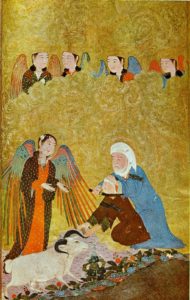
“Abraham’s Sacrifice”, a 15th century piece of Timurid-Mongolian art

While the Sages do debate whether some of the Torah’s major events (including Creation itself) happened in the month of Tishrei or Nisan, the accepted Jewish tradition is that the Akedah happened in Tishrei. Nonetheless, it is quite fitting that the Binding of Isaac should happen on Passover, when Isaac was born. In this case, the ram that Abraham ultimately offered in place of Isaac would serve as a proto-Pesach offering. After all, the ram is nothing but a male sheep, and it is the ram that is the astrological sign of Nisan, and it was those ram-headed gods that the Egyptians worshipped that needed to be slaughtered by the Israelites (as discussed last week). Whatever the case, the Book of Jubilees offers an intriguing possibility for the spiritual origins of Passover, and for why the Patriarchs themselves ate matzot long before the Exodus.

Torah on the Big Bang and the Age of the Universe

The Torah begins with Beresheet, the famous account of Creation.  In recent times, many have questioned the validity of this narrative in light of the findings of modern science. In reality, the Torah’s account is quite accurate in scientific terms, and the Jewish tradition described the origins of the universe and its age with stunning precision centuries before modern science caught up.

According to Science

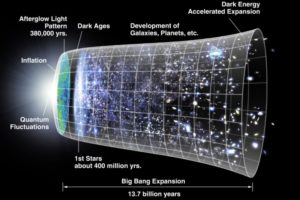
The current scientific model holds that 13.7 billion years ago, the entire universe was compacted into a super tiny point with infinite density. For some unknown reason, this point suddenly burst in a massively vast and rapid expansion of energy and radiation. As the early universe cooled and expanded, particles began to form, and then whole atoms, starting with hydrogen. Hydrogen atoms fused into helium atoms, and later on heavy elements formed from further fusion in the cores of stars and their explosions. Everything that we see today—the entire universe and all matter within it—emerged from that initial expansion, “the Big Bang”.

The evidence for a Big Bang is extensive. In fact, you can see some of it when you look at the “snow” on an old television that is not tuned to any channel. The antenna is picking up some of the cosmic microwave background radiation, the “afterglow” of the Big Bang. The entire universe is still glowing from that initial expansion! Popular physicist Brian Greene writes in his bestselling The Hidden Reality (pg. 43):
…if you were to shut off the sun, remove the other stars from the Milky Way, and even sweep away the most distant galaxies, space would not be black. To the human eye it would appear black, but if you could see radiation in the microwave part of the spectrum, then every which way you turned, you’d see a uniform glow. It’s origin? The origin.

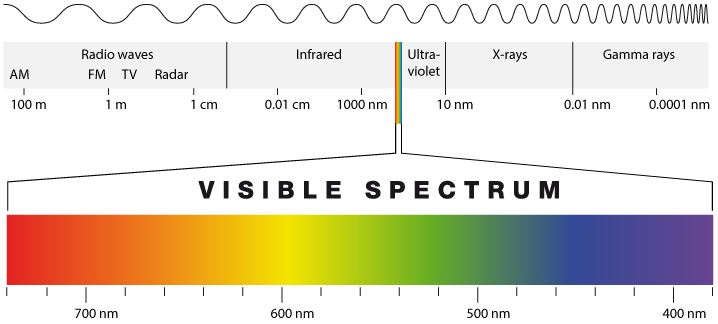
The universe is glowing, it’s just that most people cannot see it because human eyes perceive only a very narrow part of the electromagnetic spectrum, which we call “visible light”. Light of a higher energy and frequency includes dangerous x-rays and gamma rays, while light of lower energy and frequency includes microwaves and radio waves. The seeming blackness of the universe is actually radiating with light—we simply cannot see it. Incredibly, this is precisely what the Torah states.

The electromagnetic spectrum. Visible light makes up just a tiny sliver of the spectrum. Some living organisms can see in UV or infrared wavelengths.

Zohar haRakia

We read in the Tanakh (Daniel 12:3) that “they who are wise shall shine as bright as the rakia…” The Torah tells us that God established a rakia (wrongly translated as “firmament”) on the second day of Creation, and this is where all the stars and planets are suspended (Genesis 1:15). The Talmud (Chagigah 12a), composed over 1500 years ago, further elaborates that above the earth is the vilon, the atmosphere that stretches over the planet, and beyond the vilon is the rakia, a vast expanse within which are all the stars. Beyond the rakia is a region called shechakim, the interface between the physical and spiritual realms, and further still are the highest levels of the Heavens, inhabited by angels and transcendental beings. From this, and other ancient sources, it is clear that rakia refers to outer space.

Daniel tells us that the wise will shine like the rakia, and goes on to state that “they who turn the many to righteousness [shall shine] as the stars”. We can understand how people might shine bright like stars, but why would Daniel say the rakia is shining? Outer space is totally dark! Of course, as Brian Greene described, today we know that the universe is indeed glowing.

One of the most ancient Jewish mystical texts is Sefer HaBahir. According to tradition, it dates back some two thousand years, and was first published at least seven hundred years ago. This book gets its name from another verse in the Tanakh (Job 37:21), which states “And now, men do not see the light that is bright [bahir] in the skies.” Once again, Scripture tells us that the universe is glowing with a bright light that humans are unable to perceive. Science has found that this glow comes from the Big Bang, and this too is accurately described by the most famous of Jewish mystical texts, the Zohar.

Cosmic Microwave Background Radiation, the glow of the universe, discovered in the 1960s by Robert Wilson and Jewish physicist Arno Penzias.

The Secret of Beresheet and the Big Bang

Like Sefer HaBahir, the Zohar was first published around seven hundred years ago, with its teachings dating back two millennia. The Zohar is a parasha-by-parasha commentary on the Torah, and naturally begins with the first section in describing Creation. The book gets its name from the above verse in Daniel which speaks of Zohar haRakia, the glow of the universe. It elaborates (I, 2a, 15a):

בְּשַׁעְתָּא דִּסְתִימָא דְכָל סְתִימִין בָּעָא לְאִתְגַּלְּיָא, עֲבַד בְּרֵישָׁא נְקוּדָה חֲדָא, וְדָא סָלֵיק לְמֶהֱוֵי מַחֲשָׁבָה. צַיֵּיר בָּהּ כָּל צִיּוּרִין חָקַק בָּהּ כָּל גְּלִיפִין… וְרָזָא דָא, בְּרֵאשִׁית בָּרָא אֱלֹהִים. זֹהַר, דְּמִנֵּיהּ כָּלְהוֹ מַאֲמָרוֹת אִתְבְּרִיאוּ בְּרָזָא דְאִתְפַּשְׁטוּתָא דִנְקוּדָה דְּזֹהַר סְתִים דָּא

When the Most Concealed One [God] began to create, He first made a singular point, with which he then brought forth all thought, drew all blueprints, and carved out all things… And the secret of “In the beginning, God created…” [Genesis 1:1] is radiance [zohar], from which all Utterances were created, in the secret of the expansion of that point of radiance.

Many centuries ago, the Zohar accurately and elegantly sums up the findings of modern science. God first created a tiny singular point which burst forth in light, and from which He “carved out” all things in existence. All of God’s Utterances (since the Torah says God created by speaking: “And God said ‘Let there be light.’”) came forth from the expansion of that initial primordial radiance.

Time is Relative

All that remains is the seeming contradiction in time. Science estimates 13.7 billion years, while the Torah speaks of six days. Of course, the nature of a “day” in the account of Creation is flexible, considering there was no Earth, sun, or moon until the third and fourth days (so how could there be a 24 hour day as we know it before this?) There were also no humans at this point, and the Torah describes Creation from the perspective of God, for whom “a thousand years is like one passing day” (Psalms 90:4). The fact that time runs differently for man and God actually highlights another scientific principle, as revealed by Albert Einstein.

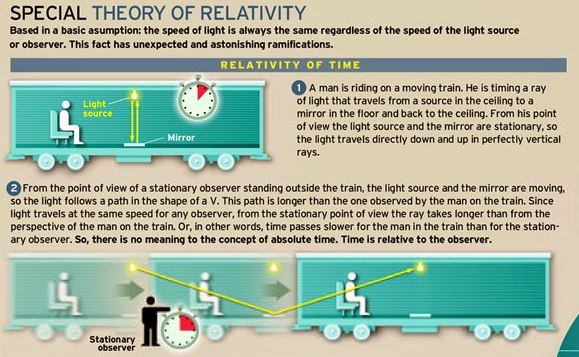
Einstein’s theory of relativity holds that the passing of time varies depending on an entity’s speed. A person who could board a spaceship and fly near light-speed would experience very slow time. A few days for this person would be equivalent to many years on Earth. (This theme has been explored in countless science fiction books and films, including 2014’s Interstellar.) The Lubavitcher Rebbe often cited this fact to conclude that arguing about apparent space-time contradictions is therefore quite pointless. Meanwhile, physicist Gerald Schroeder has mathematically calculated that six days could be equivalent to 13.7 billion years when factoring in the universe’s expansion. After all, we are looking back in time at an ancient universe through human eyes, while God was looking forward in time from the universe’s first moments.

An infographic explaining the relativity of time. Note the conclusion: “there is no meaning to the concept of absolute time.” The whole debate of 6 days vs 13.7 billion years is therefore quite meaningless.

Physicist and Rabbi Aryeh Kaplan explored this issue extensively and cites multiple ancient Jewish texts that support the notion of a very ancient universe (see his book Kabbalah and the Age of the Universe). In multiple places, the Midrash states that before creating this world, God was creating and destroying many previous worlds (see, for example, Kohelet Rabbah 3:14), while the Talmud calculates that “there were 974 generations before Adam” (Chagigah 13b, Shabbat 88a).

On this last point, it has been shown that a generation according to the Torah is forty years (Numbers 32:13), and as we saw, a day for God is likened to 1000 human years (Psalms 90:4), therefore:

            974 generations × 40 years/generation × 365 days/year × 1000 human years/divine day =

14.2 billion years

Compared to the current best estimate of science at 13.7 billion years, it is amazing that one can come to a very similar number by simply putting together a few Torah verses.

What we see from all of the above is that ancient Jewish texts describe the universe’s origins in absolutely perfect detail. And it is only in recent decades that science has finally caught up. In many other ways, too, science has a lot of catching up to do.


The above is an excerpt adapted from Garments of Light: 70 Illuminating Essays on the Weekly Torah Portion and Holidays. Click here to get the book! 

Secrets of Rosh Hashanah

This first of this week’s two Torah portions, Nitzavim, is always read right before Rosh Hashanah, and appropriately begins: “You are all standing today before Hashem, your God…” The verse has traditionally been seen as an allusion to Rosh Hashanah, when each person stands before God and is judged. The Torah says today, implying one day, yet everyone celebrates Rosh Hashanah over two days. This is true even in Israel, where yom tovs are typically observed for only one day.
The reason for this is because in ancient times there was no set calendar, so a new month was declared based on the testimony of two witnesses. Once the new month was declared in Jerusalem, messengers were sent out to inform the rest of the communities in the Holy Land, and beyond. Communities that were far from Israel would not receive the message until two or three weeks later, so they would often have to observe the holidays based on their own (doubtful) opinion of when the holiday should be. They therefore kept each yom tov for two days.

Rosh Hashanah, however, is the only holiday that takes place on the very first day of the month, so as soon as the new month of Tishrei was declared, it was immediately Rosh Hashanah, and messengers could not be sent out! Thus, even communities across Israel would observe the holiday for two days, based on their own observations.

Although today we have a set calendar, and there is no longer a declaration of a new month based on witnesses, two days are still observed since established traditions become permanent laws. Of course, this is only the simplest of explanations, for there are certainly deeper reasons in observing two days, especially when it comes to Rosh Hashanah.

Judgement in Eden

Rosh Hashanah commemorates the day that God fashioned Adam and Eve. On that same day, the first couple consumed the Forbidden Fruit, were judged, and banished from the Garden of Eden. Originally, they had been made immortal. Now, they had brought death into the world, and God decreed that their earthly life would have an end. Adam and Eve were, not surprisingly, the first people to be inscribed in the Book of Death. Each year since, on the anniversary of man’s creation and judgement, every single human being (Jewish or not) is judged in the Heavenly Court, and inscribed in the Book of Life, or the Book of Death.

This is the idea behind the symbolic consumption of apples in honey. In Jewish tradition, the Garden of Eden is likened to an apple orchard, with the scent of the air in Eden being like that of apples. (Having said that, it is not a Jewish tradition that the Forbidden Fruit itself was an apple!) The apple reminds us of the Garden—of Adam and Eve and their judgement—and we dip it in honey so that our judgement should be sweet.

But what happens when Rosh Hashanah falls on Shabbat? It is well-known that there is no judgement on Shabbat. The Heavenly Court rests, and even the souls in Gehinnom are said to have a day off. This is illustrated by a famous exchange in the Talmud (Sanhedrin 65b) between Rabbi Akiva and the Roman governor of Judea at the time, Turnus Rufus:

Turnus Rufus asked Rabbi Akiva: “How does [Shabbat] differ from any other day?”
He replied: “How does one official differ from another?”
“Because my lord [the Roman Emperor], wishes it so.”
Rabbi Akiva said: “the Sabbath, too, is distinguished because the Lord wishes it so.”
He asked: “How do you know that this day is the Sabbath?”
[Rabbi Akiva] answered: “The River Sambation proves it; the ba’al ov proves it; your father’s grave proves it, as no smoke ascends from it on Shabbat.”

An illustration of Rabbi Akiva from the Mantua Haggadah of 1568

Rufus asks Rabbi Akiva how the Jews are certain that the Sabbath that they keep is actually the correct seventh day since Creation. Rabbi Akiva brings three proofs:

The first is a legendary river called the Sambation (or Sabbation), which was known in those days, and which raged the entire week, but flowed calmly only on Shabbat. The second proof is that people who summon the dead from the afterlife (practicing a form of witchcraft called ov) are unable to channel the dead on Shabbat. (I know of a person who was once involved in such dark arts and became a religious Jew after realizing that he was never able to summon spirits on the Sabbath or on Jewish holidays!) Lastly, Rabbi Akiva notes how Turnus Rufus’ own father’s grave would emit smoke every day of the week, except on Shabbat. This is because the soul of Rufus’ wicked father was in Gehinnom, but all souls in that purgatory get a reprieve on Shabbat. (Historical sources suggest that Rufus’ father was Terentius Rufus, one of the generals involved in the destruction of the Second Temple.)

Based on this, we can understand why Rosh Hashanah must be observed over two days. When the holiday falls on Shabbat, no judgement can take place, so the judgement is pushed off to the next day. This is also related to the fact that when Rosh Hashanah falls on Shabbat, the shofar is not blown. This is not at all because blowing a shofar is forbidden on Shabbat, which is, in fact, permitted.

The simple explanation given for this is that we’re worried the person blowing the shofar might carry it to the synagogue (in a place without an eruv), and carrying is forbidden on Shabbat. The deeper reason is this: Blowing the shofar is supposed to “confound Satan”. Satan is not the trident-carrying, horned demon of the underworld (as popularly believed in Christianity). Rather, Satan literally means the “one who opposes” or the “prosecutor”. It is Satan’s job to serve as the prosecution in the Heavenly Court. The shofar’s blow confuses Satan, and prevents him from working too much against us. On Shabbat, the Heavenly Court rests, and Satan is having a day off, so there is no need to confound him!

The First Shabbat

One might argue that Rosh Hashanah should only be two days long when it falls on Shabbat; in other years, one day would suffice. Other than the fact that this would be confusing—as the holiday would span different lengths in different years—there are other explanations for the two days, including that each day involves different types of judgement (for example, one day for sins bein adam l’Makom, between man and God; and one day for bein adam l’havero, between man and his fellow). Nonetheless, our Sages still describe Rosh Hashanah as really being one day—one unique, extra-long, 48-hour day which our Sages called yoma arichta, literally the “long day”. Perhaps this is another reason for the custom of not sleeping on the “first night” of Rosh Hashanah. (The other reason: how could anyone possibly sleep through their own trial?)

Finally, the story of Rabbi Akiva and Turnus Rufus gives us one more reason to commemorate Rosh Hashanah over two days. Rufus questioned Rabbi Akiva on how he can be so sure that the Sabbath which he keeps is indeed the correct seventh day going back to Creation. If Rosh Hashanah is the day Adam and Eve were created, then it corresponds to the sixth day of Creation. That means the very next day was the seventh day of Creation, and that the second day of Rosh Hashanah always commemorates the very first Sabbath. When we celebrate on the second day of Rosh Hashanah, we mark Adam and Eve’s first Shabbat, and recognize that each seventh day has been observed ever since, and will continue to be observed for another, 5778th upcoming year.

Shana Tova u’Metuka!