Tag Archives: King David

How Many Soulmates Do You Have?

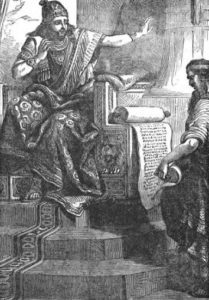
An 1873 illustration of King Josiah (Yoshiyahu) listening to a reading of the Torah

In this week’s parasha, Shoftim, the Torah relates the laws pertaining to Jewish kings. According to the Torah, the king of the Jews is not, and should not be, like the king of other nations. His primarily role is not to be a dictator or a conqueror. Rather, he must act like a divine messenger of God, and his duty is to ensure the observance of Torah law throughout the Holy Land. This is why we read across the Tanakh how the best Jewish kings—like Hezekiah and Josiah—were the ones that expunged idolatry from Israel and restored proper spirituality.

It is also why we see on several occasions in the Book of Shoftim (not to be confused with this week’s parasha of the same name) that the time before kings was lawless: “…there was no king in Israel; every man did that which was right in his own eyes.” (Judges 21:25) The Jewish king, therefore, is like God’s representative on Earth. In this regard, he is likened to an angel, which is why the term for a king, melekh (מלך), is nearly identical and shares the same root with the word for an angel, malakh (מלאך).

Not surprisingly, the Jewish king is held to a very high standard. The Torah (Deuteronomy 17:16-20) tells us that he:

may not acquire many horses for himself… And he shall not take many wives for himself, and his heart must not turn away, and he shall not acquire much silver and gold for himself. And it will be, when he sits upon his royal throne, that he shall write for himself two copies of this Torah on a scroll, before the priests. And it shall be with him, and he shall read it all the days of his life, so that he may learn to fear Hashem, his God, to keep all the words of this Torah and these statutes, to perform them, so that his heart will not be haughty over his brothers, and so that he will not turn away from the commandment, either to the right or to the left, in order that he may prolong [his] days in his kingdom, he and his sons, among Israel.

The Talmud discusses the finer points of these rules. One of the questions the Sages ask is: How many wives is too many? (Sanhedrin 21a) The Mishnah states the maximum is eighteen wives. Rav Yehuda then opines that a king can take more wives, as long as they will not “turn his heart astray”. Rabbi Shimon insists that even a single wife might turn her husband’s heart astray, and thus, the king must not take more than eighteen “even if they be women like Abigail”. Abigail, of course, was one of the righteous wives of King David, who is listed among the seven female prophetesses of Judaism.

In fact, the Talmud derives the maximum of eighteen wives from the case of King David:

Whence do we deduce the number eighteen? From the verse, “And unto David were sons born in Hebron; and his firstborn was Amnon of Ahinoam the Jezraelite; the second, Khilav of Abigail, the [former] wife of Naval the Carmelite; the third, Avshalom the son of Maacah; and the fourth, Adoniyah the son of Hagit; and the fifth, Shefatiah the son of Avital; and the sixth, Ithream of Eglah, David’s wife. These were born to David in Hebron.” (II Samuel 3:2-5) And of them the Prophet [Nathan] said: “And if that were too little, then would I add unto thee the like of these, and the like of these” (II Samuel 12:8), each “these” implying six, which, with the original six, makes eighteen in all.

Scripture tells us that David had six wives while he reigned from Hebron during his first seven years: Ahinoam, Abigail, Maacah, Hagit, Avital, and Eglah. When his court prophet Nathan recounted how he had once blessed him, he said he would multiply the king’s wealth (and wives) kahena v’kahena, more and more “like these”. This implies that David would have, or potentially could have, eighteen wives.

The Talmud continues to cite the opinion of Ravina, who believed that each kahena refers not to six, but twelve. He holds that David had six wives, the blessing was to double that to twelve, and “if that were too little”—as Nathan said—then he would multiple them kahena v’kahena. Thus, Ravina reasons that the maximum is twenty-four wives, not eighteen. The Talmud admits that there is an alternate Mishnaic teaching that 24 is the maximum, and yet another teaching that the maximum is 48. The latter comes from the fact that there is a letter vav in the term, meaning 24 and another 24! Nonetheless, the accepted tradition is a maximum of 18 wives, and no more.

The Talmud interestingly points out a potential flaw: wasn’t David also married to Michal, the daughter of King Saul, while in Hebron? The Sages conclude that Michal is the same person as Eglah. They then raise the following issue: how could Michal be Eglah if the Tanakh states Michal was childless while Eglah gave David a son? In a classic Talmudic interpretation, the Sages take the verse “Michal the daughter of Saul had no child until the day of her death” (II Samuel 6:23) to mean that she did not have children until her death, and died in childbirth. So, she finally had a child on the day of her death.

The Kabbalah of Soulmates

The Arizal (Rabbi Itzchak Luria, 1534-1572) gives a deeper, mystical answer to why the maximum number of wives for a king is eighteen. The implications of his teachings are not just relevant to kings, but to every Jew. While we generally think of a person as having a single soulmate, the Arizal explains that a person actually has eighteen soulmates (see, for example, Sha’ar HaMitzvot on this week’s parasha). Why would a person need eighteen soulmates?

The Talmud (Sotah 2a) famously states that “forty days before conception a Bat Kol [Heavenly Voice] proclaims: the daughter of so-and-so is destined for so-and-so…” The same passage states that pairing a person with their soulmate is “as difficult as the Splitting of the Sea”. The Midrash adds to this that ever since the Splitting of the Sea, God is busy making matches between people (Pesikta d’Rav Kahana 2:4). The Sages conclude that a person’s first match is pre-destined, while a second or subsequent match (if the first marriage fell through) becomes as difficult as splitting a sea.

The central issue that all of this rests on is free will. While a person does have a perfect, pre-destined match, free will can very easily get in the way and ruin things. For example, person A is destined to be with person B, but A makes some really poor decisions in life and ends up in a bad place (or dead). Does that mean B is now condemned to spend the rest of their life without their rightful soulmate? Must they now hopelessly struggle in search of the “right one” or be miserable in a series of failed relationships for the rest of their life, through no fault of their own? Surely, the Most Merciful God would not allow this to happen. And so, He spends all of His time “making matches”, finding alternate soulmates.

For this reason, a person has up to 18 different soulmates designated for them. If, due to free will, the match of A and B doesn’t work, there is always A and C. And if C, too, decides to move to the other side of the world, there’s a D behind them. Granted, the Arizal puts the soulmates in hierarchical fashion: D is not as good as C, nor is C as good as B—but they are all matching souls for A nonetheless. Of course, each of B, C, and D have 18 of their own soulmates, so one can see how complicated this matchmaking game becomes—“as difficult as the Splitting of the Sea”. The Arizal notes that 18 is a maximum, and not necessarily will there be 18 soulmates for a person alive all at once. Elsewhere, the Arizal explains that a person who does not find one of their soulmates will reincarnate to try again in a future life, as might one who needs to unite with a better soulmate, higher up on the chain of 18.

This brings us back to the first question: why is a king allowed up to, but no more than, 18 wives? A king, like every person, has up to 18 soulmates. He may choose to seek out and find all 18 of them, to unite with all of his soulmates. However, he must not take even a single wife more, for a nineteenth wife would certainly not be a soulmate. A king should not be taking a wife or concubine solely for pleasure. He may have more than one (and this may even be a political necessity), but only on the condition that she is one of his soulmates anyway.

The Kabbalah of David and Batsheva

The above discussion helps to explain the Talmudic dictum that one who believes David sinned with Batsheva is mistaken (Shabbat 56a). Recall that Batsheva was the wife of Uriah the Hittite, one of David’s generals. When Uriah was away in battle, David spotted Batsheva bathing and ended up sleeping with her. She would become pregnant, and to hide the sin, David ultimately placed Uriah in a situation where he would die in battle.
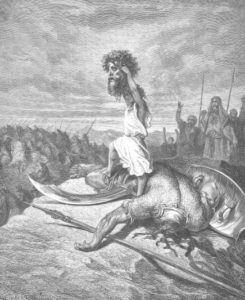
‘David and Goliath’ by Gustave Doré

From a mystical perspective, Batsheva was one of David’s 18 soulmates. In fact, she was his #1, and the two had been matched by God all the way back in the “six days of Creation” (Sanhedrin 107a). The Midrash relates that it was David’s own hubris that prevented him from marrying her. When David had defeated Goliath, he wanted (or needed) to decapitate the giant with his own sword. At the time, Uriah the Hittite happened to be the attendant of Goliath. David promised Uriah the best woman in Israel if Uriah would only provide him with Goliath’s sword. Uriah did so. He later became a righteous convert, and one of David’s greatest warriors. (This is why he is called a Hittite, for he was not originally Jewish.)

At the same time that David made the promise to Uriah, God made a decree in Heaven: Because of David’s haughty and immodest offer to distribute the daughters of Israel, God will mete out his punishment by giving away his very own soulmate to Uriah! What David did with Batsheva was certainly a sin, and the Talmud (ibid.) recounts how severely he was punished, including six months of intense leprosy in addition to the punishments already enumerated in Scripture. Yet, Batsheva was his rightful soulmate, and would go on to produce his rightful heir, King Solomon. The Talmud concludes that David simply rushed to be with her. Uriah was destined to die soon enough anyway, and then David could marry Batsheva with no issues.

The Kabbalists see David and Batsheva rushing to be with each other as a replay of Adam and Eve rushing to consume the Forbidden Fruit. Had Adam and Eve waited until Shabbat, they would have been permitted to eat from the Tree of Knowledge. David and Batsheva, too, needed only to wait a little longer. The connection between the two couples is deeper than that, for David and Batsheva were none other than the reincarnations of Adam and Eve. They had the opportunity to complete a great tikkun, a rectification for that primordial sin. (In some ways, so does every young couple that must wait until marriage to be intimate in holiness.) Alas, they failed, and the same souls will return one last time in Mashiach and his wife to finally fulfil the task.

(For more on the Adam-David-Mashiach connection, see here.)


The above essay is adapted from Garments of Light, Volume Three.
Get the book here! 
The Jewish View on Cards and Gambling

In this week’s parasha, Matot-Massei, we read how the Israelites were supposed to divide up the Holy Land between the Twelve Tribes:

And you shall inherit the land by lot according to your families; to the more [numerous] you shall give the more inheritance, and to the fewer you shall give the lesser inheritance; wherever the lot falls to any man, that shall be his…

We learn that the land of Israel was apportioned based on family size, with larger families logically receiving a larger share. Now, to determine which chunk of land a family would receive, the Israelites cast lots. The Talmud (Bava Batra 122a) describes how this was done: two urns were prepared, one containing the names of the Twelve Tribes, and the other containing the names of the various allotments of land. Elazar the High Priest would pick one name from each urn, thus designating a piece of land for a particular tribe.

Casting lots was very common in Biblical times, and is mentioned frequently in the Tanakh. For example, the Torah commands casting lots to determine which goat is sent to Azazel on Yom Kippur (Leviticus 16:8). In the Book of Jonah (1:7), the sailors on Jonah’s ship cast lots to determine who was guilty of causing the storm. In the time of King David, the kohanim were thus divided into 24 groups (I Chronicles 24). Haman cast lots to determine the best day to attack the Jews, and this is why the holiday is called “Purim”, since purim was the Persian word for “lots” (Esther 3:7).

Casting lots suggests a large degree of chance or randomness in the process. Yet, people of faith are naturally quite averse to the concept of random chance, for isn’t everything determined by God? Not surprisingly, the word “lot” (goral) also takes on the meaning of “fate” in the Tanakh. For instance, Isaiah (17:14) prophesies: “At evening there will be terror, and before morning they are not. This is the portion of them that spoil us, and the goral of them that rob us.” The ultimate fate of those that harm the Jewish people will be utter destruction. The Sages, too, were uncomfortable with the idea of dividing the Holy Land by seemingly random lots. They therefore stated (ibid.) that the lots were really just a show for the people to see what God intended. In reality:

Elazar was wearing the Urim and Tumim, while Joshua and all Israel stood before him… Animated by the Holy Spirit, he gave directions, exclaiming: “Zevulun” is coming up and the boundary lines of Acco are coming up with it. [Thereupon], he shook well the urn of the tribes and Zevulun came up in his hand. [Likewise] he shook well the urn of the boundaries and the boundary lines of Acco came up in his hand…

Elazar would prophetically see which tribe needed which land, and when he then shook the urns those exact pairs that he foresaw would emerge! So, the process was not random at all, but simply a materialization of the Divine Will. Still, the Sages insist that in the messianic era the Holy Land will not be apportioned through this method of casting lots, but rather “The Holy One, blessed be He, Himself, will divide it among them; for it is said [Ezekiel 48:29], ‘And these are their portions, says the Lord God.’”

If the Sages were not fond of casting random lots by chance, how would they feel about playing games of chance and gambling?

Gambling in the Talmud

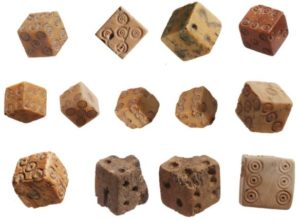
In 1999 and 2000, the Muslim Waqf (Temple Mount authority) dug up 9000 tons of Temple Mount soil and unceremoniously dumped it in the Kidron Valley, creating one of the largest archaeological catastrophes in history. Thankfully, archaeologists did not give up on this precious soil, and began the “Temple Mount Sifting Project”. Among the many incredible finds are these Second Temple-era playing dice.

In a list of people that are ineligible to serve as witnesses or as judges, the Mishnah includes a mesachek b’kubia, a person who plays with dice, and mafrichei yonim, “pigeon flyers”. According to the Talmud, the latter most likely refers to people who bet on pigeon races, which were apparently common in those days. We know from historical sources that gambling with various dice games was very popular in Greek and Roman times. The Talmud (Sanhedrin 24b) goes on to discuss what the problem with such people is.

Rami bar Hama teaches that the issue with gambling is that it is essentially built on a lie: each player agrees to pay a certain sum of money if they lose, yet they hope (and fully intend) not to lose at all! That means the initial agreement made by the players is not even valid. The losing gambler is entirely dejected, and gives up their money reluctantly, often with a nagging feeling of being robbed or cheated out of their money.

Rav Sheshet disagrees. After all, there may be some people who are not so sad to part with their money, or are simply addicted to the game itself. Whatever the case, Rav Sheshet holds that gambling is inappropriate because it is a terribly unproductive waste of time, and the gambler contributes nothing to “the welfare of the world”. This is why, Rav Sheshet says, the Mishnah above concludes by saying that only a full-time gambler is prohibited, but one who has an actual job and just plays for fun on the side is permitted.

Nonetheless, Rav Yehudah holds that regardless of whether the gambler has an occupation or not, or whether he is a full-time player or not, a gambler is disqualified from being a kosher witness or judge. Rav Yehudah bases his statement on a related teaching of Rabbi Tarfon, and on this Rashi comments that a gambler is likened to a thief. The Midrash is even more vocal, saying that gamblers “calculate with their left hand, and press with their right, and rob and wrong one another” (Midrash Tehillim on Psalm 26:10).

The Talmud (Sanhedrin 25b) goes on to state that the prohibitions above don’t only refer to a literal dice-player, but any kind of gambler, including one who plays with pebbles (or checkers), and even with nuts. The Sages state that such a person is only readmitted when they do a complete repentance, and refuse to play the game even just for fun without any money!

Halachically-speaking, the Shulchan Arukh (Choshen Mishpat 370:2-3) first states that any kind of gambling is like theft and is forbidden, but then suggests that while it may not exactly be theft it is certainly a waste of time and not something anyone should engage in.

A Ban on Gambling

While the Talmud does not explicitly forbid gambling, later rabbis recognized its addictive nature and sought to ban the practice entirely. In 1628, for example, the rabbis of Venice issued a decree (to last six years) excommunicating any Jew who gambled. Part of the motivation for this decree was the case of Leon da Modena (Rabbi Yehudah Aryeh of Modena, 1571-1648).

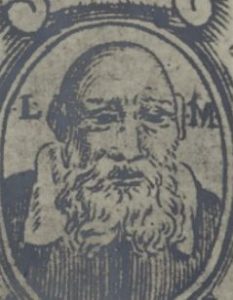
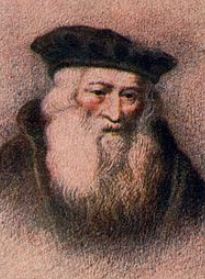
Rabbi Leon Yehudah Aryeh da Modena

Born in Venice to a family of Sephardic exiles, da Modena went on to become a respected rabbi and the hazzan of Venice’s main synagogue for forty years. A noted scholar, he wrote about a dozen important treatises. In Magen v’Herev, he systematically tore down the major tenets of Christianity, while in Ari Nohem he sought to discredit Kabbalah and prove that the Zohar has no ancient or divine origin. (The latter is probably why he isn’t as well-known in Jewish circles today as he should be.)

In 1637, he published Historia de’riti hebraici, an overview of Judaism for the European world, meant to dispel myths about Judaism and quell anti-Semitism. Historians credit this with being the first Jewish text written for the non-Jewish world in over a millennium, since the time of Josephus. The book was incredibly popular, and played a key role in England’s readmitting Jews to the country in the 1650s (after having being expelled in 1290).

More pertinent to the present discussion, Rabbi da Modena wrote Sur miRa (“Desist from Evil”), outlining the problems with gambling. He would know, since he was horribly addicted to gambling himself. He wrote of this problem in his own autobiography, Chayei Yehudah. And because such a high-profile sage was a gambler, his rabbinic colleagues in Venice issued that decree to ban any form of gambling.

Rabbi da Modena’s game of choice was cards. At that point in time, playing cards had become wildly popular in Europe. First invented in China in the 9th century, playing cards slowly made their way across Asia, and reached Europe around 1365. They have remained popular ever since, both for gambling and non-gambling games. While it is clear from an halachic standpoint that card games involving money (like Poker or Blackjack) should not be played, is it permissible to play non-gambling card games (like Crazy Eights or Go Fish)?

At first glance, it may not seem like there should be a problem with this. Yet, some rabbis have recently spoken out against all playing cards. Usually, this prohibition is connected not to gambling or wasting time, but rather to cards’ apparent origins in idolatry or the dark arts. Although it is true that some types of cards are used in divination and fortune-telling, it is important to examine the matter in depth and determine whether cards really are associated with forbidden practices.

The History of Playing Cards

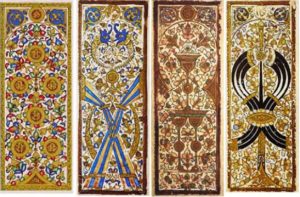
Mamluk Cards

The exact origins of cards are unclear. We do know that they come from China, where paper and printing were invented. Card games are attested to in Chinese texts as early as 868 CE. In the 12th and 13th centuries, the Muslims brought cards across Asia. They were particularly popular in Egypt during the Mamluk Sultanate (1250-1517). The Mamluks created the first modern-style deck of 52 cards with 4 suits. The suits were sticks, coins, swords, and cups. In the 15th century, Italians started to make cards of their own, with the suits being leaves, hearts, bells, and acorns. The French had three-leaf clovers for leaves, square tiles (or diamonds) for bells, and pikes for acorns. Although these suit symbols remained, the English names reflect the earlier suits of sticks (“clubs”) and swords (“spades”).

The Muslim Mamluks did not draw any faces on their court cards (since depicting faces in art is forbidden in Islam). The Europeans did not have this issue, and adapted the Muslim court cards of malik (king), malik na’ib (deputy king), and thani na’ib (second deputy) to king, queen, and prince or knight (“jack”). In 16th century France, the four kings were depicted as particular historical figures: the King of Spades was King David, the King of Clubs was Alexander the Great, the King of Hearts was Charlemagne, and the King of Diamonds was Julius (or Augustus) Caesar.
We see that playing cards have no origins in idolatry. The style of cards we know today were developed by staunchly monotheistic Muslims. They were further developed by mostly non-religious European renaissance printers, against the wishes of the Church which sought to ban cards on a number of occasions. Neither are playing cards known for being used in fortune-telling. However, a related type of card is used in divination today.

Tarot Cards and Kabbalah

In 15th century Italy, a different type of playing card developed. These were called trionfi, later tarocchi, and finally “tarot cards”. They, too, have four suits, but with 56 cards. These were, and still are, used for a number of different games, just like regular playing cards are. Outside of Europe, tarot cards are not well-known, and are generally associated with fortune-tellers.

In reality, the earliest mention of tarot cards being used in divination is only from 1750, and it was essentially unheard of until the late 19th century. Besides, most diviners actually use a different deck of 78 cards. Of course, such divination is entirely forbidden according to the Torah. So, it seems like some well-meaning rabbis have confused these tarot cards with regular playing cards. Ironically, many occultists actually claim that tarot cards come from Kabbalah!

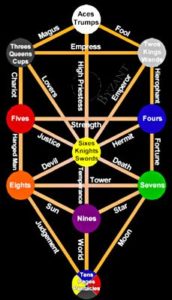
The Tarot “Tree of Life” (Credit: Byzant.com)

These occultists tie the 22 additional divination cards to the 22 letters of the Hebrew alphabet and the 22 paths on the mystical “Tree of Life”. The ten numeral cards (naturally) correspond to the Ten Sefirot, while the four suits correspond to the four olamot, or universes. Finally, the four court cards and the ace represent the five partzufim (with the king and queen appropriately being Aba and Ima). While these parallels are neat, there is absolutely no known historical or textual basis to support these claims. Tarot cards have nothing to do with traditional Kabbalah or Jewish mysticism. (There is a concept in Kabbalah of a negative set of Ten Sefirot belonging to the Sitra Achra, so perhaps there is some connection between these tarot cards and certain evil spiritual forces.)

Having said all that, to forbid playing with cards (or even standard tarot cards) just because some people recently started using them in divination is like forbidding drinking coffee because some people recently started divining with coffee (a practice called “tassology” or “tasseography”). While playing cards copiously is certainly a waste of time, there is nothing wrong with the occasional—no gambling—game.

Ba’al HaTurim

It is fitting to end with the words of the Ba’al HaTurim (Rabbi Yakov ben Asher, c. 1269-1343) who writes in his commentary on the Torah (Tur HaAroch on Deuteronomy 1:1) that Moses himself cautioned Israel about gambling in his final speech before passing away:

Before Moses got ready to relate all these various commandments, he used the present opportunity, a few weeks before his death, to admonish the people, and to remind them of past sins, and how they had caused Hashem a lot of grief during these years. He reminded them how God had treated them by invoking His attribute of mercy and loving kindness time and again. He warned them not to become corrupt again by gambling… They should not rely on the fact that because they were human they were bound to err and sin from time to time and that God, knowing this, would overlook their trespasses.


The above is adapted from Garments of Light, Volume Two. Get the book here

The Spiritual Significance of Israel Turning 70

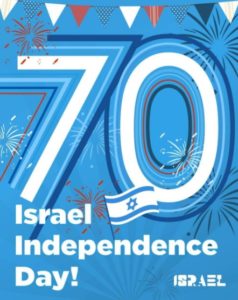
This week we commemorate Yom Ha’Atzmaut, the State of Israel’s Independence Day, marking seventy years since its founding. Although the State is certainly far from perfect, its establishment and continued existence is without a doubt one of the greatest developments in Jewish history. Many have seen it as the first steps towards the final redemption, and even among Haredi rabbis (which are generally opposed to the secular State) there were those who bravely admitted Israel’s significance and validity. Rav Shlomo Zalman Auerbach (1910-1995), for example, considered the State as Malkhut Israel, a valid Jewish “kingdom”—at least for halakhic purposes—while the recently deceased Rav Shteinman unceasingly supported the Nachal Haredi religious IDF unit despite the great deal of controversy it brought him. Rav Ovadia Yosef permitted saying Hallel without a blessing on Yom Ha’Atzmaut, and some have even composed an Al HaNissim text to be recited. While we have already written in the past about the significance of the State’s founding (along with one perspective to bridge together the secular and the religious on this issue), there is something particularly special about Israel’s 70th birthday.
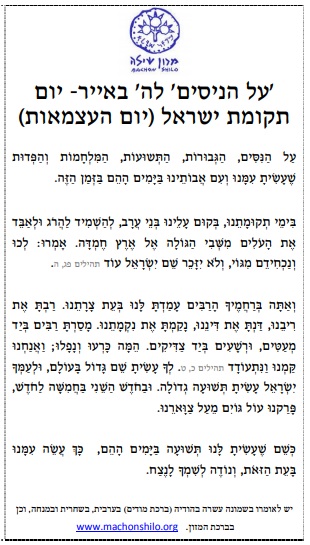
Al HaNissim for the Amidah and Birkat HaMazon provided by Rav David Bar-Hayim of Machon Shilo

The number 70 holds tremendous significance in Judaism. It is the number of root languages and root nations in the world (with Israel traditionally described as “a sheep among seventy wolves”). It is the number of Jacob’s family that descended to Egypt and from whom sprung up the entire nation. The number of elders that assisted Moses, and parallel to them the number of sages that sat on the Sanhedrin. Although Moses lived 120 years, he wrote in his psalm that 70 years is considered a complete lifespan (Psalms 90:10), and King David, who put the final edit on that psalm and incorporated it into his book, lived precisely 70 years. As is well-known, David was granted those 70 years by Adam, which is why the Torah says Adam lived 930 years instead of the expected 1000 years. (See here for how he may have been able to live so long.)

The Arizal taught that Adam (אדם) stands for Adam, David, and Mashiach, for the final redeemer is both a reflection of the first man, and the scion of David. More amazingly, as we wrote earlier this year it is said that David is literally the middle-point in history between Adam and Mashiach, and as such, if one counts the years elapsed between Adam and David then it is possible to find the start of the messianic era—which just happens to be our current year 5778. In this year, the State of Israel itself turns 70, and our Sages speak of “seventy cries of the soul during labour”, and parallel to these, “seventy cries of the birthpangs of Mashiach”. It is possible to interpret these seventy birthpangs preceding the arrival of the messiah as the seventy years leading up to the redemption. Thus, Israel’s seventy years potentially bear great significance.

Just as Psalms says that seventy years is one complete lifespan, for the State of Israel these past seventy years can be likened to the end of one “lifetime”, with Israel now standing at the cusp of a new era. Indeed, with all that has happened in the Middle East in recent years and months, Israel has undoubtedly emerged stronger and more secure than ever before. In this seventieth year, the world has begun to recognize Israel’s permanence, and affirm its unwavering right to Jerusalem the Eternal. We see more and more nations formally recognizing Jerusalem as Israel’s rightful capital, and the United States plans to open its new Jerusalem embassy on May 14, which is Yom Ha’Atzmaut according to the secular calendar.

These seemingly disparate points—David’s seventy years, the completion of Israel’s first seventy year lifespan, and the recognition of Jerusalem—are actually intricately connected, for it was King David who established the first official, unified, Jewish state in the Holy Land, with Jerusalem as its capital. In fact, David’s kingdom was the only fully independent, unified Jewish state until the modern State of Israel! (Other Jewish entities, including the Maccabean and Herodian, were essentially always vassals to some greater power like Greece or Rome.) It is therefore quite fitting that the State of Israel has the Star of David on its flag, and it is this Davidic symbol that has become emblematic of not just Israel itself but all of modern Judaism.*

Living Prophecy

Perhaps the most famous seventy in Scripture is the seventy year period of exile in Babylon, between the First and Second Temples. It is said that God decreed a seventy year exile in particular because Israel failed to keep seventy Sabbatical and Jubilee years between the settling of Israel under Joshua and the destruction of the First Temple. While the Exile was certainly a “punishment”, we know that God never truly “punishes” Israel, and out of each devastation (which is nothing more than a just measure-for-measure retribution) emerges something greater.

As we’ve written before, it is in Babylon that the vibrant Judaism that we know was born. (See ‘The First Jewish Holiday’ in Garments of Light.)  Unable to journey to the Temple, the Sages reworked each holiday to become more than a pilgrimage; unable to offer sacrifices, the Sages established prayers instead, “paying the cows with our lips” (Hosea 14:3); unable to fulfil the many agricultural laws, the Sages taught that learning the laws was as good as observing them. The Judaism of study, prayer, and mysticism was born out of the difficulty of the seventy-year Babylonian Exile. These past seventy years for Israel—also of great difficulty, and coming on the heels of another great devastation—was similarly one where Judaism has evolved considerably, and instead of dying out as some feared, has actually flourished.

Many have pointed out another modern “Babylonian Exile”, too. This is the communist regime of the Soviet Union, where millions of Jews were trapped for some seventy years. (The officially accepted start and end dates for the USSR are December 30, 1922 to December 26, 1991.) The histories of Russia and Israel are tightly bound, for many of Israel’s founders came directly from the Russian Empire, including Ze’ev Jabotinsky, Golda Meir, and the Netanyahus. Some even argue that the severe persecution by the Russians—unrivaled until the Nazis—is what gave the greatest motivation for the founding of Israel. The Kishinev Pogrom of 1903 was the final straw for the Zionists. The description of that pogrom by Bialik (another Russian Jew, and later Israel’s national poet) aroused the masses to take up the call and make aliyah, and convinced many more of the necessity of an independent Jewish state.

Russia’s involvement is all the more significant when we consider the possibility of Moscow as the prophesied “Third Rome”. As explored in the past, the “Red Army” headquartered in Moscow’s Red Square brings to mind the villainous Edom. Just as Rabbi Yose ben Kisma taught long ago in the Talmud (Sanhedrin 98a-b) that Mashiach will come when Rome/Edom falls for the third time, and there will not be a fourth, the Russian monk Filofey of Pskov (1465-1542) wrote of Moscow that “Two Romes have fallen, the third stands, and there will be no fourth.” This is all the more interesting in light of what we see in the news today about the growing conflict between the West and the Russia-Syria-Iran axis. It is important to keep in mind that Iran (Paras or Persia) is explicitly mentioned in Ezekiel’s prophecy of the great wars of the End of Days, the wars referred to as Gog u’Magog. The Midrash (Yalkut Shimoni on Isaiah 60, siman 499) comments on this that

In the year that Mashiach will be revealed, all the kings of the nations of the world will provoke each other. The king of Persia will threaten the king of Arabia, and the king of Arabia will go to Aram for advice. The king of Persia will then destroy the world, and all the nations will tremble and fall upon their faces, and they will be grasped by birthpangs like the birthpangs of labour, and Israel, too, will tremble and falter, and they will ask: “Where will we go?” And [God] will answer: “My children, do not fear, for all that I have done, I have done for you… the time of your salvation has come.”

Those who follow geopolitics will immediately identify this midrashic passage with current events. The war in Syria is very much a proxy war between Saudi Arabia and Iran, just as is the war currently raging in Yemen. Saudi Arabia has joined the Western (Aram?) camp, and has even begun to speak positively of Israel in public. The prophet Jeremiah (49:27) further details that Syria will be the epicenter of the war, and the “end” will come when Damascus has fallen. Amazingly, Jeremiah calls the king of Damascus Ben Hadad (בן הדד), the gematria of which happens to equal Assad (אסד). And it also happens that the value of Gog u’Magog (גוג ומגוג) is 70.

Top right: Arab Coalition forces led by Saudi Arabia (and backed by the US, UK, and France) fighting in Yemen to defeat Iran-backed Houthi rebels. Bottom right: Today in the news we read about Saudi Arabia considering sending ground forces into Syria, where Iranian Revolutionary Guards are deeply entrenched. Some say Saudi Arabia secretly has forces in Syria already. It is highly likely that there are Russian and American paramilitary groups in Syria as well. Turkish and Israeli forces are heavily involved, too, and the US, UK, and France recently launched a missile strike on Syrian facilities.

Thus, Israel turning 70 carries remarkable symbolic meaning. The Midrash states that Israel has 70 names, and these correspond to the 70 names of the Torah (and the Torah’s 70 layers of meaning, to be revealed in full with Mashiach’s coming), as well as the 70 Names of God, and the 70 names for the holy city of Jerusalem. The last of these names, the Midrash says (based on Isaiah 62:2), is “a new name that God will reveal in the End of Days.” The struggle over Jerusalem and the Holy Land will soon end, with a new city and a new name to be reborn in its place.

May we merit to see it soon.

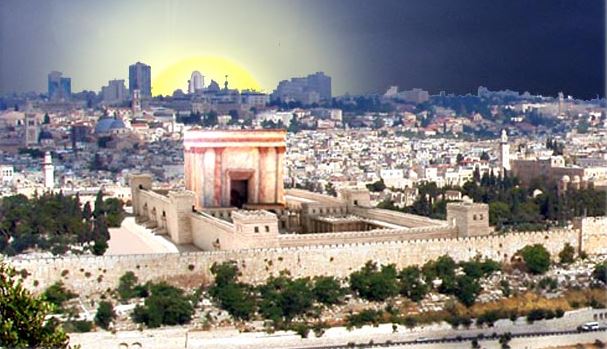
Courtesy: Temple Institute

*Judaism began with Abraham. In an amazing “coincidence” of numbers, Jewish tradition holds that Abraham was born in the Hebrew year 1948. The State of Israel was, of course, born in the secular year 1948. Jewish tradition also holds that Abraham was 70 years old at the “Covenant Between the Parts”, when God officially appointed Abraham as His chosen one. This means the Covenant took place in the Jewish year 2018, paralleling Israel’s 70th birthday in this secular year of 2018.