Tag Archives: Hebrew Calendar

Eye-Openers from the Book of Jubilees

Parashat Behar begins with the command to observe shemitah, the Sabbatical year, and to proclaim a yovel, “Jubilee”, every 50th year after seven such cycles. The 50th year is a particularly special one, where “freedom shall be proclaimed”, slaves are freed, and all property returns to their ancestral owners. This is one of several incredible mitzvot which demonstrate the Torah’s strong emphasis on socio-economic equality and justice.

In the ancient Jewish world, the Jubilee was an important milestone for tracking the passage of time. For example, the Talmud (Arakhin 12b) calculates how long each Temple stood in terms of the number of Sabbaticals and Jubilees elapsed, and that there were exactly 17 Jubilees between Israel’s entry into the Holy Land and their exile by the Babylonians. In fact, there is an entire book, known as Jubilees, written some time in the Second Temple era which divides the early history of Israel and the world into segments of Jubilees. This intriguing text is one of the most controversial books from that era.

It is unknown who wrote Jubilees, but it itself claims to be a revelation given to Moses by the angels upon Mt. Sinai. Moses is the subject of the book, the “you” to whom the angels are speaking. It presents a comprehensive history from Creation until the given of the Torah on Mt. Sinai, organized into 50 Jubilees. The book holds that a Jubilee year, the fiftieth year, is also the first year of the next shemitah cycle. This means that a complete cycle is not 50 years, but 49 years. That’s precisely the debate in the Talmud page cited above. The Sages question whether the Jubilee year is the first year of the next shemitah or not. Rabbi Yehuda insists that it does, which is just one example of the Book of Jubilees overlapping with traditional Judaism.

Having said that, our Sages did not include Jubilees in the Tanakh. Although it reads very much like a Biblical book, it was excluded from the canon. This was not the case among Ethiopian Jews, who surprisingly did include Jubilees in their Tanakh! The same is true for the Ethiopian Orthodox Church. Many ancient Christian scholars referenced Jubilees, too, while modern scholars have shown that Jubilees was an important book for the Maccabees. The Hasmonean dynasty that followed made extensive use of it, as did the priests of the late Second Temple era. Among the Dead Sea Scrolls, Jubilees is one of the most prevalent texts, more than all other books of ‘Nakh except Psalms and Isaiah. All of this proves that the Book of Jubilees was of great significance in olden days, and greatly influenced Judaism (and Christianity). Intriguingly, some scholars have shown that Jubilees had an even greater impact on Islam, and much of the Quran was clearly inspired by it (see the work of Jan van Reeth for more).

In traditional Jewish texts, too, especially in Midrash and Kabbalah, there are numerous teachings which overlap with Jubilees. In fact, Jubilees may be the earliest known written source for some foundational points of Judaism today. For example, in chapter 7 we see the first description of God giving a set of laws to Noah. A careful count shows there are seven. The Torah does not explicitly say anything about a code of law given to Noah, but Jewish tradition of course speaks of seven “Noahide” laws.

In Jubilees, these laws are: 1) be just and righteous, 2) dress modestly, 3) bless the Creator, 4) honour parents, 5) love your fellow, 6) abstain from sexual sins, plus 7) the prohibition of eating the limb of a live animal which was relayed a bit earlier in the text. In the Talmud (Sanhedrin 56a-b), the Noahide laws are: 1) establish courts of law, 2) bless the Creator, 3) do not worship idols, 4) abstain from sexual sins, 5) do not murder, 6) do not steal, and 7) do not eat the limb of a live animal.

The first law in Jubilees and the Talmud is one and the same: being just implies having a justice system, ie. establishing courts of law. The second in the Talmud is phrased as “blessing Hashem”, just like the third in Jubilees, but is taken to mean not to curse Hashem, since we don’t expect gentiles to know Hebrew blessings. In any case, it is the same law. Not to engage in sexual sins and not to consume the limb of a live animal are the same. All in all, four of the seven are identical, and there are some parallels between the other three.

Another idea that finds its earliest expression in Jubilees is the concept of a messianic “millennium” (23:18-29). After a series of great travails, the world will enter an idyllic age that lasts one thousand years, with no evil and Satan destroyed. This is similar to descriptions in the Talmud (see, for instance, Sanhedrin 97a).

A final example: Jubilees states that God created seven things on the First Day: Heaven and Earth, water, spirits, darkness and light, and the abyss (tehom, as in Genesis 1:2). This is essentially identical to the Midrash (Pirkei d’Rabbi Eliezer, ch. 3), which says eight things were created on the First Day: Heaven and Earth, water, the Divine Spirit, darkness and light, and tohu v’vohu (also in Genesis 1:2), which can be seen as two parts of the tehom.

The Book of Jubilees presents many more fascinating details. Although not officially accepted in the Jewish canon, we see that it does contain a great deal of accurate information that is also in accepted Jewish texts. This makes it a potentially very useful tool to shed light on some of the big mysteries in Judaism. What follows is a list of some of the most intriguing and perhaps controversial teachings from the Book of Jubilees.


The above is an excerpt from Garments of Light, Volume Two. To continue reading, get the book here

The Spiritual Significance of Israel Turning 70

This week we commemorate Yom Ha’Atzmaut, the State of Israel’s Independence Day, marking seventy years since its founding. Although the State is certainly far from perfect, its establishment and continued existence is without a doubt one of the greatest developments in Jewish history. Many have seen it as the first steps towards the final redemption, and even among Haredi rabbis (which are generally opposed to the secular State) there were those who bravely admitted Israel’s significance and validity. Rav Shlomo Zalman Auerbach (1910-1995), for example, considered the State as Malkhut Israel, a valid Jewish “kingdom”—at least for halakhic purposes—while the recently deceased Rav Shteinman unceasingly supported the Nachal Haredi religious IDF unit despite the great deal of controversy it brought him. Rav Ovadia Yosef permitted saying Hallel without a blessing on Yom Ha’Atzmaut, and some have even composed an Al HaNissim text to be recited. While we have already written in the past about the significance of the State’s founding (along with one perspective to bridge together the secular and the religious on this issue), there is something particularly special about Israel’s 70th birthday.
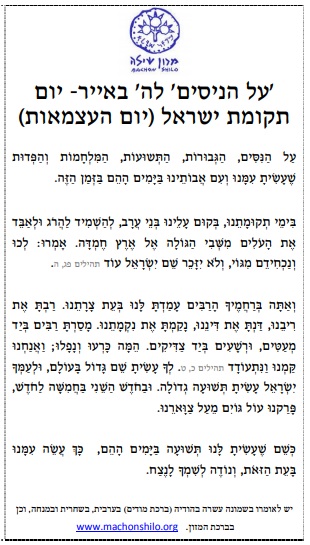
Al HaNissim for the Amidah and Birkat HaMazon provided by Rav David Bar-Hayim of Machon Shilo

The number 70 holds tremendous significance in Judaism. It is the number of root languages and root nations in the world (with Israel traditionally described as “a sheep among seventy wolves”). It is the number of Jacob’s family that descended to Egypt and from whom sprung up the entire nation. The number of elders that assisted Moses, and parallel to them the number of sages that sat on the Sanhedrin. Although Moses lived 120 years, he wrote in his psalm that 70 years is considered a complete lifespan (Psalms 90:10), and King David, who put the final edit on that psalm and incorporated it into his book, lived precisely 70 years. As is well-known, David was granted those 70 years by Adam, which is why the Torah says Adam lived 930 years instead of the expected 1000 years. (See here for how he may have been able to live so long.)

The Arizal taught that Adam (אדם) stands for Adam, David, and Mashiach, for the final redeemer is both a reflection of the first man, and the scion of David. More amazingly, as we wrote earlier this year it is said that David is literally the middle-point in history between Adam and Mashiach, and as such, if one counts the years elapsed between Adam and David then it is possible to find the start of the messianic era—which just happens to be our current year 5778. In this year, the State of Israel itself turns 70, and our Sages speak of “seventy cries of the soul during labour”, and parallel to these, “seventy cries of the birthpangs of Mashiach”. It is possible to interpret these seventy birthpangs preceding the arrival of the messiah as the seventy years leading up to the redemption. Thus, Israel’s seventy years potentially bear great significance.

Just as Psalms says that seventy years is one complete lifespan, for the State of Israel these past seventy years can be likened to the end of one “lifetime”, with Israel now standing at the cusp of a new era. Indeed, with all that has happened in the Middle East in recent years and months, Israel has undoubtedly emerged stronger and more secure than ever before. In this seventieth year, the world has begun to recognize Israel’s permanence, and affirm its unwavering right to Jerusalem the Eternal. We see more and more nations formally recognizing Jerusalem as Israel’s rightful capital, and the United States plans to open its new Jerusalem embassy on May 14, which is Yom Ha’Atzmaut according to the secular calendar.

These seemingly disparate points—David’s seventy years, the completion of Israel’s first seventy year lifespan, and the recognition of Jerusalem—are actually intricately connected, for it was King David who established the first official, unified, Jewish state in the Holy Land, with Jerusalem as its capital. In fact, David’s kingdom was the only fully independent, unified Jewish state until the modern State of Israel! (Other Jewish entities, including the Maccabean and Herodian, were essentially always vassals to some greater power like Greece or Rome.) It is therefore quite fitting that the State of Israel has the Star of David on its flag, and it is this Davidic symbol that has become emblematic of not just Israel itself but all of modern Judaism.*

Living Prophecy

Perhaps the most famous seventy in Scripture is the seventy year period of exile in Babylon, between the First and Second Temples. It is said that God decreed a seventy year exile in particular because Israel failed to keep seventy Sabbatical and Jubilee years between the settling of Israel under Joshua and the destruction of the First Temple. While the Exile was certainly a “punishment”, we know that God never truly “punishes” Israel, and out of each devastation (which is nothing more than a just measure-for-measure retribution) emerges something greater.

As we’ve written before, it is in Babylon that the vibrant Judaism that we know was born. (See ‘The First Jewish Holiday’ in Garments of Light.)  Unable to journey to the Temple, the Sages reworked each holiday to become more than a pilgrimage; unable to offer sacrifices, the Sages established prayers instead, “paying the cows with our lips” (Hosea 14:3); unable to fulfil the many agricultural laws, the Sages taught that learning the laws was as good as observing them. The Judaism of study, prayer, and mysticism was born out of the difficulty of the seventy-year Babylonian Exile. These past seventy years for Israel—also of great difficulty, and coming on the heels of another great devastation—was similarly one where Judaism has evolved considerably, and instead of dying out as some feared, has actually flourished.

Many have pointed out another modern “Babylonian Exile”, too. This is the communist regime of the Soviet Union, where millions of Jews were trapped for some seventy years. (The officially accepted start and end dates for the USSR are December 30, 1922 to December 26, 1991.) The histories of Russia and Israel are tightly bound, for many of Israel’s founders came directly from the Russian Empire, including Ze’ev Jabotinsky, Golda Meir, and the Netanyahus. Some even argue that the severe persecution by the Russians—unrivaled until the Nazis—is what gave the greatest motivation for the founding of Israel. The Kishinev Pogrom of 1903 was the final straw for the Zionists. The description of that pogrom by Bialik (another Russian Jew, and later Israel’s national poet) aroused the masses to take up the call and make aliyah, and convinced many more of the necessity of an independent Jewish state.

Russia’s involvement is all the more significant when we consider the possibility of Moscow as the prophesied “Third Rome”. As explored in the past, the “Red Army” headquartered in Moscow’s Red Square brings to mind the villainous Edom. Just as Rabbi Yose ben Kisma taught long ago in the Talmud (Sanhedrin 98a-b) that Mashiach will come when Rome/Edom falls for the third time, and there will not be a fourth, the Russian monk Filofey of Pskov (1465-1542) wrote of Moscow that “Two Romes have fallen, the third stands, and there will be no fourth.” This is all the more interesting in light of what we see in the news today about the growing conflict between the West and the Russia-Syria-Iran axis. It is important to keep in mind that Iran (Paras or Persia) is explicitly mentioned in Ezekiel’s prophecy of the great wars of the End of Days, the wars referred to as Gog u’Magog. The Midrash (Yalkut Shimoni on Isaiah 60, siman 499) comments on this that

In the year that Mashiach will be revealed, all the kings of the nations of the world will provoke each other. The king of Persia will threaten the king of Arabia, and the king of Arabia will go to Aram for advice. The king of Persia will then destroy the world, and all the nations will tremble and fall upon their faces, and they will be grasped by birthpangs like the birthpangs of labour, and Israel, too, will tremble and falter, and they will ask: “Where will we go?” And [God] will answer: “My children, do not fear, for all that I have done, I have done for you… the time of your salvation has come.”

Those who follow geopolitics will immediately identify this midrashic passage with current events. The war in Syria is very much a proxy war between Saudi Arabia and Iran, just as is the war currently raging in Yemen. Saudi Arabia has joined the Western (Aram?) camp, and has even begun to speak positively of Israel in public. The prophet Jeremiah (49:27) further details that Syria will be the epicenter of the war, and the “end” will come when Damascus has fallen. Amazingly, Jeremiah calls the king of Damascus Ben Hadad (בן הדד), the gematria of which happens to equal Assad (אסד). And it also happens that the value of Gog u’Magog (גוג ומגוג) is 70.

Top right: Arab Coalition forces led by Saudi Arabia (and backed by the US, UK, and France) fighting in Yemen to defeat Iran-backed Houthi rebels. Bottom right: Today in the news we read about Saudi Arabia considering sending ground forces into Syria, where Iranian Revolutionary Guards are deeply entrenched. Some say Saudi Arabia secretly has forces in Syria already. It is highly likely that there are Russian and American paramilitary groups in Syria as well. Turkish and Israeli forces are heavily involved, too, and the US, UK, and France recently launched a missile strike on Syrian facilities.

Thus, Israel turning 70 carries remarkable symbolic meaning. The Midrash states that Israel has 70 names, and these correspond to the 70 names of the Torah (and the Torah’s 70 layers of meaning, to be revealed in full with Mashiach’s coming), as well as the 70 Names of God, and the 70 names for the holy city of Jerusalem. The last of these names, the Midrash says (based on Isaiah 62:2), is “a new name that God will reveal in the End of Days.” The struggle over Jerusalem and the Holy Land will soon end, with a new city and a new name to be reborn in its place.

May we merit to see it soon.

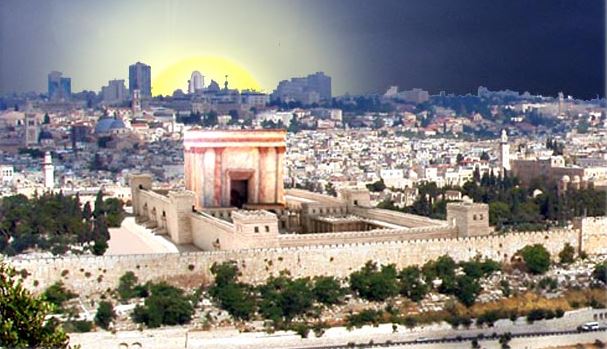
Courtesy: Temple Institute

*Judaism began with Abraham. In an amazing “coincidence” of numbers, Jewish tradition holds that Abraham was born in the Hebrew year 1948. The State of Israel was, of course, born in the secular year 1948. Jewish tradition also holds that Abraham was 70 years old at the “Covenant Between the Parts”, when God officially appointed Abraham as His chosen one. This means the Covenant took place in the Jewish year 2018, paralleling Israel’s 70th birthday in this secular year of 2018.

Mashiach and the Mysterious 13th Zodiac Sign

When Jacob blesses his children before his passing, he begins by telling his sons that he wishes to reveal to them what will happen b’acharit hayamim, “in the End of Days”. Yet, the text we read does not appear to say anything about the End of Days! The Talmud (Pesachim 56a) states that the Shekhinah withdrew from Jacob at that moment so he was unable to reveal those secrets. If that’s the case, how was he able to properly bless his children?

The Talmud states that when the Shekhinah left him, Jacob worried one of his children was unworthy to hear those secrets. His sons then recited the Shema in unison and said, “just as there is only One in your heart, so is there in our heart only One.” Jacob was comforted to know they are all indeed righteous, and it seems the Shekhinah returned to him at this point, allowing him to bless his children in holiness. Nonetheless, Jacob reasoned that to reveal the secret of the End in explicit fashion would be unwise, so he encoded these mysteries within the blessings he recited. In fact, Jacob not only encrypted what will happen in the End, but summarized the breadth of Jewish history (see ‘How Jacob Prophesied All of Jewish History’ in Volume One of Garments of Light).

One place where Jacob appears to make an explicit reference to the End is in blessing Dan, when he says, “I hope for Your salvation, Hashem” (Genesis 49:18). Jacob says Dan will be the one to judge his people—alluding to the great Judgement Day—and wage the final battles like a “snake upon the road… who bites the horse’s heel so that its rider falls backwards”. Jacob is speaking of Mashiach. Although Mashiach is a descendent of David and from the tribe of Judah, the Midrash states that this is only through his father, while through his mother’s lineage Mashiach hails from the tribe of Dan.

Why does Jacob compare Mashiach to a snake?

Snakes of Divination

In cultures around the world, there is a peculiar connection between snakes and prophecy. In ancient Greece, for example, the Oracle went into a prophetic trance when supposedly breathing in the fumes (or spirit) of the dead python upon which the Temple in Delphi was built. According to myth, this great python (a word which has a Hebrew equivalent in the Tanakh, פתן) was slain by Apollo. The Temple was built upon its carcass. For this reason, the Greek prophetess was known as Pythia.

Similarly, the Romans had their sacred hill on the Vatican (later adopted as the centre of Christianity). The second-century Latin author Aulus Gellius explained that the root of the word Vatican is vates, Latin for “prophet”. Others explain that vatican refers more specifically to a “divining serpent”. Meanwhile, on the other side of the world the Aztecs had Quetzalcoatl and the Mayans had Kukulkan, the “feathered serpent” god of wisdom and learning. And such mystical dragons appear just about everywhere else, from Scandinavia to China.

Incredibly, the Torah makes the same connection, where Joseph is described as a diviner who uses a special goblet to nachesh inachesh (Genesis 44:5). This term for divination is identical to nachash, “snake”. In Modern Hebrew, too, the term for guessing or predicting is lenachesh. Why is the snake associated with otherworldly wisdom and prophecy?

Primordial Serpent

Back in the Garden of Eden, it was the Nachash, “Serpent”, who encouraged Eve to consume of the Forbidden Fruit. This was the fruit of the Tree of Knowledge. The Serpent is the one who unlocked the minds of Adam and Eve to higher wisdom so that they could “be like God”. Jewish tradition maintains that Adam and Eve were eventually supposed to eat of the Tree of Knowledge (for otherwise why would God put it there to begin with?) but they simply rushed to do so when they were not yet ready. They transgressed God’s command, and knew not what to do with all of this tremendous information, resulting in the shameful descent of man into sin. The one who instigated it all was the Nachash.

It appears that ever since then, the snake has been a symbol of forbidden wisdom. Such divination and mysticism can be quite dangerous, and most are unable to either grasp or properly use this knowledge. The Talmud cautions as much in its famous story of the four sages who entered “Pardes” (Chagigah 14b). Pardes is an acronym for the depths of Jewish wisdom, from the simple (pshat) and sub-textual (remez) to the metaphorical (drash) and esoteric (sod). The result of entering the mystical dimensions was that Ben Azzai died, Ben Zoma detached from this world, and Elisha ben Avuya became a heretic. Only Rabbi Akiva was able to “enter in peace and depart in peace.” It is important to remember that Rabbi Akiva was the teacher of Rabbi Shimon bar Yochai, the originator of the Zohar. (Still, the Zohar, like most mystical texts, does not speak explicitly of esoteric matters, but cloaks them in layers of garments and complex language which only the most astute can unravel.)

Long before, Joseph was a master of this wisdom, surprising even the Pharaoh and his best mystics, who proclaimed: “Can there be such a man in whom the spirit of God rests?” (Genesis 41:38). Joseph, of course, is a prototype of Mashiach. The sages state that Mashiach is a great prophet and sage in his own right, but can he really surpass the unparalleled prophecy of Moses or the wisdom of Solomon? The Alter Rebbe (Rabbi Schneur Zalman of Liadi, 1745-1812) solved the issue thus:

After the resurrection all will rise… the Patriarchs and Matriarchs, Moses and Aaron, all the righteous ones and the prophets, tens of thousands beyond number. Is it possible that Mashiach will teach them the same Torah that is revealed to us today? …Will all who knew the whole Torah be required to learn new laws from Mashiach? We must therefore say that Mashiach will instruct them in the “good of discernment and knowledge of the secrets of the esoteric teachings of Torah” that the “eyes will not have seen”—Moses and the Patriarchs not having been privileged to that knowledge, for only to Mashiach will it be revealed as it is written of him [Isaiah 52:13] “and he shall be very high.” (Likkutei Torah, Tzav)

Mashiach is the greatest of mystics, the holder of “forbidden” knowledge which will soon no longer be forbidden. The time will come when, as God originally intended, man will eat from the Tree of Knowledge and be “like God”. That first requires a return of mankind to the Garden of Eden, which is the very task of Mashiach. Beautifully, the gematria of Mashiach (משיח)—the one who brings us back into Eden—is 358, the same as Nachash (נחש)—the one who forced us out to begin with. And so, as Jacob foresaw, the snake symbolizes Mashiach himself.

While Mashiach is likened to a serpent, he must also defeat the Primordial Serpent which embodies all evil. Indeed, the Sages speak of two serpents (based on Isaiah 27:1): the “straight” serpent (nachash bariach) and the “twisted” serpent (nachash ‘akalaton). Mashiach is the straight serpent that devours the twisted one. This was all alluded to in Moses’ staff-turned-serpent consuming the Pharaoh’s staff-turned-serpent. In fact, another serpent staff, the nachash nechoshet, is later used by Moses to heal the nation. This healing staff found its way into Greek myth as well, where it was wielded by the healer god Asclepius, and eventually into the modern internationally-recognized medical symbol.

And that brings us back to the End of Days.

The 13th Zodiac

In recent years, there have been whispers of a necessity to change the current 12-sign horoscope to include a 13th zodiac sign. This was featured in the media on a number of occasions, with flashy headlines suggesting that some people’s astrological sign may now have changed. It is based on the fact that there is a “precession of the equinoxes”: Earth’s axis changes very slowly over time, meaning that the constellations which are visible in the night sky change, too.

The astrological signs are based on the 12 major constellations (out of 88 constellations total) that align with the sun and “rule” for about a month’s time every year (each making up 30º of the total 360º). The argument is that due to the precession of the equinoxes, a 13th sign has crept in which we can no longer ignore. The majority of astrologers have rejected this argument, mainly because astrology isn’t really based on the stars but fixed to the vernal equinox. While some in the East (namely Hindus) use “sidereal astrology”, which is based on shifting star positions, the system used in the West (“tropical astrology”) has 12 signs roughly corresponding to the 12 months.

The same is true in traditional Jewish thought, where each sign corresponds to a month on the Hebrew calendar, as well as to one of the twelve tribes of Israel. Having said that, including a 13th month for the Jewish system is not a problem at all. In fact, it is actually a solution, since the Jewish calendar has a 13th month in a leap year. The extra month has an astrological sign, too! Similarly, although we always speak of twelve tribes of Israel, there are really thirteen since, as we read in this week’s parasha, Jacob made Joseph count as two separate tribes: Ephraim and Menashe.

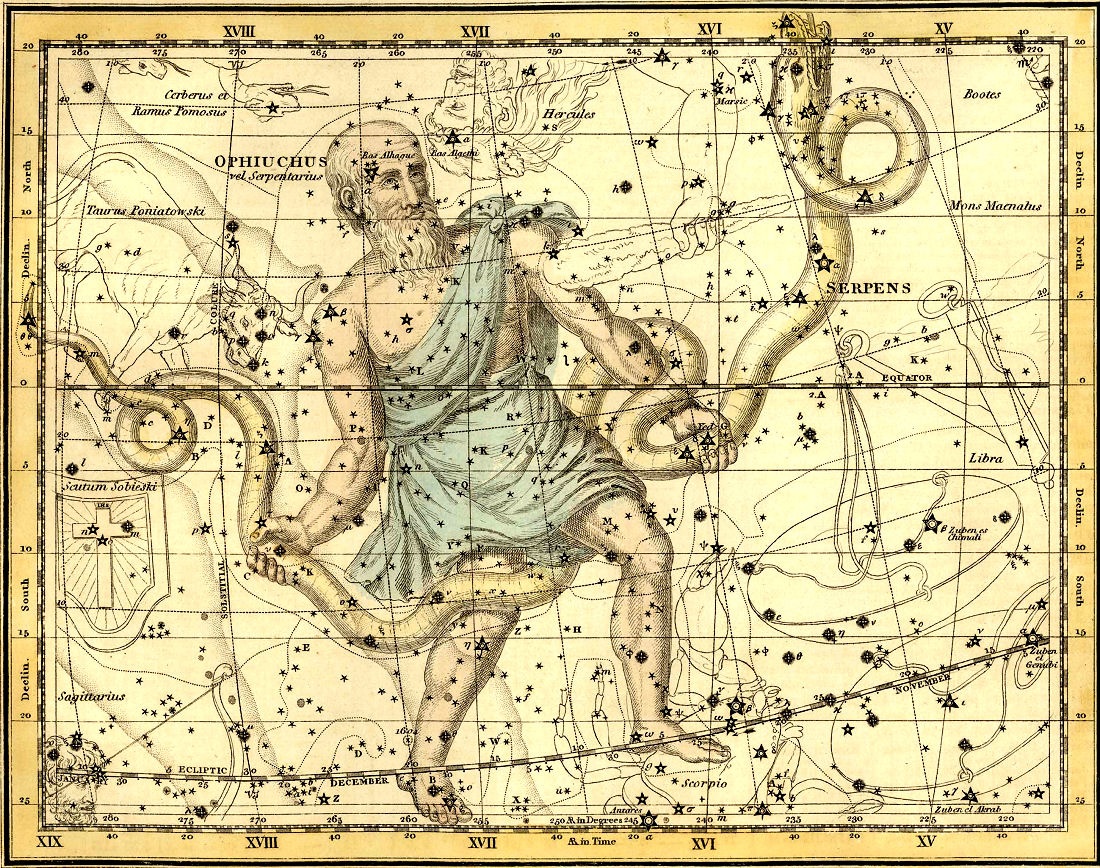
Whatever the case, whether the horoscope requires modification or not is irrelevant to Judaism, which denies any astrological effect on Israel (see ‘Should Jews Believe in Astrology’ in Volume One of Garments of Light). Besides, unlike astrologers, astronomers both ancient and modern have always been aware of this thirteenth constellation. To the ancient Babylonians it was the snake-like Nirah, while to the ancient Greeks it was known as Ophiuchus, the “serpent-bearer”. This constellation is in the shape of a man firmly grasping a twisted snake (the interlinked constellation Serpens). This is, of course, the very symbol of Mashiach, that serpentine saviour who defeats the primordial snake and all of its evil. After being an astrological footnote for a very long time, Ophiuchus has entered the spotlight, as if the cosmos itself is reminding us of Mashiach’s impending arrival.

The constellation Ophiuchus (or Serpentarius) grasping the constellation Serpens, from Alexander Jamieson’s Celestial Atlas of 1822. It is interesting to note that Mashiach must be a direct descendant of King David, whose own father Yishai (Jesse) was also called Nachash! (See Talmud, Shabbat 55b.)


The above is an excerpt from Garments of Light, Volume Two. Get the book here