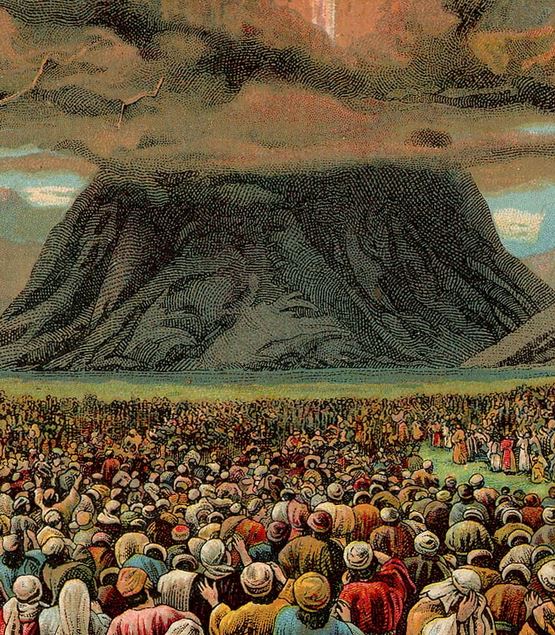
 With Shavuot coming tomorrow night, let us delve into some of its deeper cosmic mysteries, as relayed in a most profound passage in the Zohar (III, 97b-98b, together with Ra’aya Mehemna). It begins by describing Shavuot night as a “wedding” between Hashem and His people. It is well-known that Mount Sinai served as the “chuppah”, the Torah as the “ketubah”, Hashem as the groom, and Israel as the bride. As explored in depth previously, in ancient times an Israelite bride was adorned with 24 different ornaments, and the corresponding “ornaments” of the Jewish people are the 24 books of Tanakh.
The Zohar says that there are those who, on Shavuot, learn the Oral Torah at night and the Written Torah during the day. But it also says that, just as a bride is excited the whole night before her wedding and doesn’t sleep, and prepares for her wedding with her 24 adornments, so too the Jewish people should stay up all night and not sleep, and “adorn” ourselves with the 24 books of Tanakh. This is why the Arizal laid out his tikkun text for Torah study on the night of Shavuot to be entirely from Tanakh, the Written Torah, and not the Oral Torah. The Arizal says that together with the Tanakh, one should study mystical commentaries on it. (This was the impetus behind my tikkun for Shavuot, to lay out the correct sections of study from Tanakh, and provide a concise and fitting mystical commentary on each section.) Why Tanakh and its encoded secrets should be the sole focus on Shavuot needs further elucidation. Continue reading