Tag Archives: Shekhinah

Do Men Have More Mitzvot than Women?

This week’s parasha, Tazria, begins by describing the rituals that a mother must perform upon giving birth to a new child. If the child is male, the mother is considered “impure” for seven days following her delivery, and then spends an additional 33 days in purification. For a female child, the durations are doubled, with the mother “impure” for 14 days, and purifying for another 66 days. Why is the duration of purification for a female doubly longer than a male?

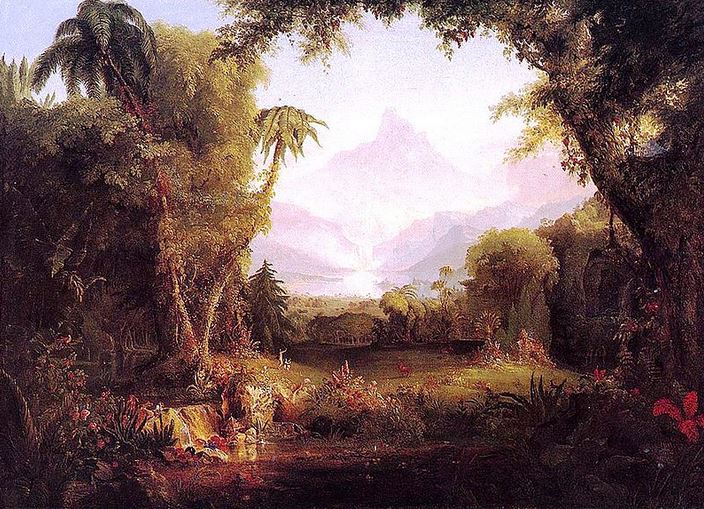
‘Garden of Eden’, by Thomas Cole

The apocryphal Book of Jubilees (3:8) suggests an interesting idea: Adam was made on the Sixth Day of Creation but, apparently, Eve wasn’t made until a whole week after. This is why a mother of a male child is impure for a week, but a mother of a female child for two weeks! Jubilees also holds that Adam was only brought into Eden forty days after being created, while Eve was brought in after eighty days. This is why a mother of a male child needs a total of forty days to purify, and a mother of a female child needs eighty days. Of course, Rabbinic tradition rejects the Book of Jubilees, and it is accepted that Adam and Eve were both created on the Sixth Day, and were in Eden from the beginning.

Commenting on this week’s parasha, the Zohar (III, 43b) states that it takes a soul 33 days to settle in the body. This is primarily referring to the new soul that enters a newborn baby, as it takes time for the ethereal soul to get used to its descent into a physical world. The Zohar doesn’t add too much more on this, but we might assume that, based on the words of the Torah, it takes a male soul 33 days to settle, and a female soul 66 days to settle. At the same time, the Zohar may be referring to the soul of the mother, too, as she is the one that spends 33 or 66 days in purification. As we’ve explained in the past, the severing of the mother’s direct connection to her child distresses her soul for 33 or 66 days following childbirth.

Whatever the case, the implication is that a female soul is somehow greater than a male soul. It has more spiritual power, taking longer to settle. The notion that female souls are greater is found throughout Jewish texts, especially mystical ones. Sefer HaBahir, one of the most ancient Kabbalistic texts, states that the female soul is the most beautiful of all, and an aspect of the Shekhinah, the Divine Presence (chs. 173-175). It explicitly makes clear that life on Earth would be impossible without the life-giving mother, who in this regard is much closer to God.

On that note, it has been said that God created the world sequentially from simple to complex, starting with the basic elements: light, air, water, earth; progressing to plants, then simple animals, then mammals, then man, and finally woman. The woman is the last of God’s creation, and therefore the most intricate and the most refined. It may be because of this that the Arizal taught that while male souls typically reincarnate to rectify themselves, female souls rarely if ever reincarnate at all (Sha’ar HaGilgulim, ch. 9).

It is important to mention here that we are speaking of female souls, not necessary to all women. The Arizal (as well as the Zohar cited above) speak of the possibility of female souls in male bodies, or male souls in female bodies. And it should also be mentioned that this does not necessarily affect the body’s sexuality. A “female” soul in a male body can still very much be a heterosexual male, and vice versa. (For more on this, see Rav Yitzchak Ginsburgh’s lecture here on the female soul of the forefather Isaac, as well as the prophets Samuel, Jonah, and Habakkuk.)

There are a number of consequences to the greater souls of females. For one, it gives them binah yeterah, an “extra understanding” sometimes referred to as “women’s intuition” (Niddah 45b). This is one reason why the women of the Exodus generation, for example, did not participate in the sin of the Golden Calf, nor the sin of the Spies. In fact, the Kli Yakar (Rabbi Shlomo Ephraim Luntschitz, 1550-1619, on Numbers 13:2) states that, had Moses sent female spies, there would have been no problem at all!

On the other hand, a more elevated soul and an extra depth of understanding means a greater sensitivity to the world, which makes women generally less prone to violence and drug abuse, but significantly more prone to depression and anxiety. The greater female soul has the amazing potential to bring life, yet simultaneously (to balance the equation) the potential for severe destruction, “more bitter than death”, to borrow from King Solomon in Kohelet 7:26. This is symbolically reflected in the menstrual cycle, where a lack of conception of life necessarily results in the shedding of blood, a “minor death” that is then rectified in the living waters of the mikveh.

Finally, a greater soul means that women require slightly less mitzvot than men. After all, the “mitzvot were given only in order that human beings might be purified by them… their purpose is to refine…” (Beresheet Rabbah 44:1) A more refined female soul does not need the same mitzvot that a male soul does. Unfortunately, this has sometimes been a point of contention in modern times. Yet, upon closer examination, we see that the differences in mitzvot between men and women are actually minimal and, contrary to the general belief, there is a perfect balance between those mitzvot done exclusively by men and those done exclusively by women.

“Time-Bound” Mitzvot?

The general rule is that, at least in principle, women are exempt from any mitzvah that can only be done at a particular time. This includes mitzvot like prayer, tefillin, and tzitzit. However, in practical terms we see that this “rule” isn’t really a thing, and there are many time-bound mitzvot that women are obligated in. For example,


The above is an excerpt from Garments of Light, Volume Two. To continue reading, get the book here

20 Things That Will Happen When Mashiach Comes

This week’s parasha, Vayikra, begins the third book of the Torah. The parasha is unique in that it is only one of two parashas (along with next week’s Tzav) where the word Mashiach appears. All four cases of the word in the Torah refer to the anointed High Priest, not to the messiah at the End of Days. Nonetheless, on a deeper level it certainly is alluding to the messiah of the End of Days. All the verses in question deal with the anointed High Priest (“HaKohen HaMashiach”) atoning for sins—both his own and the people’s—and purifying his nation. Indeed, one of the roles of Mashiach will be to prepare Israel for that final purification at the End of Days. This includes identifying one last Red Cow to produce those special waters which alone are capable of removing the impurity of death.

The early Christians saw these verses as allusions to their purported saviour, Jesus. In one place, for example, they wrote:

the Law [ie. the Torah] made those high priests who had infirmity, and who needed daily to offer up sacrifices, first for their own sins, and then for the people’s; but our high priest, Christ Jesus, was holy, harmless, undefiled, and separate from sinners, and made higher than the heavens. (Hebrews 7:27-28)

For the Christians, Jesus was the ultimate anointed high priest. Yet, Jesus accomplished essentially nothing of what Mashiach is supposed to. This was perhaps best explained in the 16th century by Isaac ben Abraham of Troki (1533-1594). He was a Karaite Jew, and a renowned Karaite scholar. His magnum opus was a book called Hizzuk Emunah, “Strengthening of Faith”, written to debunk Christianity, silence missionaries, and convince Jews to remain Jewish. The book was so popular that it spread like wildfire, not just among Karaites but all Jews, and even Christians. In fact, it played an important role in the start of the Enlightenment, leading countless Christians to abandon their faith. One of these was the French philosopher Voltaire (1694-1778), who called the Latin translation of Hizzuk Emunah (first published in 1681) a “masterpiece”.

Because it was a Karaite text, traditional rabbis were wary of consulting it. The great Rabbi Menashe ben Israel (Manoel Dias Soeiro, 1604-1657), who opened the first Hebrew printing press in Amsterdam in 1626, ultimately refused to print it. Still, Abba Hillel Silver, in his A History of Messianic Speculation in Israel (pg. 225), points out how Troki’s text borrowed from earlier Rabbinic texts, including Mashmia Yeshua, “Announcing Salvation”, of Rabbi Isaac Abarbanel (1437-1508).

Silver goes on to summarize the sixth chapter of Troki’s Hizzuk Emunah, which includes a list of twenty clear prophecies in Scripture that must be fulfilled upon the coming of Mashiach—none of which were fulfilled by Jesus (thereby necessitating for Christians some future “second coming” yet to materialize after nearly two millennia). Briefly going over these twenty events is enlightening both as a reminder for why Jesus could not be the messiah, and for what to expect when the true Mashiach does come.

Living Waters and Dead Waters
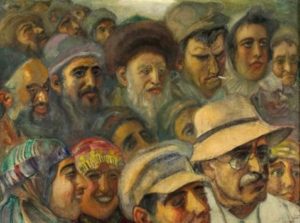
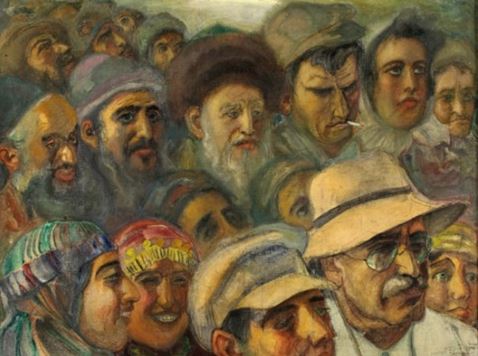
‘Israelis – The Ingathering of the Exiles’ by Saul Raskin (1878-1966)

The first prophecy is the return of the Lost Tribes of Israel. In ancient times, following the reign of King Solomon, the Twelve Tribes of Israel split into two kingdoms: the southern Judah and the northern Israel (or Ephraim). The more sinful northern kingdom was eventually overrun by the Assyrians, who exiled its tribes. These are sometimes referred to as the Ten Lost Tribes. It should be noted, though, that they weren’t necessarily ten tribes, nor were the tribes completely expunged. In reality, there were many Benjaminites, Simeonites, and Levites already living inside the Kingdom of Judah, and members of all the northern tribes fled to Judah when the northern kingdom was destroyed.

What happened was that all the tribes eventually assimilated into the larger, ruling tribe of Judah. Over time, the tribes lost knowledge of their lineage, and today everyone is simply a Yehudi, a Judahite, or Jew. (Levites, because of their unique role, retain knowledge of their ancestry). One of the prophesied events of the End of Days is that the identity of the Lost Tribes will once more be known. Though this idea is much more developed in later Rabbinic literature, it comes from numerous places in Scripture. Troki chooses to use Ezekiel 37:15-22:

And the word of God came to me, saying: “And you, son of man, take one stick, and write upon it: For Judah, and for the children of Israel his companions; then take another stick, and write upon it: For Joseph, the stick of Ephraim, and of all the house of Israel his companions; and join them one to another into one stick, that they may become one in your hand… And say to them: ‘Thus says the Lord God: Behold, I will take the children of Israel from among the nations, wherever they have gone, and will gather them on every side, and bring them into their own land…’”

Related to this is the second great prophecy, that of Gog u’Magog. This refers to the great world war at the End of Days, described in detail in Ezekiel 38, among other places. During the course of this war, Zechariah 14:4 states that the Mount of Olives in Jerusalem will be split in half. Then, new “living waters” will go out of Jerusalem to make Israel flourish (Zechariah 14:8).

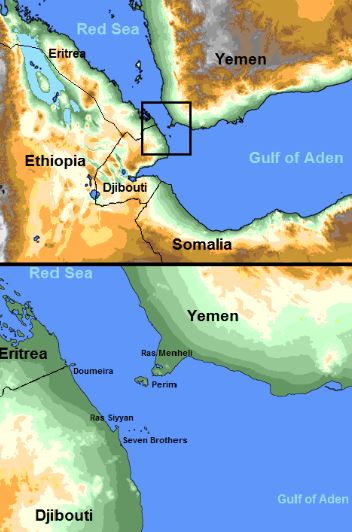
Bab-el-Mandeb Strait (Credit: Skilla1st)

Meanwhile, Isaiah 11:15 states that God “will utterly destroy the tongue of the Egyptian Sea; and with His scorching wind will He shake His hand over the River, and will smite it into seven streams, and cause men to march over dry-shod.” The identity of the “Egyptian Sea” and the “River” is unclear, though Silver has it as the Red Sea and the Euphrates. On the possibility of the Red Sea drying up, we know today from geological records that the Red Sea had once (and possibly more than once) become a dry chunk of land due to the narrow and shallow Bab-el-Mandeb closing up.

As for the “River”, in context it would make more sense if it referred to the Nile, the lifeline of Egypt. Today, we are indeed seeing the Nile drying up rapidly, and the Washington Post recently reported that the Nile Delta is losing as much as 20 metres per year in some areas. With this in mind, when Isaiah prophesies that the “tongue of the Egyptian Sea” will be destroyed, it may be referring to the Nile Delta, which opens up into the Egyptian Mediterranean, ie. the “Egyptian Sea”. The Post article is quite an accurate realization of Isaiah’s prophecy, with images of men that “march over dry-shod”.

(Having said that, the Euphrates River isn’t doing much better than the Nile, so whether Isaiah meant the Nile or the Euphrates is irrelevant in light of the mass devastation that has plagued both rivers.)

A Renewed Jerusalem

The sixth prophecy in Troki’s list is also from Zechariah (8:23):

Thus said the Lord of Hosts: “In those days it shall come to pass, that ten men shall take hold, out of all the languages of the nations, shall take hold of the garment of him that is a Jew, saying: We will go with you, for we have heard that God is with you.”

The tremendous anti-Semitism that Jews have experienced throughout history, into the present day, will finally end. The nations will be at peace with the Jews, and wish to learn from them. This is related to another prophecy: that gentiles from all over the world will come to Jerusalem to worship the God of Israel on every Rosh Chodesh and every Shabbat (Isaiah 66:20-23):

“…upon horses, and in chariots, and in litters, and upon mules, and upon swift beasts, to My holy mountain Jerusalem,” said God, “as the children of Israel bring their offering in a clean vessel into the house of God. And of them also will I take for the priests and for the Levites,” said God. “For as the new heavens and the new earth, which I will make, shall remain before Me,” said God, “so shall your seed and your name remain. And it shall come to pass, that from one new moon to another, and from one Sabbath to another, all flesh shall come to worship before Me, said God.

The gentiles—“all flesh”—will come to Jerusalem, upon every kind of transport. One of these is a rekhev, “chariot” in ancient Hebrew, and “vehicle” in Modern Hebrew. Another two of the transports are unique words that aren’t found elsewhere in Scripture and are impossible to translate: a tzab, and a kirkar. It is possible that the former refers to some kind of slow transport (as the word is written the same as that for a “turtle”) while the latter conversely refers to a very fast form of transport. In our day and age we have no shortage of either.

Troki lists separately a related prophecy from Zechariah (14:16): “And it shall come to pass, that every one that is left of all the nations that came against Jerusalem shall go up from year to year to worship the King, the Lord of Hosts, and to keep the feast of tabernacles.” Once a year, during the holiday of Sukkot, those nations that warred against Israel at the End of Days will come to Jerusalem to worship. The fact that it must be during Sukkot is no coincidence, for it is during Sukkot that our Sages say the offerings in the Temple atone for all the gentiles. This is why the Torah requires seventy bulls to be offered over the course of the holiday, corresponding to the seventy root nations of the world.

A Renewed World

If all the nations are coming to worship the God of Israel in Jerusalem, there is certainly no need for any “idols… false prophets… and unclean spirits” which God will entirely “cut off” (Zechariah 13:2). Zechariah further adds: “And God [YHWH] shall be King over all the earth; in that day God shall be One, and His name one.” (14:9) There will be world peace (Isaiah 2:4, Micah 4:3), which will be ensured and enforced by Israel, to whom all the kings and nations will listen (Isaiah 60:10-12, Daniel 7:27). Even the animals will be at peace with each other, as Isaiah (11:6-8) famously writes:

And the wolf shall dwell with the lamb, and the leopard shall lie down with the kid; and the calf and the young lion and the fatling together; and a little child shall lead them. And the cow and the bear shall feed; their young ones shall lie down together; and the lion shall eat straw like the ox…

On that last prophecy there is an interesting debate. Will the animals miraculously stop fighting and consuming one another? Or, is the prophecy only metaphorical and the natural order will remain? The Rambam (Rabbi Moshe ben Maimon, 1135-1204) held by the latter. Silver translates here that peace will be “between wild and domestic animals”. When reading Isaiah’s verses, this makes perfect sense: a wolf with a lamb, a leopard with a goat; calf and lion, cow and bear. So perhaps what Isaiah meant is that farmers and ranchers will no longer have to worry about wild animals devouring their livestock—once a common, and particularly disturbing, problem. (Or maybe there will be no need to raise livestock at all, for we are now at the dawn of the synthetic meat revolution.)

Israel will finally be completely righteous and free of sin (Deuteronomy 30:6, Isaiah 60:21, Ezekiel 36:25), and lead the rest of the world in doing the same (Jeremiah 3:17). There will no longer be any kind of suffering or sorrow in Israel, for the prophet said “the voice of weeping shall be no more heard in her, nor the voice of crying” (Isaiah 65:19).

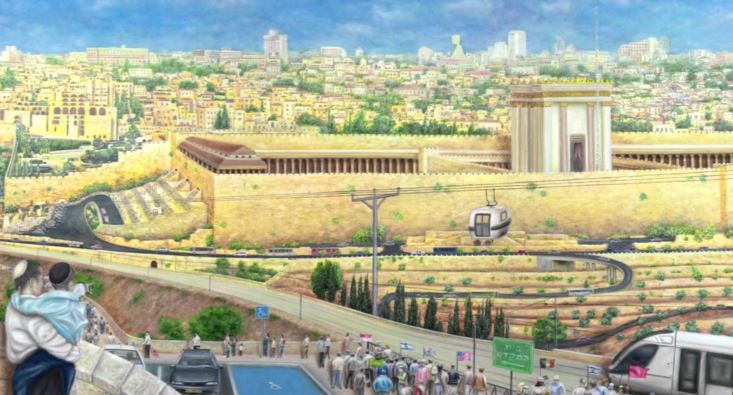
‘Going Up To The Third Temple’ by Ofer Yom Tov

Finally, the prophet Eliyahu will return (Micah 3:24), and the Temple will be rebuilt (Ezekiel 40-45). The Shekhinah will return to Israel (Ezekiel 37:26), as will the ability to prophecy (Jeremiah 31:32-33), and there will be great knowledge in the world (Isaiah 11:9). The Holy Land will be redistributed among the Twelve Tribes of Israel (Ezekiel 47:13). Lastly, at the very end, will come the long-awaited Resurrection of the Dead (Daniel 12:2).

To summarize:

  1. Return of the Lost Tribes
  2. Gog u’Magog
  3. Mount of Olives splitting
  4. Egyptian Sea and River destroyed
  5. Living waters emerge from Jerusalem
  6. Gentiles declaring to Jews “we will go with you”
  7. Israel’s former enemies coming to Jerusalem each year on Sukkot
  8. Gentile pilgrims coming to Jerusalem to worship on the new moons and Sabbaths
  9. Destruction of all idols, false prophets, and unclean spirits
  10. One religion around the world, and recognition of one God
  11. Israel’s recognized leadership on the international stage
  12. World peace
  13. Peace between wild and domesticated animals
  14. A sinless Israel and a sinless world
  15. No more suffering or sorrow in the Land of Israel and for the Jewish people
  16. Shekhinah and prophecy return
  17. Eliyahu reappears
  18. Rebuilding of the Temple in Jerusalem
  19. Redistribution of the Holy Land among the restored Twelve Tribes
  20. Resurrection of the Dead

Did Moses Have a Black Wife?

Towards the end of this week’s Torah portion, Beha’alotcha, we read that “Miriam and Aaron spoke against Moses because of the Cushite woman whom he had married, for he had married a Cushite woman.” (Numbers 12:1) This verse brings up many big questions, and the Sages grapple with its meaning. Who is this Cushite woman? When did Moses marry her? Why did Miriam and Aaron speak “against” Moses because of her? Why the superfluous phrasing of mentioning twice that he married the Cushite woman? What does “Cushite” even mean?

Traditionally, there are two main ways of looking at this passage: either Moses actually took on a second wife in addition to his wife Tzipporah, or the term “Cushite” simply refers to Tzipporah herself. The second interpretation is problematic, since we know Tzipporah was a Midianite, not a Cushite. The term “Cushite” generally refers to the people of Cush, or Ethiopia, and more broadly refers to all black people or Africans. Scripture does connect the Cushites with the Midianites in one verse (Habakkuk 3:7), which some use as proof that the Midianites were sometimes referred to as Cushites, or had particularly dark skin.

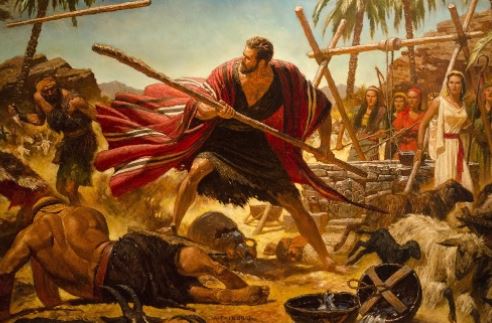
‘The Fight at Jethro’s Well’ – where Moses first meets Tzipporah – scene from ‘The Ten Commandments’ (1953) painted by Arnold Friberg.

Rashi (Rabbi Shlomo Itzchaki, 1040-1105) prefers the second interpretation. He says that Tzipporah was called a “Cushite” because she was very beautiful. He cites Midrash Tanchuma in stating that just as everyone can immediately identify a black person (Cushite), everyone immediately recognized the incomparable beauty of Tzipporah. The same Midrash offers another possibility: apparently if a person had a very beautiful child in those days, they would call them “Cushite” to ward off the evil eye. This suggests that a Cushite was not considered beautiful at all, yet Rashi provides a numerical proof that Cushite does indeed mean “beautiful”, since the gematria of Cushite (כושית) is 736, equal to “beautiful in appearance” (יפת מראה), the term frequently used in the Torah to describe beauty.

If the Cushite is Tzipporah, then why did Miriam and Aaron suddenly have a problem with her? Rashi cites one classic answer: because Moses had become so holy—recall how after coming down Sinai, his skin glowed with such a blinding light that he had to wear a mask over his face—he had essentially removed himself from this material world. This means he was no longer intimate with his wife Tzipporah. Miriam had learned of this, and thought Moses was in error for doing so.

Unlike certain other religions, Judaism does not preach celibacy, and does not require complete abstinence to remain holy and pure. Conversely, Judaism holds that sexual intimacy is an important aspect of spiritual growth. The famous Iggeret HaKodesh (the “Holy Letter”, often attributed to the Ramban, Rabbi Moshe ben Nachman, 1194-1270, but more likely written by Rabbi Joseph Gikatilla, 1248-1305) writes that it is specifically during sexual union (if done correctly and in holiness) that a man and woman can bring down and experience the Shekhinah, God’s divine presence.

As such, Miriam and Aaron came to their little brother and admonished him for separating from his wife. This is why the Torah goes on to state that “They said, ‘Has God spoken only to Moses? Hasn’t He spoken to us too?’” (Numbers 12:2) Miriam and Aaron argued that they, too, were prophets, and they clearly had no need to separate from their own spouses! Moses was so humble and modest that he did not respond at all: “…Moses was exceedingly humble, more so than any person on the face of the earth.” (Numbers 12:3)

God immediately interjected and summoned Miriam and Aaron to the Ohel Mo’ed, the “Tent of Meeting”, where He regularly conversed with Moses. God told them:

If there be prophets among you, I will make Myself known to him in a vision; I will speak to him in a dream. Not so My servant Moses; he is faithful throughout My house. With him I speak mouth to mouth; in [plain] sight and not in riddles, and he beholds the image of the Lord…

God makes it clear to Miriam and Aaron that although they are also prophets, they are nowhere near the level of Moses. In all of history, Moses alone was able to speak to God “face to face”, while in a conscious, awake state. All other prophets only communed with God through dreams or visions, while asleep or entranced.

By juxtaposing the fact that Moses was the humblest man of all time, and also the greatest prophet of all time, the Torah may be teaching us that the key to real spiritual greatness is humility. Moses had completely subdued his ego, and so he merited to be filled with Godliness. Fittingly, the Talmud (Sotah 5a) states that where there is an ego, there cannot be a Godly presence, because a person with a big ego essentially sees themselves as a god—and there cannot be two gods! “Every man in whom there is haughtiness of spirit, the Holy One, blessed be He, declares: ‘I and he cannot both dwell in the world.’”

Moses Had a Black Wife

The explanation above is certainly a wonderful one, yet it is hard to ignore the plain meaning of the text: that Moses actually married a Cushite woman. The repetitive phrasing of the verse seems like it really wants us to believe he had taken another wife. And many of the Sages agree. However, Moses hadn’t married her at this point in time, but many years earlier. The Midrash describes in great detail what Moses was up to between the time that he fled Egypt and arrived in Midian. After all, he had fled as a young man, and returned to Egypt in his 80th year. What did he do during all those intervening decades?

The Midrash (Yalkut Shimoni, Shemot 168) says that Moses initially fled to Cush. At the time, the Cushites had lost their capital in a war and were unsuccessful in recapturing it. Their king, named Koknus (קוקנוס, elsewhere called Kikanos or Kikianus), fought a nine-year war that he was unable to win, and then died. The Cushites sought a strong ruler to help them finally end the conflict. They chose Moses, presumably because he had fought alongside the Cushites and had a reputation as a great warrior. Moses did not disappoint, and devised a plan to win the war and recapture the Cushite capital. (His enemy was none other than Bilaam!) The grateful Cushites gave Moses the royal widow of Koknus for a wife, and placed him upon the throne.

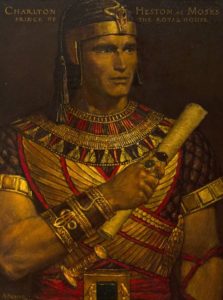
Charlton Heston as Egyptian General Moses, also by Arnold Friberg

This Midrash is very ancient, and was already attested to by the Jewish-Roman historian Josephus (37-100 CE). Josephus writes (Antiquities, II, 10:239 et seq.) a slightly different version of the story, with Moses leading an Egyptian army against the Cushites. The Cushite princess, named Tharbis, watches the battle and falls in love with the valiant Moses. She goes on to help him win the battle, and he fulfils his promise in return to marry her. In some versions, Moses eventually produces a special ring that causes one to forget certain events, and puts it upon Tharbis so that she can forget him. He then returns to Egypt.

So, Moses married a Cushite queen. Yet, he remembered “what Abraham had cautioned his servant Eliezer” about intermarriage, and abstained from touching her. (If you are wondering how Moses later married Tzipporah, who was not an Israelite, remember that the Midianites are also descendants of Abraham through his wife Keturah, see Genesis 25:2. Thus, Moses still married within the extended family of Abrahamites.) Although Moses married the Cushite queen, he never consummated the marriage. The Midrash says he reigned over a prosperous Cush for forty years until his Cushite wife couldn’t take the celibacy anymore and complained to the wise men of Cush. Moses abdicated his throne and finally left Ethiopia. He was 67 years old at the time.

All of this was kept secret until it came out publicly in this week’s parasha. This is a terrific version of the story, but it doesn’t answer why Miriam and Aaron complained to Moses. For this we must look to the mysticism of the Arizal.

Soulmates of Moses

The Arizal cites the above Midrash in a number of places (see Sefer Likutei Torah and Sha’ar HaPesukim on this week’s parasha, as well as Sha’ar HaMitzvot on parashat Shoftim). He explains that both Tzipporah and the Cushite were Moses’ soulmates. This is because Moses was a reincarnation of Abel, who had two wives according to one tradition. This was the reason for the dispute between Cain and Abel, resulting in the latter’s death. Cain was born with a twin sister, and Abel was born with two twin sisters (otherwise, with whom would they reproduce?) Cain reasoned that he should have two wives since he was the older brother, and the elder always deserves a double portion. Abel reasoned that he should have the second wife since, after all, she was his twin! Cain ultimately killed Abel over that second wife.

Therefore, the Arizal explains that Cain reincarnated in Jethro, and Abel in Moses. This is why Jethro gave his daughter Tzipporah to Moses, thus rectifying his past sin by “returning” the wife that he had stolen.* Moses’ other spiritual twin was the Cushite woman. The Arizal suggests that Miriam and Aaron were aware of this, and were frustrated that Moses did not consummate his marriage to the Cushite, for she was his true soulmate! Apparently, after the Exodus Moses summoned the Cushite woman and she happily joined the Israelites and converted to Judaism. The Arizal explains that this was a necessary tikkun, a spiritual rectification for her lofty soul. However, he could not consummate the marriage because her soul originated from a place of intense dinim gemurim, strict judgement and severity. It appears that when Miriam heard about his abstention from his wife, she complained to Moses, failing to grasp that a soul as pure as Moses’ had different requirements.

Whatever the case may be, the root of the matter is Moses’ separation from his wife (or wives). Having said all that, there is a third possibility. This comes from a simple reading of the Torah text, and the lesson that we learn from it is particularly relevant today.

Black or White

When we read the first two verses of Numbers 12 in isolation, we might be led to believe that Miriam and Aaron had a problem with Moses marrying a black woman. Was there a hint of racism in their complaint, or did they just genuinely wonder whether an Israelite was allowed to marry a black person? Either way, we see how perfectly the punishment fits the crime: “… Behold, Miriam was afflicted with tzara’aat, [as white] as snow.” (Numbers 12:10)

If the issue was about Moses separating from his wife, it isn’t clear why Miriam would be punished with tzara’at (loosely translated as “leprosy”). Rashi, for one, does not seem to offer a clear explanation why this in particular was her punishment. Of course, we know that God doesn’t really “punish”, and simply metes out justice, middah k’neged middah, “measure for measure”. It is therefore totally fitting that in complaining about Moses taking a black woman as a wife, Miriam’s own skin is turned white “like snow”. Perhaps God wanted to remind her that she is not so white herself.

We can learn from this that there really is no place for racism in Judaism. In fact, God explicitly compares the Israelites to the Cushites (Amos 9:7), and maintains that He is not the God of the Jews alone, but the God of all peoples: “‘Are you not as the children of the Cushites unto Me, O children of Israel?’ Said Hashem. ‘Have I not brought up Israel out of the land of Egypt, [just as I brought] the Philistines from Caphtor, and Aram from Kir?’” Among a list of nine holy people that merited to enter Heaven alive, without ever dying, the Sages include a Cushite man named Eved-Melekh (Derekh Eretz Zuta 1:43, see Jeremiah 39:16).

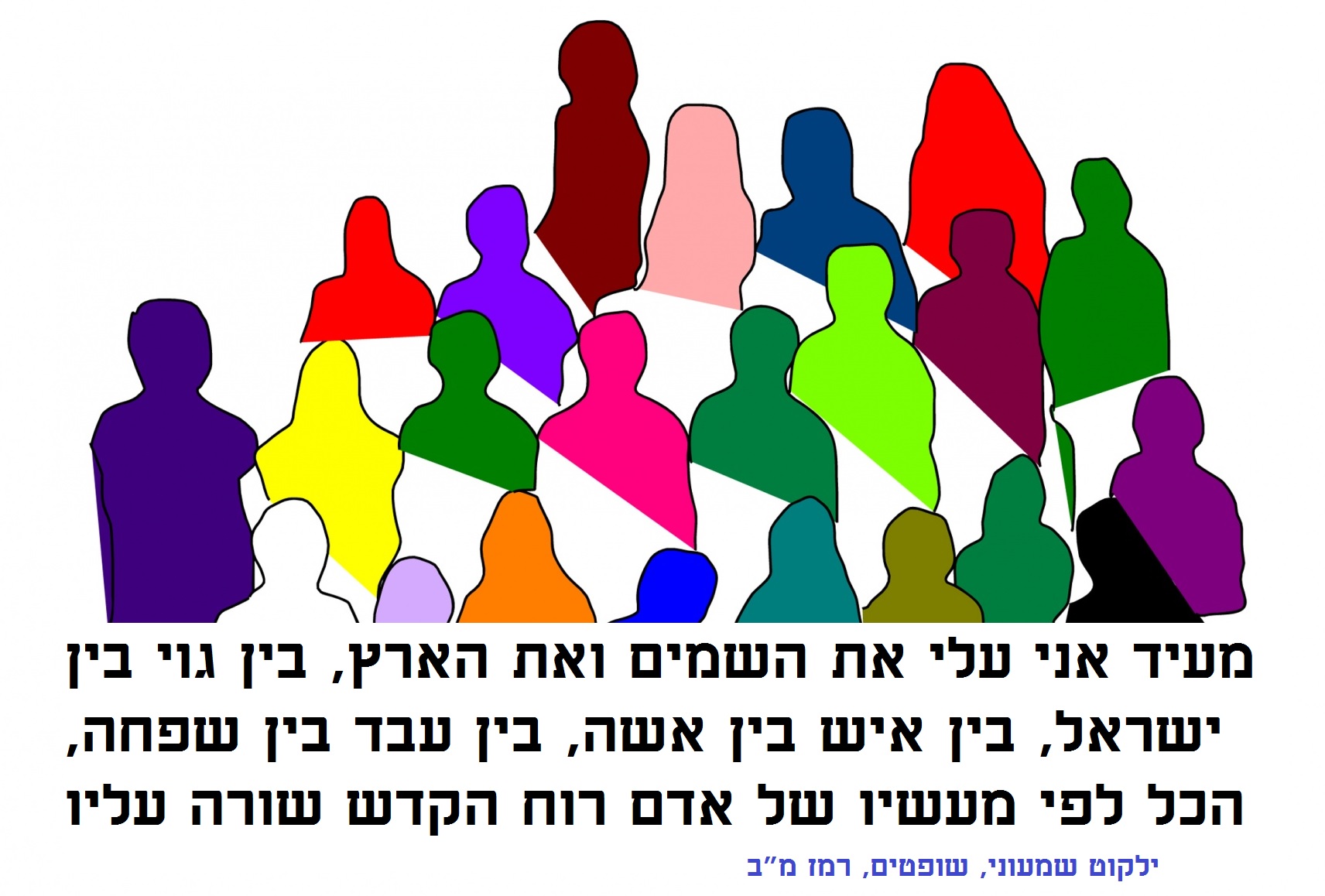
At the end of the day, there is no reason to hold prejudice against anyone, or discriminate against any individual at all, as the Midrash (Yalkut Shimoni, Shoftim 42) clearly states:

I bring Heaven and Earth to witness that the Divine Spirit may rest upon a non-Jew as well as a Jew, upon a woman as well as a man, upon a maidservant as well as a manservant. All depends on the deeds of the particular individual.

*The Arizal actually writes how Cain reincarnated in three people: Korach, Jethro, and the Egyptian taskmaster that Moses killed before fleeing Egypt. The rectification for the improper dispute between Cain and Abel was rectified in the dispute between Korach and Moses, with Moses’ victory. The rectification for the stolen wife was fulfilled by Jethro. And the rectification for Cain murdering Abel was that Moses, in return, killed the Egyptian taskmaster. Thus, all the rectifications were complete. We can see a hint in the name Cain (קין) to his three future incarnations: the ק for Korach (קרח), the י for Jethro (יתרו), and the ן for the Egyptian, whose name we don’t know but perhaps it started with a nun!


The above essay is adapted from Garments of Light, Volume Three.
Get the book here!