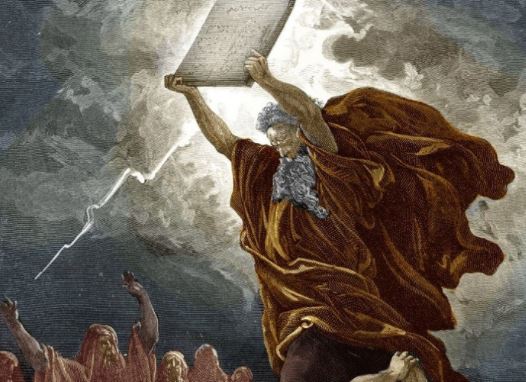
An illustrated section from Gustav Doré’s “Moses Breaking the Tablets of the Law”
In this week’s parasha, Ki Tisa, we read how Moses goes up Mount Sinai on three separate occasions. His first ascent concludes with receiving the Two Tablets, only to come down and see the horror of the Golden Calf. Following this, the Torah tells us that “Moses returned to God”, back up the mountain, to address the Calf fiasco and its aftermath (Exodus 32:31). Moses then came back down to pitch a “Tent of Meeting” (33:7) where he could more regularly communicate with God without having to ascend the Mountain, and for when the Israelites would leave Sinai to head to Israel. Moses asked to see God’s Presence directly, and God replied that no mortal can see God and live, though He would show Moses His “back”. To do this, God asked Moses to come up Sinai one last time (34:2), where a new set of tablets would be created to replace the shattered ones.
When Moses descended from Sinai for the last time to present the new Tablets, the Torah tells us that “He was there with God for forty days and forty nights; he ate no bread and drank no water…” (34:28) Moses had gone up Sinai three times, each for forty days, making 120 days total. Indeed, if one counts the days of the Jewish calendar between Shavuot and Yom Kippur, one would find 120 days, since Shavuot is the date of the initial Sinai Revelation while Yom Kippur is when God forgave the Israelites for the Golden Calf and Moses returned with the new Tablets. At the end of Moses’ three sessions of intense meditation with God, his face glowed and the people could no longer look at him directly (34:29-30). Moses would henceforth wear a mask.
The Torah motif of going up a mountain to spend time in prayer and divine meditation spread all over the world, and we find very similar descriptions in other faiths that emerged after Judaism. Buddha, for instance, spent 40 days (or 49 days) up on a mountain meditating under a bodhi tree to attain enlightenment, and also abstained from food and water during that time. Jesus is said to have spent forty days in the wilderness without food and water, and Mohammad purportedly received his first revelation while meditating and fasting for days on Mount Hira at the age of 40. Despite the fact that Moses was undoubtedly the first, meditation today is associated more with Eastern faiths, and strangely not with Judaism.
The truth is that meditation has always been central to Judaism since ancient times. In fact, it is highly likely that it was Jewish exiles who introduced meditative practices around the world after their expulsion from Israel in the 6th century BCE at the hands of the Babylonians. It is intriguing to point out that many world religions began in the century following Israel’s exile, including Buddhism and Confucianism, as well as the Pythagorean and Orphic religions in Greece. Even ancient Zoroastrianism and Hinduism were heavily influenced by spreading Torah ideas in the middle of the first millennium BCE.
Today, science has uncovered the vast benefits of regular meditation—everything from reducing stress and improving sleep, to boosting the immune system and accelerating healing, even positively impacting the expression of our genes! So, what does the Torah tradition have to teach us about meditation, and what are some specific Jewish meditative techniques we can put into practice daily to enhance our lives? Continue reading →
This week’s parasha, Tazria, begins by describing the rituals that a mother must perform upon giving birth to a new child. If the child is male, the mother is considered “impure” for seven days following her delivery, and then spends an additional 33 days in purification. For a female child, the durations are doubled, with the mother “impure” for 14 days, and purifying for another 66 days. Why is the duration of purification for a female doubly longer than a male?
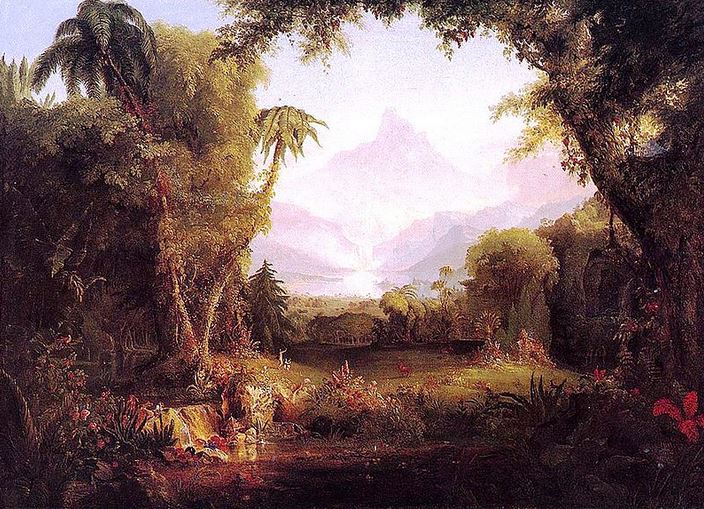
‘Garden of Eden’, by Thomas Cole
The apocryphal Book of Jubilees (3:8) suggests an interesting idea: Adam was made on the Sixth Day of Creation but, apparently, Eve wasn’t made until a whole week after. This is why a mother of a male child is impure for a week, but a mother of a female child for two weeks! Jubilees also holds that Adam was only brought into Eden forty days after being created, while Eve was brought in after eighty days. This is why a mother of a male child needs a total of forty days to purify, and a mother of a female child needs eighty days. Of course, Rabbinic tradition rejects the Book of Jubilees, and it is accepted that Adam and Eve were both created on the Sixth Day, and were in Eden from the beginning.
Commenting on this week’s parasha, the Zohar (III, 43b) states that it takes a soul 33 days to settle in the body. This is primarily referring to the new soul that enters a newborn baby, as it takes time for the ethereal soul to get used to its descent into a physical world. The Zohar doesn’t add too much more on this, but we might assume that, based on the words of the Torah, it takes a male soul 33 days to settle, and a female soul 66 days to settle. At the same time, the Zohar may be referring to the soul of the mother, too, as she is the one that spends 33 or 66 days in purification. As we’ve explained in the past, the severing of the mother’s direct connection to her child distresses her soul for 33 or 66 days following childbirth.
Whatever the case, the implication is that a female soul is somehow greater than a male soul. It has more spiritual power, taking longer to settle. The notion that female souls are greater is found throughout Jewish texts, especially mystical ones. Sefer HaBahir, one of the most ancient Kabbalistic texts, states that the female soul is the most beautiful of all, and an aspect of the Shekhinah, the Divine Presence (chs. 173-175). It explicitly makes clear that life on Earth would be impossible without the life-giving mother, who in this regard is much closer to God.
On that note, it has been said that God created the world sequentially from simple to complex, starting with the basic elements: light, air, water, earth; progressing to plants, then simple animals, then mammals, then man, and finally woman. The woman is the last of God’s creation, and therefore the most intricate and the most refined. It may be because of this that the Arizal taught that while male souls typically reincarnate to rectify themselves, female souls rarely if ever reincarnate at all (Sha’ar HaGilgulim, ch. 9).
It is important to mention here that we are speaking of female souls, not necessary to all women. The Arizal (as well as the Zohar cited above) speak of the possibility of female souls in male bodies, or male souls in female bodies. And it should also be mentioned that this does not necessarily affect the body’s sexuality. A “female” soul in a male body can still very much be a heterosexual male, and vice versa. (For more on this, see Rav Yitzchak Ginsburgh’s lecture here on the female soul of the forefather Isaac, as well as the prophets Samuel, Jonah, and Habakkuk.)
There are a number of consequences to the greater souls of females. For one, it gives them binah yeterah, an “extra understanding” sometimes referred to as “women’s intuition” (Niddah 45b). This is one reason why the women of the Exodus generation, for example, did not participate in the sin of the Golden Calf, nor the sin of the Spies. In fact, the Kli Yakar (Rabbi Shlomo Ephraim Luntschitz, 1550-1619, on Numbers 13:2) states that, had Moses sent female spies, there would have been no problem at all!
On the other hand, a more elevated soul and an extra depth of understanding means a greater sensitivity to the world, which makes women generally less prone to violence and drug abuse, but significantly more prone to depression and anxiety. The greater female soul has the amazing potential to bring life, yet simultaneously (to balance the equation) the potential for severe destruction, “more bitter than death”, to borrow from King Solomon in Kohelet 7:26. This is symbolically reflected in the menstrual cycle, where a lack of conception of life necessarily results in the shedding of blood, a “minor death” that is then rectified in the living waters of the mikveh.
Finally, a greater soul means that women require slightly less mitzvot than men. After all, the “mitzvot were given only in order that human beings might be purified by them… their purpose is to refine…” (Beresheet Rabbah 44:1) A more refined female soul does not need the same mitzvot that a male soul does. Unfortunately, this has sometimes been a point of contention in modern times. Yet, upon closer examination, we see that the differences in mitzvot between men and women are actually minimal and, contrary to the general belief, there is a perfect balance between those mitzvot done exclusively by men and those done exclusively by women.
“Time-Bound” Mitzvot?
The general rule is that, at least in principle, women are exempt from any mitzvah that can only be done at a particular time. This includes mitzvot like prayer, tefillin, and tzitzit. However, in practical terms we see that this “rule” isn’t really a thing, and there are many time-bound mitzvot that women are obligated in. For example,
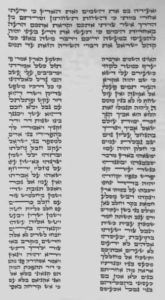
This week’s parasha, the second last of the Torah, is Ha’azinu. This parasha is unique in that it consists almost entirely of one lengthy song – clearly visible when looking at a Torah scroll, where the text of Ha’azinu is split into two narrow columns. Moses sang this prophetic song to the nation right before his passing.
Two columns of parashat Ha’azinu
In the verses that introduce it (Deut. 31:19), we see God commanding Moses to write the song and “teach it to the Children of Israel. Place it in their mouths so that this song will be for Me a witness for the Children of Israel.” God wanted Moses to diligently teach this song to the entire nation. In fact, the actual wording of the verse has God commanding everyone – each member of the nation – to write the song for themselves. It is based on this verse that the Sages drew the mitzvah of writing a Torah scroll (or participating in writing one), even though the plain text of the verse states only to write this particular song, Ha’azinu.
Perhaps because of this, the Ramban taught that Ha’azinu contains the entire Torah within it. Moreover, he believed that every detail of every person’s life is somehow encoded within this song! In one famous story, when a student of the Ramban, a man named Avner, heard this teaching, he was so baffled by it that he left Judaism entirely, converted to another religion, and became a prominent anti-Semite. When Avner later confronted the Ramban, the Rabbi showed him how one verse in the song did indeed accurately point to this man’s life. Avner was so ashamed that he disappeared, never to be heard from again.
Heavenly Princes
And so, each and every one of the song’s 43 verses has a great deal to teach us. The eighth verse begins by telling us that God gave each nation their lot, and the ninth verse says that “Hashem’s portion is His people, the lot of His inheritance.” The Zohar comments on these words that while God established Heavenly “princes” to watch over every nation in the world, Israel is watched over by God Himself. The Ramban (in his Discourse on Rosh Hashanah) elaborates:
He gave each and every nation… some known star or constellation, as is known by means of the science of astrology… Higher above [the constellations] are the angels of the Supreme One, whom He appointed as “princes” over them… It is further written, “So shall you be My people, and I will be your God, and you will not be subject to other powers at all.” (Jeremiah 11:4)
When we often say that Hashem is our God (as we do in the daily Shema), or when the Tanakh writes that we are God’s people, this does not mean that gentiles cannot have a relationship with God, or that there are other gods out there for the non-Jewish world. Rather, it means that while God oversees absolutely everything in His universe, and has created all people, He has also appointed various Heavenly (or astrological) forces above each nation – except Israel. These forces are not independent in their own right, as they are subject to the angels above them, and these angels ultimately serve God. As such, the nations of the world have various Heavenly intermediaries between themselves and Hashem. Israel, however, has a direct connection to Him. In fact, this is the hidden meaning within the name “Israel” (ישראל), which can be read as yashar El. (ישר-אל), “straight to God”.
Ain Mazal L’Israel
Long before the Ramban, the Sages of the Talmud debated whether the constellations had an effect on people (Shabbat 156a). The consensus of the Rabbis was that constellations do impact people, but Jews are free from this influence. They learn this from the prophet Jeremiah, who prophesied: “Thus said Hashem: Learn not the way of the nations, and be not dismayed at the signs of heaven, for the nations are dismayed at them.” (10:2) God tells Israel not to draw meaning from heavenly signs as the other nations do. The Talmud goes on to tell us a story about Abraham, who cried out to God: “Master of the Universe! I have looked at the constellations and find that I am not fated to have children.” To this, God replied: “Stop your star-gazing! Israel has no constellations.”
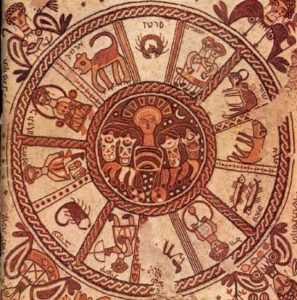
Hebrew Zodiac from a 6th-Century Synagogue
Elsewhere, the Talmud tells us that Abraham was once a powerful astrologer, and great men from around the world came to consult with him about their fortunes (Bava Batra 16b). When Abraham looked into his own fate, he saw that he would not have children. God commanded him to desist from astrology, for the Jewish people have the power to transcend the stars. Of course, Abraham went on to have many children.
Later on, Moses would record in the Torah the prohibition for Jews to consult various fortune-tellers and astrologers. The Rambam codifies the law in this way:
It is forbidden to tell fortunes. [This applies] even though one does not perform a deed, but merely relates the falsehoods which the fools consider to be words of truth and wisdom. Anyone who performs a deed because of an astrological calculation or arranges his work or his journeys to fit a time that was suggested by the astrologers is [liable for] lashes, as [Leviticus 19:26] states: “Do not tell fortunes.” (Sefer HaMadda, Hilchot Avodah Zarah, Chapter 11, Halacha 9)
Transcending Nature
We see from the above that various Heavenly forces, angels, and constellations do exist, and certainly do influence the world. Astrological signs can be potent forces. Ironically, earlier in his discourse, the Ramban points out how astrology is intricately tied into the Jewish calendar: it is no coincidence that Pesach is celebrated in the month of Nisan, the sign of which is Aries (the ram, or sheep), since the main mitzvah of Pesach was to sacrifice a lamb; and it is no coincidence that Rosh Hashanah – judgement day, when each person is put on trial – is in the month of Tishrei, the sign of which is Libra, the scales of justice. The Midrash (Yalkut Shimoni, Shemot 418) even tells us how each of the 12 Tribes of Israel corresponds to one of the 12 astrological signs of the zodiac!
And yet, all the sources are clear: Jews are not to dabble in astrology, for we have no need for intermediaries, and we have all the power to break free from the influence of the constellations. It is precisely when we believe in astrology that it becomes real, just as Abraham had no children as long as he believed in the heavenly signs that he saw. Every Jew must realize that we are Israel, yashar El, and that Hashem alone is our astrological sign. There is no need to believe in what the Rambam calls “emptiness and vanity”. The Rambam ends his laws on this subject by telling us to live up to the Torah’s call (Deut. 18:13) to be of “perfect faith with Hashem, your God.” When one has perfect faith in the Master of the Universe, anything is possible, and this is how God finished his rebuke to Abraham:
“Stop your star-gazing! Ain mazal l’Israel. What is your calculation? Is it because Jupiter stands in the West? Then I will turn it back and place it in the East!”
The article above is an excerpt from Garments of Light: 70 Illuminating Essays on the Weekly Torah Portion and Holidays. Click here to get the book!