Tag Archives: King Solomon

Can a Husband and Wife Speak Lashon HaRa To Each Other?

This week’s parasha, Metzora, is primarily concerned with the laws of various skin diseases. Jewish tradition holds that the main reason for a person to contract these skin afflictions is for the sin of evil speech. The term metzora, loosely translated as “leper”, is said to be a contraction of motzi ra or motzi shem ra, “one who brings out evil” or gives someone a “bad name”. The Sages described lashon hara, a general category referring to all kinds of negative speech (even if true), as the gravest of sins.

The Ba’al HaTurim (Rabbi Yakov ben Asher, 1269-1343) comments on the parasha (on Leviticus 13:59) that the word “Torah” is used in conjunction with words like tzaraat or metzora five times, alluding to the fact that one who speaks lashon hara is likened to one who has transgressed all five books of the Torah! The Talmud (Arakhin 15b) famously states that one who speaks lashon hara “kills” three people: the subject of the evil speech, the speaker, and the listener. The same page states that lashon hara is equal to the three cardinal sins: murder, idolatry, and adultery. Other opinions (all supported by Scriptural verses) include: one who speaks lashon hara is considered a heretic, deserves death by stoning, and God personally declares that He and the speaker of lashon hara cannot dwell in the same space.

Having said that, the Talmud’s definition of lashon hara is quite narrow. It doesn’t include general tale-bearing, but specifically refers to slandering another person. It also states that lashon hara is only applicable when two people are speaking in private, secretly. If one slanders before three or more people, then it is evident that he doesn’t care that the subject will know he said it. It is like saying it publicly, or to the person’s face directly, which does not constitute lashon hara. (It is still a horrible thing to do, of course.) This is why God says (Psalms 101:5) that “Whoever slanders his fellow in secret, him I will destroy.” It is specifically when done in secret that it is such a terrible, cowardly sin.

Since Talmudic times, the definition of lashon hara has broadened considerably. It has come to include rechilut, “gossiping”, saying negative things about another person that are true, saying them publicly, and even to suggest or imply something disparaging about another, without naming a person specifically. When it comes to gossiping, one can find an allusion to its severity from the Torah itself, which states “You shall not go as a talebearer among your people, neither shall you stand idly by the blood of your fellow” (Leviticus 19:16). In a single verse, the Torah juxtaposes gossiping with failing to prevent bloodshed. One can learn from this that one who listens to gossip (specifically where another person is spoken of unfavourably) without trying to stop it is like one standing idly while the “blood” of another is being shed.

One question frequently asked about this is whether lashon hara applies between a husband and wife. We saw that the Talmud states lashon hara is especially horrible when spoken in secret between two people. Does this include a married couple as well? On the one hand, we want to distance ourselves from negative speech as much as possible, at all times. On the other hand, we expect a married couple to be allowed to speak freely between one another as they wish. After all, they are two halves of one soul and considered a singular unit.

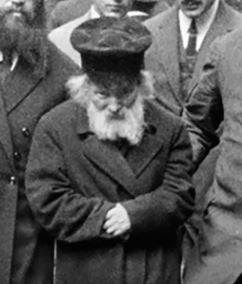
A still of the Chafetz Chaim from a rare, recently released video of the great rabbi. Click the image to see the video.

The Chafetz Chaim (Rabbi Israel Meir Kagan, 1839-1933), generally considered the greatest authority on lashon hara, forbids such speech even between husband and wife. However, many other great authorities before and after him (including Rav Shlomo Zalman Auerbach, 1910-1995, and the Chazon Ish, Rabbi Avraham Isaiah Karelitz, 1878-1953) ruled on the contrary, and permitted a husband and wife to speak about whatever is on their mind, particularly if something bothers them. Technically, even the Chafetz Chaim is lenient in a case where a spouse is in distress and needs to get something off their shoulders.

Still, all agree that we should limit negative words as much as possible, and certainly keep gossip to a minimum. Of course, when negative words have a constructive purpose, it is not considered lashon hara at all, whether between spouses or fellows. This is the case if a person undoubtedly knows, for example, that a particular contractor or salesman is dishonest, and tells a friend in order to protect them from harm.

Repairing Evil Speech, Repairing the World

In the days of the Temple, the kohanim would bring about atonement for the nation through sacrifices and various offerings and rituals. The most important time for atonement was Yom Kippur, and the greatest atonement ritual of the day was when the Kohen Gadol, the high priest, would enter the Holy of Holies (just once a year) and fill it with incense smoke. What was the ultimate purpose of this? The Talmud (Arakhin 16a) states that it served to atone for lashon hara! This was especially necessary because, elsewhere, the Talmud (Bava Batra 165a) states: “Many transgress the law of stealing, few transgress the prohibition of adultery, and all transgress lashon hara.” Everyone is guilty of negative speech, at least to some degree. How do we repair this sin, especially when we don’t have a Temple today?

The Talmud (Arakhin 15b) states that if one is a Torah scholar, they should learn more Torah, and if one is not a Torah scholar, they should strive to be more humble. Like all the other statements, support is brought from verses in Tanakh. King Solomon said “A healing tongue is a tree of life” (Proverbs 15:4). The Sages see the use of the word tongue (lashon) as alluding to lashon hara, and therefore if one wants to heal their lashon hara, they should cleave to the Tree of Life. What is the Tree of Life? King Solomon himself said in another place (Proverbs 3:18) that the Torah is a Tree of Life! Therefore, to rectify the sin of lashon hara one should study Torah.

Upon closer examination, we see that Torah study is actually the perfect remedy for lashon hara. When a person speaks lashon hara they are using their tongue in a negative way and infusing bad energy into the world. When a person learns Torah (which is traditionally done vocally), they are using their tongue in a positive way and infusing good energy into the world. The balance is thereby restored, measure for measure. On top of this, the purpose of Torah study is ultimately to make a person better. The Torah is the best tool to counter the yetzer hara, the evil inclination, as God Himself declared: “I have created the evil inclination, and I have created the Torah as its remedy” (Sifre Devarim, 45). Thus, a person who learns Torah simultaneously neutralizes the evil speech they have spoken and refines their inner qualities so that they will not participate in evil speech in the future.

On that note, there are two kinds of people when it comes to lashon hara: those that like to speak it, and those that love listening to it. The latter often quell their conscience by telling themselves that they never speak lashon hara, God forbid, but only passively, faultlessly, hear it. As we’ve seen above, the listener is almost as culpable as the speaker. Thankfully, there is a remedy for this, too. While many don’t necessarily learn Torah directly from a sefer or on their own, today we have unlimited potential to learn Torah by listening to lectures. These are shared widely on social media, and through digital devices, on apps, and over the radio. Every person today is a click away from Torah learning.

This takes us back to the Talmud, which stated that a Torah scholar can repair lashon hara by learning, while one who is not a Torah scholar should become more humble. The big question here is how can a person just “become more humble”? Humility is one of the most difficult traits to attain! We might even say that the Talmud should have required the Torah scholar—who is constantly learning, growing, and working on themselves—to “become more humble”, not the other way around! How can we make sense of the Talmud?

To prove the point about the non-Torah scholar, the Talmud uses that same verse from Proverbs: “A healing tongue is a tree of life, while perverseness through it will break the spirit.” The plain reading of the verse is that a person who uses their tongue for positive, healing purposes is likened to a Tree of Life, while one who uses their tongue for perverseness is destroying their soul. The Sages take the latter half of the verse to mean, on a simple level, that one who uses their tongue for perverseness should “break their spirit”, ie. become more humble, in order to rectify the sin. There is also a deeper way to read that same verse.

To solve the puzzle, one needs to re-examine what “it” (bah, in Hebrew) refers to. The simple meaning is that “it” refers to the tongue, and one who speaks perverseness through it (the tongue) will break their spirit. However, the verse can just as easily be read so that “it” refers to the Tree of Life. If so, the verse is read this way: “A healing tongue is a tree of life while perverseness, through it [the Tree of Life] will break the spirit.” What is it that will “break” one’s spirit and cause them to become humble? The Tree of Life itself!

Therefore, it is specifically the learning of Torah, the Tree of Life, that brings one to more humility. With this in mind, if we go back to the Talmudic statement of our Sages, what they are saying is: The Torah scholar should rectify their sin by learning more Torah, as they have yet to attain the proper level of holiness, while a non-Torah scholar should learn by listening to more Torah, for this will have the same effect of bringing a person to humility, and rectifying lashon hara.

At the end, this rectification is what will bring Mashiach. In Kabbalistic texts, the generation before Mashiach is in the sefirah of Yesod, which is concerned primarily with sexuality. It is not a coincidence that this is one of the major global issues today. The time following Mashiach’s coming is that of the final sefirah, Malkhut, “Kingdom”. One of the most famous passages from the Tikkunei Zohar is “Patach Eliyahu”, customarily recited before the prayers. There we are told that “Malkhut is the mouth, the Oral Torah.” While Yesod is the sexual organ, Malkhut is the mouth; it is Torah sh’be’al Peh, the Oral Torah, literally “Torah on the mouth”. The key path to realizing Mashiach, Malkhut, is by rectifying the mouth, which is done through the study of Torah.*

As we prepare for Pesach, we should remember the Midrash (Vayikra Rabbah, ch. 32) which states that the Israelites were redeemed from Egypt in the merit of four things: for not changing their names, not forgetting their language, not engaging in sexual sins, and not speaking lashon hara. The same is true if we wish to bring about the Final Redemption. Not engaging in sexual immorality is a direct reference to Yesod, while the other three all deal with the holy tongue, with proper speech and Malkut: using holy names, speaking the Holy Language, and making sure to speak only positive words.

‘Going Up To The Third Temple’ by Ofer Yom Tov


*More specifically, the first rectification is that of the “lower mouth”, Yesod, a tikkun that will be fulfilled by Mashiach ben Yosef. This is followed by the tikkun of the upper mouth, Malkhut, fulfilled by Mashiach ben David (of whom the Prophet says he will slay evil with his mouth, Isaiah 11:4) bringing about God’s perfect Kingdom on Earth.

What is Tekhelet?

At the beginning of this week’s parasha, Tetzave, the Torah describes the special garments worn by the Kohanim. Making these garments requires the use of three unique dyed fabrics: tekhelet, argaman, v’tola’at shani, “blue, purple, and crimson wool”. Last year, we discussed tola’at shani and the practice of wearing a red string on the wrist. This year we will explore the other two ingredients: tekhelet and argaman. What are they and where do they come from?

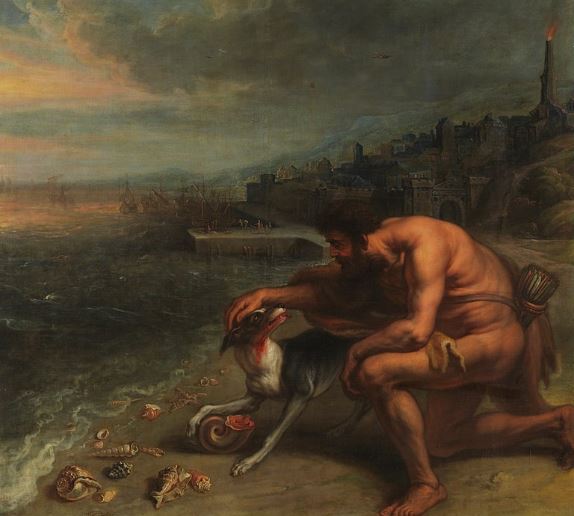
In Greek mythology, the hero Hercules discovered Tyrian purple when his dog chewed on sea snails, as depicted here in Peter Paul Rubens’ “Hercules’ Dog Discovers Purple Dye”

Argaman is more commonly known as “Tyrian purple” or “royal purple”, a famous and prized dye in ancient times. Historical records and archaeological findings show that as early as 3500 years ago, trade in Tyrian purple was widespread across the Mediterranean and the Middle East. It was the Phoenicians who were experts in its production, and carried it around the region. (In fact, the root of the term Phoenician means “purple” in Greek. Similarly, some scholars have found evidence that Canaan means “dye merchant”.) Tyrian purple was worth at least as much as silver, and in some points in history, more than gold.

By the Roman Era, it was so expensive and prized that it was essentially only worn by royalty, hence “royal purple”. An average Roman, or even a Roman senator, would wear a toga pura, plain white, while magistrates and priests wore a toga praetexta, with a purple stripe or hem. Only the emperor would wear a toga picta, one that was entirely dyed purple, with gold embroidery. (Such a toga might also be worn by high ranking generals during their victory processions, as well as by the consuls.)

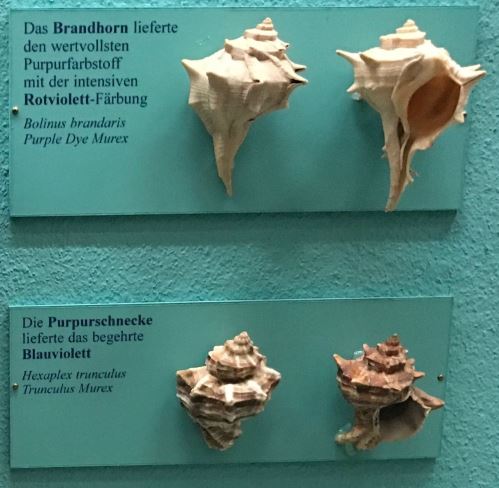
Shells of the Murex snails that produce purple and blue dye. (Credit: U.Name.Me)

How did the Phoenicians produce argaman? It was extracted from the glands of shellfish on the Phoenician shores of the Eastern Mediterranean. These Murex snails make the dye as a defense mechanism, spraying it on potential predators (just as squids and octopuses, their mollusc relatives, famously do). Research shows that the snails also use the dye for their own predatory behaviour when catching prey, and also as an antimicrobial to protect their eggs. To extract the dye, the snails are either “milked”, which takes a very long time, or more commonly, pierced through their shells to have the glands removed. It would take over 10,000 snails to produce just a few grams of dye!

Tekhelet was made the same way. Though not nearly as popular in ancient times, it was known as “royal blue”. The Phoenicians made it the same way, extracted from a snail. Some say it was derived from a different species of snail, while others point out that the same Tyrian purple, when exposed to large amounts of UV radiation (sunlight), becomes blue.

The Talmud (Menachot 44a) states that the dye was made from chilazon, a snail “whose body resembles the sea, and its form resembles a fish, and it comes up once in seventy years, and with its blood one dyes tekhelet, and therefore its blood is expensive.” It’s not quite the blood of the snail that makes the dye, of course, nor do the snails emerge only once in seventy years. This bit probably entered the Talmud because by that point in history, tekhelet production among Jews had long ended, and knowledge of its exact extraction forgotten. It was probably difficult, if not entirely impossible, for Jews to get their hands on it.

Tzitzit with tekhelet (Credit: Tekhelet.com)

Dr. Baruch Sterman, in a paper for B’Or HaTorah (vol. 11, pg. 185), points out that by the 4th century CE it was actually a crime for a commoner to wear tekhelet across the Roman world. It is highly likely that it was then, for this reason, that most Jews stopped using tekhelet in their tzitzit. Dr. Sterman brings proof from the Talmud (Sanhedrin 12a), where we read how two rabbis were arrested by the Romans for possessing tekhelet. Wealthy Jews living in the Persian Empire continued to pay exorbitant rates to import and use it, until sometime in the middle of the 7th century. It was then, likely due to the rise of Islam and the rapid Arab conquest of the region, that use of tekhelet among all Jews essentially ceased. This is why until today the majority of Jews do not use tekhelet in their tzitzit (as the Torah commands). However, in recent decades, the Murex snails have been rediscovered, and tekhelet is once again available.

Having said all that, Karaite Jews—a small group that rejects the Talmud—believe that tekhelet (and argaman) could not have been derived from snails. And they actually have a couple of seemingly valid points.

The Problem of Karaite Tekhelet

The Karaites believe that tekhelet cannot come from a snail because the Torah would not command something so important to come from a non-kosher animal. They also argue that royal blue tekhelet from snails would have been far too expensive for the average Israelite. Finally, they point out that God commanded this to the Israelites in the Wilderness—so where would they find sea snails in the middle of the desert? Instead, Karaite scholars proposed that tekhelet came from an indigo plant, such as the Indian Indigofera tinctoria (incidentally, this is the indigo once used to dye jeans blue).

Another, more likely, possibility is the woad plant, Isatis tinctoria, which contains the same indigo dye. This plant actually grows in Israel, and was once known as “Asp of Jerusalem”. Interestingly, the Mishnah (Megillah 4:7) states how Kohanim are forbidden from blessing the congregation if their hands are stained with “istis”, ie. the Isatis tinctoria dye. The Bartenura (Rabbi Ovadiah of Bartenura, c. 1445-1515) confirms that istis is a dye “whose colour resembles tekhelet”. This makes it clear that Kohanim in the ancient Holy Temple did use woad as a blue dye, though for what purpose is unclear.

Karaite Jews today continue to make tekhelet from indigo or woad to dye their tzitzit. Since Karaites hold strictly to the Written Torah, they maintain that tzitzit must be blue (and cannot be entirely white like most current “Rabbinic” tzitzit). They hold that any blue dye is fine, since the Torah does not explicitly say that other blue dyes are forbidden. The Talmud, meanwhile, states that a person who uses plant-derived blue dyes instead of authentic tekhelet is sinning, and God declares that He will “exact retribution” from such a person (Bava Metzia 61b, see also Tosefta on Menachot 9:6). And here the Karaites should take heed, for when it comes to tekhelet they are absolutely mistaken.

The big problem for the Karaites is basically everyone else. Aristotle (384-322 BCE) wrote in his History of Animals about the production of blue and purple dyes from snails, as did the Roman philosopher and historian Pliny the Elder (23-79 CE) in his Natural History. These were the choicest and best dyes for clothes and fabrics. While tekhelet and argaman were expensive for the distant Greeks and Romans to procure, they would not have been expensive for the ancient Israelites. After all, these dyes were only expensive to purchase; there is no indication that they were expensive to produce. And the Israelites, like the Phoenicians and Canaanites, were the producers. They made the dyes cheaply, and exported them far and wide, for a healthy profit.

It was only in later centuries, when Israel was no longer an independent entity and was subject to a series of foreign empires, that Jews lost control of the means of tekhelet production. Tekhelet became rarer, and more expensive, and eventually forbidden. This development only occurred in the late Second Temple era, and possibly later. Still, when chemists in the 1990s analyzed blue fabrics uncovered at the Masada archaeological site, they discovered that the fabrics were indeed dyed with Murex snail tekhelet. Even in the late Second Temple era, tekhelet was available and used widely. Besides, the average Israelite in those days would have needed only a minute amount to dye a handful of strings to fulfil the mitzvah of tzitzit.

Another bit of evidence for the fact that snail dye was the real tekhelet comes from the Tanakh itself. While we’ve already seen how historical and archaeological records make it clear that the ancient Phoenicians were experts in snail dyes (not any plant-based blue dyes), we mustn’t forget that these same Phoenicians were heavily involved in the production of Israelite holy items, too! We read in the haftarah for last week’s parasha (I Kings 5:26-6:13) how King Solomon made an agreement with the Phoenician King Hiram, and the latter’s workers played an instrumental role in the construction of the Holy Temple. Granted, this was not the Mishkan of the Wilderness, but the later Temple was based on the earlier Mishkan, and the items were fashioned to the same specifications.

Where was Hiram’s capital city? The Tanakh always refers to him as melekh tzor, “King of Tyre”. This is the selfsame Tyre as the Tyre of Tyrian purple and Tyrian royal blue. We read how “Hiram, king of Tyre, sent his servants to Solomon…” (I Kings 5:15) It is hard to believe that it’s only a coincidence that the Tyrians renowned around the ancient world for their snail dyes are the same ones that the Tanakh tells us worked in Jerusalem! The evidence is therefore quite strong that tekhelet and argaman are the same as the snail-derived Tyrian dyes.

Tekhelet in the Wilderness

The nail on the coffin comes from an even more ancient historical text. Long before Pliny, Aristotle, and even Hiram, the ancient Egyptian Papyrus Anastasi I—dated back to the Nineteenth Dynasty (c. 1292-1189 BCE)—mentions how a royal blue dye is made from sea creatures and smells like putrid fish. This is particularly important because the Nineteenth Dynasty was the time of Pharaoh Ramses II, who is the one most associated with the Exodus. Ramses II built a new capital city which, of course, he named after himself, and which archaeologists have uncovered and refer to as Pi-Ramesses. This is the same city that the Torah mentions the Israelite slaves built (Exodus 1:11). Putting the pieces together, we now have an answer to the question posed by the Karaites: how did the Israelites find tekhelet and argaman in the Wilderness?

The Torah tells us that when the Israelites left Egypt, God commanded them to ask the Egyptians to give them precious materials: “And the children of Israel did according to the word of Moses, and they asked of the Egyptians jewels of silver, and jewels of gold, and raiment.” (Exodus 12:35) The Israelites got tekhelet and argaman from the same place they got their gold and silver (also used in constructing the Mishkan): from the Egyptians. The Papyrus of Anastasi proves that the ancient Egyptians, too, produced blue and purple dyes from Mediterranean snails. They made “raiment”, garments and fabrics dyed with these colours. The Torah informs us that the Israelites took these fabrics with them. And this is how they had them available for the Mishkan in the Wilderness!

Despite all that’s been said, the Orthodox world today has been very slow in readapting the use of tekhelet. Some rabbis maintain that these Murex snails are not the right ones. The Radziner Rebbe (Rabbi Gershon Henoch Leiner, 1839–1891) didn’t know about the snails at all and instead consulted chemists to produce a blue dye from the common cuttlefish, Sepia officinalis. The problem is that the cuttlefish only produces black ink, and turning it blue was a long chemical process that required adding iron filings. When later analyzed by experts, it was found that the Radziner Rebbe’s dye was basically synthetic, and the blue was simply a result of the added iron. (For more, see Dr. Sterman’s article in B’Or haTorah, cited above.) Meanwhile, Rabbi Isaac Herzog (1888-1959, Israel’s first Ashkenazi Chief Rabbi) was an early proponent of snail-derived dyes.

In recent decades, more and more researchers have explored the subject, and today everything points to tekhelet being the blue dye of the Murex trunculus snail. The scientists at Masada confirmed it chemically, and although some state that there is no chemical difference between woad, indigo, and Murex blue, there are small differences in their molecular structure. One with a chemistry background will agree that the addition of even a single atom can dramatically change the nature of a substance. Still, many rabbis are reluctant to adopt tekhelet, and have decided it is best to wait until Mashiach comes just to be sure.

Comparing the chemistry of blue dyes: though looking similar to the untrained eye, the chemical structure of plant-based Indigotin (top left) is different from synthetic indigo (bottom left) and the indigo of Murex snails (bottom right).

And as for the Karaite argument that the Torah wouldn’t command something derived from a non-kosher animal, this argument falls apart when considering the third ingredient that always goes along with tekhelet and argaman: tola’at shani. The word is literally translated as a “crimson worm” or, more accurately, “red insect”. Tola’at definitely refers to a bug of some sort, as we read in Exodus 16:20 how leftover manna was infested with tola’im.

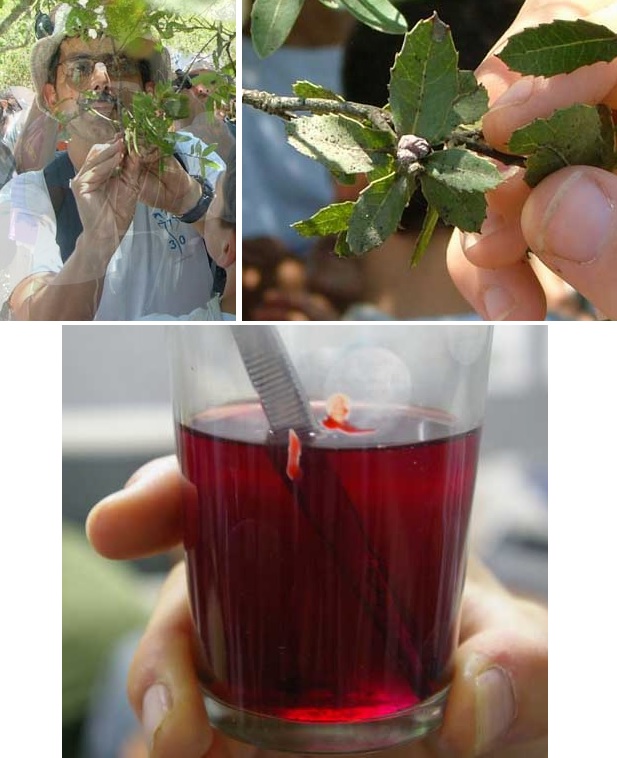
Tola’at shani is undoubtedly referring to the common carmine dye used around the world, and known commercially in food as E120. This dye is derived from a variety of scale insects, most commonly the cochineal family of bugs. Professor Zohar Amar of Bar Ilan University spent many years researching tola’at shani and concluded that it is unquestionably a red insect, which nests in the common Israeli oak tree. In fact, the Temple Institute has already begun harvesting these insects to produce an authentic avnet, the priestly belt that requires the red dye, in preparation for Mashiach’s coming and the return of priestly service in the forthcoming Third Temple.

Clockwise from top left: Professor Amar leads the Temple Institute’s Tola’at Shani harvest; the “crimson worm” on a branch of an Israeli oak tree; Professor Amar holds a cup of crimson water produced by crushing a single worm.


The above essay is adapted from Garments of Light, Volume Three.
Get the book here! 

Red Sea or Reed Sea: Where is Mount Sinai?

This week’s parasha, Beshalach, recounts the Splitting of the Sea. It is common knowledge that this was the Red Sea, called yam suf in Hebrew. Yet, in recent decades scholars have tried to “debunk” that notion, preferring to associate yam suf with a smaller lake of some sort. They often start by pointing out that yam suf literally means “sea of reeds”. It is the Reed Sea, not the Red Sea. There are indeed several shallow, marshy lakes with reeds in that vicinity of Egypt, around the modern Suez Canal. The fact that the Torah speaks of the “Reed Sea” being near places like Pi-Hahirot, whose location is believed to be known, is used as further proof of yam suf not being the Red Sea.

Of course, this serves to diminish the great miracle of the Splitting of the Sea. It almost implies that the Israelites waded through a shallow lake, as opposed to crossing a vast expanse. The reality is that such a hypothesis does not at all fit with the descriptions we receive in the Torah. A careful look reveals what yam suf actually is, and further helps to locate an even bigger prize: Mount Sinai.  

A Sea or a Lake?

From the Torah’s description of the Splitting of the Sea, we learn that the waters stood as large walls to the left and right of the Israelites, and that the Egyptians later drowned in its depths (see, for instance, Exodus 14:28-29, 15:4, 8). This implies a deep sea, not a shallow, marshy lake.

Yam suf is mentioned well over twenty times in the Tanakh. When going through these verses and their context, one will find that it is a major geographical entity, not a small lake. For example, Numbers 14:25 says that the Amalekites and Canaanites live near yam suf, while Numbers 21:4 says the Edomites are near it, too. If it was a small lake somewhere in the Sinai Peninsula, or by the Suez Canal, this wouldn’t make much sense.

The Biblical lands of Edom, stretching down to the Red Sea (Credit: Briangotts)

In fact, the land of Edom is known to be in the area of what is today the Negev desert, roughly southern Israel and Jordan, going down to what is today Eilat. This is confirmed by I Kings 9:26, where we read that “King Solomon made a navy of ships in Etzion-Geber, which is beside Elot, on the shore of yam suf, in the land of Edom.” King Solomon built a navy-yard in a port near Elot (אֵלוֹת), undoubtedly related to today’s Eilat. And, like today’s Eilat, is in on the shore of yam suf, the Red Sea, in the land of Edom. This verse solves the entire puzzle. Scholars wonder why the sea became known as the Red Sea, when the answer might be right there in the Torah: to the Israelites, this was the sea by the land of Edom, which literally means “red”. It was the Edomite Sea, the “Red Sea”. And it is the selfsame body of water as yam suf.  

On that note, some have proposed that is isn’t yam suf, but yam sof, literally the sea “at the end”, since it is at the southernmost tip of Israel. Yet another idea is that it is yam sufa, “Storm Sea”, referring to the great wind storm that God sent to part the waters (Exodus 14:21). Whatever the case, there is little doubt that the Israelites did indeed cross what we know today as the Red Sea.

The bigger question is: where exactly did they cross?

Some believe that the Red Sea got its name from the red blooms of sea sawdust, Trichodesmium erythraeum (a type of cyanobacteria), that occasionally happen there.

Sinai or Saudi Arabia?

NASA Satellite Image of the Sinai Peninsula

It is commonly thought that Mount Sinai is somewhere in what is today called the Sinai Peninsula. In fact, back in the 6th century, Christians built a monastery on a mountain in the Peninsula which they believed to be Sinai. It still operates today as Saint Catherine’s Monastery, and is among the oldest Christian monasteries in the world. The only problem is that it isn’t anywhere near the real Mt. Sinai.

First off, the Torah introduces us to Mount Sinai when Moses is living far from Egypt in Midian. Recall that Moses had fled Egypt, and eventually ended up living among the Bedouins of Midian… This already confirms that Mount Sinai was probably not in today’s Sinai Peninsula, which would have still been under Egyptian control in those days. In fact, we know from historical and archaeological evidence that in those days, the Egyptians ruled at least as far as Canaan itself. Moses fled outside of Egypt’s domain, across the Red Sea, to what is today Saudi Arabia. This is the land traditionally associated with the Midianites. And the Torah tells us that Mt. Sinai is there (Exodus 3:1-2):

And Moses was shepherding the flock of Jethro, his father-in-law, the priest of Midian; and he led the flock to the farthest end of the wilderness, and came to the mountain of God, unto Horev. And the angel of God appeared unto him in a flame of fire out of the midst of a bush; and he looked, and, behold, the bush burned with fire, and the bush was not consumed…

The Torah famously tells us that Moses saw a burning bush during his first encounter on the “mountain of God”. In Hebrew, it is called a s’neh, which gives rise to the name Mount Sinai. This mountain is in the wilderness around Midian, in a land call Horev. Later on, the Israelites cross the Red Sea and journey towards this same mountain, where they receive the Ten Commandments. This implies that the Israelites crossed somewhere in the Gulf of Aqaba, ending up in what is today Saudi Arabia. This makes all the more sense since they can journey from there to the wilderness “on the other side of the Jordan”, where they spent forty years before crossing the Jordan River—from the East—into Israel.

Amazingly, there is a mountain in Saudi Arabia which is completely sealed off by the authorities, and off limits to any historians or archaeologists…


The above is an excerpt from Garments of Light, Volume Two. To continue reading, get the book here