Category Archives: Mashiach & End of Days

A Mystical Map of Your Soul

This week, outside of Israel, we read the parasha of Acharei Mot. (In Israel, since Pesach is seven days and finished last Friday, Acharei Mot was read on Shabbat and this week the following parasha, Kedoshim, is read. For the next few months, the weekly parasha read in the Diaspora will be different than that read in Israel.) In Acharei Mot, we are commanded:

And any man of the House of Israel or of the foreigner that lives among them, who eats any blood, I will set My countenance upon the soul who eats the blood, and I will cut him off from among his people. For the soul of the flesh is in the blood, and I have therefore given it to you [to be placed] upon the altar, to atone for your souls. For it is the blood that atones for the soul. (Leviticus 17:10-11)
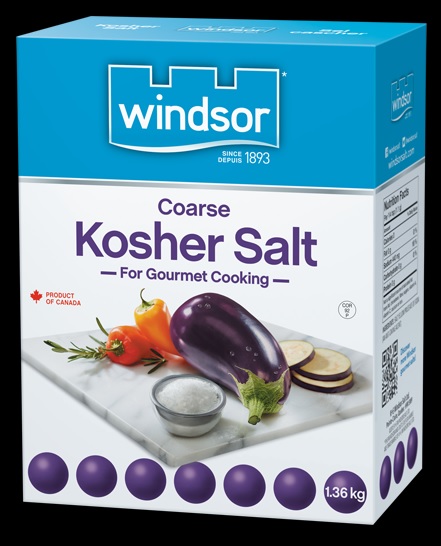
Many recipes call for the use of “kosher salt”. Chefs like it because the larger grains allow them to season their meals more precisely. Jews use koshering salt to remove the tiniest drops of blood that may have remained after draining.

The Jewish people are absolutely forbidden from consuming any kind of blood, whether in a juicy steak or even the tiniest drop inside an egg. It is quite ironic that one of the most disgusting anti-Semitic accusations thrown upon the Jews is that Jews, God forbid, consume the blood of children. (It is all the more ironic that this “blood libel” originates among Catholics who, when taking communion, believe they are drinking the blood of Jesus—who was a Jew!) In reality, Jews obsess over ensuring that we consume no blood whatsoever, and one of the requirements of kosher meat is that all of the blood has been completely removed.

The Torah explains that we should not consume blood because nefesh habasar b’dam hi, the “soul of the flesh is in the blood”. If we eat meat, it is in order to obtain the nutrients in the flesh, not to absorb the spirit of the animal. The animal’s soul is, as the Torah commands, to be placed “upon the altar”. The Kabbalists explain that by doing so, the soul of the animal is allowed to return to the spiritual worlds from which it originates.

In precisely balanced language, the verses cited above state that a Jew who consumes any blood within which is soul, nefesh, will be “cut off” from his nation, and God will personally set His wrath upon that Jewish soul, nefesh. The same word is used to refer to the soul of the Jew and that of the animal. People sometimes forget that animals, too, have souls, and it is forbidden to harm animals in any way.

Having said that, there is of course a great difference between the soul of an animal and the soul of a human. In fact, we find in the Tanakh that five different words are used to refer to the soul. Our Sages explain that a person actually has five souls, or more accurately, five parts or levels to their soul. (The Ba’al HaTurim, Rabbi Yakov ben Asher [1269-1343], states that the five prayer services of Yom Kippur, and the five times that the Kohen Gadol would immerse in the mikveh that day, is in order to purify all five souls; see his commentary on this week’s parasha, Leviticus 16:14.) These five souls are in ascending order, and correspond to the spiritual universes of Creation and to the divine Sefirot. Each soul is itself made up of even smaller, intertwining parts. Understanding the soul and its dynamics is a central part of Jewish mysticism, and what follows is a brief overview of that spiritual map.

The First Three Souls
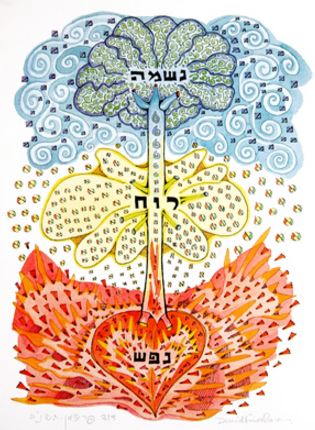
The first and lowest of the souls is the nefesh. As we have already seen, this soul is associated with the blood, and is the “life force” of a living organism. Above that is the soul called ruach, literally “wind” or “spirit”. We find this term right at the beginning of the Torah (Genesis 1:2) in referring to the Spirit of God (Ruach Elohim) and in many other places to refer to the souls of great people, such as Joshua (Numbers 27:18). Above that is the neshamah, literally “breath”, which we are first introduced to during the creation of Adam, where God breathes a nishmat chayim, “soul of life” into the first civilized man (Genesis 2:7).

These first three souls—nefesh, ruach, and neshamah; often abbreviated as naran—are spoken of widely across Jewish holy texts, from the Tanakh through the Talmud and the Zohar. For example, the Talmud (Niddah 31a) states how there are three partners in the creation of a person: the father is the primary source of five “white” things (bones, nerves, nails, brain, eyeball), the mother is the primary source of five “red” things (blood, skin, flesh, hair, iris), and God gives ten things, including the ruach and neshamah. (The nefesh presumably goes together with the blood from the mother.)

The Zohar (I, 205b-206a) elaborates that the neshamah is greater than the ruach, which is greater than the nefesh, and that a person only accesses higher levels of their soul if they are worthy. Sinners do not have access to their neshamas at all. They are just living nefesh, like animals. Based on this, the Zohar has a unique perspective on Genesis 7:22-23:

All in whose nostrils was the breath of the spirit of life [nishmat ruach], whatsoever was in the dry land, died. And He blotted out every living substance which was upon the face of the ground, both man, and cattle, and creeping thing, and fowl of the sky; and they were blotted out from the earth; and Noah alone was left, and they that were with him in the ark.

The Zohar sees these two verses as distinct. First, all those people who did merit a ruach and neshamah (meaning they weren’t completely sinful and didn’t deserve to perish in the Flood) died of natural causes. Only after this did God “blot out” all that remained, including animals and people who were so sinful they were essentially like animals, bearing only a nefesh.

With these three souls in mind, many aspects of life can be better understood. For example, when one is asleep only the nefesh remains in the body (to keep it alive), while the higher souls may migrate. This is why a sleeping body is unconscious and likened to a corpse, and why sometimes dreams can be prophetic, as the higher souls may be accessing information from the Heavens, or through interaction with other souls.

Another intriguing example is from Ibn Ezra (Rabbi Abraham ben Meir ibn Ezra, 1089-1167) who relates the three souls to three major purposes of sexual intercourse. The first and simplest is for procreation, something that even animals do, and naturally corresponds to nefesh. The second is for good health, corresponding to ruach. The third is for love and intimacy, fusing the souls of husband and wife, corresponding to the neshamah.

In addition to naran, the Zohar sometimes speaks of additional, even higher souls, such as “nefesh of Atzilut” and “neshamah of Aba and Ima” (see II, 94b). To make sense of these, we must turn to the Arizal.

Earning Your Higher Souls

In multiple places, Rabbi Chaim Vital (1543-1620), the primary disciple of the Arizal (Rabbi Isaac Luria, 1534-1572) and the one who recorded the bulk of his teachings, describes the anatomy of the soul (see, for example, the first passages of Sha’ar HaGilgulim or Derush Igulim v’Yosher 3 in Etz Chaim). At birth, a baby only contains a full nefesh. As the Torah states, the nefesh is in the blood, and the Arizal adds that since the liver filters blood and is full of it, it is the organ most associated with nefesh. By the age of bar or bat mizvah, a person now has the ability to fully access their ruach. The organ of ruach is the heart (also stated in the Zohar, III, 29b, Raya Mehemna), associated with one’s drives, and both inclinations, the yetzer hatov and the yetzer hara. Only at age 20 does the neshamah become fully available (in most cases). The neshamah is housed in the brain, and is associated with the mind.

Today, we know how scientifically precise those statements are. For example, at any given time the liver (the body’s largest internal organ) contains about 10% of the body’s blood volume, and filters about a quarter of all blood each minute. As well, we know today that the majority of the brain’s development ends around age 20 (though minor changes continue for at least another decade, if not longer). It therefore isn’t surprising that teenagers are so good at making bad decisions. We can also understand why being a teenager is so difficult emotionally, as this is when the ruach is in full force in the heart, and one struggles with their desires and inclinations.

Reinforcing what was said in the Zohar, the Arizal taught that one does not automatically have full access to these souls, but must work on themselves and merit to attain them. Unfortunately, a great many people spend their entire lives stuck in nefesh, living very materialistic and animalistic lives, never overcoming their desires and inclinations (ruach), or achieving any kind of mental greatness (neshamah). The potential is there, though never realized.

For those who do grow ever-higher, they may be able to access even loftier soul levels: the chayah and yechidah. In the Torah, we see many places where the soul is referred to as chayah, including right at the start where God breathes a soul into Adam and makes him l’nefesh chayah (Genesis 2:7). The chayah is sometimes described as an aura. It is not housed within the body, but glows outward, and plays an important role in the interactions between people. (Conversely, some early sources speak of the chayah as being within the body, and serving as its life force. See, for example, Beresheet Rabbah 14:9.)

Above it is the highest level of soul, the yechidah, “singular one”, which connects a person directly with God. It is like a divine umbilical cord, and one who realizes it and senses it may certainly draw through it information from Above. The yechidah, too, has Scriptural basis, for example in Psalms 22:21 and 35:17 where David asks God to save his nefesh and yechidah from danger.

Souls Intertwined With Universes

In Etz Chaim, Rabbi Vital cites the Talmud (Berakhot 10a) as the source for the concept of five souls, as well as the five olamot, spiritual universes. (The mystical Sefer HaBahir adds that this is the secret of the letter hei, which has a numerical value of five.) There in the Talmud, the Sages point out how David’s Barchi Nafshi, Psalms 103-104, uses the phrase Barchi nafshi et Hashem, “May my soul bless God” five times. These, the Sages state, correspond to the five olamot, “worlds” or “universes” that David inhabited. Though the Talmud goes on to present a more physical explanation of what these worlds are, it is possible to read deeper between the lines, and the Kabbalists find allusions to five cosmic, spiritual universes, which are: Asiyah, Yetzirah, Beriah, Atzilut, and Adam Kadmon. While explaining these worlds in depth is a topic for another time, we can state that the five souls correspond to these five universes.

In fact, the Arizal teaches that one can identify the soul elevation of another by studying the colour of their aura: black is the colour of Asiyah, the lowest, physical realm which we visibly inhabit. The higher world of Yetzirah, the domain of angels and spirits, is red. Even higher is Beriah, literally “Creation”, where the very spiritual foundations of Creation exist. It is white. Above this is Atzilut, “divine emanation”, which is pure, brilliant light. These worlds, and souls, correspond to the letters of God’s Name. The final hei is Asiyah/Nefesh, the vav is Yetzirah/Ruach, the first hei is Beriah/Neshamah, the yud is Atzilut/Chayah, and the “crown” atop the yud is Adam Kadmon/Yechidah.
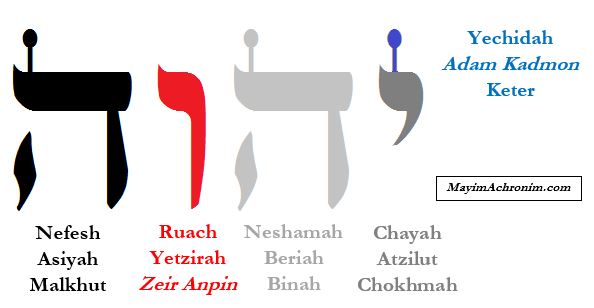
How the letters of God’s Ineffable Name relate to the five levels of soul, the five “universes”, and the Ten Sefirot. (Zeir Anpin refers to the middle six Sefirot from Chessed to Yesod.)

All of these also correspond to the major branches of Torah study. Learning Tanakh is in Asiyah, while Mishnah is in Yetzirah. Talmud is in Beriah, while Kabbalah is in Atzilut. When one learns these texts, they are putting on a spiritual “garment” for that soul level, rectifying it and elevating it further, and this garment will remain with them in the World to Come (see Sha’ar HaPesukim on Tehilim). This is the deeper meaning of Psalm 19:8, which states that God’s Torah is temimah, meshivat nafesh, is “pure and restores the soul”.

Adam Kadmon is left out of the above (and in general is made distinct from the other four universes) because that level is where one has mastered all of the Torah branches, has refined their soul to the highest degree, and is a perfectly righteous person. This level may be equated to the super-lofty soul of Nefesh d’Atzilut which we previously mentioned from the Zohar. Such a rare person is referred to as a malakh, an “angel”, and this was the case with people like Eliyahu, Yehudah, Hezekiah, and Enoch (Sha’ar HaGilgulim, ch. 39).
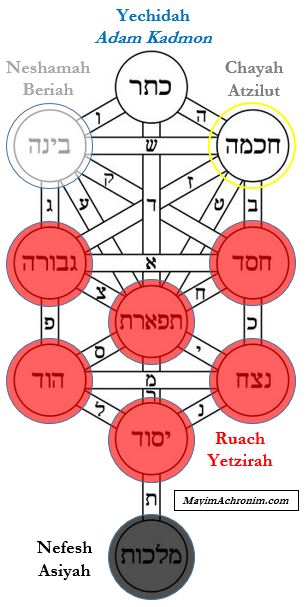
How the souls and universes relate to the “Tree of Life” which depicts the 32 Paths of Creation – the 10 Sefirot and the 22 Hebrew letters.

Emptying The Universe’s Soul

In case it wasn’t complicated enough just yet, the Arizal taught that each of the five souls is itself composed of five souls. So, within the nefesh, ruach, neshamah, chayah, and yechidah (abbreviated as naran chai) there is an inner nefesh, ruach, neshamah, chayah, and yechidah! That makes 25 smaller parts to the soul. Furthermore, each of these parts is composed of 613 sparks corresponding to the 613 mitzvot. Each of those sparks is further composed of 600,000 even smaller sparks. Multiplying them all together, we get 9.195 billion sparks.

In the same place where he writes this (Sha’ar HaGilgulim, ch. 11), Rabbi Vital explains that all of these sparks were contained within Adam. We may assume that it probably isn’t the case that each person has 9 billion or more sparks, but that Adam’s original soul divided up into so many sparks. Since it is said that in the same way all people are physical descendants of Adam, they are also his spiritual descendants, we might conclude that the world should expect to have a population of up to 9.195 billion people. Interestingly, demographers are currently predicting that Earth’s population will actually top out around 9 billion, and will then start to decline. This prediction is quite amazing in light of one famous Talmudic teaching:

In Yevamot 62a, the Sages state that Mashiach will not come until all souls are born. They describe a Heavenly repository of souls called Guf, literally “body”. Only when Guf is empty can Mashiach arrive. The Guf may be mystically referring to that first “body” of Adam which contained all souls within it. Once all of those sparks are born, all souls from the beginning of time will be alive simultaneously so that everyone can witness the tremendous Final Redemption. It appears we are inching ever closer to that moment.


The above essay is adapted from Garments of Light, Volume Three.
Get the book here! 

For more about soul dynamics, see the following:
Can a Husband and Wife Speak Lashon HaRa To Each Other?

This week’s parasha, Metzora, is primarily concerned with the laws of various skin diseases. Jewish tradition holds that the main reason for a person to contract these skin afflictions is for the sin of evil speech. The term metzora, loosely translated as “leper”, is said to be a contraction of motzi ra or motzi shem ra, “one who brings out evil” or gives someone a “bad name”. The Sages described lashon hara, a general category referring to all kinds of negative speech (even if true), as the gravest of sins.

The Ba’al HaTurim (Rabbi Yakov ben Asher, 1269-1343) comments on the parasha (on Leviticus 13:59) that the word “Torah” is used in conjunction with words like tzaraat or metzora five times, alluding to the fact that one who speaks lashon hara is likened to one who has transgressed all five books of the Torah! The Talmud (Arakhin 15b) famously states that one who speaks lashon hara “kills” three people: the subject of the evil speech, the speaker, and the listener. The same page states that lashon hara is equal to the three cardinal sins: murder, idolatry, and adultery. Other opinions (all supported by Scriptural verses) include: one who speaks lashon hara is considered a heretic, deserves death by stoning, and God personally declares that He and the speaker of lashon hara cannot dwell in the same space.

Having said that, the Talmud’s definition of lashon hara is quite narrow. It doesn’t include general tale-bearing, but specifically refers to slandering another person. It also states that lashon hara is only applicable when two people are speaking in private, secretly. If one slanders before three or more people, then it is evident that he doesn’t care that the subject will know he said it. It is like saying it publicly, or to the person’s face directly, which does not constitute lashon hara. (It is still a horrible thing to do, of course.) This is why God says (Psalms 101:5) that “Whoever slanders his fellow in secret, him I will destroy.” It is specifically when done in secret that it is such a terrible, cowardly sin.

Since Talmudic times, the definition of lashon hara has broadened considerably. It has come to include rechilut, “gossiping”, saying negative things about another person that are true, saying them publicly, and even to suggest or imply something disparaging about another, without naming a person specifically. When it comes to gossiping, one can find an allusion to its severity from the Torah itself, which states “You shall not go as a talebearer among your people, neither shall you stand idly by the blood of your fellow” (Leviticus 19:16). In a single verse, the Torah juxtaposes gossiping with failing to prevent bloodshed. One can learn from this that one who listens to gossip (specifically where another person is spoken of unfavourably) without trying to stop it is like one standing idly while the “blood” of another is being shed.

One question frequently asked about this is whether lashon hara applies between a husband and wife. We saw that the Talmud states lashon hara is especially horrible when spoken in secret between two people. Does this include a married couple as well? On the one hand, we want to distance ourselves from negative speech as much as possible, at all times. On the other hand, we expect a married couple to be allowed to speak freely between one another as they wish. After all, they are two halves of one soul and considered a singular unit.

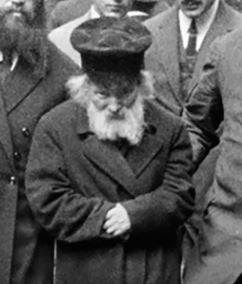
A still of the Chafetz Chaim from a rare, recently released video of the great rabbi. Click the image to see the video.

The Chafetz Chaim (Rabbi Israel Meir Kagan, 1839-1933), generally considered the greatest authority on lashon hara, forbids such speech even between husband and wife. However, many other great authorities before and after him (including Rav Shlomo Zalman Auerbach, 1910-1995, and the Chazon Ish, Rabbi Avraham Isaiah Karelitz, 1878-1953) ruled on the contrary, and permitted a husband and wife to speak about whatever is on their mind, particularly if something bothers them. Technically, even the Chafetz Chaim is lenient in a case where a spouse is in distress and needs to get something off their shoulders.

Still, all agree that we should limit negative words as much as possible, and certainly keep gossip to a minimum. Of course, when negative words have a constructive purpose, it is not considered lashon hara at all, whether between spouses or fellows. This is the case if a person undoubtedly knows, for example, that a particular contractor or salesman is dishonest, and tells a friend in order to protect them from harm.

Repairing Evil Speech, Repairing the World

In the days of the Temple, the kohanim would bring about atonement for the nation through sacrifices and various offerings and rituals. The most important time for atonement was Yom Kippur, and the greatest atonement ritual of the day was when the Kohen Gadol, the high priest, would enter the Holy of Holies (just once a year) and fill it with incense smoke. What was the ultimate purpose of this? The Talmud (Arakhin 16a) states that it served to atone for lashon hara! This was especially necessary because, elsewhere, the Talmud (Bava Batra 165a) states: “Many transgress the law of stealing, few transgress the prohibition of adultery, and all transgress lashon hara.” Everyone is guilty of negative speech, at least to some degree. How do we repair this sin, especially when we don’t have a Temple today?

The Talmud (Arakhin 15b) states that if one is a Torah scholar, they should learn more Torah, and if one is not a Torah scholar, they should strive to be more humble. Like all the other statements, support is brought from verses in Tanakh. King Solomon said “A healing tongue is a tree of life” (Proverbs 15:4). The Sages see the use of the word tongue (lashon) as alluding to lashon hara, and therefore if one wants to heal their lashon hara, they should cleave to the Tree of Life. What is the Tree of Life? King Solomon himself said in another place (Proverbs 3:18) that the Torah is a Tree of Life! Therefore, to rectify the sin of lashon hara one should study Torah.

Upon closer examination, we see that Torah study is actually the perfect remedy for lashon hara. When a person speaks lashon hara they are using their tongue in a negative way and infusing bad energy into the world. When a person learns Torah (which is traditionally done vocally), they are using their tongue in a positive way and infusing good energy into the world. The balance is thereby restored, measure for measure. On top of this, the purpose of Torah study is ultimately to make a person better. The Torah is the best tool to counter the yetzer hara, the evil inclination, as God Himself declared: “I have created the evil inclination, and I have created the Torah as its remedy” (Sifre Devarim, 45). Thus, a person who learns Torah simultaneously neutralizes the evil speech they have spoken and refines their inner qualities so that they will not participate in evil speech in the future.

On that note, there are two kinds of people when it comes to lashon hara: those that like to speak it, and those that love listening to it. The latter often quell their conscience by telling themselves that they never speak lashon hara, God forbid, but only passively, faultlessly, hear it. As we’ve seen above, the listener is almost as culpable as the speaker. Thankfully, there is a remedy for this, too. While many don’t necessarily learn Torah directly from a sefer or on their own, today we have unlimited potential to learn Torah by listening to lectures. These are shared widely on social media, and through digital devices, on apps, and over the radio. Every person today is a click away from Torah learning.

This takes us back to the Talmud, which stated that a Torah scholar can repair lashon hara by learning, while one who is not a Torah scholar should become more humble. The big question here is how can a person just “become more humble”? Humility is one of the most difficult traits to attain! We might even say that the Talmud should have required the Torah scholar—who is constantly learning, growing, and working on themselves—to “become more humble”, not the other way around! How can we make sense of the Talmud?

To prove the point about the non-Torah scholar, the Talmud uses that same verse from Proverbs: “A healing tongue is a tree of life, while perverseness through it will break the spirit.” The plain reading of the verse is that a person who uses their tongue for positive, healing purposes is likened to a Tree of Life, while one who uses their tongue for perverseness is destroying their soul. The Sages take the latter half of the verse to mean, on a simple level, that one who uses their tongue for perverseness should “break their spirit”, ie. become more humble, in order to rectify the sin. There is also a deeper way to read that same verse.

To solve the puzzle, one needs to re-examine what “it” (bah, in Hebrew) refers to. The simple meaning is that “it” refers to the tongue, and one who speaks perverseness through it (the tongue) will break their spirit. However, the verse can just as easily be read so that “it” refers to the Tree of Life. If so, the verse is read this way: “A healing tongue is a tree of life while perverseness, through it [the Tree of Life] will break the spirit.” What is it that will “break” one’s spirit and cause them to become humble? The Tree of Life itself!

Therefore, it is specifically the learning of Torah, the Tree of Life, that brings one to more humility. With this in mind, if we go back to the Talmudic statement of our Sages, what they are saying is: The Torah scholar should rectify their sin by learning more Torah, as they have yet to attain the proper level of holiness, while a non-Torah scholar should learn by listening to more Torah, for this will have the same effect of bringing a person to humility, and rectifying lashon hara.

At the end, this rectification is what will bring Mashiach. In Kabbalistic texts, the generation before Mashiach is in the sefirah of Yesod, which is concerned primarily with sexuality. It is not a coincidence that this is one of the major global issues today. The time following Mashiach’s coming is that of the final sefirah, Malkhut, “Kingdom”. One of the most famous passages from the Tikkunei Zohar is “Patach Eliyahu”, customarily recited before the prayers. There we are told that “Malkhut is the mouth, the Oral Torah.” While Yesod is the sexual organ, Malkhut is the mouth; it is Torah sh’be’al Peh, the Oral Torah, literally “Torah on the mouth”. The key path to realizing Mashiach, Malkhut, is by rectifying the mouth, which is done through the study of Torah.*

As we prepare for Pesach, we should remember the Midrash (Vayikra Rabbah, ch. 32) which states that the Israelites were redeemed from Egypt in the merit of four things: for not changing their names, not forgetting their language, not engaging in sexual sins, and not speaking lashon hara. The same is true if we wish to bring about the Final Redemption. Not engaging in sexual immorality is a direct reference to Yesod, while the other three all deal with the holy tongue, with proper speech and Malkut: using holy names, speaking the Holy Language, and making sure to speak only positive words.

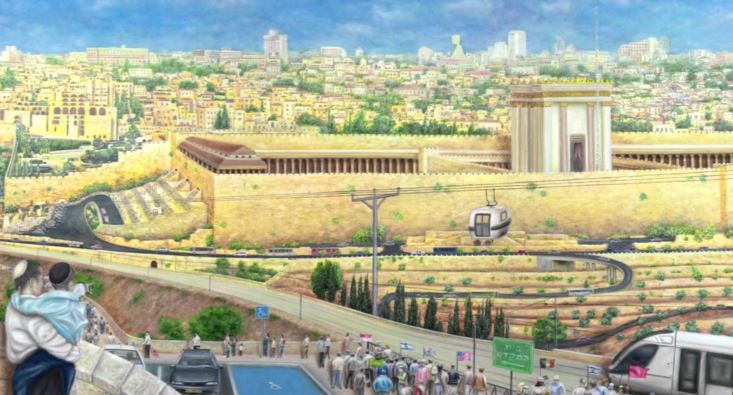
‘Going Up To The Third Temple’ by Ofer Yom Tov


*More specifically, the first rectification is that of the “lower mouth”, Yesod, a tikkun that will be fulfilled by Mashiach ben Yosef. This is followed by the tikkun of the upper mouth, Malkhut, fulfilled by Mashiach ben David (of whom the Prophet says he will slay evil with his mouth, Isaiah 11:4) bringing about God’s perfect Kingdom on Earth.

20 Things That Will Happen When Mashiach Comes

This week’s parasha, Vayikra, begins the third book of the Torah. The parasha is unique in that it is only one of two parashas (along with next week’s Tzav) where the word Mashiach appears. All four cases of the word in the Torah refer to the anointed High Priest, not to the messiah at the End of Days. Nonetheless, on a deeper level it certainly is alluding to the messiah of the End of Days. All the verses in question deal with the anointed High Priest (“HaKohen HaMashiach”) atoning for sins—both his own and the people’s—and purifying his nation. Indeed, one of the roles of Mashiach will be to prepare Israel for that final purification at the End of Days. This includes identifying one last Red Cow to produce those special waters which alone are capable of removing the impurity of death.

The early Christians saw these verses as allusions to their purported saviour, Jesus. In one place, for example, they wrote:

the Law [ie. the Torah] made those high priests who had infirmity, and who needed daily to offer up sacrifices, first for their own sins, and then for the people’s; but our high priest, Christ Jesus, was holy, harmless, undefiled, and separate from sinners, and made higher than the heavens. (Hebrews 7:27-28)

For the Christians, Jesus was the ultimate anointed high priest. Yet, Jesus accomplished essentially nothing of what Mashiach is supposed to. This was perhaps best explained in the 16th century by Isaac ben Abraham of Troki (1533-1594). He was a Karaite Jew, and a renowned Karaite scholar. His magnum opus was a book called Hizzuk Emunah, “Strengthening of Faith”, written to debunk Christianity, silence missionaries, and convince Jews to remain Jewish. The book was so popular that it spread like wildfire, not just among Karaites but all Jews, and even Christians. In fact, it played an important role in the start of the Enlightenment, leading countless Christians to abandon their faith. One of these was the French philosopher Voltaire (1694-1778), who called the Latin translation of Hizzuk Emunah (first published in 1681) a “masterpiece”.

Because it was a Karaite text, traditional rabbis were wary of consulting it. The great Rabbi Menashe ben Israel (Manoel Dias Soeiro, 1604-1657), who opened the first Hebrew printing press in Amsterdam in 1626, ultimately refused to print it. Still, Abba Hillel Silver, in his A History of Messianic Speculation in Israel (pg. 225), points out how Troki’s text borrowed from earlier Rabbinic texts, including Mashmia Yeshua, “Announcing Salvation”, of Rabbi Isaac Abarbanel (1437-1508).

Silver goes on to summarize the sixth chapter of Troki’s Hizzuk Emunah, which includes a list of twenty clear prophecies in Scripture that must be fulfilled upon the coming of Mashiach—none of which were fulfilled by Jesus (thereby necessitating for Christians some future “second coming” yet to materialize after nearly two millennia). Briefly going over these twenty events is enlightening both as a reminder for why Jesus could not be the messiah, and for what to expect when the true Mashiach does come.

Living Waters and Dead Waters

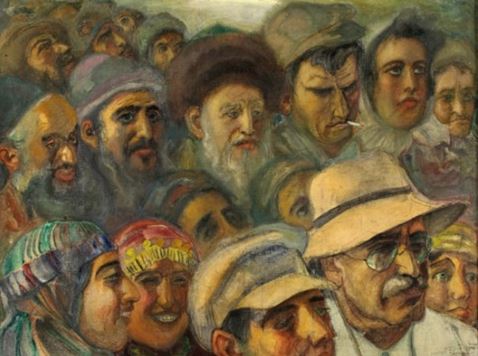
‘Israelis – The Ingathering of the Exiles’ by Saul Raskin (1878-1966)

The first prophecy is the return of the Lost Tribes of Israel. In ancient times, following the reign of King Solomon, the Twelve Tribes of Israel split into two kingdoms: the southern Judah and the northern Israel (or Ephraim). The more sinful northern kingdom was eventually overrun by the Assyrians, who exiled its tribes. These are sometimes referred to as the Ten Lost Tribes. It should be noted, though, that they weren’t necessarily ten tribes, nor were the tribes completely expunged. In reality, there were many Benjaminites, Simeonites, and Levites already living inside the Kingdom of Judah, and members of all the northern tribes fled to Judah when the northern kingdom was destroyed.

What happened was that all the tribes eventually assimilated into the larger, ruling tribe of Judah. Over time, the tribes lost knowledge of their lineage, and today everyone is simply a Yehudi, a Judahite, or Jew. (Levites, because of their unique role, retain knowledge of their ancestry). One of the prophesied events of the End of Days is that the identity of the Lost Tribes will once more be known. Though this idea is much more developed in later Rabbinic literature, it comes from numerous places in Scripture. Troki chooses to use Ezekiel 37:15-22:

And the word of God came to me, saying: “And you, son of man, take one stick, and write upon it: For Judah, and for the children of Israel his companions; then take another stick, and write upon it: For Joseph, the stick of Ephraim, and of all the house of Israel his companions; and join them one to another into one stick, that they may become one in your hand… And say to them: ‘Thus says the Lord God: Behold, I will take the children of Israel from among the nations, wherever they have gone, and will gather them on every side, and bring them into their own land…’”

Related to this is the second great prophecy, that of Gog u’Magog. This refers to the great world war at the End of Days, described in detail in Ezekiel 38, among other places. During the course of this war, Zechariah 14:4 states that the Mount of Olives in Jerusalem will be split in half. Then, new “living waters” will go out of Jerusalem to make Israel flourish (Zechariah 14:8).

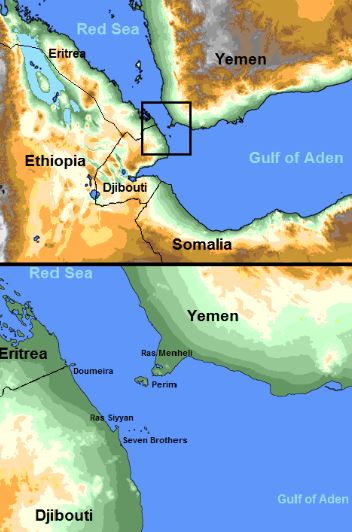
Bab-el-Mandeb Strait (Credit: Skilla1st)

Meanwhile, Isaiah 11:15 states that God “will utterly destroy the tongue of the Egyptian Sea; and with His scorching wind will He shake His hand over the River, and will smite it into seven streams, and cause men to march over dry-shod.” The identity of the “Egyptian Sea” and the “River” is unclear, though Silver has it as the Red Sea and the Euphrates. On the possibility of the Red Sea drying up, we know today from geological records that the Red Sea had once (and possibly more than once) become a dry chunk of land due to the narrow and shallow Bab-el-Mandeb closing up.

As for the “River”, in context it would make more sense if it referred to the Nile, the lifeline of Egypt. Today, we are indeed seeing the Nile drying up rapidly, and the Washington Post recently reported that the Nile Delta is losing as much as 20 metres per year in some areas. With this in mind, when Isaiah prophesies that the “tongue of the Egyptian Sea” will be destroyed, it may be referring to the Nile Delta, which opens up into the Egyptian Mediterranean, ie. the “Egyptian Sea”. The Post article is quite an accurate realization of Isaiah’s prophecy, with images of men that “march over dry-shod”.

(Having said that, the Euphrates River isn’t doing much better than the Nile, so whether Isaiah meant the Nile or the Euphrates is irrelevant in light of the mass devastation that has plagued both rivers.)

A Renewed Jerusalem

The sixth prophecy in Troki’s list is also from Zechariah (8:23):

Thus said the Lord of Hosts: “In those days it shall come to pass, that ten men shall take hold, out of all the languages of the nations, shall take hold of the garment of him that is a Jew, saying: We will go with you, for we have heard that God is with you.”

The tremendous anti-Semitism that Jews have experienced throughout history, into the present day, will finally end. The nations will be at peace with the Jews, and wish to learn from them. This is related to another prophecy: that gentiles from all over the world will come to Jerusalem to worship the God of Israel on every Rosh Chodesh and every Shabbat (Isaiah 66:20-23):

“…upon horses, and in chariots, and in litters, and upon mules, and upon swift beasts, to My holy mountain Jerusalem,” said God, “as the children of Israel bring their offering in a clean vessel into the house of God. And of them also will I take for the priests and for the Levites,” said God. “For as the new heavens and the new earth, which I will make, shall remain before Me,” said God, “so shall your seed and your name remain. And it shall come to pass, that from one new moon to another, and from one Sabbath to another, all flesh shall come to worship before Me, said God.

The gentiles—“all flesh”—will come to Jerusalem, upon every kind of transport. One of these is a rekhev, “chariot” in ancient Hebrew, and “vehicle” in Modern Hebrew. Another two of the transports are unique words that aren’t found elsewhere in Scripture and are impossible to translate: a tzab, and a kirkar. It is possible that the former refers to some kind of slow transport (as the word is written the same as that for a “turtle”) while the latter conversely refers to a very fast form of transport. In our day and age we have no shortage of either.

Troki lists separately a related prophecy from Zechariah (14:16): “And it shall come to pass, that every one that is left of all the nations that came against Jerusalem shall go up from year to year to worship the King, the Lord of Hosts, and to keep the feast of tabernacles.” Once a year, during the holiday of Sukkot, those nations that warred against Israel at the End of Days will come to Jerusalem to worship. The fact that it must be during Sukkot is no coincidence, for it is during Sukkot that our Sages say the offerings in the Temple atone for all the gentiles. This is why the Torah requires seventy bulls to be offered over the course of the holiday, corresponding to the seventy root nations of the world.

A Renewed World

If all the nations are coming to worship the God of Israel in Jerusalem, there is certainly no need for any “idols… false prophets… and unclean spirits” which God will entirely “cut off” (Zechariah 13:2). Zechariah further adds: “And God [YHWH] shall be King over all the earth; in that day God shall be One, and His name one.” (14:9) There will be world peace (Isaiah 2:4, Micah 4:3), which will be ensured and enforced by Israel, to whom all the kings and nations will listen (Isaiah 60:10-12, Daniel 7:27). Even the animals will be at peace with each other, as Isaiah (11:6-8) famously writes:

And the wolf shall dwell with the lamb, and the leopard shall lie down with the kid; and the calf and the young lion and the fatling together; and a little child shall lead them. And the cow and the bear shall feed; their young ones shall lie down together; and the lion shall eat straw like the ox…

On that last prophecy there is an interesting debate. Will the animals miraculously stop fighting and consuming one another? Or, is the prophecy only metaphorical and the natural order will remain? The Rambam (Rabbi Moshe ben Maimon, 1135-1204) held by the latter. Silver translates here that peace will be “between wild and domestic animals”. When reading Isaiah’s verses, this makes perfect sense: a wolf with a lamb, a leopard with a goat; calf and lion, cow and bear. So perhaps what Isaiah meant is that farmers and ranchers will no longer have to worry about wild animals devouring their livestock—once a common, and particularly disturbing, problem. (Or maybe there will be no need to raise livestock at all, for we are now at the dawn of the synthetic meat revolution.)

Israel will finally be completely righteous and free of sin (Deuteronomy 30:6, Isaiah 60:21, Ezekiel 36:25), and lead the rest of the world in doing the same (Jeremiah 3:17). There will no longer be any kind of suffering or sorrow in Israel, for the prophet said “the voice of weeping shall be no more heard in her, nor the voice of crying” (Isaiah 65:19).

‘Going Up To The Third Temple’ by Ofer Yom Tov

Finally, the prophet Eliyahu will return (Micah 3:24), and the Temple will be rebuilt (Ezekiel 40-45). The Shekhinah will return to Israel (Ezekiel 37:26), as will the ability to prophecy (Jeremiah 31:32-33), and there will be great knowledge in the world (Isaiah 11:9). The Holy Land will be redistributed among the Twelve Tribes of Israel (Ezekiel 47:13). Lastly, at the very end, will come the long-awaited Resurrection of the Dead (Daniel 12:2).

To summarize:

  1. Return of the Lost Tribes
  2. Gog u’Magog
  3. Mount of Olives splitting
  4. Egyptian Sea and River destroyed
  5. Living waters emerge from Jerusalem
  6. Gentiles declaring to Jews “we will go with you”
  7. Israel’s former enemies coming to Jerusalem each year on Sukkot
  8. Gentile pilgrims coming to Jerusalem to worship on the new moons and Sabbaths
  9. Destruction of all idols, false prophets, and unclean spirits
  10. One religion around the world, and recognition of one God
  11. Israel’s recognized leadership on the international stage
  12. World peace
  13. Peace between wild and domesticated animals
  14. A sinless Israel and a sinless world
  15. No more suffering or sorrow in the Land of Israel and for the Jewish people
  16. Shekhinah and prophecy return
  17. Eliyahu reappears
  18. Rebuilding of the Temple in Jerusalem
  19. Redistribution of the Holy Land among the restored Twelve Tribes
  20. Resurrection of the Dead