Tag Archives: Sefirat HaOmer

The Rabbi Who Made Judaism as We Know It

An illustration of Rabbi Akiva from the Mantua Haggadah of 1568

This week we continue to celebrate Passover and count the days of the Omer. The 49-day counting period is meant to prepare us spiritually for Shavuot, for the great day of the Giving of the Torah. As our Sages teach, the Torah wasn’t just given once three millennia ago, but is continually re-gifted each year, with new insights opening up that were heretofore never possible to uncover. At the same time, the Omer is also associated with mourning, for in this time period the 24,000 students of Rabbi Akiva perished, as the Talmud (Yevamot 62b) records:

Rabbi Akiva had twelve thousand pairs of disciples, from Gabbatha to Antipatris, and all of them died at the same time because they did not treat each other with respect. The world remained desolate until Rabbi Akiva came to our Masters in the South and taught the Torah to them. These were Rabbi Meir, Rabbi Yehudah, Rabbi Yose, Rabbi Shimon, and Rabbi Elazar ben Shammua—and it was they who revived the Torah at that time. A Tanna taught: All of them died between Pesach and Shavuot.

Rabbi Akiva is a monumental figure in Judaism. People generally don’t appreciate how much we owe to Rabbi Akiva, and how much he transformed our faith. In many ways, he established Judaism as we know it, during those difficult days following the destruction of the Second Temple, until the Bar Kochva Revolt, in the aftermath of which he was killed.

Rabbi Akiva is by far the most important figure in the development of the Talmud. From various sources, we learn that it was he who first organized the Oral Torah of Judaism into the Six Orders that we have today. The Mishnah, which is really the first complete book of Jewish law and serves as the foundation for the Talmud, was possibly first composed by Rabbi Akiva. The Talmud (Sanhedrin 86a) states that the main corpus of the Mishnah (including any anonymous teaching) comes from Rabbi Meir, while the Tosefta comes from Rabbi Nehemiah, the Sifra from Rabbi Yehuda, and the Sifre from Rabbi Shimon—and all are based on the work of Rabbi Akiva. Indeed, each of these rabbis was a direct student of Rabbi Akiva. (Although Rabbi Nehemiah is not listed among the five students of Rabbi Akiva in the Talmudic passage above, he is on the list in Sanhedrin 14a.)

In short, Rabbi Akiva began the process of formally laying down the Oral Tradition, which resulted in the production of the Mishnah a generation later, and culminated in the completion of the Talmud after several centuries.

It wasn’t just the Oral Torah that Rabbi Akiva had a huge impact on. We learn in the Talmud (Megillah 7a) that Rabbi Akiva was involved in a debate regarding which of the books of the Tanakh is holy and should be included in the official canon. Although it was the Anshei Knesset HaGedolah (“Men of the Great Assembly”) who are credited with first compiling the holy texts that make up the Tanakh, the process of canonization wasn’t quite complete until the time of Rabbi Akiva. Therefore, Rabbi Akiva both “completed” the Tanakh and “launched” the Talmud. This may just make him the most important rabbi ever.

That distinction is further reinforced when we consider the time period that Rabbi Akiva lived in. On the one hand, he had to contend with the destruction wrought by the Romans, who sought to exterminate Judaism for good. They made Torah study and Torah teaching illegal, and executed anyone who trained new rabbis. In fact, Rabbi Akiva was never able to ordain his five new students after his original 24,000 were killed. He taught them, but lost his life before the ordination could take place. The Talmud (Sanhedrin 14a) records:

The Evil Government [ie. Rome] decreed that whoever performed an ordination should be put to death, and whoever received ordination should be put to death, and the city in which the ordination took place should be demolished, and the boundaries wherein it had been performed, uprooted.

What did Rabbi Yehudah ben Bava do? He went and sat between two great mountains, between two large cities; between the Sabbath boundaries of the cities of Usha and Shefaram, and there ordained five sages: Rabbi Meir, Rabbi Yehudah, Rabbi Shimon, Rabbi Yose, and Rabbi Elazar ben Shammua. Rabbi Avia also adds Rabbi Nehemiah to the list.

As soon as their enemies discovered them, Rabbi Yehudah ben Bava urged them: “My children, flee!” They said to him: “What will become of you, Rabbi?” He replied: “I will lie down before them like a stone which none can overturn.” It was said that the enemy did not stir from the spot until they had driven three hundred iron spears into his body, making it like a sieve…

An illustration of Rabbis Akiva, Elazar ben Azaria, Tarfon, Eliezer, and Yehoshua, as they sit in Bnei Brak on Passover discussing the Exodus all night long, as described in the Passover Haggadah. Some say what they were actually discussing all night is whether to support the Bar Kochva Rebellion against Rome. In the morning, their students came to ask for their decision. They answered: “shfoch hamatcha el hagoyim asher lo yeda’ucha…” as we say when we pour the fifth cup at the Seder.

In the wake of the catastrophic destruction of the Bar Kochva Revolt, and the unbearable decrees of the Romans, traditional Judaism and its holy wisdom nearly vanished. The “world was desolate”, as the Talmud describes, “until Rabbi Akiva came” and relayed that holy wisdom to the five students who would ensure the survival of the Torah. In fact, the vast majority of the Mishnah’s teachings are said in the name of either Rabbi Akiva or these five students. Rabbi Yehudah bar Ilai alone is mentioned over 600 times in the Mishnah—way more than anyone else—followed by Rabbi Meir, Rabbi Shimon, and Rabbi Yose. Without Rabbi Akiva’s genius and bravery, Judaism may have been extinguished.

Meanwhile, Judaism at the time also had to contend with the rise of Christianity. Rabbi Akiva had to show Jews the truth of the Torah, and protect them from the sway of Christian missionaries. It is generally agreed that Onkelos (or Aquila of Sinope) was also a student of Rabbi Akiva. Recall that Onkelos was a Roman who converted to Judaism, and went on to make an official translation of the Torah for the average Jew. That translation, Targum Onkelos, is still regularly read today. What is less known is that Onkelos produced both a Greek and Aramaic translation of the Torah to make the holy text more accessible to Jews (as Greek and Aramaic were the main vernacular languages of Jews at the time). Every Jew could see for himself what the Torah really says, and would have the tools necessary to respond to missionaries who often mistranslated verses and interpreted them to fit their false beliefs.

Interestingly, some scholars have pointed out that Rabbi Akiva may have instituted Mishnah and began its recording into written form as a way to help counter Christianity. Because Christians adopted the Torah and appropriated the Bible as their own, it was no longer something just for Jews. As such, it was no longer enough for Jews to focus solely on Tanakh, for Christians were studying it, too, and the study of Tanakh was no longer a defining feature of a Jew either. The Jewish people therefore needed another body of text to distinguish them from Christians, and the Mishnah (and later, Talmud) filled that important role. This may be a further way in which Rabbi Akiva preserved Judaism in the face of great adversity.

Finally, Rabbi Akiva also preserved and relayed the secrets of the Torah. He was the master Kabbalist, the only one who was able to enter Pardes and “exit in peace” (Chagigah 14b). One of his five students was Rabbi Shimon, yes that Rabbi Shimon: Shimon bar Yochai, the hero of the Zohar. Thus, the entire Jewish mystical tradition was housed in Rabbi Akiva. Without him, there would be no Zohar, no Ramak or Arizal, nor any Chassidut for that matter.

All in all, Rabbi Akiva is among the most formidable figures in Jewish history. In some ways, he rivals only Moses.

How Moses Returned in Rabbi Akiva

We see a number of remarkable parallels in the lives of Moses and Rabbi Akiva. According to tradition, Rabbi Akiva also lived to the age of 120, like Moses. We also know that Rabbi Akiva was an unlearned shepherd for the first third of his life. At age 40, he went to study Torah for twenty-four years straight and became a renowned sage. According to the Arizal, Rabbi Akiva carried a part of Moses’ soul, which is why their lives parallel so closely (Sha’ar HaGilgulim, ch. 36):

Moses spent the first forty years of his life in the palace of Pharaoh, ignorant of Torah, just as Rabbi Akiva spent his first forty without Torah. The next forty years Moses spent in Cush and Midian, until returning to Egypt as the Redeemer of Israel at age 80, and leading the people for the last forty years of his life. Rabbi Akiva, too, became the leading sage of Israel at age 80, and spent his last forty years as Israel’s shepherd. As we’ve seen above, it isn’t a stretch to say that Rabbi Akiva “redeemed” Israel in his own way.

More specific details of their lives are similar as well. Moses’ critical flaw was in striking the rock to draw out water from it. With Rabbi Akiva, the moment that made him realize he could begin learning Torah despite his advanced age was when he saw a rock with a hole in it formed by the constant drip of water. He reasoned that if soft water can make a permanent impression on hard stone, than certainly the Torah could make a mark on his heart (Avot d’Rabbi Natan 6:2). Perhaps this life-changing encounter of Rabbi Akiva with the rock and water was a tikkun of some sort for Moses’ error with the rock and water.

Similarly, we read in the Torah how 24,000 men of the tribe of Shimon were killed in a plague under Moses’ watch (Numbers 25:9). This was a punishment for their sin with the Midianite women. Moses stood paralyzed when this happened, unsure of how to deal with the situation. The plague (and the sin) ended when Pinchas took matters into his own hands, and was blessed with a “covenant of peace”. The death of the 24,000 in the time of Moses resembles the 24,000 students of Rabbi Akiva that perished, with Rabbi Akiva, like Moses, unable to prevent their deaths. In fact, Kabbalistic sources say that the 24,000 students of Rabbi Akiva were reincarnations of the 24,000 men of Shimon (see Sefer Gilgulei Neshamot, Letter Kaf).

There is at least one more intriguing parallel between Moses and Rabbi Akiva. We know that the adult generation in the time of Moses was condemned to die in the Wilderness because of the Sin of the Spies. Yet, we see that some people did survive and enter the Promised Land. The Torah tells us explicitly that Joshua and Caleb, the good spies, were spared the decree. In addition, Pinchas was blessed with a long life (for his actions with the plague of the 24,000) and survived to settle in Israel. (According to tradition, Pinchas became Eliyahu, who never died but was taken up to Heaven in a flaming chariot.) We also read in the Book of Joshua that Elazar, the son and successor of Aaron, continued to serve as High Priest into the settlement of Israel, and passed away around the same time as Joshua (Joshua 24:33). Finally, the Sages teach that the prophet Ahiyah HaShiloni was born in Egypt and “saw Amram” (the father of Moses) and lived until the times of Eliyahu, having been blessed with an incredibly long life (Bava Batra 121b). In his introduction to the Mishneh Torah, the Rambam (Rabbi Moses ben Maimon, 1135-1204) lists Ahiyah as a disciple of Moses, later a member of David’s court, and the one who passed on the tradition through to the time of Eliyahu.

Altogether, there are five people who were born in the Exodus generation but were spared the decree of dying in the Wilderness. (Note: the Sages do speak of some other ancient people who experienced the Exodus and settled in Israel, including Serach bat Asher and Yair ben Menashe, but these people were born long before the Exodus, in the time of Jacob and his sons.) These five people were also known to be students of Moses. The conclusion we may come to is that five of Moses’ students survived to bring the people and the Torah into Israel, just as five of Rabbi Akiva’s students survived to keep alive the Torah and Israel.

If we look a little closer, we’ll find some notable links between these groups of students. We know that Elazar ben Shammua, the student of Rabbi Akiva, was also a kohen, like Elazar the Priest. Caleb and Joshua are descendants of Yehudah and Yosef, reminiscent of Rabbi Yehudah and Rabbi Yose (whose name is short for “Yosef”), the students of Rabbi Akiva. Rabbi Meir, often identified with the miracle-worker Meir Baal HaNess, has much in common with Pinchas/Eliyahu, while Rabbi Shimon bar Yochai explicitly compared himself to Ahiyah haShiloni in the Midrash (Beresheet Rabbah 35:2). As such, there may be a deeper connection lurking between the five surviving students of Moses and the five surviving students of Rabbi Akiva.

Lastly, we shouldn’t forget the Talmudic passage that describes how Moses visited the future classroom of Rabbi Akiva, and was amazed at the breadth of wisdom of the future sage. Moses asked God why He didn’t just choose Akiva to give the Torah to Israel? It was such a great question that God didn’t reply to Moses!

The Greatest Torah Principles

Of all the vast oceans of wisdom that Rabbi Akiva taught and relayed, what were the most important teachings he wished everyone to take to heart? First and foremost, Rabbi Akiva taught that the “greatest Torah principle” (klal gadol baTorah) is to love your fellow as yourself (see Sifra on Kedoshim). Aside from this, he left several gems in Pirkei Avot (3:13-16), which is customary to read now between the holidays of Pesach and Shavuot:

Rabbi Akiva would say: excessive joking and light-headedness accustom a person to promiscuity. Tradition is a safety fence for Torah, tithing is a safety fence for wealth, vows a safety fence for abstinence; a safety fence for wisdom is silence.

He would also say: Beloved is man, for he was created in the image [of God]; it is a sign of even greater love that it has been made known to him that he was created in that image, as it  says, “For in the image of God, He made man” [Genesis 9:6]. Beloved are Israel, for they are called children of God; it is a sign of even greater love that it has been made known to them that they are called children of God, as it is stated: “You are children of the Lord, your God” [Deuteronomy 14:1]. Beloved are Israel, for they were given a precious item [the Torah]; it is a sign of even greater love that it has been made known to them that they were given a precious item, as it is stated: “I have given you a good portion—My Torah, do not forsake it” [Proverbs 4:2].

All is foreseen, yet freedom of choice is granted. The world is judged with goodness, and all is in accordance with the majority of one’s deeds.

He would also say: Everything is given as collateral, and a net is spread over all the living. The store is open, the storekeeper extends credit, the account-book lies open, the hand writes, and all who wish to borrow may come and borrow. The collection-officers make their rounds every day and exact payment from man, with his knowledge and without his knowledge. Their case is well-founded, the judgement is a judgement of truth, and ultimately, all is prepared for the feast.

These words carry tremendous meanings, both on a simple level and on a mystical one, and require a great deal of contemplation. If we can summarize them in two lines: We should be exceedingly careful with our words and actions, strive to treat everyone with utmost care and respect, and remember that a time will come when we will have to account for—and pay for—all of our deeds. We should be grateful every single moment of every single day for what we have and who we are, and should remember always that God is good and just, and that all things happen for a reason.


The above essay is adapted from Garments of Light, Volume Three.
Get the book here! 

Do Men Have More Mitzvot than Women?

This week’s parasha, Tazria, begins by describing the rituals that a mother must perform upon giving birth to a new child. If the child is male, the mother is considered “impure” for seven days following her delivery, and then spends an additional 33 days in purification. For a female child, the durations are doubled, with the mother “impure” for 14 days, and purifying for another 66 days. Why is the duration of purification for a female doubly longer than a male?

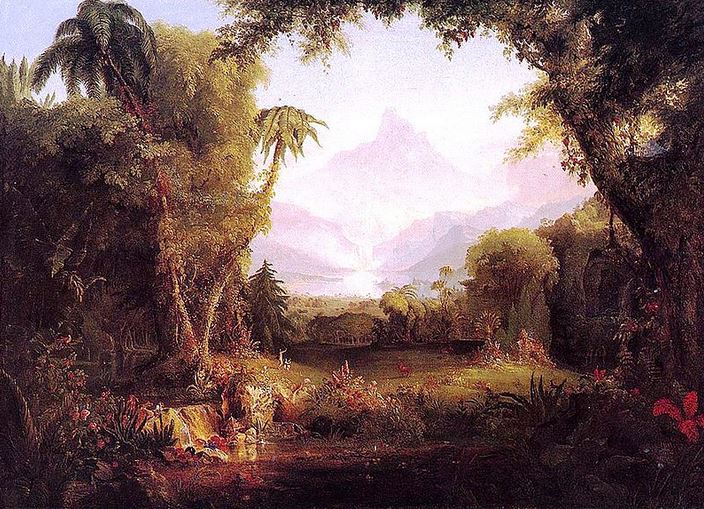
‘Garden of Eden’, by Thomas Cole

The apocryphal Book of Jubilees (3:8) suggests an interesting idea: Adam was made on the Sixth Day of Creation but, apparently, Eve wasn’t made until a whole week after. This is why a mother of a male child is impure for a week, but a mother of a female child for two weeks! Jubilees also holds that Adam was only brought into Eden forty days after being created, while Eve was brought in after eighty days. This is why a mother of a male child needs a total of forty days to purify, and a mother of a female child needs eighty days. Of course, Rabbinic tradition rejects the Book of Jubilees, and it is accepted that Adam and Eve were both created on the Sixth Day, and were in Eden from the beginning.

Commenting on this week’s parasha, the Zohar (III, 43b) states that it takes a soul 33 days to settle in the body. This is primarily referring to the new soul that enters a newborn baby, as it takes time for the ethereal soul to get used to its descent into a physical world. The Zohar doesn’t add too much more on this, but we might assume that, based on the words of the Torah, it takes a male soul 33 days to settle, and a female soul 66 days to settle. At the same time, the Zohar may be referring to the soul of the mother, too, as she is the one that spends 33 or 66 days in purification. As we’ve explained in the past, the severing of the mother’s direct connection to her child distresses her soul for 33 or 66 days following childbirth.

Whatever the case, the implication is that a female soul is somehow greater than a male soul. It has more spiritual power, taking longer to settle. The notion that female souls are greater is found throughout Jewish texts, especially mystical ones. Sefer HaBahir, one of the most ancient Kabbalistic texts, states that the female soul is the most beautiful of all, and an aspect of the Shekhinah, the Divine Presence (chs. 173-175). It explicitly makes clear that life on Earth would be impossible without the life-giving mother, who in this regard is much closer to God.

On that note, it has been said that God created the world sequentially from simple to complex, starting with the basic elements: light, air, water, earth; progressing to plants, then simple animals, then mammals, then man, and finally woman. The woman is the last of God’s creation, and therefore the most intricate and the most refined. It may be because of this that the Arizal taught that while male souls typically reincarnate to rectify themselves, female souls rarely if ever reincarnate at all (Sha’ar HaGilgulim, ch. 9).

It is important to mention here that we are speaking of female souls, not necessary to all women. The Arizal (as well as the Zohar cited above) speak of the possibility of female souls in male bodies, or male souls in female bodies. And it should also be mentioned that this does not necessarily affect the body’s sexuality. A “female” soul in a male body can still very much be a heterosexual male, and vice versa. (For more on this, see Rav Yitzchak Ginsburgh’s lecture here on the female soul of the forefather Isaac, as well as the prophets Samuel, Jonah, and Habakkuk.)

There are a number of consequences to the greater souls of females. For one, it gives them binah yeterah, an “extra understanding” sometimes referred to as “women’s intuition” (Niddah 45b). This is one reason why the women of the Exodus generation, for example, did not participate in the sin of the Golden Calf, nor the sin of the Spies. In fact, the Kli Yakar (Rabbi Shlomo Ephraim Luntschitz, 1550-1619, on Numbers 13:2) states that, had Moses sent female spies, there would have been no problem at all!

On the other hand, a more elevated soul and an extra depth of understanding means a greater sensitivity to the world, which makes women generally less prone to violence and drug abuse, but significantly more prone to depression and anxiety. The greater female soul has the amazing potential to bring life, yet simultaneously (to balance the equation) the potential for severe destruction, “more bitter than death”, to borrow from King Solomon in Kohelet 7:26. This is symbolically reflected in the menstrual cycle, where a lack of conception of life necessarily results in the shedding of blood, a “minor death” that is then rectified in the living waters of the mikveh.

Finally, a greater soul means that women require slightly less mitzvot than men. After all, the “mitzvot were given only in order that human beings might be purified by them… their purpose is to refine…” (Beresheet Rabbah 44:1) A more refined female soul does not need the same mitzvot that a male soul does. Unfortunately, this has sometimes been a point of contention in modern times. Yet, upon closer examination, we see that the differences in mitzvot between men and women are actually minimal and, contrary to the general belief, there is a perfect balance between those mitzvot done exclusively by men and those done exclusively by women.

“Time-Bound” Mitzvot?

The general rule is that, at least in principle, women are exempt from any mitzvah that can only be done at a particular time. This includes mitzvot like prayer, tefillin, and tzitzit. However, in practical terms we see that this “rule” isn’t really a thing, and there are many time-bound mitzvot that women are obligated in. For example,


The above is an excerpt from Garments of Light, Volume Two. To continue reading, get the book here

The Mysterious Custom of Upsherin

In this week’s double Torah portion (Acharei-Kedoshim) we read that “when you will have planted all manner of trees for food, its fruit shall be forbidden; three years shall it be forbidden to you, it shall not be eaten.” (Leviticus 19:23) This refers to the mitzvah of orlah, where a newly-planted tree must be left unharvested for its first three years. Seemingly based on this, a custom has developed to leave the hair of newborn boys uncut until age three. On or around the boy’s third birthday, a special celebration is held (called upsherin or halakeh), often with family and friends taking turns to cut a bit of the boy’s hair. Henceforth, the boy is encouraged to wear a kippah and tzitzit, and his formal Jewish education will begin. It is said that just as a tree needs the first three years to establish itself firmly in the ground before it can flourish and its fruit be used in divine service, so too does a child.

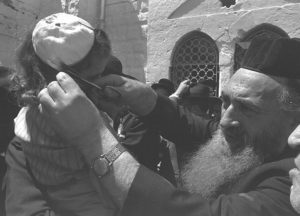
Lag B’Omer 1970 in Meron. Photo from Israel’s National Photo Collection

Indeed, the Torah makes a comparison between trees and humans in other places. Most famously, Deuteronomy 20:19 states that fruit trees should not be harmed during battle, “for is the tree of the field a man?” The tree is not an enemy combatant, so it should be left alone. Although the plain meaning of the verse is that the tree is not a man, an alternate way of reading it is that “man is a tree of the field”. Elsewhere, God compares the righteous man to a tree firmly rooted in the ground (Jeremiah 17:8), and in another place compares the entire Jewish nation to a tree (Isaiah 65:22).

Having said that, the custom of upsherin is essentially unknown in ancient Jewish sources. It is not mentioned anywhere in the Talmud, nor in any early halakhic codes, including the authoritative Shulchan Arukh of the 16th century. Where did this very recent practice originate?

Lag b’Omer and the Arizal

The first Jews to take up this custom were those living in Israel and surrounding lands under Arab Muslim dominion in the Middle Ages. We see that Sephardic Jews in Spain and Morocco did not have such a custom, nor did the Yemenite Jews. (In fact, Yemenite Jews did not even have a custom to abstain from haircuts during Sefirat HaOmer at all.) This is particularly relevant because the upsherin ceremony is often connected with the Sefirat HaOmer period, with many waiting until Lag b’Omer for their child’s first haircut, and taking the boy to the grave of Rashbi (Rabbi Shimon bar Yochai) in Meron for the special ceremony.

It appears that the earliest textual reference to upsherin is from Rabbi Chaim Vital (1543-1620), the primary disciple of the Arizal (Rabbi Isaac Luria, 1534-1572). Because of this, many believe that upsherin is a proper Kabbalistic custom that was instituted by, or at least sanctioned by, the great Arizal. In reality, the text in question says no such thing. The passage (Sha’ar HaKavanot, Inyan HaPesach, Derush 12) states the following:

ענין מנהג שנהגו ישראל ללכת ביום ל”ג לעומר על קברי רשב”י ור”א בנו אשר קבורים בעיר מירון כנודע ואוכלים ושותי’ ושמחים שם אני ראיתי למוז”ל שהלך לשם פ”א ביום ל”ג לעומר הוא וכל אנשי ביתו וישב שם שלשה ימים ראשו’ של השבוע ההו’ וזה היה פעם הא’ שבא ממצרים אבל אין אני יודע אם אז היה בקי ויודע בחכמה הזו הנפלאה שהשיג אח”כ. והה”ר יונתן שאגי”ש העיד לי שבשנה הא’ קודם שהלכתי אני אצלו ללמוד עם מוז”ל שהוליך את בנו הקטן שם עם כל אנשי ביתו ושם גילחו את ראשו כמנהג הידוע ועשה שם יום משתה ושמחה

On the custom of Israel going on Lag b’Omer to the grave of Rabbi Shimon bar Yochai and Rabbi Elazar his son (who are buried in the town of Meron as is known) and to eat and drink and rejoice there—I saw that my teacher, of blessed memory [the Arizal], that he went there once on Lag b’Omer with his whole family and remained there for three days, until the start of the sixth week [of the Omer]. And this was that one time, when he came from Egypt, but I do not know if he was then knowledgeable in this wisdom that he would later attain. And Rav Yonatan Sagis related to me that in the first year before I went to him to learn with my teacher of blessed memory, he took his small son with his whole family and there they cut his hair according to the known custom, and he held a feast and celebration there.

First, what we see in this passage is that the Arizal apparently only visited Meron on Lag b’Omer once, when he just made aliyah from Egypt, and before he had become the pre-eminent Kabbalist in Tzfat. (Some say this was actually before he made aliyah, and was simply on a trip to Israel.) Lag b’Omer is the 5th day of the 5th week of the Omer, and the Arizal stayed there for the remainder of the fifth week. Rav Chaim Vital wonders whether the Arizal was already an expert mystic at the time or not. Once he became the leader of the Tzfat Kabbalists, the Arizal apparently never made it a point to pilgrimage to Meron on Lag b’Omer. Rabbi Vital notes just that one time in the past, and it almost seems like once the Arizal was a master mystic, he understood there was nothing particularly mystical about it. In any case, nothing is said here of cutting hair.

The next part of the passage is more problematic. To start, it is unclear whether Rabbi Vital means that he and the Arizal went to study with Rav Yonatan Sagis, or that he and Rav Sagis went to study with the Arizal. We know that Rabbis Sagis and Vital were later both students of the Ari. However, when the Ari first came to Tzfat he was essentially unknown, and was briefly a disciple of other Kabbalists, namely the Ramak (Rabbi Moshe Cordovero, 1522-1570). In fact, the Arizal only spent a couple of years in Tzfat before suddenly passing away at a very young age. Whatever the case, it is unclear from the passage whether it was the Arizal or Rav Sagis who was the one to take his son for a haircut on Lag b’Omer. Based on the context, it would appear that it was Rav Sagis who did so, not the Arizal, since we already learned that the Arizal did not make it a point to pilgrimage to Meron.

The nail on the coffin may come from an earlier passage in the same section of Sha’ar HaKavanot, where we read:

ענין הגילוח במ”ט ימים אלו לא היה מוז”ל מגלח ראשו אלא בערב פסח ובערב חג השבועות ולא היה מגלח לא ביום ר”ח אייר ולא ביום ל”ג לעומר בשום אופן

On the matter of shaving during these forty-nine days [of the Omer], my teacher of blessed memory did not shave his head [hair], except for the evening of Passover and the evening of Shavuot, and would not shave his hair at all [in between], not on Rosh Chodesh Iyar, and not on Lag b’Omer.

According to the Arizal, one should not shave at all during the entire Omer period, including Lag b’Omer! If that’s the case, then the Ari certainly wouldn’t take his child to Meron for a haircutting on Lag b’Omer. It must be that the previous passage is referring to Rav Sagis. Nowhere else in the vast teachings of the Arizal is the custom of waiting until a boy’s third birthday (whether on Lag b’Omer or not) mentioned. Thus, the Arizal was not the custom’s originator, did not expound upon it, and most likely did not even observe it.

So where did it come from?

A Far-Eastern Custom

While no ancient Jewish mystical or halakhic text before the 17th century appears to mention upsherin, a similar custom is discussed in much older non-Jewish sources. The Kalpa Sutras of the ancient Hindu Vedic schools speak of a ceremony called Chudakarana or Mundana, literally “haircutting”. It is supposed to be done before a child turns three, usually at a Hindu temple. It is explained that the hair a child is born with it connected to their past life, and all the negative things which that may entail. Removing this hair is symbolic of leaving the past life behind and starting anew. Interestingly, a small lock of hair is usually left behind, called a sikha, “flame” or “ray of light”, as a sign of devotion to the divine. This is surprisingly similar to the Chassidic custom of leaving behind the long peyos at the upsherin.

Hindu Sikha and Chassidic Peyos

From India, the custom seemingly moved across Asia to Arabia. One Muslim tradition called Aqiqah requires shaving the head of a newborn. Of this practice, Muhammad had apparently stated that “sacrifice is made for him on the seventh day, his head is shaved, and a name is given him.” An alternate practice had Muslims take their boys to the graves of various holy people for their first haircut. The Arabic for “haircut” is halaqah, which is precisely what the Mizrachi Jews of Israel called upsherin. Thus, it appears that Jews in Muslim lands adopted the custom from their neighbours. However, many of them waited not until the child is three, but five, which is when the Mishnah (Avot 5:22) says a child must start learning Torah. (In this case, the practice has nothing to do with the mitzvah of orlah or any connection to a sapling.)

In the early 19th century, Rabbi Yehudah Leibush Horenstein made aliyah to Israel and first encountered this practice of “the Sephardim in Jerusalem… something unknown to the Jews in Europe.” He was a Hasid, and in that time period many more Hasidim were migrating to Israel—a trend instigated by Rabbi Menachem Mendel of Vitebsk (c. 1730-1788), the foremost student of the Maggid of Mezeritch (Rabbi Dov Ber, d. 1772), who in turn was the foremost student of the Baal Shem Tov (Rabbi Israel ben Eliezer, 1698-1760) the founder of Hasidism. These hasidim in Israel adopted the practice from the local Sephardim, and spread it to the rest of the Hasidic world over the past century and a half.

While it has become more popular in recent decades, and has been adopted by other streams within Orthodoxy, and even many secular Israelis and Jews, upsherin is far from universally accepted. The Steipler (Rabbi Yaakov Yisrael Kanievsky, 1899-1985) was particularly upset about this practice (see Orchos Rabbeinu, Vol. I, pg. 233). When a child was brought before Rav Yitzchok Zev Soloveitchik of Brisk (1886-1959) for an upsherin, he frustratingly replied: “I am not a barber.” Other than the fact that it is not an established or widespread Jewish custom, there is a serious issue of it being in the category of darkei Emori, referring to various non-Jewish (and potentially idolatrous) practices.

Not So Fast

While there is no mention of the upsherin that we know today in ancient Jewish mystical or halakhic texts, there is mention of something very much related. In one of his responsa, the great Radbaz (Rabbi David ibn Zimra, c. 1479-1573) speaks of a practice where some people take upon themselves a “vow to shave their son in the resting place of Samuel the Prophet” (see She’elot v’Teshuvot haRadbaz, siman 608).

Recall that Samuel was born after the heartfelt prayer of his mother Hannah who was barren for many years. She came to the Holy Tabernacle in Shiloh and vowed that if God gave her a son, she would dedicate him to divine service from his very birth, and he would be a nazir his entire life (I Samuel 1:11). This means that he would never be allowed to shave or trim the hair of his head, just as the Torah instructs for anyone taking on a nazirite vow. There is something particularly holy about this, and we see earlier in Scripture how an angel comes to declare the birth of the judge Samson and instructs the parents to ensure he would be a nazirite for life, and that no blade ever come upon his head (Judges 13:5).

The Tanakh goes on to state that once Samuel was weaned, Hannah took him to the Tabernacle and left him in the care of the holy priests so that he could serve God his entire life. How old was he when he was weaned? While it doesn’t say so here, there is an earlier case where the Torah speaks of a child being weaned. This is in Genesis 21:8, where we read how Abraham through a great feast upon the weaning of his son Isaac. Rashi comments here (drawing from the Midrash and Talmud) that Isaac was two years old at the time. For this reason, many Hasidic groups actually perform the upsherin at age two, not three.

Back to the Radbaz, he was born in Spain but was exiled with his family in the Expulsion of 1492. The family settled in Tzfat, where the Radbaz was tutored by Rabbi Yosef Saragossi, the holy “White Saint” credited with transforming Tzfat from a small town of 300 unlearned Jews to a holy Jewish metropolis and the capital of Kabbalistic learning. In adulthood, the Radbaz settled in Fes, Egypt and his fame as a tremendous scholar and posek spread quickly. In 1517, he moved to Cairo and was appointed Hakham Bashi, the Chief Rabbi of Egypt. There, he founded a world-class yeshiva that attracted many scholars. Coming full circle, it was here in the yeshiva of the Radbaz that the Arizal began his scholarly career. In the last years of his life, the Radbaz wished to return to the Holy Land, and made his way back to Tzfat. It is possible that the Arizal left Egypt for Tzfat in the footsteps of his former rosh yeshiva. Ironically, the Radbaz (who lived to age 94, or even 110 according to some sources) would outlive the Arizal (who died at just 38 years of age).

While neither the Arizal nor his old teacher the Radbaz discuss cutting a three-year-old’s hair in particular (or doing it at the tomb of Rashbi), the Radbaz does speak of a personal vow that one may take to cut their child’s hair at the tomb of Samuel the Prophet. This practice comes from emulating Hannah, who took a vow with regards to her son Samuel. Samuel went on to be compared in Scripture to Moses and Aaron (and the Sages say Moses and Aaron combined!) Of course, Hannah never cut her child’s hair at all, but perhaps there is something spiritual in treating the child like a nazirite until the child is “weaned”.

In any case, the question that the Radbaz was addressing is what one must do if they took up such a haircutting vow but are unable to fulfil it because the authorities prohibit Jews from going to the grave sites of their ancestors. From here, some scholars conclude that the Ottoman authorities at the time really must have prohibited Jews from going to the grave of Samuel, near Jerusalem. Thus, it is possible that those Jerusalem Jews who had a custom of going to Samuel’s grave decided to journey to another famous grave instead. Perhaps it was in these years of the early 16th century that the custom to go to Rashbi in Meron (instead of Shmuel near Jerusalem) evolved.

So, there may be something to the upsherin custom after all. Of course, we still don’t know when the practice of going to Samuel’s grave emerged. That appears to have been a local custom (or possibly not a custom at all, but a personal vow) of Jerusalem’s medieval Jewish community. It, too, may have been influenced by neighbouring Muslims who went to the graves of their saints to cut their children’s hair.

Whatever the case, we see that foundations of upsherin are not so clear-cut. Contrary to popular belief, it is neither a universally accepted Jewish custom, nor a mandatory halakhic requirement. It did not originate with the Arizal either, although we do see some basis for it in the writings of the Radbaz. For those who wish to uphold this custom, they have upon whom to rely, and should meditate foremost upon the holy figures of Hannah and Samuel, who appear to be the spiritual originators of this mysterious practice.


The above is an excerpt from Garments of Light, Volume Two. Get the book here