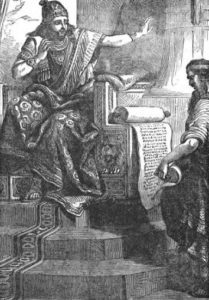
An 1873 illustration of King Josiah (Yoshiyahu) listening to a reading of the Torah
In this week’s parasha, Shoftim, the Torah relates the laws pertaining to Jewish kings. According to the Torah, the king of the Jews is not, and should not be, like the king of other nations. His primarily role is not to be a dictator or a conqueror. Rather, he must act like a divine messenger of God, and his duty is to ensure the observance of Torah law throughout the Holy Land. This is why we read across the Tanakh how the best Jewish kings—like Hezekiah and Josiah—were the ones that expunged idolatry from Israel and restored proper spirituality.
It is also why we see on several occasions in the Book of Shoftim (not to be confused with this week’s parasha of the same name) that the time before kings was lawless: “…there was no king in Israel; every man did that which was right in his own eyes.” (Judges 21:25) The Jewish king, therefore, is like God’s representative on Earth. In this regard, he is likened to an angel, which is why the term for a king, melekh (מלך), is nearly identical and shares the same root with the word for an angel, malakh (מלאך).
Not surprisingly, the Jewish king is held to a very high standard. The Torah (Deuteronomy 17:16-20) tells us that he:
may not acquire many horses for himself… And he shall not take many wives for himself, and his heart must not turn away, and he shall not acquire much silver and gold for himself. And it will be, when he sits upon his royal throne, that he shall write for himself two copies of this Torah on a scroll, before the priests. And it shall be with him, and he shall read it all the days of his life, so that he may learn to fear Hashem, his God, to keep all the words of this Torah and these statutes, to perform them, so that his heart will not be haughty over his brothers, and so that he will not turn away from the commandment, either to the right or to the left, in order that he may prolong [his] days in his kingdom, he and his sons, among Israel.
The Talmud discusses the finer points of these rules. One of the questions the Sages ask is: How many wives is too many? (Sanhedrin 21a) The Mishnah states the maximum is eighteen wives. Rav Yehuda then opines that a king can take more wives, as long as they will not “turn his heart astray”. Rabbi Shimon insists that even a single wife might turn her husband’s heart astray, and thus, the king must not take more than eighteen “even if they be women like Abigail”. Abigail, of course, was one of the righteous wives of King David, who is listed among the seven female prophetesses of Judaism.
In fact, the Talmud derives the maximum of eighteen wives from the case of King David:
Whence do we deduce the number eighteen? From the verse, “And unto David were sons born in Hebron; and his firstborn was Amnon of Ahinoam the Jezraelite; the second, Khilav of Abigail, the [former] wife of Naval the Carmelite; the third, Avshalom the son of Maacah; and the fourth, Adoniyah the son of Hagit; and the fifth, Shefatiah the son of Avital; and the sixth, Ithream of Eglah, David’s wife. These were born to David in Hebron.” (II Samuel 3:2-5) And of them the Prophet [Nathan] said: “And if that were too little, then would I add unto thee the like of these, and the like of these” (II Samuel 12:8), each “these” implying six, which, with the original six, makes eighteen in all.
Scripture tells us that David had six wives while he reigned from Hebron during his first seven years: Ahinoam, Abigail, Maacah, Hagit, Avital, and Eglah. When his court prophet Nathan recounted how he had once blessed him, he said he would multiply the king’s wealth (and wives) kahena v’kahena, more and more “like these”. This implies that David would have, or potentially could have, eighteen wives.
The Talmud continues to cite the opinion of Ravina, who believed that each kahena refers not to six, but twelve. He holds that David had six wives, the blessing was to double that to twelve, and “if that were too little”—as Nathan said—then he would multiple them kahena v’kahena. Thus, Ravina reasons that the maximum is twenty-four wives, not eighteen. The Talmud admits that there is an alternate Mishnaic teaching that 24 is the maximum, and yet another teaching that the maximum is 48. The latter comes from the fact that there is a letter vav in the term, meaning 24 and another 24! Nonetheless, the accepted tradition is a maximum of 18 wives, and no more.
The Talmud interestingly points out a potential flaw: wasn’t David also married to Michal, the daughter of King Saul, while in Hebron? The Sages conclude that Michal is the same person as Eglah. They then raise the following issue: how could Michal be Eglah if the Tanakh states Michal was childless while Eglah gave David a son? In a classic Talmudic interpretation, the Sages take the verse “Michal the daughter of Saul had no child until the day of her death” (II Samuel 6:23) to mean that she did not have children until her death, and died in childbirth. So, she finally had a child on the day of her death.
The Kabbalah of Soulmates
The Arizal (Rabbi Itzchak Luria, 1534-1572) gives a deeper, mystical answer to why the maximum number of wives for a king is eighteen. The implications of his teachings are not just relevant to kings, but to every Jew. While we generally think of a person as having a single soulmate, the Arizal explains that a person actually has eighteen soulmates (see, for example, Sha’ar HaMitzvot on this week’s parasha). Why would a person need eighteen soulmates?
The Talmud (Sotah 2a) famously states that “forty days before conception a Bat Kol [Heavenly Voice] proclaims: the daughter of so-and-so is destined for so-and-so…” The same passage states that pairing a person with their soulmate is “as difficult as the Splitting of the Sea”. The Midrash adds to this that ever since the Splitting of the Sea, God is busy making matches between people (Pesikta d’Rav Kahana 2:4). The Sages conclude that a person’s first match is pre-destined, while a second or subsequent match (if the first marriage fell through) becomes as difficult as splitting a sea.
The central issue that all of this rests on is free will. While a person does have a perfect, pre-destined match, free will can very easily get in the way and ruin things. For example, person A is destined to be with person B, but A makes some really poor decisions in life and ends up in a bad place (or dead). Does that mean B is now condemned to spend the rest of their life without their rightful soulmate? Must they now hopelessly struggle in search of the “right one” or be miserable in a series of failed relationships for the rest of their life, through no fault of their own? Surely, the Most Merciful God would not allow this to happen. And so, He spends all of His time “making matches”, finding alternate soulmates.
For this reason, a person has up to 18 different soulmates designated for them. If, due to free will, the match of A and B doesn’t work, there is always A and C. And if C, too, decides to move to the other side of the world, there’s a D behind them. Granted, the Arizal puts the soulmates in hierarchical fashion: D is not as good as C, nor is C as good as B—but they are all matching souls for A nonetheless. Of course, each of B, C, and D have 18 of their own soulmates, so one can see how complicated this matchmaking game becomes—“as difficult as the Splitting of the Sea”. The Arizal notes that 18 is a maximum, and not necessarily will there be 18 soulmates for a person alive all at once. Elsewhere, the Arizal explains that a person who does not find one of their soulmates will reincarnate to try again in a future life, as might one who needs to unite with a better soulmate, higher up on the chain of 18.
This brings us back to the first question: why is a king allowed up to, but no more than, 18 wives? A king, like every person, has up to 18 soulmates. He may choose to seek out and find all 18 of them, to unite with all of his soulmates. However, he must not take even a single wife more, for a nineteenth wife would certainly not be a soulmate. A king should not be taking a wife or concubine solely for pleasure. He may have more than one (and this may even be a political necessity), but only on the condition that she is one of his soulmates anyway.
The Kabbalah of David and Batsheva
The above discussion helps to explain the Talmudic dictum that one who believes David sinned with Batsheva is mistaken (Shabbat 56a). Recall that Batsheva was the wife of Uriah the Hittite, one of David’s generals. When Uriah was away in battle, David spotted Batsheva bathing and ended up sleeping with her. She would become pregnant, and to hide the sin, David ultimately placed Uriah in a situation where he would die in battle.
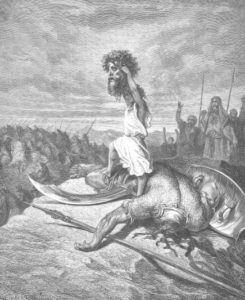
‘David and Goliath’ by Gustave Doré
From a mystical perspective, Batsheva was one of David’s 18 soulmates. In fact, she was his #1, and the two had been matched by God all the way back in the “six days of Creation” (Sanhedrin 107a). The Midrash relates that it was David’s own hubris that prevented him from marrying her. When David had defeated Goliath, he wanted (or needed) to decapitate the giant with his own sword. At the time, Uriah the Hittite happened to be the attendant of Goliath. David promised Uriah the best woman in Israel if Uriah would only provide him with Goliath’s sword. Uriah did so. He later became a righteous convert, and one of David’s greatest warriors. (This is why he is called a Hittite, for he was not originally Jewish.)
At the same time that David made the promise to Uriah, God made a decree in Heaven: Because of David’s haughty and immodest offer to distribute the daughters of Israel, God will mete out his punishment by giving away his very own soulmate to Uriah! What David did with Batsheva was certainly a sin, and the Talmud (ibid.) recounts how severely he was punished, including six months of intense leprosy in addition to the punishments already enumerated in Scripture. Yet, Batsheva was his rightful soulmate, and would go on to produce his rightful heir, King Solomon. The Talmud concludes that David simply rushed to be with her. Uriah was destined to die soon enough anyway, and then David could marry Batsheva with no issues.
The Kabbalists see David and Batsheva rushing to be with each other as a replay of Adam and Eve rushing to consume the Forbidden Fruit. Had Adam and Eve waited until Shabbat, they would have been permitted to eat from the Tree of Knowledge. David and Batsheva, too, needed only to wait a little longer. The connection between the two couples is deeper than that, for David and Batsheva were none other than the reincarnations of Adam and Eve. They had the opportunity to complete a great tikkun, a rectification for that primordial sin. (In some ways, so does every young couple that must wait until marriage to be intimate in holiness.) Alas, they failed, and the same souls will return one last time in Mashiach and his wife to finally fulfil the task.
(For more on the Adam-David-Mashiach connection, see here.)
The above essay is adapted from Garments of Light, Volume Three.
Get the book here!



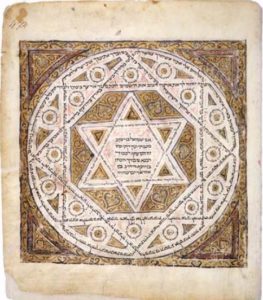
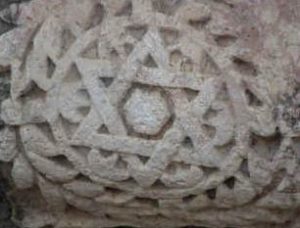
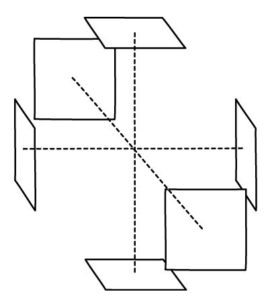

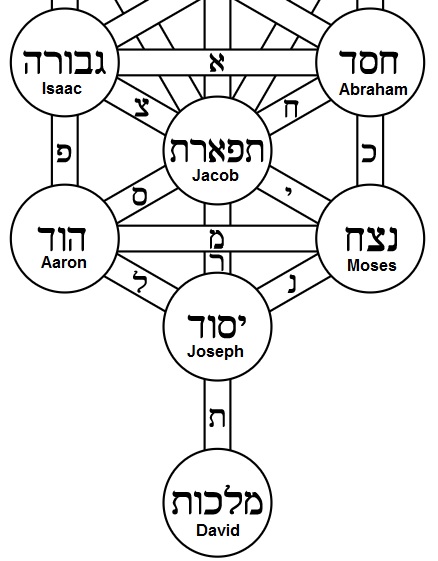
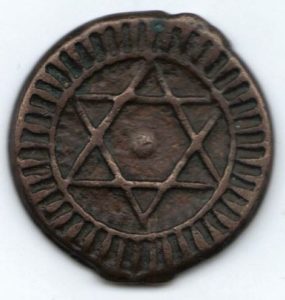
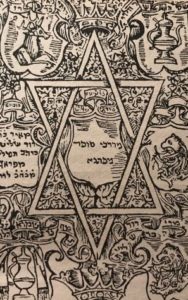
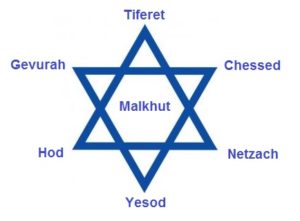 This arrangement of seven (or more specifically, of three-three-one) is found within the Menorah, too, that most ancient of Jewish symbols. For this reason, some argue that the opinion of the Shield of David having the Menorah and the opinion of it having the hexagram are really one and the same. They both reflect a divine geometry of 3-3-1. The sefirot are arranged in the same 3-3-1 manner, and corresponding to them are the seven shepherds of Israel: Chessed, Gevurah, and Tiferet parallel the patriarchs Abraham, Isaac, and Jacob; Netzach, Hod, Yesod parallel the next three great leaders of Moses, Aaron, and Joseph; and Malkhut (“Kingdom”) naturally stands for David. David is at the centre of the star, so it is fitting that the star is named after him.