Author Archives: Efraim Palvanov

How Many Soulmates Do You Have?

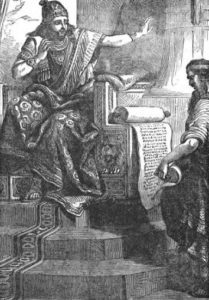
An 1873 illustration of King Josiah (Yoshiyahu) listening to a reading of the Torah

In this week’s parasha, Shoftim, the Torah relates the laws pertaining to Jewish kings. According to the Torah, the king of the Jews is not, and should not be, like the king of other nations. His primarily role is not to be a dictator or a conqueror. Rather, he must act like a divine messenger of God, and his duty is to ensure the observance of Torah law throughout the Holy Land. This is why we read across the Tanakh how the best Jewish kings—like Hezekiah and Josiah—were the ones that expunged idolatry from Israel and restored proper spirituality.

It is also why we see on several occasions in the Book of Shoftim (not to be confused with this week’s parasha of the same name) that the time before kings was lawless: “…there was no king in Israel; every man did that which was right in his own eyes.” (Judges 21:25) The Jewish king, therefore, is like God’s representative on Earth. In this regard, he is likened to an angel, which is why the term for a king, melekh (מלך), is nearly identical and shares the same root with the word for an angel, malakh (מלאך).

Not surprisingly, the Jewish king is held to a very high standard. The Torah (Deuteronomy 17:16-20) tells us that he:

may not acquire many horses for himself… And he shall not take many wives for himself, and his heart must not turn away, and he shall not acquire much silver and gold for himself. And it will be, when he sits upon his royal throne, that he shall write for himself two copies of this Torah on a scroll, before the priests. And it shall be with him, and he shall read it all the days of his life, so that he may learn to fear Hashem, his God, to keep all the words of this Torah and these statutes, to perform them, so that his heart will not be haughty over his brothers, and so that he will not turn away from the commandment, either to the right or to the left, in order that he may prolong [his] days in his kingdom, he and his sons, among Israel.

The Talmud discusses the finer points of these rules. One of the questions the Sages ask is: How many wives is too many? (Sanhedrin 21a) The Mishnah states the maximum is eighteen wives. Rav Yehuda then opines that a king can take more wives, as long as they will not “turn his heart astray”. Rabbi Shimon insists that even a single wife might turn her husband’s heart astray, and thus, the king must not take more than eighteen “even if they be women like Abigail”. Abigail, of course, was one of the righteous wives of King David, who is listed among the seven female prophetesses of Judaism.

In fact, the Talmud derives the maximum of eighteen wives from the case of King David:

Whence do we deduce the number eighteen? From the verse, “And unto David were sons born in Hebron; and his firstborn was Amnon of Ahinoam the Jezraelite; the second, Khilav of Abigail, the [former] wife of Naval the Carmelite; the third, Avshalom the son of Maacah; and the fourth, Adoniyah the son of Hagit; and the fifth, Shefatiah the son of Avital; and the sixth, Ithream of Eglah, David’s wife. These were born to David in Hebron.” (II Samuel 3:2-5) And of them the Prophet [Nathan] said: “And if that were too little, then would I add unto thee the like of these, and the like of these” (II Samuel 12:8), each “these” implying six, which, with the original six, makes eighteen in all.

Scripture tells us that David had six wives while he reigned from Hebron during his first seven years: Ahinoam, Abigail, Maacah, Hagit, Avital, and Eglah. When his court prophet Nathan recounted how he had once blessed him, he said he would multiply the king’s wealth (and wives) kahena v’kahena, more and more “like these”. This implies that David would have, or potentially could have, eighteen wives.

The Talmud continues to cite the opinion of Ravina, who believed that each kahena refers not to six, but twelve. He holds that David had six wives, the blessing was to double that to twelve, and “if that were too little”—as Nathan said—then he would multiple them kahena v’kahena. Thus, Ravina reasons that the maximum is twenty-four wives, not eighteen. The Talmud admits that there is an alternate Mishnaic teaching that 24 is the maximum, and yet another teaching that the maximum is 48. The latter comes from the fact that there is a letter vav in the term, meaning 24 and another 24! Nonetheless, the accepted tradition is a maximum of 18 wives, and no more.

The Talmud interestingly points out a potential flaw: wasn’t David also married to Michal, the daughter of King Saul, while in Hebron? The Sages conclude that Michal is the same person as Eglah. They then raise the following issue: how could Michal be Eglah if the Tanakh states Michal was childless while Eglah gave David a son? In a classic Talmudic interpretation, the Sages take the verse “Michal the daughter of Saul had no child until the day of her death” (II Samuel 6:23) to mean that she did not have children until her death, and died in childbirth. So, she finally had a child on the day of her death.

The Kabbalah of Soulmates

The Arizal (Rabbi Itzchak Luria, 1534-1572) gives a deeper, mystical answer to why the maximum number of wives for a king is eighteen. The implications of his teachings are not just relevant to kings, but to every Jew. While we generally think of a person as having a single soulmate, the Arizal explains that a person actually has eighteen soulmates (see, for example, Sha’ar HaMitzvot on this week’s parasha). Why would a person need eighteen soulmates?

The Talmud (Sotah 2a) famously states that “forty days before conception a Bat Kol [Heavenly Voice] proclaims: the daughter of so-and-so is destined for so-and-so…” The same passage states that pairing a person with their soulmate is “as difficult as the Splitting of the Sea”. The Midrash adds to this that ever since the Splitting of the Sea, God is busy making matches between people (Pesikta d’Rav Kahana 2:4). The Sages conclude that a person’s first match is pre-destined, while a second or subsequent match (if the first marriage fell through) becomes as difficult as splitting a sea.

The central issue that all of this rests on is free will. While a person does have a perfect, pre-destined match, free will can very easily get in the way and ruin things. For example, person A is destined to be with person B, but A makes some really poor decisions in life and ends up in a bad place (or dead). Does that mean B is now condemned to spend the rest of their life without their rightful soulmate? Must they now hopelessly struggle in search of the “right one” or be miserable in a series of failed relationships for the rest of their life, through no fault of their own? Surely, the Most Merciful God would not allow this to happen. And so, He spends all of His time “making matches”, finding alternate soulmates.

For this reason, a person has up to 18 different soulmates designated for them. If, due to free will, the match of A and B doesn’t work, there is always A and C. And if C, too, decides to move to the other side of the world, there’s a D behind them. Granted, the Arizal puts the soulmates in hierarchical fashion: D is not as good as C, nor is C as good as B—but they are all matching souls for A nonetheless. Of course, each of B, C, and D have 18 of their own soulmates, so one can see how complicated this matchmaking game becomes—“as difficult as the Splitting of the Sea”. The Arizal notes that 18 is a maximum, and not necessarily will there be 18 soulmates for a person alive all at once. Elsewhere, the Arizal explains that a person who does not find one of their soulmates will reincarnate to try again in a future life, as might one who needs to unite with a better soulmate, higher up on the chain of 18.

This brings us back to the first question: why is a king allowed up to, but no more than, 18 wives? A king, like every person, has up to 18 soulmates. He may choose to seek out and find all 18 of them, to unite with all of his soulmates. However, he must not take even a single wife more, for a nineteenth wife would certainly not be a soulmate. A king should not be taking a wife or concubine solely for pleasure. He may have more than one (and this may even be a political necessity), but only on the condition that she is one of his soulmates anyway.

The Kabbalah of David and Batsheva

The above discussion helps to explain the Talmudic dictum that one who believes David sinned with Batsheva is mistaken (Shabbat 56a). Recall that Batsheva was the wife of Uriah the Hittite, one of David’s generals. When Uriah was away in battle, David spotted Batsheva bathing and ended up sleeping with her. She would become pregnant, and to hide the sin, David ultimately placed Uriah in a situation where he would die in battle.
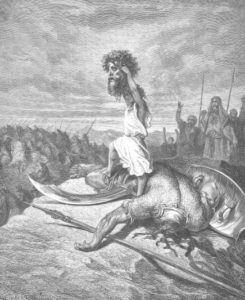
‘David and Goliath’ by Gustave Doré

From a mystical perspective, Batsheva was one of David’s 18 soulmates. In fact, she was his #1, and the two had been matched by God all the way back in the “six days of Creation” (Sanhedrin 107a). The Midrash relates that it was David’s own hubris that prevented him from marrying her. When David had defeated Goliath, he wanted (or needed) to decapitate the giant with his own sword. At the time, Uriah the Hittite happened to be the attendant of Goliath. David promised Uriah the best woman in Israel if Uriah would only provide him with Goliath’s sword. Uriah did so. He later became a righteous convert, and one of David’s greatest warriors. (This is why he is called a Hittite, for he was not originally Jewish.)

At the same time that David made the promise to Uriah, God made a decree in Heaven: Because of David’s haughty and immodest offer to distribute the daughters of Israel, God will mete out his punishment by giving away his very own soulmate to Uriah! What David did with Batsheva was certainly a sin, and the Talmud (ibid.) recounts how severely he was punished, including six months of intense leprosy in addition to the punishments already enumerated in Scripture. Yet, Batsheva was his rightful soulmate, and would go on to produce his rightful heir, King Solomon. The Talmud concludes that David simply rushed to be with her. Uriah was destined to die soon enough anyway, and then David could marry Batsheva with no issues.

The Kabbalists see David and Batsheva rushing to be with each other as a replay of Adam and Eve rushing to consume the Forbidden Fruit. Had Adam and Eve waited until Shabbat, they would have been permitted to eat from the Tree of Knowledge. David and Batsheva, too, needed only to wait a little longer. The connection between the two couples is deeper than that, for David and Batsheva were none other than the reincarnations of Adam and Eve. They had the opportunity to complete a great tikkun, a rectification for that primordial sin. (In some ways, so does every young couple that must wait until marriage to be intimate in holiness.) Alas, they failed, and the same souls will return one last time in Mashiach and his wife to finally fulfil the task.

(For more on the Adam-David-Mashiach connection, see here.)


The above essay is adapted from Garments of Light, Volume Three.
Get the book here! 
What Does God Ask Of You?

In this week’s parasha, Ekev, we read: “And now, Israel, what does Hashem, your God, ask of you? Only to fear Hashem, your God, to walk in all of His ways, and to love Him, and to serve Hashem, your God, with all your heart and with all your soul.” (Deuteronomy 10:12) Moses instructs his people that they should sincerely love, fear, and serve God. We have written in the past how the Sages say that loving God and serving God is often best done by loving and serving His creations. The Midrash compares this to a servant who takes care of the king’s son. Surely, the king will love such a servant and wish to bestow goodness upon him, for the servant cares for the king’s beloved child. As the Torah calls us all children of Hashem, the King, it goes without saying that those who take care of God’s children are naturally beloved by God.

This is the quality that made Aaron so special, and, according to some, earned him the merit of being chosen the progenitor of the priestly lineage. Pirkei Avot (1:12) famously instructs us to be, above all else, like Aaron (and his disciples): “loving peace and pursuing peace, loving all people, and bringing them closer to Torah.” Elsewhere in Avot (3:10), we are told that “One with whom his fellows are pleased with, God is pleased with.” The Kabbalists beautifully point out that the gematria of the command to love God (ואהבת את יי אלהיך) is 907, the same as the command to love your fellow (ואהבת לרעך כמוך אני יי), for one is impossible without the other.

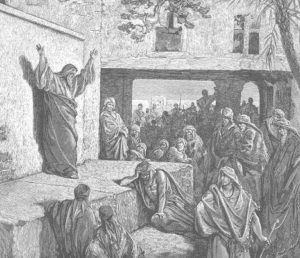
‘Micah Extorting the Israelites to Repentance’, by Gustave Doré

This is what the prophet Michah concluded when he, too, asked the same question as Moses did: “… And what does Hashem request of you? Only to act justly, and to love kindness, and to walk modestly with your God.” (Micah 6:8) Be just and treat everyone fairly; be kind and genuinely love to help others—and do it all humbly and modestly.

The Talmud (Shabbat 31a) takes a more literal approach, with Rava stating that God will ask each person six specific questions upon their death:

When man is led in for Judgment, he is asked: Did you deal faithfully? Did you fix times for learning? Did you engage in procreation? Did you hope for salvation? Did you engage in the dialectics of wisdom? Did you understand one thing from another?

The first question implies dealing honestly in business or in financial matters. Judaism has always taught the necessity of being scrupulously honest when it comes to money. The Kabbalists state that a person will be forced to reincarnate into this world if they so much as owe a single penny. They discuss how the value of shekel (שקל) is 430, equal to nefesh (נפש), “soul”, for each person’s material wealth is intricately tied to their spiritual nature. This is why giving money to charity can actually alter a person’s fate, as explained in the past. (See ‘How Charity Can Save Your Life’ in Garments of Light.)

Meanwhile, the Talmud holds that even though the Torah allows Jews to loan with interest to non-Jews, one shouldn’t charge interest from anyone, and a usurer might not even be a kosher witness in court (Sanhedrin 24b-25b). The same is true for someone who owes a lot of money. A person should not get themselves into great debt, and should ensure as much as possible that they will be able to repay a loan. This is why Rabbi Shimon, one of the five great students of Rabbi Yochanan ben Zakkai, held that the worst possible trait is that of a person who takes on debt and fails to repay (Avot 2:10). He bases himself on the words of King David: “The wicked man borrows and does not repay, but the righteous one is benevolent and gives.” (Psalms 37:21)

The wording of the Talmud is that a person will be asked if they took care of their finances b’emunah, “in faith”. Unfortunately, there are plenty of people who seem faithful, but engage in all kinds of financial tricks under the table. A person cannot be of great emunah if, at the same time, they cheat in financial matters, or are even a little bit dishonest with money. This includes gambling, stock market speculation, and all sorts of tax deceptions which have become so commonplace in our time.

Upholding Creation

The second question asked in the afterlife is whether a person set aside regular times to learn Torah. The Sages state that learning Torah is the most important mitzvah. Indeed, without learning Torah a person won’t know the right way to fulfil any mitzvah. The Torah is a “Tree of life for those who grasp it” (Proverbs 3:18), and the Sages quoted God stating: “I created the evil inclination, and I created the Torah as its antidote.” (Sifre Devarim 45) One who learns Torah is upholding the Covenant between God and Israel—since the Torah is the very text of that Covenant—and hence God states “If not for My covenant day and night, I would not have set the ordinances of Heaven and Earth.” (Jeremiah 33:25) God declares that He would not have created this universe were it not for His Torah—and His people upholding it day and night. (Some have therefore said that the world has time zones so that at any given moment, a Jew somewhere in the world is learning Torah.)

Similarly, the third question refers to procreation, for without it, too, humanity would cease to exist. More specifically, without Jewish procreation, there would be no Jews, and therefore no one to uphold that Covenant. The schools of Hillel and Shammai debated what it takes to fulfil the mitzvah of procreation (Yevamot 62a). According to Hillel, a person must have one boy and one girl, while according to Shammai, a person must have two boys and two girls. The reasoning of the latter is that Eve initially had four children: Cain, Abel, and the sisters each was born with. The first instance of pru u’rvu in the Torah resulted in two boys and two girls, so this is the standard for fulfilling the mitzvah.

However, the Talmud goes on to note another opinion that it was Shammai that taught one must have at least one boy and one girl, whereas Hillel taught that a person must simply have at least one child, whether boy or girl. The most lenient opinion, therefore, is that a person fulfils the mitzvah by having a single child, while the praiseworthy has at least two of each. A person who adopts a child or “raises an orphan” fulfils the mitzvah as well (Megillah 13a).

Of course, it isn’t enough just to have the kids. Parents need to invest their time and energy to ensure the children will be both righteous and successful. The Talmud (Kiddushin 29a) reminds us that, among other things, a parent is obligated to teach their child Torah, and also some kind of craft or career to ensure an honest livelihood. After all, “If there is no Torah, there is no flour; if there is no flour, there is no Torah.” (Avot 3:17) To raise children solely with Torah and assume a livelihood will come on its own, or to rely on the charity of others, is a gross sin. The Rambam (Hilkhot Talmud Torah 3:10) is particularly vocal about it:

Anyone who comes to the conclusion that he should involve himself in Torah study without doing work and derive his livelihood from charity, desecrates God’s Name, dishonors the Torah, extinguishes the light of faith, brings evil upon himself, and forfeits the life of the World to Come, for it is forbidden to derive benefit from the words of Torah in this world.

Our Sages declared: “Whoever benefits from the words of Torah forfeits his life in the world.” Also, they commanded and declared: “Do not make them a crown to magnify oneself, nor an axe to chop with.” Also, they commanded and declared: “Love work and despise rabbinic positions.” All Torah that is not accompanied by work will eventually be negated and lead to sin. Ultimately, such a person will steal from others.

Rabbi Moshe ben Maimon, the Rambam, aka. Maimonides, 1135-1204

Although the Rambam makes it clear that Torah study is of absolute importance, and should take precedence over one’s worldly occupation, he nonetheless reminds us that “the greatest sages of Israel were lumberjacks and water-drawers…” (ibid., 1:9) To be fair, there are other rabbinic authorities that allow for full-time Torah scholars who make learning their occupation, but this must only be for a minority of distinguished thinkers. It is certainly not a standard for everyone, for that would be completely unsustainable.

To get back to the third question, the Sages state that having children “hastens the Redemption”. There are a certain number of souls (in a Heavenly repository called “guf”) that must be born, and only when all of these souls have been born can Mashiach come. Thus, having children accelerates the time of Redemption.

This ties into the fourth question a person is asked: did they look forward to the Redemption? The wording is not if they waited for the Redemption, or hoped for it. Instead, whether they looked forward to it, suggesting a more active form. It isn’t enough to passively wait for the Redemption. Each person must do what they can to hasten it. This includes things like doing more acts of kindness and showing ahavat chinam, expressing baseless, non-judgemental love for all fellow Jews (Yoma 9b); engaging in kiruv; and, of course, repenting wholeheartedly (Sanhedrin 97b). Each person has to continue working on themselves to be ever-more righteous. Increasing one’s charitable donations hastens the Redemption, too (Isaiah 1:27 and Bava Batra 10a).

Garment for the Soul

The final two questions deal with one’s knowledge and understanding. It isn’t enough to engage in light learning here and there. A person must be steeped in dialectics (pilpul) and understand the depths of one thing from another (davar mitokh davar). The Arizal taught that a person must learn Torah on all four of its levels; pshat (simple), remez (sub-textual), drash (metaphorical), and sod (secret). These levels are collectively known by the acronym pardes, “orchard”—a word that is also the origin of the English “paradise”. One who doesn’t learn Torah on all four levels has not fulfilled the mitzvah of Torah study and will return in a reincarnation to do so (Sha’ar HaGilgulim, 16).

The Arizal also taught that Torah study not only strengthens a person spiritually, but literally creates a “garment” for the soul to be worn in the World to Come (Sha’ar HaPesukim, Tehillim). This is the meaning of the verse “The Torah of Hashem is perfect, it restores the soul” (Psalms 19:8). Meanwhile, the power of Torah study is so great that it creates angels, and these angels could eventually communicate with the student and bestow Ruach HaKodesh, divine inspiration, upon them (Sha’ar Ruach HaKodesh, 1).

The Talmud specifies that one should spend a third of their time studying Tanakh, then a third studying Mishnah, and a third studying Gemara (Kiddushin 30a). This was at a time when no other texts were available, so one should probably make another “third” for the many other areas of Jewish study we have today, including halachic and midrashic literature, mussar, hashkafa, various responsas and commentaries, as well as Kabbalah. The Arizal divided up his Torah study routine as follows (Sha’ar HaMitzvot, Va’etchanan):

First, he would read the weekly Torah portion. On Sunday, he would focus on the first six verses. On Monday, the next four. On Tuesday, the next five, and on Wednesday the next six. Another five on Thursday, making a total of 26 verses, and then the whole parasha on Friday. This was done in the traditional manner, shnaim mikra v’echad targum—reading each verse twice in Hebrew, and once in Aramaic.

Next, he would study a portion of Nevi’im, the Prophets, followed by Ketuvim, the other Holy Writings that make up the Tanakh. This, too, was done with shnaim mikra and a targum. The Arizal then studied the Mishnah, followed by Gemara, together with the various commentaries. Finally, he engaged in Kabbalah.

Yirat Hashem

Rava derived the six questions above from Isaiah 33:6, where the prophet declares, “And there shall be faith in your times; strength, salvation, wisdom and knowledge…” Faith refers to the first question regarding faithful business, times refers to the second question of setting times for Torah-learning, strength to procreation, salvation to the Redemption, wisdom and knowledge to the last two questions.

The Isaiah verse concludes with “… the fear of Hashem is His treasure.” One’s rewards (treasure) in the afterlife are contingent upon these six questions. Yet, what unifies them all is yirat Hashem, “fear” or “awe” of God.

One who is truly God-fearing will undoubtedly be scrupulously honest with financial matters, and strive to hasten the Redemption. It is doubtful that a Jew can be truly God-fearing without constantly meditating upon Torah and understanding its depths. Thus, complete yirat Hashem encompasses all of these things. Conversely, a person who does not live these ideals is probably not as God-fearing or faithful as they might believe themselves to be.

The Jewish View on Cards and Gambling

In this week’s parasha, Matot-Massei, we read how the Israelites were supposed to divide up the Holy Land between the Twelve Tribes:

And you shall inherit the land by lot according to your families; to the more [numerous] you shall give the more inheritance, and to the fewer you shall give the lesser inheritance; wherever the lot falls to any man, that shall be his…

We learn that the land of Israel was apportioned based on family size, with larger families logically receiving a larger share. Now, to determine which chunk of land a family would receive, the Israelites cast lots. The Talmud (Bava Batra 122a) describes how this was done: two urns were prepared, one containing the names of the Twelve Tribes, and the other containing the names of the various allotments of land. Elazar the High Priest would pick one name from each urn, thus designating a piece of land for a particular tribe.

Casting lots was very common in Biblical times, and is mentioned frequently in the Tanakh. For example, the Torah commands casting lots to determine which goat is sent to Azazel on Yom Kippur (Leviticus 16:8). In the Book of Jonah (1:7), the sailors on Jonah’s ship cast lots to determine who was guilty of causing the storm. In the time of King David, the kohanim were thus divided into 24 groups (I Chronicles 24). Haman cast lots to determine the best day to attack the Jews, and this is why the holiday is called “Purim”, since purim was the Persian word for “lots” (Esther 3:7).

Casting lots suggests a large degree of chance or randomness in the process. Yet, people of faith are naturally quite averse to the concept of random chance, for isn’t everything determined by God? Not surprisingly, the word “lot” (goral) also takes on the meaning of “fate” in the Tanakh. For instance, Isaiah (17:14) prophesies: “At evening there will be terror, and before morning they are not. This is the portion of them that spoil us, and the goral of them that rob us.” The ultimate fate of those that harm the Jewish people will be utter destruction. The Sages, too, were uncomfortable with the idea of dividing the Holy Land by seemingly random lots. They therefore stated (ibid.) that the lots were really just a show for the people to see what God intended. In reality:

Elazar was wearing the Urim and Tumim, while Joshua and all Israel stood before him… Animated by the Holy Spirit, he gave directions, exclaiming: “Zevulun” is coming up and the boundary lines of Acco are coming up with it. [Thereupon], he shook well the urn of the tribes and Zevulun came up in his hand. [Likewise] he shook well the urn of the boundaries and the boundary lines of Acco came up in his hand…

Elazar would prophetically see which tribe needed which land, and when he then shook the urns those exact pairs that he foresaw would emerge! So, the process was not random at all, but simply a materialization of the Divine Will. Still, the Sages insist that in the messianic era the Holy Land will not be apportioned through this method of casting lots, but rather “The Holy One, blessed be He, Himself, will divide it among them; for it is said [Ezekiel 48:29], ‘And these are their portions, says the Lord God.’”

If the Sages were not fond of casting random lots by chance, how would they feel about playing games of chance and gambling?

Gambling in the Talmud

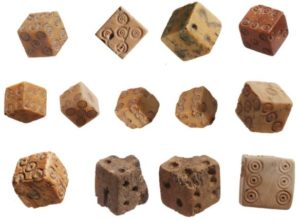
In 1999 and 2000, the Muslim Waqf (Temple Mount authority) dug up 9000 tons of Temple Mount soil and unceremoniously dumped it in the Kidron Valley, creating one of the largest archaeological catastrophes in history. Thankfully, archaeologists did not give up on this precious soil, and began the “Temple Mount Sifting Project”. Among the many incredible finds are these Second Temple-era playing dice.

In a list of people that are ineligible to serve as witnesses or as judges, the Mishnah includes a mesachek b’kubia, a person who plays with dice, and mafrichei yonim, “pigeon flyers”. According to the Talmud, the latter most likely refers to people who bet on pigeon races, which were apparently common in those days. We know from historical sources that gambling with various dice games was very popular in Greek and Roman times. The Talmud (Sanhedrin 24b) goes on to discuss what the problem with such people is.

Rami bar Hama teaches that the issue with gambling is that it is essentially built on a lie: each player agrees to pay a certain sum of money if they lose, yet they hope (and fully intend) not to lose at all! That means the initial agreement made by the players is not even valid. The losing gambler is entirely dejected, and gives up their money reluctantly, often with a nagging feeling of being robbed or cheated out of their money.

Rav Sheshet disagrees. After all, there may be some people who are not so sad to part with their money, or are simply addicted to the game itself. Whatever the case, Rav Sheshet holds that gambling is inappropriate because it is a terribly unproductive waste of time, and the gambler contributes nothing to “the welfare of the world”. This is why, Rav Sheshet says, the Mishnah above concludes by saying that only a full-time gambler is prohibited, but one who has an actual job and just plays for fun on the side is permitted.

Nonetheless, Rav Yehudah holds that regardless of whether the gambler has an occupation or not, or whether he is a full-time player or not, a gambler is disqualified from being a kosher witness or judge. Rav Yehudah bases his statement on a related teaching of Rabbi Tarfon, and on this Rashi comments that a gambler is likened to a thief. The Midrash is even more vocal, saying that gamblers “calculate with their left hand, and press with their right, and rob and wrong one another” (Midrash Tehillim on Psalm 26:10).

The Talmud (Sanhedrin 25b) goes on to state that the prohibitions above don’t only refer to a literal dice-player, but any kind of gambler, including one who plays with pebbles (or checkers), and even with nuts. The Sages state that such a person is only readmitted when they do a complete repentance, and refuse to play the game even just for fun without any money!

Halachically-speaking, the Shulchan Arukh (Choshen Mishpat 370:2-3) first states that any kind of gambling is like theft and is forbidden, but then suggests that while it may not exactly be theft it is certainly a waste of time and not something anyone should engage in.

A Ban on Gambling

While the Talmud does not explicitly forbid gambling, later rabbis recognized its addictive nature and sought to ban the practice entirely. In 1628, for example, the rabbis of Venice issued a decree (to last six years) excommunicating any Jew who gambled. Part of the motivation for this decree was the case of Leon da Modena (Rabbi Yehudah Aryeh of Modena, 1571-1648).

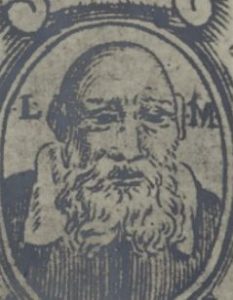
Rabbi Leon Yehudah Aryeh da Modena

Born in Venice to a family of Sephardic exiles, da Modena went on to become a respected rabbi and the hazzan of Venice’s main synagogue for forty years. A noted scholar, he wrote about a dozen important treatises. In Magen v’Herev, he systematically tore down the major tenets of Christianity, while in Ari Nohem he sought to discredit Kabbalah and prove that the Zohar has no ancient or divine origin. (The latter is probably why he isn’t as well-known in Jewish circles today as he should be.)

In 1637, he published Historia de’riti hebraici, an overview of Judaism for the European world, meant to dispel myths about Judaism and quell anti-Semitism. Historians credit this with being the first Jewish text written for the non-Jewish world in over a millennium, since the time of Josephus. The book was incredibly popular, and played a key role in England’s readmitting Jews to the country in the 1650s (after having being expelled in 1290).

More pertinent to the present discussion, Rabbi da Modena wrote Sur miRa (“Desist from Evil”), outlining the problems with gambling. He would know, since he was horribly addicted to gambling himself. He wrote of this problem in his own autobiography, Chayei Yehudah. And because such a high-profile sage was a gambler, his rabbinic colleagues in Venice issued that decree to ban any form of gambling.

Rabbi da Modena’s game of choice was cards. At that point in time, playing cards had become wildly popular in Europe. First invented in China in the 9th century, playing cards slowly made their way across Asia, and reached Europe around 1365. They have remained popular ever since, both for gambling and non-gambling games. While it is clear from an halachic standpoint that card games involving money (like Poker or Blackjack) should not be played, is it permissible to play non-gambling card games (like Crazy Eights or Go Fish)?

At first glance, it may not seem like there should be a problem with this. Yet, some rabbis have recently spoken out against all playing cards. Usually, this prohibition is connected not to gambling or wasting time, but rather to cards’ apparent origins in idolatry or the dark arts. Although it is true that some types of cards are used in divination and fortune-telling, it is important to examine the matter in depth and determine whether cards really are associated with forbidden practices.

The History of Playing Cards

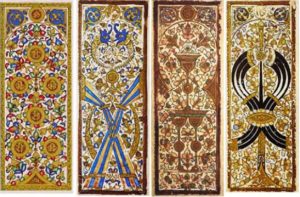
Mamluk Cards

The exact origins of cards are unclear. We do know that they come from China, where paper and printing were invented. Card games are attested to in Chinese texts as early as 868 CE. In the 12th and 13th centuries, the Muslims brought cards across Asia. They were particularly popular in Egypt during the Mamluk Sultanate (1250-1517). The Mamluks created the first modern-style deck of 52 cards with 4 suits. The suits were sticks, coins, swords, and cups. In the 15th century, Italians started to make cards of their own, with the suits being leaves, hearts, bells, and acorns. The French had three-leaf clovers for leaves, square tiles (or diamonds) for bells, and pikes for acorns. Although these suit symbols remained, the English names reflect the earlier suits of sticks (“clubs”) and swords (“spades”).

The Muslim Mamluks did not draw any faces on their court cards (since depicting faces in art is forbidden in Islam). The Europeans did not have this issue, and adapted the Muslim court cards of malik (king), malik na’ib (deputy king), and thani na’ib (second deputy) to king, queen, and prince or knight (“jack”). In 16th century France, the four kings were depicted as particular historical figures: the King of Spades was King David, the King of Clubs was Alexander the Great, the King of Hearts was Charlemagne, and the King of Diamonds was Julius (or Augustus) Caesar.
We see that playing cards have no origins in idolatry. The style of cards we know today were developed by staunchly monotheistic Muslims. They were further developed by mostly non-religious European renaissance printers, against the wishes of the Church which sought to ban cards on a number of occasions. Neither are playing cards known for being used in fortune-telling. However, a related type of card is used in divination today.

Tarot Cards and Kabbalah

In 15th century Italy, a different type of playing card developed. These were called trionfi, later tarocchi, and finally “tarot cards”. They, too, have four suits, but with 56 cards. These were, and still are, used for a number of different games, just like regular playing cards are. Outside of Europe, tarot cards are not well-known, and are generally associated with fortune-tellers.

In reality, the earliest mention of tarot cards being used in divination is only from 1750, and it was essentially unheard of until the late 19th century. Besides, most diviners actually use a different deck of 78 cards. Of course, such divination is entirely forbidden according to the Torah. So, it seems like some well-meaning rabbis have confused these tarot cards with regular playing cards. Ironically, many occultists actually claim that tarot cards come from Kabbalah!

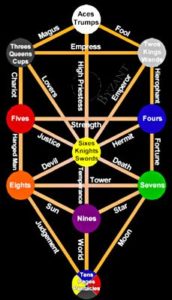
The Tarot “Tree of Life” (Credit: Byzant.com)

These occultists tie the 22 additional divination cards to the 22 letters of the Hebrew alphabet and the 22 paths on the mystical “Tree of Life”. The ten numeral cards (naturally) correspond to the Ten Sefirot, while the four suits correspond to the four olamot, or universes. Finally, the four court cards and the ace represent the five partzufim (with the king and queen appropriately being Aba and Ima). While these parallels are neat, there is absolutely no known historical or textual basis to support these claims. Tarot cards have nothing to do with traditional Kabbalah or Jewish mysticism. (There is a concept in Kabbalah of a negative set of Ten Sefirot belonging to the Sitra Achra, so perhaps there is some connection between these tarot cards and certain evil spiritual forces.)

Having said all that, to forbid playing with cards (or even standard tarot cards) just because some people recently started using them in divination is like forbidding drinking coffee because some people recently started divining with coffee (a practice called “tassology” or “tasseography”). While playing cards copiously is certainly a waste of time, there is nothing wrong with the occasional—no gambling—game.

Ba’al HaTurim

It is fitting to end with the words of the Ba’al HaTurim (Rabbi Yakov ben Asher, c. 1269-1343) who writes in his commentary on the Torah (Tur HaAroch on Deuteronomy 1:1) that Moses himself cautioned Israel about gambling in his final speech before passing away:

Before Moses got ready to relate all these various commandments, he used the present opportunity, a few weeks before his death, to admonish the people, and to remind them of past sins, and how they had caused Hashem a lot of grief during these years. He reminded them how God had treated them by invoking His attribute of mercy and loving kindness time and again. He warned them not to become corrupt again by gambling… They should not rely on the fact that because they were human they were bound to err and sin from time to time and that God, knowing this, would overlook their trespasses.


The above is adapted from Garments of Light, Volume Two. Get the book here