Category Archives: Mysteries & Origins

Secrets of the Pesach Seder Plate

This Friday evening marks the start of Passover. At the Passover seder, it is customary to have a plate upon which all the symbolic Passover foods are placed. According to one arrangement, on the top right we place the zeroa bone; parallel to it on the left is an egg; then the maror (bitter herb) in the centre; the sweet charoset on the bottom right, opposite the karpas vegetable; and in the bottom centre the chazeret, horseradish or another serving of maror (which is used in the korech “sandwich”). In addition, we have three matzahs and the cup of wine, to be filled four times. What is the significance of these Pesach elements?

The zeroa represents the fact that God took us out of Egypt “with an outstretched arm” (b’zeroa netuya), as the Torah states. It also represents the korban pesach, the Pesach offering that would be brought and consumed in the days of the Temple. For this reason, it is best to have a zeroa from a lamb shank, since the Pesach offering was a lamb. The lamb itself was in commemoration of the fact that the Israelites smeared the blood of the lamb on their doorposts on the eve of their Exodus, to protect their homes from the tenth and final plague. It was a lamb in particular because the astrological sign for the month of Nisan is Aries, a ram or sheep. This is tied to Egyptian idolatry, where a number of Egyptian gods were depicted as ram-headed, or with the horns of a ram, including Khnum and Osiris. The slaughter of a lamb was thus symbolic of destroying the idols of Egypt, like the Ten Plagues themselves (see ‘The Ten Plagues: Destroying the Idols of Egypt’ in Garments of Light).

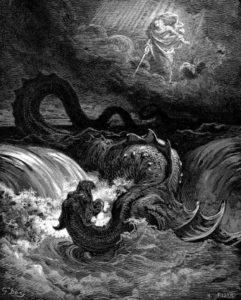
The egg symbolizes another offering brought on Passover: the chagigah, or holiday offering. This was the standard offering brought on all festivals in the days of the Temple. The reason that it is specifically an egg is because a whole egg is one of the foods traditionally consumed by mourners. (The round egg represents the cycle of life.) In this case, the egg is a symbol of mourning for the destruction of the Temple. Intriguingly, Rav Sherira Gaon (d. 1006) wrote how it is customary to eat meat, fish, and egg at the Pesach seder to represent the foods that will be eaten in the End of Days at the Feast of Mashiach. According to the Midrash, in that time the righteous will eat the fishy flesh of Leviathan, that great sea-dragon that Mashiach will slay; as well as the meat of the beast called Behemoth; and the egg of the mythical bird Ziz. So, eating an egg at the Pesach meal is symbolic of that future messianic feast.

‘Destruction of Leviathan’ by Gustav Doré

The maror famously represents the bitter oppression of the Jews, just as the Torah states that the Egyptians “embittered” (v’imareru) the lives of the Jews with mortar and brick, and hard labour (Exodus 1:14). The need to eat maror actually comes explicitly from the Torah, which commands that Jews should eat the Pesach offering together with matzah and bitter herbs (Exodus 12:8). The Mishnah (Pesachim 2:6) lists five possible maror herbs, though their identity is not entirely clear. The only one that appears to be undisputed is lettuce, and hence it is lettuce that is used for maror in Sephardic communities. Another possibility is that maror is horseradish—not the mustard-like sauce but an actual horseradish root (since maror must be a raw vegetable, as the Shulchan Arukh states in Orach Chaim 473:5). There are other traditions for maror’s identity as well.

Interestingly, the Midrash states that the consumption of maror on Pesach is one of the few things King Solomon did not understand! In Proverbs 30:18, Solomon wrote that “Three things are wondrous to me and four I do not know.” Although the passage continues to state what it is that Solomon wondered about, the Midrash (Vayikra Rabbah 30:14) has an alternate explanation: The three things wondrous to Solomon were the Pesach offering, matzah, and maror; and the four he didn’t know were the mysteries behind the four species of Sukkot!

The Mystery of Karpas and Charoset

The maror is dipped into the sweet charoset. This paste is meant to resemble the clay mortar that the Israelites used, or the mud that was baked into clay bricks. The word charoset comes from cheres, “clay”. There are vastly different traditions as to the ingredients of charoset. One tradition is to use the fruits mentioned in Shir HaShirim, the Song of Songs, among them: apples (2:3), figs (2:13), nuts (6:11), dates (7:7), wine (1:2), and cinnamon (4:14). The romantic lyrics of the Song are interpreted as an allegorical “love story” between God and Israel, and the fruits are used throughout the text in metaphorical fashion to describe that passionate love. It is particularly appropriate to use the Song of Songs recipe since it is customary to read the Song of Songs on the holiday of Pesach. (There are five megillot, “scrolls”, in the Tanakh, and each is read on a particular holiday: Shir HaShirim on Passover, Ruth on Shavuot, Eichah on Tisha b’Av, Kohelet on Sukkot, and Esther on Purim.)

Some have pointed out that charoset may have a Greek origin, as it was common…


The above is an excerpt from Garments of Light, Volume Two. To continue reading, get the book here

Are “Torah Codes” Legit?

This week’s Torah portion, Tzav, has a total of 96 verses. It just so happens that the numerical value of the world “Tzav” (צו) is also 96. This is a good example of a classic gematria, the Jewish numerology technique which the Mishnah describes as a “condiment to wisdom” (Avot 3:18). Over the centuries, gematria has become more and more common, and is now an inseparable part of Judaism. Rabbi Aaron Kornfeld (1795-1881) even elucidated 300 laws using the gematrias of their corresponding Torah verses (see his Tziunim l’Divrei HaKabbalah). Indeed, the ancient Baraita of Rabbi Eliezer lists gematria as one of the 32 valid principles of Torah interpretation. The Ba’al HaTurim (Rabbi Yakov ben Asher, 1269-1343), who uses gematria extensively in his commentary on the Torah, points out on the verse כִּי לֹא-דָבָר רֵק הוּא מִכֶּם, “it is not an empty thing for you” (Deuteronomy 32:47), that it equals the value of גימטריות, “gematrias”. In other words, gematria is not an empty or meaningless practice! Gematriot are the original “Torah codes” dating back to millennia-old teachings.

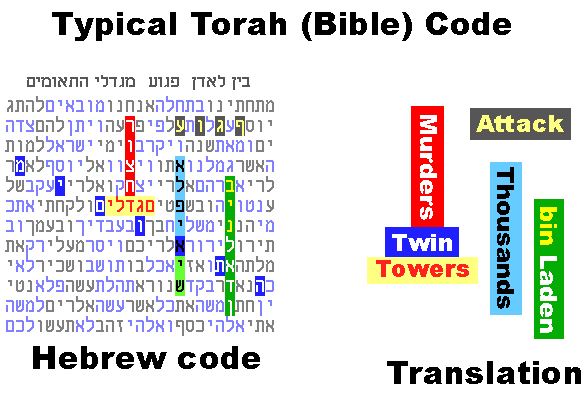
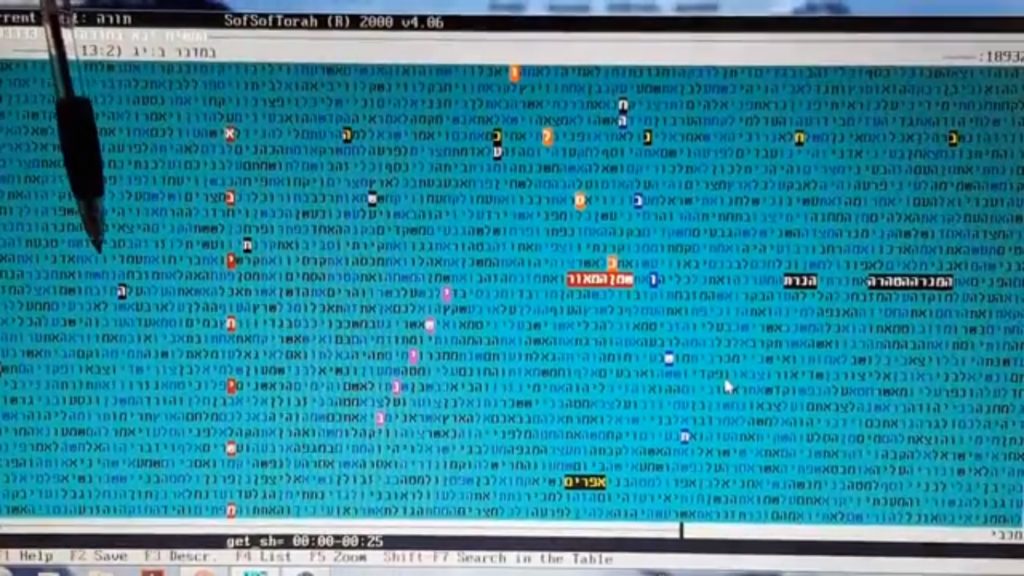
Meanwhile, in recent decades a new phenomenon has emerged and usurped the title of “Torah codes”. Today, when people think of “Torah codes” they are referring to the so-called “equidistant letter sequences” (ELS) method, often called in Hebrew (perhaps erroneously, as we shall see below) dilug, “skipping”. This method involves searching the Torah text for words that appear spaced out across large intervals. Here is one “Torah code”, courtesy of www.torahcodes.net:

Codes found in Moby Dick. Click here for more Moby Dick “codes”.

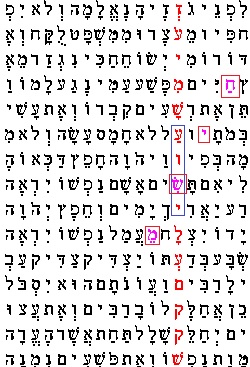
Apparently, the Torah encoded within it the terrible events of September 11, 2001. Such “codes” have been found for just about everything. Indeed, those who use the method claim that this just proves that the Torah really does literally encode all of human history within it, as per tradition. The reality, though, is that you can find everything in Torah codes because the method is inherently flawed, and when you have a text with so many letters, you will naturally be able to find just about anything you look for. Similar “prophecies” have been found in Moby Dick, and in English translations of the Bible. Worse yet, the code has been used to “prove” that Jesus is the messiah:

Professor A.M. Hasofer has pointed out that the word “Yeshua” appears hundreds of times when using ELS, and twice appears overlapped with “navi sheker”, or “false prophet”! (See Hasofer’s article in B’Or Ha’Torah #11, “Torah Code Abuse”, for a thorough analysis and debunking of Torah codes.)

This alone should be enough to debunk Torah codes for good. (See here for why Jesus is not the messiah.) Yet, such codes are still widely spread and taught by well-meaning people. Just weeks ago on Purim I received one that claims skipping 12,196 letters from the mem in the term מור דרור (which our Sages say hints to Mordechai) will spell out מרדכי, “Mordechai”; and skipping the same 12,196 letters from the aleph in the term אסתיר פני (which our Sages say hints to Esther), will spell out אסתר, “Esther”. The kicker at the end is that supposedly Megillat Esther has exactly 12,196 letters. Immediately I went on the computer to check if this is true. Opening up a “Torah code” program, I found that if one skips 12,196 letters from either of the above, they will not get the claimed words. As I did more research, I found that the Megillah may not even have 12,196 letters. I found a similar claim that says the Megillah actually has 12,110 letters, and that the codes are from different words entirely. This one, too, did not work out in the search program! Finally, an article on Chabad.org explained the origin of the claim, dating it back to Rabbi Chaim Michoel Dov Weissmandl, “the Father of Torah Codes”, who is equally famous for his heroic efforts to save Jews in the Holocaust. According to the anecdote here, Rabbi Weissmandel taught that one gets “Esther” if they count from the Torah’s first aleph, and “Mordechai” from מור דרור. Funny enough, in a footnote at the very end, Chabad.org admits that they were

not able to duplicate the above results from the same starting places, but they did find “Esther” and “Mordechai” at the cited interval in different locations. Also, some “codes” programs yield a different number of letters for Megilat Esther, such as 13,408 and 12,110. “Esther” and “Mordechai” can be found at these intervals too.

In other words, the code is completely bogus. (Why Chabad.org—otherwise a terrific resource—would publish a story and admit at the end that it is based on something false eludes me.)

True Torah Codes

In his Pardes Rimonim, the great Ramak (Rabbi Moshe Cordovero, 1522-1570) does mention a practice called dilug, along with similar practices like gematria, roshei and sofei tevot, and letter permutations. Of course, he is not at all speaking about the ELS method, which is essentially impossible without a computer, and would have been unknown to the Ramak. The dilug he speaks of is where a word emerges from letter skipping within a verse or short passage—not hundreds of letters apart, or across different chapters, parashas, or even books, as is common in ELS.

For example, there is the old story of the apostate Avner, a former student of the Ramban (which we’ve discussed before). The story ends with the Ramban showing that Avner’s name is embedded within a verse in parashat Ha’azinu; a verse that speaks specifically of God destroying the memory of those who oppose Him, like Avner.* Such small codes—with short skips in verses that actually relate to the topic at hand—may certainly be valid. Still, the Ramban himself points out (in the first gate of Sefer haGeulah) that these kinds of practices must be based on a proper tradition going back to Sinai; a person should not conjure their own gematrias and codes, for in such a way a person will be able to “prove” just about anything.

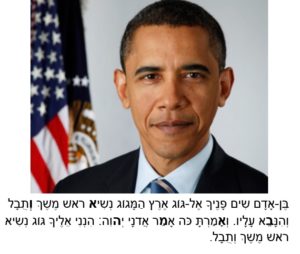
When Barack Obama was elected, many pointed out that his name appears when skipping to every seventh letter from the aleph in the word “nasi” or “president” in the famous apocalyptic passage of Gog u’Magog (Ezekiel 38:2-3). Apparently, Obama did not fulfil his “prophesied” role of bringing the apocalypse.

“Bible Codes” abound on YouTube. This video has a code suggesting Mashiach would come during Chanukah of 5778 (ie. December 2017). The same YouTube channel still has videos going back to at least 5774 with codes proving each year to be an auspicious time for Mashiach to come!

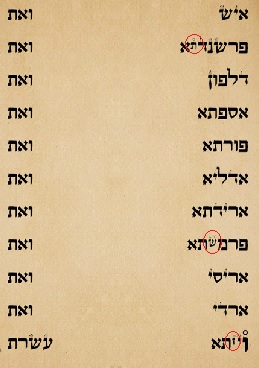
Having debunked one supposed “Purim code”, let’s conclude with a better-known Purim code. This one actually does work quite well and would be valid in the time of the Ramak, too (since it appears within one small passage, requires no computers, and is in context). It was Rabbi Weissmandl who once again first pointed it out. At the end of Megillat Esther, we read how Haman’s ten sons were hanged. The scroll shifts to a unique appearance here in listing the names of the ten sons. Traditionally, three letters in this list are written smaller than normal. Such smaller or larger letters always carry great significance wherever they appear in Scripture. The three here make up תש״ז, as if alluding to the year 5707, corresponding to the year 1946-47.

Amazingly, it was right at that time that the Nuremberg Trials concluded with the hanging of ten of the Nazi elite. In the Scroll itself we read how Esther was asked what to do with the hanged sons of Haman, and she responded: “If it please the king, let it be granted to the Jews that are in Shushan to do tomorrow also according to this day’s decree, and let Haman’s ten sons be hanged upon the gallows.” (9:13) Esther perplexingly asks for the ten sons to be hanged again!

Centuries later, ten of Hitler’s “sons”—some of his closest confidantes and co-conspirators—were hanged on the gallows, forbidden to go by firing squad as would be normal for military men.** And it’s almost as if they were aware of it all: it was reported that among the last words of the despicable Julius Streicher were: “Purimfest 1946”.

The cover of the October 28, 1946 edition of Newsweek. In its coverage of the Nuremberg executions, it states: “Only Julius Streicher went without dignity. He had to be pushed across the floor, wild-eyed and screaming: ‘Heil Hitler!’ Mounting the steps he cried out: ‘And now I go to God.’ He stared at the witnesses facing the gallows and shouted” ‘Purimfest, 1946.’ (Purim is a Jewish feast) … A groan came from inside the scaffold. Critics suggested afterward that Streicher was clumsily hanged and that the rope may have strangled him instead of breaking his neck.”


*The Avner code is actually not an ELS at all. Rather, the Ramban said that the third letter of each word spells “Avner”. These letters are not equidistant.

**The Talmud (Megillah 16a) states that Haman also had a daughter who committed suicide. In 1946, Hermann Göring was sentenced to death as well, but committed suicide the night before. Interestingly, Göring was known to be a cross-dresser. The hangings took place on October 16, 1946, just days after Rosh Hashanah 5707 (תש״ז) and fittingly, on the holiday of Hoshana Rabbah, the “Great Salvation”.

Secrets of the Star of David

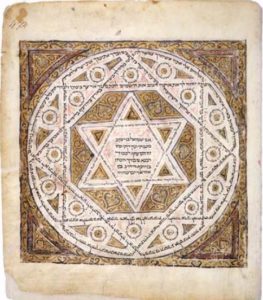
Star of David on the 1000-year old Leningrad Codex (1008 CE).

This week’s double parasha is Vayak’hel-Pekudei, which speaks of the Sabbath, the construction of the Tabernacle, and the formal establishment of the priesthood. One of the things described is the creation of the Menorah. This seven-branched candelabrum is perhaps the oldest symbol of Judaism. We’ve discussed elsewhere how King David had the Menorah emblazoned on his shield (with the words of Psalm 67), and this was the famous magen David, “shield of David” (see ‘Secrets of the Menorah Psalm and the Jewish Holidays’ in Garments of Light.) Yet, strangely, the term magen David today is associated not with the Menorah symbol but with the “star of David”. Stranger still, this hexagram was historically known not as the “star of David” but rather as the “seal of Solomon”! Where did this symbol come from, what is its significance, and how did it become associated with the Jewish people?

Alchemy and Mysticism
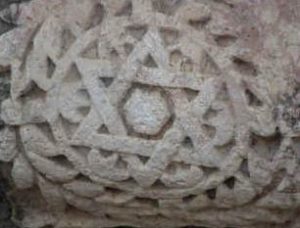
Star of David in the Capernaum synagogue

The hexagram is a relatively simple shape and is found in art and architecture across Europe and Asia. While few ancient synagogues bear the star, many churches do. The most famous synagogue to have the star is the one discovered in 1866 in Capernaum (Kfar Nachum), a village on the Galilee initially founded by the Hashmoneans following their Chanukah victories. This synagogue is actually more popular among Christians, since the gospels of Luke and Mark describe how Jesus preached there. Archaeologists have also found the symbol on the seal of one Yehoshua ben Asayahu in the remains of the ancient city of Sidon. The seal is dated all the way back to the seventh century BCE.

Renowned scholar Gershom Scholem (see his Kabbalah, pgs. 362-368) pointed out that the hexagram was used by alchemists to represent the fusion of fire (the up-triangle) and water (the down-triangle). This may have a connection to a Jewish teaching on the meaning of the term oseh shalom bimromav, which describes God as making peace in the Heavenly realms. One explanation is that here in the lower world, water and fire are unable to co-exist, while up in the Heavens God is able to unify these opposing forces. This divine power was demonstrated with the seventh plague in Egypt, which was “hail with fire” intertwined (Exodus 9:24). The fact that it was the seventh plague in particular may be noteworthy, since the Star of David has seven parts: the six points of the star and the inner hexagon.
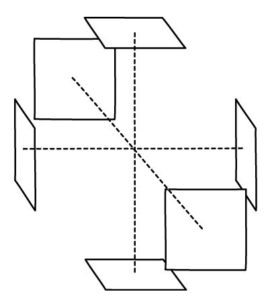
The three axes (x, y, z) of our three-dimensional reality, and the six faces (or six directions) that they produce.

That seven-based arrangement has a great deal of significance in Judaism. It represents Creation, with the six days of the week and the special Sabbath. This itself is a reflection of the fact that all physical things in this universe exist in three dimensions, ie. within a “cube” of six faces, while the seventh represents the inner, spiritual dimension. The same arrangement is found in the mystical Tree of Life, where the lower sefirot are arranged as six “male” qualities and the seventh, “female” quality (Malkhut). Because of this, the Arizal (Rabbi Isaac Luria, 1534-1572) arranged his Passover seder plate in a hexagonal style, with each of the components corresponding to one of the lower sefirot, while the three matzahs correspond to the higher sefirot (Chokhmah, Binah, Da’at), and the plate itself (or the cup of wine) paralleling the seventh and final Malkhut. 
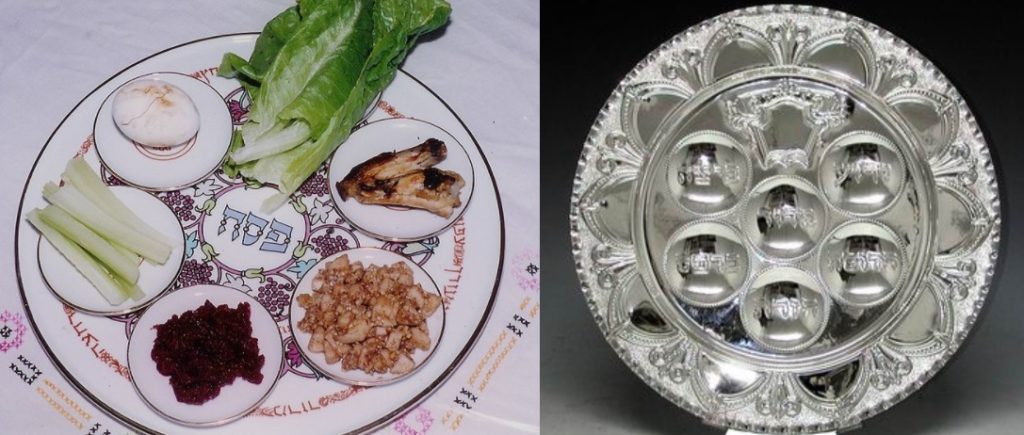
The Pesach Seder Plate. There is a debate whether the Arizal intended the items to be placed in a star shape, or with two triangles one atop the other. The latter is likely as it more closely resembles the Tree of Life diagram.
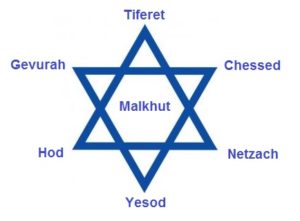
This arrangement of seven (or more specifically, of three-three-one) is found within the Menorah, too, that most ancient of Jewish symbols. For this reason, some argue that the opinion of the Shield of David having the Menorah and the opinion of it having the hexagram are really one and the same. They both reflect a divine geometry of 3-3-1. The sefirot are arranged in the same 3-3-1 manner, and corresponding to them are the seven shepherds of Israel: Chessed, Gevurah, and Tiferet parallel the patriarchs Abraham, Isaac, and Jacob; Netzach, Hod, Yesod parallel the next three great leaders of Moses, Aaron, and Joseph; and Malkhut (“Kingdom”) naturally stands for David. David is at the centre of the star, so it is fitting that the star is named after him.
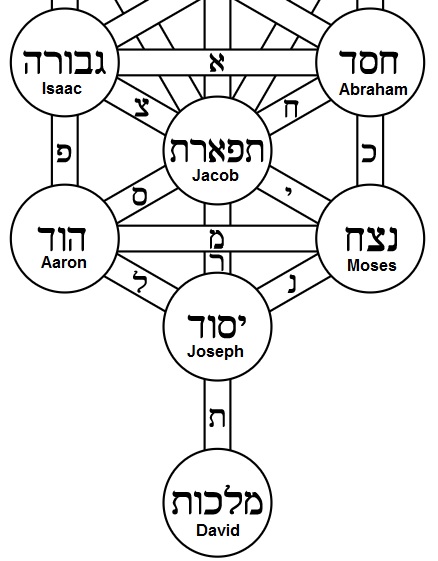
The first row of three (called by the acronym CHaGa”T), is followed by the second row of three (called NeHe”Y), and then the singular, “feminine” Malkhut (or Nukva), which receives from all the others.

Yet, it isn’t clear when and why the symbol became known as the “Star of David”. Rabbi Yirmiyahu Ullman points out that it may come from the fact that in Ancient Hebrew script the letter dalet has a triangular shape (much like the Greek delta), thus making “David” (דוד) appear as two triangles. Whatever the case, the symbol is already described as magen David, the “Shield of David”, in 14th century Kabbalistic texts, as Scholem points out. However, in those days it more commonly went by another name: the Seal of Solomon.
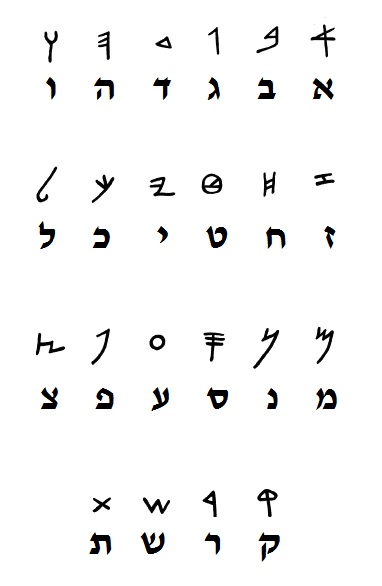
Ancient Hebrew Script. The letter dalet is a triangle.

The Seal of Solomon

In medieval texts, the hexagram is most commonly referred to as the “seal of Solomon”. The earliest texts that mention it are actually Islamic texts, not Jewish ones. They speak of a special ring that King Solomon had which allowed him to interact with jinn spirits (the root of “genie”) both good and bad. Although the texts are Arabic, they are clearly based on more ancient Jewish teachings. In fact, the earliest reference to a special ring possessed by Solomon which allowed him to defend from evil spirits is in the Talmud.

In what is likely the longest story related in the Talmud (Gittin 68a-b), we are told of how Solomon sought to find the special shamir “worm” which would allow him to cut the stones for the Temple without using iron tools. He found the shamir’s whereabouts from the prince of demons, Ashmedai, whom he was able to subdue thanks to his special ring. In an incredible twist, Ashmedai gets a hold of Solomon’s ring and banishes the king from his own kingdom, turning him into a pauper, while Ashmedai himself took the throne impersonating Solomon! Thankfully, this “new” Solomon’s strange behaviour was soon noticed, and the real Solomon eventually made his way back to the palace to reclaim his throne, and his ring.

The Talmud does not state that the ring had a hexagram on it, but rather that it had God’s Name engraved upon it. It is Arabic texts that first connect the ring to the hexagram. Some attempt to distinguish between the “Star of David” and the “Seal of Solomon” by suggesting that the hexagram of the former is made up of overlapping triangles while the hexagram of the latter is intertwined:

This argument seems to be without any foundation; the two symbols are one and the same, with the Star of David often depicted intertwined and the Seal of Solomon depicted overlapping (sometimes within a circle).
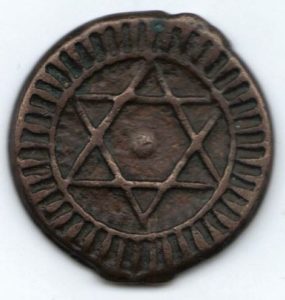
“Seal of Solomon” on a 19th-century Moroccan coin.

A Symbol for Israel
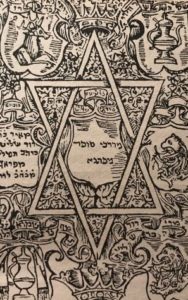
Hexagram on ‘Seder Tefillot’, the first siddur printed in Central Europe. (From Scholem’s ‘Kabbalah’, pg. 365)

Gershom Scholem argues that Jews in the 18th and 19th centuries were looking for a unifying symbol to represent themselves, something like the cross of the Christians or the crescent moon of the Muslims. In the city of Prague, the hexagram had been associated with Jews since the 14th century. It was back in 1354 that King Charles IV of Bohemia granted the Jewish community its own flag, with the hexagram upon a red banner. It soon started to appear on the synagogues of Prague. In 1512, the first modern siddur was printed in Prague and, not surprisingly, had the hexagram on its cover. After the Jews’ vital assistance to the city’s defences in 1648, the community was granted another royal flag, now with a yellow star on a red banner. This flag has been used by the community ever since.

The timing couldn’t be better (or worse). Just a few years later, the Shabbatean heresy would begin, and Prague was soon one of the movement’s strongholds. It appears that the Shabbateans adopted the symbol and used it in secret to identify each other. Scholem points out that use of the star was one of the reasons Rabbi Yakov Emden accused Rabbi Yonatan Eybeschutz of being a closet Shabbatean.
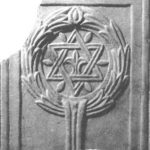
Star from 5th century CE Byzantine Church uncovered at Khirbet Sufa in the Negev

Interestingly, among the Shabbateans the symbol was known as Magen ben David, the Shield of the Son of David, ie. the Shield of the Messiah. This makes sense considering they believed that Shabbatai Tzvi was Mashiach. This isn’t too different from that star-bearing Capernaum synagogue where Jesus supposedly preached. Not too far away from Capernaum in Israel, a 5th century Byzantine church was uncovered, also with the hexagram symbol. Another ancient church in Tiberias displays the star. Perhaps early Christians believed the hexagram was a symbol of their purported Ben David, too! Indeed, to this day one of the Pope’s mitres (the ceremonial hat) has the hexagram prominently displayed upon it.
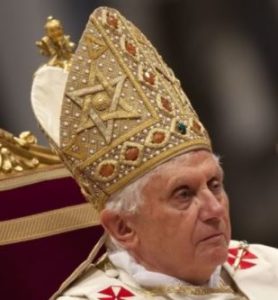
Pope Benedict XVI with a star of David mitre

Scholem suggests that the symbol is referred to as Magen ben David in older Kabbalistic texts that predate the Shabbateans (which is where they would have gotten it). Since Kabbalistic teachings date back to at least the Second Temple period, it is possible that even in the time of Jesus there was a tradition of the hexagram being a messianic symbol. In truth, calling it the Shield of David is problematic, since the accepted tradition is that David’s shield had the Menorah upon it. It was Solomon that apparently used the hexagram to shield from demons. And Solomon is literally a ben David, the son of King David, the very first potential Mashiach ben David in history.

Mashiach’s role is to reunite all of the Jews in Israel, and to restore the original Twelve Tribes. The twelve vertices of the hexagram are said to refer to the Twelve Tribes of Israel, all reunited as one. Meanwhile, the land of Israel itself is often described in sevens: the seven Canaanite nations, and the seven shepherds to whom it was promised; the “seven species” through which the land is praised, and the seventy names that the land is known by (see Midrash HaGadol on Genesis 46:8). It is therefore most appropriate that the Zionist movement which sought to restore the Jews to their ancestral land chose the hexagram as its symbol.

While the secular Theodor Herzl drew up a flag that had seven golden stars on a white banner, it was the Orthodox-born and raised David Wolffsohn that came up with the modern flag of Israel, basing the design on the tallit. Wolffsohn responded to Herzl’s call to create a flag for the Jews by stating: “We have a flag—and it is blue and white. The tallit with which we wrap ourselves when we pray: that is our symbol. Let us take this tallit from its bag and unroll it before the eyes of Israel and the eyes of all nations.”

By this point in history, the Star of David was used by Jewish communities and synagogues across Europe and beyond, so it was natural for it to be emblazoned upon the blue and white tallit-flag. Around the same time, the Orthodox Jewish scholar Franz Rosenzweig (1886-1929) wrote The Star of Redemption, where he used the hexagram to explain the relationship between God and man. Previously, Rosenzweig had resolved to convert to Christianity, then decided to spend one more day as a Jew on Yom Kippur. That day, in a small Orthodox shul in Berlin, Rosenzweig experienced a mystical revelation and an awakening. He became a pious baal teshuva, and a passionate champion for traditional Judaism. His popular “star of redemption” added further meaning to Israel’s new flag.
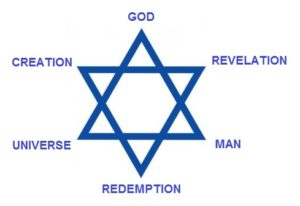
Rosenzweig’s ‘Star of Redemption’

There is one last irony in all of this: the same hexagram was used by the Nazis to degrade the Jews in their attempt to eradicate the nation (likely based on the use of a yellow badge forced upon Jews in some medieval-era towns centuries earlier). To proudly fly the Star of David today is to demonstrate that we are still here, stronger than ever, and we are not going anywhere. We took those stars off of our beaten and bloodied robes and put them on our tanks and jets. And now we await Mashiach ben David, Magen ben David, to come and take command of them. It is, after all, his symbol.


The above essay is adapted from Garments of Light, Volume Three.
Get the book here!