
In this week’s parasha, Vayera, the word “love” appears for the first time in the Torah. There is a general rule that when a certain term appears for the first time in the Torah, the context in which it appears can teach us the true meaning of that term. Nothing is coincidental, of course, so if a word makes its first appearance in a particular place, this is where to look in order to understand its significance. It is specifically when God puts Abraham to the test that the Torah tells us Abraham loved his son Isaac (Genesis 22:2). There is much we can learn from this. Continue reading
Tag Archives: Adam and Eve
Why Kiddush on Wine?
 In this week’s parasha, Nasso, the Torah commands that a nazir is to abstain from wine and any other grape products. Wine appears frequently in the Torah, and plays a huge role in Judaism. Every Shabbat and holiday is ushered in with kiddush on wine, and concludes with a wine havdallah. Every wedding has a blessing on wine under the chuppah, as does a brit milah, and in ancient times wine libations were brought in the Temple. What makes wine so special?
The numerical value of “wine” (יין) is 70, a most significant number. It reminds us of the seventy names of God, of the seventy root nations of the world, and the seventy “faces” of Torah understanding. Our Sages famously stated that nichnas yayin, yatza sod, “when wine enters, secrets come out”. More than a simple proverb, it is a mathematical equation since the value of “secret” (סוד) is also 70. So, as seventy comes in, seventy comes out. On the surface level, the statement means that alcohol makes a person more likely to spill their secrets. On the deeper level, though, the Sages meant that one who drinks wine may be able to enter a mental state where they can uncover the secrets of Torah, and see it through all seventy faces. Wine can make “a man’s mind more receptive” (Yoma 76a).
Our Sages taught that wine is unique in that it defies the natural order: whereas other things degrade over time (as encapsulated in the second law of thermodynamics, the law of entropy, that the universe always tends towards disorder), wine improves and gets more valuable over time. Wine has another incredible scientific quirk: Japanese scientists researching electrical superconductors had a party in their lab and ended up accidentally discovering that wine makes certain metals superconductive!
Superconductivity refers to the property of being able to transmit electricity perfectly with no resistance and no energy loss. Generally, superconductivity requires cooling substances to near absolute zero (-273ºC). Some substances are able to superconduct at higher temperatures, around -90ºC, but even this is far too cold to be practical. Scientists around the world are therefore on the hunt for a room-temperature superconductor which, if found, would completely revolutionize the world. It would result in dramatic energy savings, and would allow for other cool phenomena like “quantum levitation”.
The Japanese scientists found that wine makes some things superconductive, especially iron-based compounds. And red wine especially was up to seven times more effective than other alcoholic beverages. No explanation for this has yet been found. It is all the more significant when we consider the central role that electricity plays in Jewish mysticism, and that our brains literally run on electrical signalling (suggesting how wine might make our brains more receptive to Torah secrets!) and that our bodies are full of iron, which makes our blood red, too.
While all of the above is fascinating, it does not explain why wine is so prevalent in Jewish rituals, especially in the recitation of every kiddush. What is the reason for wine? Continue reading
Practical Jewish Meditation
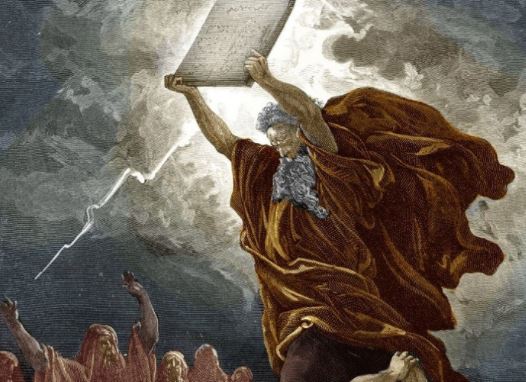
An illustrated section from Gustav Doré’s “Moses Breaking the Tablets of the Law”
In this week’s parasha, Ki Tisa, we read how Moses goes up Mount Sinai on three separate occasions. His first ascent concludes with receiving the Two Tablets, only to come down and see the horror of the Golden Calf. Following this, the Torah tells us that “Moses returned to God”, back up the mountain, to address the Calf fiasco and its aftermath (Exodus 32:31). Moses then came back down to pitch a “Tent of Meeting” (33:7) where he could more regularly communicate with God without having to ascend the Mountain, and for when the Israelites would leave Sinai to head to Israel. Moses asked to see God’s Presence directly, and God replied that no mortal can see God and live, though He would show Moses His “back”. To do this, God asked Moses to come up Sinai one last time (34:2), where a new set of tablets would be created to replace the shattered ones.
When Moses descended from Sinai for the last time to present the new Tablets, the Torah tells us that “He was there with God for forty days and forty nights; he ate no bread and drank no water…” (34:28) Moses had gone up Sinai three times, each for forty days, making 120 days total. Indeed, if one counts the days of the Jewish calendar between Shavuot and Yom Kippur, one would find 120 days, since Shavuot is the date of the initial Sinai Revelation while Yom Kippur is when God forgave the Israelites for the Golden Calf and Moses returned with the new Tablets. At the end of Moses’ three sessions of intense meditation with God, his face glowed and the people could no longer look at him directly (34:29-30). Moses would henceforth wear a mask.
The Torah motif of going up a mountain to spend time in prayer and divine meditation spread all over the world, and we find very similar descriptions in other faiths that emerged after Judaism. Buddha, for instance, spent 40 days (or 49 days) up on a mountain meditating under a bodhi tree to attain enlightenment, and also abstained from food and water during that time. Jesus is said to have spent forty days in the wilderness without food and water, and Mohammad purportedly received his first revelation while meditating and fasting for days on Mount Hira at the age of 40. Despite the fact that Moses was undoubtedly the first, meditation today is associated more with Eastern faiths, and strangely not with Judaism.
The truth is that meditation has always been central to Judaism since ancient times. In fact, it is highly likely that it was Jewish exiles who introduced meditative practices around the world after their expulsion from Israel in the 6th century BCE at the hands of the Babylonians. It is intriguing to point out that many world religions began in the century following Israel’s exile, including Buddhism and Confucianism, as well as the Pythagorean and Orphic religions in Greece. Even ancient Zoroastrianism and Hinduism were heavily influenced by spreading Torah ideas in the middle of the first millennium BCE.
Today, science has uncovered the vast benefits of regular meditation—everything from reducing stress and improving sleep, to boosting the immune system and accelerating healing, even positively impacting the expression of our genes! So, what does the Torah tradition have to teach us about meditation, and what are some specific Jewish meditative techniques we can put into practice daily to enhance our lives? Continue reading