Tag Archives: Alexander the Great

Is It Necessary to Have a Hebrew Name?

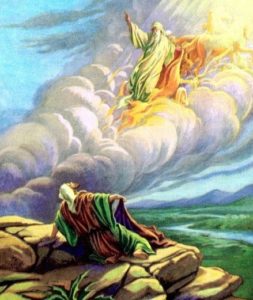
‘Elijah Taken Up to Heaven’

This week’s parasha is named after Pinchas, grandson of Aaron, who is commended for taking action during the sin with the Midianite women. Pinchas was blessed with an “eternal covenant”, and Jewish tradition holds that he never really died. Pinchas became Eliyahu, and as the Tanakh describes, Eliyahu was taken up to Heaven alive in a flaming chariot (II Kings 2). While we know what the name “Eliyahu” means, the name “Pinchas” is far more elusive. It doesn’t seem to have any meaning in Hebrew. Historical records show that there was a very similar name in ancient Egypt, “Pa-Nehasi”. Did Pinchas have a traditional Egyptian name?

When we look more closely, we find that multiple figures of the Exodus generation actually bore Egyptian names. For example, “Aaron” (or Aharon) doesn’t have a clear meaning in Hebrew, and appears to be adapted from the ancient Egyptian name “Aha-Rw”, meaning “warrior lion”. Even the origin of Moses’ name is not so clear.

Although the Torah tells us that Pharaoh’s daughter named him “Moshe” because she “drew him [meshitihu] from the water” (Exodus 2:10), it seems very unlikely that an Egyptian princess should know Hebrew so well and give her adopted child a Hebrew name. Our Sages noted this issue long ago, and grappled with the apparent problem. Chizkuni (Rabbi Hezekiah ben Manoach, c. 1250-1310) writes that it was actually Moses’ own mother Yocheved that named him “Moshe”, and then informed Pharaoh’s daughter of the name. Yet, the Midrash affirms that Yocheved called her son “Tuviah”, or just “Tov” (based on Exodus 2:2), and Moshe was the name given by Pharaoh’s daughter. Meanwhile, Ibn Ezra (Rabbi Abraham ben Meir ibn Ezra, 1089-1167) suggests that Pharaoh’s daughter called him “Munius”. Josephus takes an alternate approach entirely, saying that Pharaoh’s daughter (whose name was Thermuthis, before she became a righteous convert and was called Batya or Bitya in Jewish tradition) named him Moses because the Egyptian word for water is mo.

The most elegant solution might be that Pharaoh’s daughter called him “Mose” (spelled the same way, but pronounced with a sin instead of shin), which means “son” in Egyptian. This is most fitting, since Pharaoh’s daughter yearned for a child of her own, and finally had a “son”. In fact, we see this suffix (and its close variant mses, from which the English “Moses” comes) used frequently in Egyptian names of that time period, such as Ahmose, Thutmose, and Ramses. Thus, he would have been known as Mose (or Moses) during his upbringing, but later known to his nation as Moshe, with a more appropriate and meaningful Hebrew etymology, yet without having to change the spelling of the name (משה) at all.

All of this begs the question: is it important to have a Hebrew name? And is it okay to have a Hebrew name together with an English name, or a name in the local language of wherever a Jew may live?

Why Are So Many Sages Called “Shimon”?

When looking through the names of the many rabbis in Talmudic and Midrashic literature, we find something quite intriguing. Although we would expect the Sages to be named after great Biblical figures like Moses, David, or Abraham, in reality there are essentially no sages with such names! Instead, we find a multitude of names of lesser-known Biblical figures, and many names that have no Biblical or Hebrew origin at all.

One very common name is Yochanan: There’s Yochanan ben Zakkai and Yochanan haSandlar, Yochanan bar Nafcha, Yochanan ben Nuri, and Yochanan ben Beroka. Another popular name is Yehoshua. While we might not expect this name to be so popular (considering its association with Jesus), we still find Yehoshua ben Perachia, Yehoshua ben Levi, Yehoshua ben Chananiah, Yehoshua ben Korchah, and many others. There are also lots and lots of Yehudas like Yehuda haNasi (and his descendents, Yehuda II and Yehuda III), Yehuda ben Beteira, Yehuda bar Ilai, and Yehuda ben Tabbai. And there are tons of Elazars: Elazar ben Arach, Elazar ben Azariah, Elazar ben Pedat, and many more with the similar “Eliezer”.

Perhaps the most common name is “Shimon”. There is Shimon haTzadik and Shimon bar Yochai, Shimon bar Abba and Shimon ben Shetach, Shimon ben Gamaliel (both I and II), Shimon ben Lakish (“Reish Lakish”), and more. We would think this is a strange choice, considering that the Biblical Shimon was actually of somewhat poor character (at least compared to the other sons of Jacob). In fact, on his deathbed, Jacob did not bless Shimon at all, and instead said he wanted nothing to do with his violent nature. Moses, meanwhile, completely omits Shimon in his last blessings! So why would so many of our Sages be called “Shimon”?

A Good-Sounding Name

What might explain the strange selection of names among our ancient Sages? While no clear reason stands out, there is one plausible answer. It appears that the choice of names above was heavily influenced by the contemporary Greek society. Just as today many Jewish parents seek Hebrew names that also sound good in English, it seems parents back then wanted names that sounded good in Greek (since most Jews lived in the Greek part of the Roman, and later “Byzantine”, Empire).

We find that Greek names tend to end with an “n”: Platon (Greek for “Plato”), Jason, and Solon, for example. Numerous others end with “s”: Aristotles (Greek for “Aristotle”), Pythagoras, Philippos. Indeed, many of our Sages actually have such Greek names directly: Yinon, Hyrcanus, Pappus, Symmachus, Teradyon, and Onkelos. There is no indication that these great rabbis had some other “Hebrew” name.

Those that did want to bear Hebrew names could choose names already ending with an “n” like Shimon and Yochanan. Or, they could choose names where adding an “s” to the end would be easy: Yehoshua in Greek is Yeosuos (later giving rise to Yesus, ie. Jesus), while Yehuda is Yudas (Judas). Such names would be easy to convert between Hebrew and Greek. We know from historical sources that several people named Chananiah were simultaneously called “Ananias” in Greek.

The same is true for Elazar or Eliezer. Many Greek names transliterated into English and other languages simple lose their “s” and end with an “r”: Antipatros becomes Antipater, while Alexandros becomes Alexander. In reverse fashion, Elazar could easily become Elazaros (or Lazarus)—very palatable in the Greek-speaking world which our early Sages inhabited.

On that note, what do we make of “Alexander”? A great number of Jews both modern and ancient (there is Alexander Yannai and Rabbi Alexandri in the Talmud) have this name. Some cite a famous Midrashic account of Alexander the Great’s arrival in Jerusalem as being proof that while Alexander is not a Hebrew name, it is something of an “honorary” Jewish name. This requires a more careful analysis.

Is Alexander a Jewish name?

The Talmud (Yoma 69a) describes Alexander the Great’s conquest of Judea. As he is marching towards Jerusalem, intent on destroying the Temple, Shimon HaTzadik goes out to meet him in his priestly garments (he was the kohen gadol at the time). When Alexander sees him, he halts, gets off his horse, and bows down to the priest. Alexander’s shocked generals ask why he would do such a thing, to which Alexander responds that he would see the face of Shimon before each successful battle. Alexander proceeds to treat the Jews kindly, and leaves the Temple intact. The Talmud stops there, though it does mention that this event took place on the 25th of Tevet, which was instituted as a minor holiday on which mourning was forbidden. (The story is also attested to by Josephus, though with a different high priest—see here for more.)
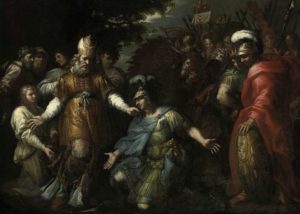
‘Alexander the Great and Jaddus the High Priest of Jerusalem’ by Pietro da Cortona (1596-1669)

According to one tradition, the priests at the time wanted to honour Alexander for his kindness, and named all the boys born that year “Alexander”. In another version, Alexander was given a tour of the Holy Temple and, naturally, wished to place a statue of himself inside. Since this was impossible (but they couldn’t refuse the emperor), Shimon haTzadik convinced him that it would be a greater honour for all the children born to be named “Alexander”. Either way, some like to say that “Alexander” has become a Jewish name ever since.

In truth, this suggestion looks more like a modern way of explaining why so many Jews were named Alexander. In reality, the Midrash clearly states that a Jew should not name his child Alexander. We read in Vayikra Rabbah 32:5:

In the merit of four things was Israel redeemed from Egypt: they did not change their names*, nor their language, they did not speak lashon hara, and not one among them committed sexually immoral sins… They did not call Yehuda “Rufus”, and not Reuben “Lullianus”, and not Yosef “Listus”, and not Benjamin “Alexander”…

Apparently, when Midrash Rabbah was composed—just like today—it was common for Jews to have a non-Jewish name that they would use regularly, together with a Hebrew name that they would use only in Jewish circles. The Hebrew name “Benjamin” was often paired with “Alexander”.

We see from the Midrash above that it is important to have a Hebrew or Jewish name. But what exactly counts as a “Jewish” name?

Non-Jewish “Jewish” Names

Although today most Jews insist on having Hebrew or Biblical names (and rightly so), it seems that our Sages weren’t so strict in this regard. Indeed, many of them bore Greek, Latin, or Aramaic names with no second Hebrew name. Akiva, Avtalyon, Nechunia, Mani, Nittai, Nehorai, Adda, Papa, Simlai, Tanhum, Tarfon, Ulla, and countless others are cited in rabbinic literature. As we saw earlier, those that did have Hebrew names naturally chose names that would be palatable to the surrounding Greeks, much like many Jews today choose names that have easy English homonyms.

This trend continued for centuries, all the way up to modern times. The result is that many seemingly “Jewish” names are actually adaptations of very non-Jewish names. For example, one popular name among Ashkenazi Jews in the past was Feivel or Feibush. This name, meaning “bright”, comes from Phoebus, one of the appellations for the Greco-Roman god of light, Apollo. With this in mind, there may actually be a big halachic problem of bearing this name, since it is forbidden to recite the names of idols. That said, the names Mordechai and Esther actually come from the Babylonian idols Marduk and Astarte, or Ishtar! Nonetheless, they became solid Jewish names, though this case is different because it comes with a clear source in Tanakh. Going back to Feivel, some say the name was only meant to substitute the Biblical name Shimshon, the root of which is “sun”, thus having a similar meaning to Phoebus or Apollo. Others link the name to Pavel, Paul, or Philipp, also not of Jewish origin.

Another appellation for Apollo was Lycegenes or Lukegenes, “born of a wolf” (possibly the source of the name “Luke”), which would be “Wolf” in Germanic countries, where the wolf was an important symbol in European mythology. Wolf also became very popular among Ashkenazis, who usually added the Hebrew translation Ze’ev to the name. The same is true for the classic German/Norse name Baer (“Bear”), to which Ashkenazis added Dov, its Hebrew translation. None of these names are Biblical or Talmudic, nor is their origin truly Hebrew. (Ironically, the name Ze’ev appears in the Tanakh [Judges 7:25] as the name of an enemy Midianite prince that the Israelites slayed!)

Having said that, many have linked these names to Biblical characters. For example, Benjamin is described in the Torah as a wolf (Genesis 49:27), so some carried the name “Binyamin Wolf”, where the former was their actual Jewish name while the latter was their social name. The same goes for “Yehuda Leib”, where Leib means “lion”, like Aryeh, the symbol of the Biblical Yehuda. It has even become common to combine all three to form “Yehuda Aryeh Leib”. Similarly, there’s “Naftali Tzvi Hirsch”, since the Biblical Naftali is described as a deer, ayalah or tzvi, and “Hirsch” is German for “deer”.
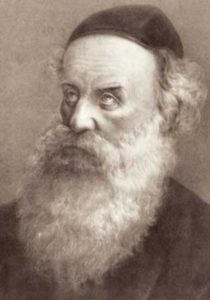
A portrait thought to be of Rabbi Schneur Zalman of Liadi, the “Alter Rebbe” (1745-1812). For more on the origins of this portrait, see here

“Schneur”, too, is of non-Jewish origin, and comes from the Spanish name Senor (and is sometimes a German equivalent for Seymour). Chassidim have since reinterpreted it in the Hebrew as Shnei Or, “two lights”. It probably didn’t have this meaning when it was given to Schneur Zalman of Liadi, the founder and first rebbe of Chabad. In his case, “Schneur” was likely meant to be his social name while “Zalman” (Solomon, or “Shlomo”) was his traditional Jewish or Hebrew name.

Sephardic Jews are just as culpable. Many have Arabic names like “Massoud” (which means “lucky”) or “Abdullah”. In fact, Rav Ovadia Yosef’s birth name was Yusuf Abdullah, and it was only when the family made aliyah to Israel that “Abdullah” was replaced with its Hebrew translation “Ovadia” (which is a Biblical name). At one point, a popular female Sephardic name was “Mercedes”. This one is highly problematic, as it happens to be a Spanish appellation for the Virgin Mary! (The automobile brand Mercedes is named after a Jewish girl of that name, the daughter of the company’s founder Emil Jellinek and his French-Sephardi wife.) A similar problem lies with the very popular “Natalie”, which literally means “Christmas” in Latin.

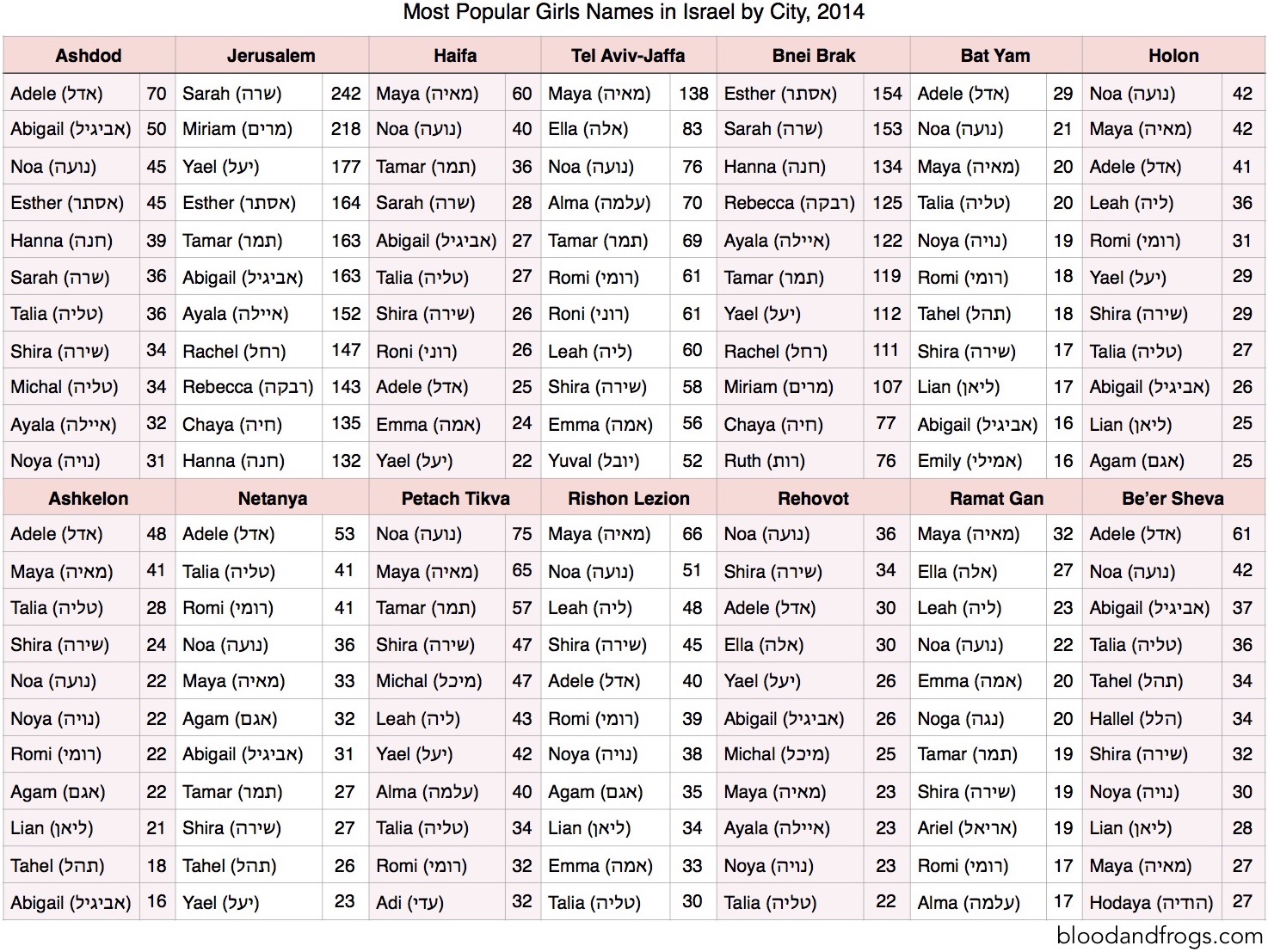
Is it okay to bear such names? A distinction must be made between those that clearly have an idolatrous origin versus those that were simply adapted from non-Jewish names but still carry a good meaning. The latter are certainly permissible, since many of our great Sages had such foreign names. Over time, many of these evolved a deeper, Jewish meaning. For instance, Adele was a classic German name (meaning “noble”) and yet the Baal Shem Tov chose it for his daughter. He explained to his chassidim that he received this name through divine inspiration, and that it is an acronym (אדל) for the important words in the Torah אש דת למו—that God gave His people “a fiery Torah” (Deuteronomy 33:2). The Torah, like fire, purifies all things. The Baal Shem Tov’s daughter went on to become a holy chassid of her own, imbued with so much Ruach haKodesh that she was nicknamed Adele HaNeviah, “Adele the Prophetess”.

Jewish “Non-Jewish” Names

The opposite case exists as well: names that appear to be non-Jewish but actually have a clear Jewish origin. Take “Elizabeth”, for example. While it may sound like a classic European name, it is actually the transliteration of “Elisheva” (אלישבע), the righteous wife of Aaron (Exodus 6:23). Some Jewish name sources incorrectly write that John is a non-Jewish name, associating it with the “New Testament” John. Yet, even that John was originally a Jewish man living in Israel, and “John” is simply a transliteration of the Hebrew name “Yochanan”. (It sounds closer in Germany and Eastern Europe, where “John” is “Johan”, or “Yohan”.)

There are numerous other examples. Susanna is Shoshana (שושנה), and Abigail is Avigayil (אביגיל). In the Tanakh, the latter makes an important comment about names, pointing out that because her first husband’s name was Naval (“abomination”) he acted abominably (I Samuel 25:25). She later married King David and is considered a prophetess in her own right.

Many are surprised to discover that “Jessica” comes from the Torah. It is an English adaptation of Iscah (יסכה), mentioned in Genesis 11:29 and, according to our Sages, the birth name of Sarah. Rashi comments:

Iscah. This is Sarah, because she would see [סוֹכָה] through divine inspiration, and because all gazed [סוֹכִין] at her beauty. Alternatively, יִסְכָּה is an expression denoting princedom [נְסִיכוּת], just as Sarah is an expression of dominion [שְׂרָרָה].

Interestingly, it appears that the earliest recorded use of the transliteration “Jessica” comes from Shakespeare’s play The Merchant of Venice. Here, Jessica is the Jewish daughter of the play’s Jewish villain, Shylock. Although many see The Merchant of Venice as an anti-Semitic work, others actually see it as Shakespeare’s cunning manipulation of that era’s rampant anti-Semitism and his own “plea for tolerance”. After all, Shylock’s most famous speech (Act III, Scene 1) reads:

Hath not a Jew eyes? Hath not a Jew hands, organs, dimensions, senses, affections, passions; fed with the same food, hurt with the same weapons, subject to the same diseases, heal’d by the same means, warm’d and cool’d by the same winter and summer as a Christian is? If you prick us, do we not bleed? If you tickle us, do we not laugh? If you poison us, do we not die? And if you wrong us, shall we not revenge? If we are like you in the rest, we will resemble you in that.

Shylock argues that his own villainy is nothing but a reflection of the villainy of the Christian world. Shakespeare recognized the cruelty that Jews had suffered, and tells his anti-Semitic audience that Jews are human, too.

Is It Necessary to Have a Hebrew Name?

Ultimately, it is certainly beneficial to have a Hebrew name of some sort, whether Biblical, Talmudic, adapted, or modern. After all, Hebrew is a holy language, and each of its letters carry profound meaning. The Hebrew term for “name” is shem (שם), which is a root of neshamah (נשמה), “soul”, and spelled the same as sham (שם), “there”, for it is there within a person’s name that his or her essence is found. For this reason, the Talmud (Yoma 83b) tells us that Rabbi Meir used to carefully analyze people’s name to determine their character. (This Talmudic passage was explored at length in Secrets of the Last Waters.)

The Talmud (Rosh Hashanah 16b) also notes that changing one’s name is one of five things a person can do to change their fate. Indeed, we see this multiple times in Scripture. Abraham and Sarah have their names changed (from Abram and Sarai) to allow them to finally have a child. Jacob becomes Israel, while Hoshea becomes Yehoshua (Joshua). At some point, Pinchas becomes Eliyahu, and even Yosef (Joseph) becomes Yehosef (Psalms 81:6). On that last name change, the Midrash explains that it was only because Yosef had an extra hei added to his name that he was able to ascend to Egyptian hegemony.

Thus, having a name with a deep meaning, in Hebrew letters, and one that is actually used regularly (as opposed to a secondary Hebrew name that no one calls you by) is of utmost significance. If you don’t yet have such a name, it isn’t too late to get one!

*This Midrash presents a possible contradiction: how can it say that the Israelites did not adopt Egyptian names when we see that some clearly did? Maybe most of the Israelites did not adopt Egyptian names, though some did. Thankfully, another Midrash (Pesikta Zutrati on parashat Ki Tavo) steps in to offer an alternate reason. Here, Israel was redeemed in the merit of three things: not changing their clothing, their food, and their language. Changing their names is conspicuously absent.


The above essay is adapted from Garments of Light, Volume Three.
Get the book here! 

The Mystical Meaning of Exile and Terrorism

This week we read the parasha of Bechukotai, famous for its list of blessings, and curses, should Israel faithfully follow God’s law, or not. In Leviticus 26:33, God warns that “I will scatter you among the nations, and I will draw out the sword after you; and your land shall be a desolation, and your cities shall be a waste.” These prophetic words have, of course, come true in Jewish history. Israel has indeed been exiled to the four corners of the world, and experienced just about every kind of persecution. Yet, within every curse there is a hidden blessing.

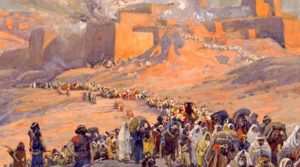
‘The Flight of the Prisoners’ by James Tissot, depicting the Jewish people being exiled to Babylon.

The Talmud (Pesachim 87b) states that the deeper purpose of exile is for the Jews to spread Godliness to the rest of the world. After all, our very mandate was to be a “light unto the nations” (Isaiah 42:6) and to spread knowledge of Hashem and His Torah. How could we ever accomplish this if we were always isolated in the Holy Land? It was absolutely necessary for Israel to be spread all over the globe in order to introduce people to Hashem, to be a model of righteousness, and to fulfil the various spiritual rectifications necessary to repair this broken world.

The Arizal explains that by praying, reciting blessings, and fulfilling mitzvot, a Jew frees the spiritual sparks trapped within the kelipot, literally “husks”. This idea hearkens back to the concept of Shevirat haKelim, the “Shattering of the Vessels”. The Arizal taught that God initially crafted an entirely perfect universe. Unfortunately, this world couldn’t contain itself and shattered into a multitude of pieces, spiritual “sparks” trapped in this material reality. While God had rebuilt most of the universe, He left it to Adam and Eve to complete the rectification through their own free will. They, too, could not affect that tikkun, and the cosmos shattered yet again. The process repeated itself on a number of occasions, the last major one being at the time of the Golden Calf.

Nonetheless, with each passing phase in history, more and more of those lost, trapped sparks are rediscovered and restored to their rightful place. The mystical mission of every Jew is to free those sparks wherever they go. The Arizal speaks of this at great length, and it permeates every part of his teachings. Eating, for example, serves the purpose of freeing sparks trapped within food—which is why it is so important to consume only kosher food, and to carefully recite blessings (which are nothing but fine-tuned formulas for spiritual rectification) before and after. The same is true with every mitzvah that we do, and every prayer we recite.

Thus, while exile is certainly difficult and unpleasant, it serves an absolutely vital spiritual purpose. This is why the Midrash states that exile is one of four things God created regretfully (Yalkut Shimoni on Isaiah, passage 424). It is why God already prophesied that we would be exiled—even though we hadn’t yet earned such a punishment! And it is why God also guaranteed that we would one day return to our Promised Land, as we have miraculously begun to do in recent decades.

Four, Five, or Eight Exiles?

In Jewish tradition, it is said that there are four major exiles: the Babylonian, the Persian, the Greek, and the Roman. We are still considered to be within the “Roman” or Edomite (European/Christian) exile. Indeed, the Roman Empire never really ended, and just morphed from one phase into another, from the Byzantine Empire to the Holy Roman Empire, and so forth.

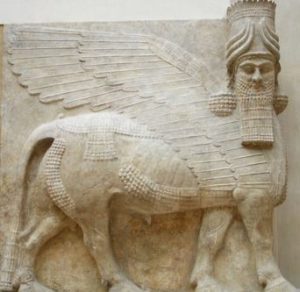
Babylonian Shedu

This idea of four exiles originated with Daniel’s vision of four great beasts (Daniel 7:3-7). The first was a lion with eagle wings—a well-known symbol of ancient Babylon. Then came a fierce bear, an animal which the Talmud always likens to the Persians. The swift leopard represents the Greeks that conquered the known world in lightning speed under Alexander the Great. The final and most devastating beast is unidentified, representing the longest and cruelest exile of Edom.

The Midrash states that Jacob himself foresaw these exiles in his vision of the ladder (Genesis 28). There he saw four angels, each going up a number of rungs on the ladder equal to the number of years Israel would be oppressed by that particular nation. The last angel continued to climb ever higher, with Jacob unable to see its conclusion, alluding to the current seemingly never-ending exile.  The big question is: why are these considered the four exiles. Haven’t the Jewish people been exiled all around the world? Have we not been oppressed by other nations besides these?

The Arizal explains (Sha’ar HaMitzvot on Re’eh) that while Jews have indeed been exiled among all seventy root nations, it is only in these four that all Jews were exiled in. Yet, he maintains that any place where even a single Jew has been exiled is considered as if the entire nation was exiled there. The Arizal further explains that these four exiles were already alluded to in Genesis 2:10-14, where the Torah describes the four rivers that emerged from Eden. Each river corresponds to one exile. The head river of Eden that gives rise to the other four corresponds to the very first exile of the Jews, the exile within which the Jewish people were forged: Egypt, the mother of all exiles.

Elsewhere, the Arizal adds that there is actually a fifth exile, that of Ishmael (Etz Ha’Da’at Tov, ch. 62). History makes this plainly evident, of course, as the Jewish people have suffered immensely under Arab and Muslim oppression to this very day. The idea of Ishmael being the final exile was known long before the Arizal, and is mentioned by earlier authorities. In fact, one tradition holds that each exile has two components:

We know that before the Babylonians came to destroy the Kingdom of Judah and its capital Jerusalem, the Assyrians had destroyed the northern Kingdom of Israel with the majority of the Twelve Tribes. We also know that the Persians were united with the Medians. Technically speaking, Alexander the Great was not a mainstream Greek, but a Macedonian. While he was the one who conquered Israel, his treatment of the Jews was mostly fair. It was only long after that the Seleucid Greeks in Syria really tried to extinguish the Jews. Thus, the doublets are Assyria-Babylon (Ashur-Bavel), Persia-Media (Paras-Madai), Macedon-Greece (Mokdon-Yavan), with the final doublet being Edom-Ishmael. The latter has a clear proof-text in the Torah itself, where we read how Esau (ie. Edom) married a daughter of Ishmael (Genesis 28:9). The Sages suggest that this is an allusion to the joint union between Edom and Ishmael to oppress Israel in its final exile.

The Arizal certainly knew the above, so why does he speak of a fifth exile under Ishmael, as well as a fifth (original) exile under Egypt?

The End is Wedged in the Beginning

One of the most well-known principles in Kabbalah is that “the end is wedged in the beginning, and the beginning in the end”. What the Arizal may have been hinting at is that the final Ishmaelite exile is a reflection of the original Egyptian exile. Indeed, the Arizal often speaks of how the final generation at the End of Days is a reincarnation of the Exodus generation. (According to one tradition, there were 15 million Jews in ancient Egypt, just as there are roughly 15 million in the world today.) The first redeemer Moses took us out of the Egyptian exile, and we await Moses’ successor, the final redeemer Mashiach, to free us from the Ishmaelite exile.

In highly symbolic fashion, the land of ancient Egypt is currently occupied by Muslim Arabs. The Ishmaelites have quite literally taken the place of ancient Egypt. Come to think of it, the lands of all the four traditional nations of exile are now Ishmaelite: Bavel is Iraq, Paras is Iran, Seleucid Greece is Syria, and the Biblical land of Edom overlaps Jordan. The four rivers of Eden would have run through these very territories. It is quite ironic that Saddam Hussein openly spoke of himself as a reincarnated Nebuchadnezzar, seeking to restore a modern-day Babylonian Empire. Meanwhile, each day in the news we hear of the looming Syria-Iran threat. Just as Egypt was the mother of all four “beasts”, it appears that the four beasts converge under a new Ishmaelite banner for one final End of Days confrontation.

There is one distinction however. In the ancient land of Egypt, all Jews were physically trapped. We do not see this at all today, where very few Jews remain living in Muslim states. Nonetheless, every single Jew around the world, wherever they may be, is living under an Ishmaelite threat. Muslims in France, for example, have persistently attacked innocent Jews in horrific acts—so much so that recently 250 French intellectuals, politicians, and even former presidents banded together to demand action against this absurd violence and anti-Semitism. Similar acts of evil have taken place all over the world. This has been greatly exacerbated by the recent influx of Muslim refugees to the West, as admitted by Germany’s chancellor Angel Merkel who recently stated: “We have refugees now… or people of Arab origin, who bring a different type of anti-Semitism into the country…”

In 2017, Swedish police admitted that there are at least 23 “no-go” Sharia Law zones in their country.

It is important to note that when Scripture speaks of the End of Days, it is not describing a regional conflict, but an international one. The House of Ishmael is not a local threat to Israel alone, or only to Jewish communities, but to the entire globe. Every continent has felt the wrath of Islamist terrorism, and whole communities in England, France, and even America have become cordoned off as “sharia law” zones. Ishmael is even a threat to himself. Muslims kill each other far more than they kill non-Muslims. In 2011, the National Counter-Terrorism Center reported that between 82% and 97% of all Islamist terror victims are actually Muslim. All but three civil wars between 2011 and 2014 were in Muslim countries, and all six civil wars that raged in 2012 were in Muslim countries. In 2013, the U.S. Commission on International Religious Freedom showed that 10 of the 15 most intolerant and oppressive states in the world were Muslim ones.

The Torah wasn’t wrong when it prophesied (Genesis 16:12) that Ishmael would be a “wild man; his hand against every man, and every man’s hand against him, and upon all of his brothers he will dwell.” Every Jew—and every human being for that matter—is experiencing an Ishmaelite exile at present.

The Exile Within

There is one more way of looking at the four exiles: not as specific nations under whom we were once oppressed, but as four oppressive forces that have always constrained Israel, and continue to do so today. These are the four root issues plaguing the Jews, and keeping us in “exile” mode.

The first is Edom, that spirit of materialism and physicality embodied by Esau. Unfortunately, such greed and gluttony has infiltrated just about every Jewish community, including those that see themselves as the most spiritual. The second, Bavel, literally means “confusion”, that inexplicable madness within the Jewish nation; the incessant infighting, the divisiveness, and the sinat chinam. Yavan is Hellenism, or secularism. In Hebrew, the word for a secular Jew is hiloni, literally a “Hellene”. Just as this week’s parasha clearly elucidates, abandoning the Torah is a root cause of many ills that befall the Jews. Finally, there is Paras. It was because the Jews had assimilated in ancient Persia that the events of Purim came about. Paras represents that persistent problem of assimilation.

It is important to point out that assimilation is different from secularism. There are plenty of secular Jews that are also very proud Jews. They openly sport a magen David around their neck, worry every day about Israel, want their kids to marry only other Jews, and though they don’t want to be religious, still try to connect to their heritage, language, and traditions. The assimilated Jew is not that secular Jew, but the one that no longer cares about their Jewish identity. It is the Jew that entirely leaves the fold. Sometimes, it is the one that becomes a “self-hating” Jew, or converts to another religion. Such Jews have been particularly devastating to the nation, and often caused tremendous grief. Some of the worst Spanish inquisitors were Jewish converts to Catholicism. Karl Marx and the Soviet Communists that followed are more recent tragedies. Not only do they leave their own people behind, they bring untold suffering to their former compatriots.

While there may be literal Babylonians, Persians, Greeks, and Edomites out there, the bigger problem for the Jewish people is the spiritual Bavel, Paras, Yavan, and Edom that infects the hearts and minds of the nation: infighting, assimilation, secularism, materialism. It is these issues that we should be spending the most time meditating upon, and expending the most effort to solve. Only when we put these problems behind us can we expect to see the long-awaited end to exile.

Who is Ahashverosh?

This Wednesday evening marks the start of Purim. The events of Purim, as described in the Book of Esther, take place in the Persian Empire during the time of King Ahashverosh. Who is this king? Is there a historical figure that matches up with what we know of the Biblical Ahashverosh? And when exactly did the Purim story happen?

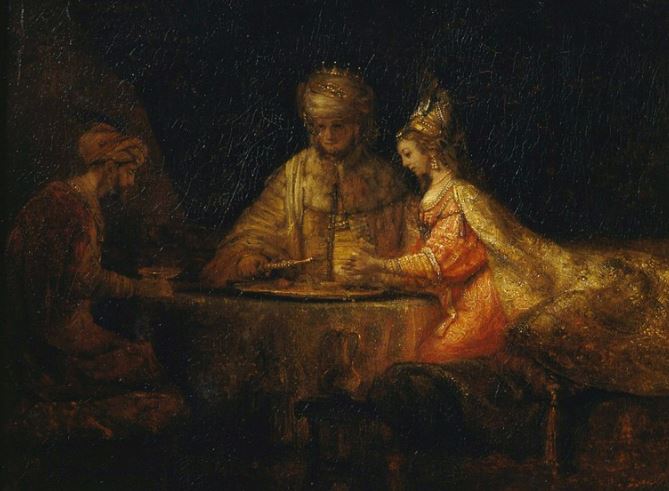
Ahaseurus and Haman at Esther’s Feast, by Rembrandt

Not long after Jerusalem was destroyed by Nebuchadnezzar and the Jews exiled to Babylon, the Babylonian Empire itself fell to the Persians. This was prophesied by Isaiah (45:1), who went so far as to describe the liberating Persian King Cyrus as “mashiach”! In one place (Megillah 12a), the Talmud states that he was obviously not the messiah—though perhaps a potential one—while in another (Rosh Hashanah 3b) it admits that he was “kosher”, and this is why his name (Koresh in Hebrew and Old Persian) is an anagram of kosher.

According to the accepted historical chronology, Cyrus took over the Babylonian Empire in 539 BCE. The Temple was destroyed some five decades earlier in 586 BCE. Our Sages, too, knew that the Babylonian Captivity lasted less than the seventy years prophesied by Jeremiah. They explained that although Cyrus freed the Jews before seventy years, they were unable to actually rebuild the Temple until seventy years had elapsed. In secular chronology, its rebuilding thus took place in 516 BCE. This was in the reign of the next great Persian king, Darius (r. 522-486 BCE). His son and successor was the famous Xerxes I (485-465 BCE), or in Old Persian Khshayarsha, ie. Ahashverosh.

Despite the name, many believe that the Ahashverosh of Purim is not Xerxes I. Scholars have suggested other possibilities, including one of several kings named Artaxerxes. The problem with Artaxerxes is that first of all the name does not match at all, being Artashacha in Old Persian, and second of all the name actually appears elsewhere in Scripture, in the books of Ezra and Nehemiah, as Artachshashta (אַרְתַּחְשַׁשְׂתָּא). This is clearly not Ahashverosh (אֲחַשְׁוֵרוֹשׁ). Having said that, Ezra 6:14 may imply that Artachshashta and Ahashverosh are one and the same. This verse lists Cyrus, then Darius, then Artachshashta, whereas we know from historical sources that following Cyrus was Cambyses, then the more famous Darius, followed by Xerxes I.

The Book of Daniel complicates things further. Daniel speaks of a Darius that conquers Babylon. Yet we know for a fact that it was Cyrus who conquered Babylon. Some scholars therefore say that Daniel is confusing Darius with Cyrus. Others say this “Darius the Mede” conquered Babylon alongside Cyrus, and this version has been accepted by many in the Jewish tradition. Later, Daniel 9:1 says that Darius was a son of Ahashverosh! Hence, some Jewish sources state that the Persian king Darius was the son of Esther. This suggests an entirely different Darius, and historical sources do speak of three Dariuses, the last one being defeated by Alexander the Great.

Perhaps the only way to find the real Ahashverosh is to ignore the other Biblical books and focus solely on Megillat Esther. In this case, the name Ahashverosh only fits Xerxes. There were two Xerxeses in ancient Persia. Xerxes II, though, ruled for just 45 days before being assassinated. That leaves us with Xerxes I. Does the Purim Ahashverosh match the historical Xerxes?

Xerxes the Great

Xerxes was born around 518 BCE to King Darius I and his wife Atossa, who was the daughter of Cyrus the Great. Xerxes was thus a grandson of the first Persian emperor. When Darius I died, his eldest son Artobazan claimed the throne. Xerxes argued that he should be king since he was the son of Atossa, the daughter of Cyrus. Ultimately, it was Xerxes that was crowned, thanks to his mother’s influence. This may be related to the Talmud’s suggestion that Ahashverosh claimed his authority through his wife Vashti, who was the daughter of a previous emperor, while Ahashverosh was just a usurper.

Xerxes immediately solidified his rule and crushed a number of rebellions. He melted down the massive idolatrous statue of Bel, or Marduk, the chief Babylonian god, triggering a number of rebellions by the Babylonians. Xerxes thus removed “king of Babylon” from his official title in an attempt to wipe out any mention of the former Babylon. He remained as “king of Persia and Media, great king, king of kings, and king of nations”.*

Xerxes is undoubtedly most famous for his massive invasion of Greece in 480 BCE, and particularly the difficulties he experienced at the Battle of Thermopylae (where he faced off against “300” Spartans). Returning home without victory, he focused on large construction projects. The ancient Greek historian (and contemporary of Xerxes) Herodotus (c. 485-425 BCE) notes that Xerxes built a palace in Susa. This is, of course, the Shushan HaBirah, “Susa the Capital” mentioned multiple times in the Megillah. Herodotus further states that Xerxes ruled from his capital in Susa over many provinces “from India to Ethiopia”, just as the Megillah says.

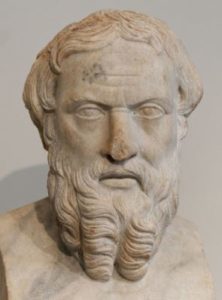
Bust of Herodotus

Herodotus also writes how Xerxes loved women and regularly threw parties where the wine never stopped flowing. Indeed, Megillat Esther speaks of the mishteh, literally “drinking party” that Ahashverosh threw. More specifically, Herodotus wrote how Xerxes returned to Persia from his failed Greek invasion in the “tenth month of his seventh year” and spent a lot of time sulking with his large harem of women. Incredibly, the Megillah also states that “Esther was taken unto king Ahashverosh into his palace in the tenth month, which is the month Tevet, in the seventh year of his reign” (Esther 2:16). This is unlikely to be a coincidence.

More amazing still, among the historical records from the time of Xerxes I that have been found we find the name of a court official named Marduka. Interestingly, this Marduka is given no other titles. It isn’t hard to see the connection to Mordechai, also an untitled official in the court of Ahashverosh.

Xerxes’ reign came to an end in 465 BCE when he was unceremoniously assassinated. His eldest son Darius, who should have succeeded him, was killed, too. This once again may relate to the Jewish tradition of Ahashverosh having a son with Esther called Darius.

However, Xerxes’ son Darius was the child of his queen Amestris, or Amastri, the daughter of a Persian nobleman. Historical sources speak of her in the most negative of terms. Herodotus writes that she buried people alive, and she apparently brutally tortured and mutilated a relative she wanted to punish. She was jealous of her husband’s extramarital affairs, and power-hungry in her own right. Although the name Amestris may sound more similar to the name Esther, Amestris’ character fits the profile of a cruel Queen Vashti quite well (see Megillah 12b).**

A Historical Nightmare

One of the greatest issues in Biblical chronology is the problem of the so-called “missing years”. As mentioned, secular scholarship has 586 BCE (or 587 BCE) as the year of the Temple’s destruction and 516 BCE as its rebuilding. Traditional Jewish dating has around 424 BCE (or 423 or even 421 BCE) for the destruction and 354 BCE (or 349 BCE) for the reconstruction. That’s a discrepancy of some 160 years!

Generally, it is concluded that the Jewish traditional dating is simply wrong, as the Sages did not have access to all the historical and archaeological sources that we have today. As we wrote in the past, the Talmud and other ancient Jewish sources do have occasional historical errors, and this has already been noted by rabbis like the Ibn Ezra and Azariah dei Rossi (c. 1511-1578). Still, the traditional Jewish dating need not be thrown out the door just yet.

In his The Challenge of Jewish History: The Bible, The Greeks, and The Missing 168 Years, Rabbi Alexander Hool makes a compelling case for rethinking the accepted chronology. He brings an impressive amount of evidence suggesting that Alexander the Great did not defeat Darius III, but rather Darius I! After Alexander, the Seleucids did not rule over all of Persia, but only the former Babylonian provinces, while the Persian Empire continued to co-exist alongside the Greek. Interestingly, there is another version of Megillat Esther (sometimes called the Apocryphal Book of Esther) which may support the theory. While the apocryphal version is certainly a later edition and not the authentic one, it still provides some additional information which may be useful. This Book of Esther actually says Haman was a Macedonian, like Alexander the Great, which fits neatly with Hool’s theory. Having said that, Hool’s theory is very difficult to accept, and would require rewriting a tremendous amount of history while ignoring large chunks of opposing evidence. Elsewhere, though, he may be right on point.

Hool suggests that Cyrus and the mysterious “Darius the Mede” are one and the same person, with evidence showing “Darius” is a title rather than a proper name. He argues that “Ahashverosh” may be a title, too, and concludes that the Ahashverosh of Purim is none other than Cambyses II (r. 530-522 BCE), the son of Cyrus. This suggestion fits well with the chronology presented in Jewish sources (especially Seder Olam) and with the Tanakh (where, for example, Darius I is the son of Ahashverosh in the Book of Daniel). It also fits with the description of Cambyses given by Herodotus, who says Cambyses was a madman with wild mood swings, much like the Ahashverosh in the Megillah. The timing is excellent, too, fitting inside the seventy year period before the Second Temple was rebuilt and while the Jews were still in exile mode.

Identifying Cambyses with Ahashverosh opens up a host of other problems though. The Megillah has Ahashverosh reigning for at least a dozen years, whereas Cambyses only reigned for about seven and a half. The other details that we know of Cambyses’ life and love interests do not match Ahashverosh either. Point for point, it seems that Xerxes I still fits the bill of Ahashverosh much better than anyone else, despite the chronological mess.

At the end of the day, history before the Common Era is so frustratingly blurry that it is difficult to conclude much with certainty. Without a doubt, there are historical errors and miscalculations in both secular scholarship and in ancient Jewish sources. It seems the identity of Ahashverosh and the exact chronology between the destruction of the First and Second Temples is one mystery that can’t be solved at the moment.


*Perhaps Xerxes’ father Darius is the one called “Darius the Mede” (being unrelated to Cyrus). This makes more sense chronologically if Daniel was one of the original Jewish exiles, as the Tanakh suggests. The Book of Daniel should have said that Ahashverosh was the son of Darius, and not vice versa. In fact, the Talmud (Megillah 12a) admits that Daniel erred in some chronological details. This may be why the Book of Daniel is not always considered an authoritative prophetic book, and is included in the Ketuvim, not the Nevi’im. In Jewish tradition, Daniel is typically excluded from the list of official prophets.

**The Talmud suggests that Vashti was the daughter of Nebuchadnezzar (Megillah 10b) or Belshazzar (Megillah 12b), while Ahashverosh was only the son of their stable-master. This makes little sense chronologically or historically. Scholars have pointed out that this extra-Biblical suggestion in the Talmud may have been adapted from the popular Persian story of the king Ardashir I (180-242 CE), which would have been well-known in Talmudic times.


The above essay is adapted from Garments of Light, Volume Three.
Get the book here!