Category Archives: Mysteries & Origins

Things You Didn’t Know About the Talmud

Judaism is famously built upon an “oral tradition”, or Oral Torah, that goes along with the Written Torah. The primary body of the Oral Torah is the Talmud. At the end of this week’s parasha, Mishpatim, the Torah states:

And Hashem said to Moses: “Ascend to Me on the mountain and be there, and I will give you the Tablets of Stone, and the Torah, and the mitzvah that I have written, that you may teach them…

The Talmud (Berakhot 5a) comments on this that the “Tablets” refers to the Ten Commandments, the “Torah” refers to the Five Books of Moses, the “mitzvah” is the Mishnah, “that I have written” are the books of the Prophets and Holy Writings, and “that you may teach them” is the Talmud. The Mishnah is the major corpus of ancient Jewish oral law, and the Talmud, or Gemara, is essentially a commentary on the Mishnah, with a deeper exposition and derivation of its laws. Today, the Mishnah is printed together with the corresponding Gemara, along with multiple super-commentaries laid out all around the page, and this whole is typically referred to as “Talmud”.
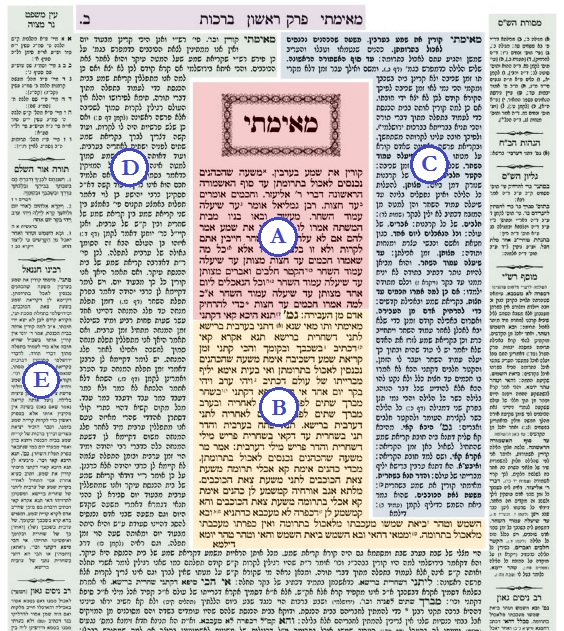
Anatomy of a page of Talmud: (A) Mishnah, (B) Gemara, (C) Commentary of Rashi, Rabbi Shlomo Itzchaki, 1040-1105, (D) Tosfot, a series of commentators following Rashi, (E) various additional commentaries around the edge of the page.

In the past, we’ve written how many have rejected the Talmud, starting with the ancient Sadducees, later the Karaites (whom some consider to be the spiritual descendants of the Sadducees), as well as the Samaritans, and many modern-day Jews whether secular or Reform. Such groups claim that either there was never such a thing as an “oral tradition” or “oral law”, or that the tradition is entirely man-made with no divine basis. Meanwhile, even in the Orthodox Jewish world there are those who are not quite sure what the Talmud truly is, and how its teachings should be regarded. It is therefore essential to explore the origins, development, importance, and necessity of the Talmud.

An Oral Torah

There are many ways to prove that there must be an oral tradition or Oral Torah. From the very beginning, we read in the Written Torah how God forged a covenant with Abraham, which passed down to Isaac, then Jacob, and so on. There is no mention of the patriarchs having any written text. These were oral teachings being passed down from one generation to the next.

Later, the Written Torah was given through the hand of Moses, yet many of its precepts are unclear. Numerous others do not seem to be relevant for all generations, and others still appear quite distasteful if taken literally. We have already written in the past that God did not intend for us to simply observe Torah law blindly and unquestioningly. (See ‘Do Jews Really Follow the Torah?’ in Garments of Light.) Rather, we are meant to toil in its words and extract its true meanings, evolve with it, and bring the Torah itself to life. The Torah is not a reference manual that sits on a shelf. It is likened to a living, breathing entity; a “tree of life for those who grasp it” (Proverbs 3:18).

Indeed, this is what Joshua commanded the nation: “This Torah shall not leave your mouth, and you shall meditate upon it day and night, so that you may observe to do like all that is written within it” (Joshua 1:8). Joshua did not say that we must literally observe all that is written in it (et kol hakatuv bo), but rather k’khol hakatuv bo, “like all that is written”, or similar to what is written there. We are not meant to simply memorize its laws and live by them, but rather to continuously discuss and debate the Torah, and meditate upon it day and night to derive fresh lessons from it.

Similarly, Exodus 34:27 states that “God said to Moses: ‘Write for yourself these words, for according to these words I have made a covenant with you and with Israel.’” Firstly, God told Moses to write the Torah for yourself, and would later remind that lo b’shamayim hi, the Torah “is not in Heaven” (Deuteronomy 30:12). It was given to us, for us to dwell upon and develop. Secondly, while the words above are translated as “according to these words”, the Hebrew is al pi hadevarim, literally “on the mouth”, which the Talmud says is a clear allusion to the Torah sh’be’al peh, the Oral Torah, literally “the Torah that is on the mouth”.

The Mishnah
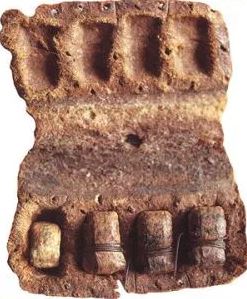
2000-year old tefillin discovered in Qumran

It is evident that by the start of the Common Era, Jews living in the Holy Land observed a wide array of customs and laws which were not explicitly mentioned in the Torah, or at least not explained in the Torah. For example, tefillin was quite common, and they have been found in the Qumran caves alongside the Dead Sea Scrolls (produced by a fringe Jewish group, likely the Essenes) and are even mentioned in the New Testament. Yet, while the Torah mentions binding something upon one’s arm and between one’s eyes four times, it does not say what these things are or what they look like. Naturally, the Sadducees (like the Karaites) did not wear tefillin, and understood the verses metaphorically. At the same time, though, the Sadducees (and the Karaites and Samaritans) did have mezuzot. Paradoxically, they took one verse in the passage literally (Deuteronomy 6:9), but the adjoining verse in the same passage (Deuteronomy 6:8) metaphorically!

This is just one example of many. The reality is that an oral tradition outside of the Written Law is absolutely vital to Judaism. Indeed, most of those anti-oral law groups still do have oral traditions and customs of their own, just not to the same extent and authority of the Talmud.

Regardless, after the massive devastation wrought by the Romans upon Israel during the 1st and 2nd centuries CE, many rabbis felt that the Oral Torah must be written down or else it might be lost. After the Bar Kochva Revolt (132-136 CE), the Talmud suggests there were less than a dozen genuine rabbis left in Israel. Judaism had to be rebuilt from the ashes. Shortly after, as soon as an opportunity presented itself, Rabbi Yehuda haNasi (who was very wealthy and well-connected) was able to put the Oral Torah into writing, likely with the assistance of fellow rabbis. The result is what is known as the Mishnah, and it was completed by about 200 CE.

The Mishnah is organized into six orders, which are further divided up into tractates. Zera’im (“Seeds”) is the first order, with 11 tractates mainly concerned with agricultural laws; followed by Mo’ed (holidays) with 12 tractates discussing Shabbat and festivals; Nashim (“Women”) with 7 tractates focusing on marriage; Nezikin (“Damages”) with 10 tractates of judicial and tort laws; Kodashim (holy things) with 11 tractates on ritual laws and offerings; and Tehorot (purities) with 12 tractates on cleanliness and ritual purity.

The root of the word “Mishnah” means to repeat, as it had been learned by recitation and repetition to commit the law to memory. Some have pointed out that Rabbi Yehuda haNasi may have used earlier Mishnahs compiled by Rabbi Akiva and one of his five remaining students, Rabbi Meir, who lived in the most difficult times of Roman persecution. Considering the circumstances of its composition, the Mishnah was written in short, terse language, with little to no explanation. It essentially presents only a set of laws, usually with multiple opinions on how each law should be fulfilled. To explain how the laws were derived from the Written Torah, and which opinions should be given precedence, another layer of text was necessary.

The Gemara
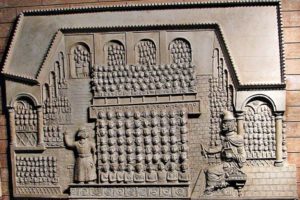
Rav Ashi teaching at the Sura Academy – a depiction from the Diaspora Museum in Tel Aviv

Gemara, from the Aramaic gamar, “to study” (like the Hebrew talmud), is that text which makes sense of the Mishnah. It was composed over the next three centuries, in two locations. Rabbis in the Holy Land produced the Talmud Yerushalmi, also known as the Jerusalem or Palestinian Talmud, while the Sages residing in Persia (centred in the former Babylonian territories) produced the Talmud Bavli, or the Babylonian Talmud. The Yerushalmi was unable to be completed as the persecutions in Israel reached their peak and the scholars could no longer continue their work. The Bavli was completed around 500, and its final composition is attributed to Ravina (Rav Avina bar Rav Huna), who concluded the process started by Rav Ashi (c. 352-427 CE) two generations earlier.

While incomplete, the Yerushalmi also has much more information on the agricultural laws, which were pertinent to those still living in Israel. In Persia, and for the majority of Jews living in the Diaspora, those agricultural laws were no longer relevant, so the Bavli does not have Gemaras on these Mishnaic tractates. Because the Yerushalmi was incomplete, and because it also discussed laws no longer necessary for most Jews, and because the Yerushalmi community was disbanded, it was ultimately the Talmud Bavli that became the dominant Gemara for the Jewish world. To this day, the Yerushalmi is generally only studied by those who already have a wide grasp of the Bavli.

The Talmud is far more than just an exposition on the Mishnah. It has both halachic (legal) and aggadic (literary or allegorical) aspects; contains discussions on ethics, history, mythology, prophecy, and mysticism; and speaks of other nations and religions, science, philosophy, economics, and just about everything else. It is a massive repository of wisdom, with a total of 2,711 double-sided pages (which is why the tractates are cited with a page number and side, for example Berakhot 2a or Shabbat 32b). This typically translates to about 6,200 normal pages in standard print format.

Placing the Talmud

With so much information, it is easy to see why the Talmud went on to take such priority in Judaism. The Written Torah (the Tanakh as a whole) is quite short in comparison, and can be learned more quickly. It is important to remember that the Talmud did not replace the Tanakh, as many wrongly claim. The following graphic beautifully illustrates all of the Talmud’s citations to the Tanakh, and how the two are inseparable:
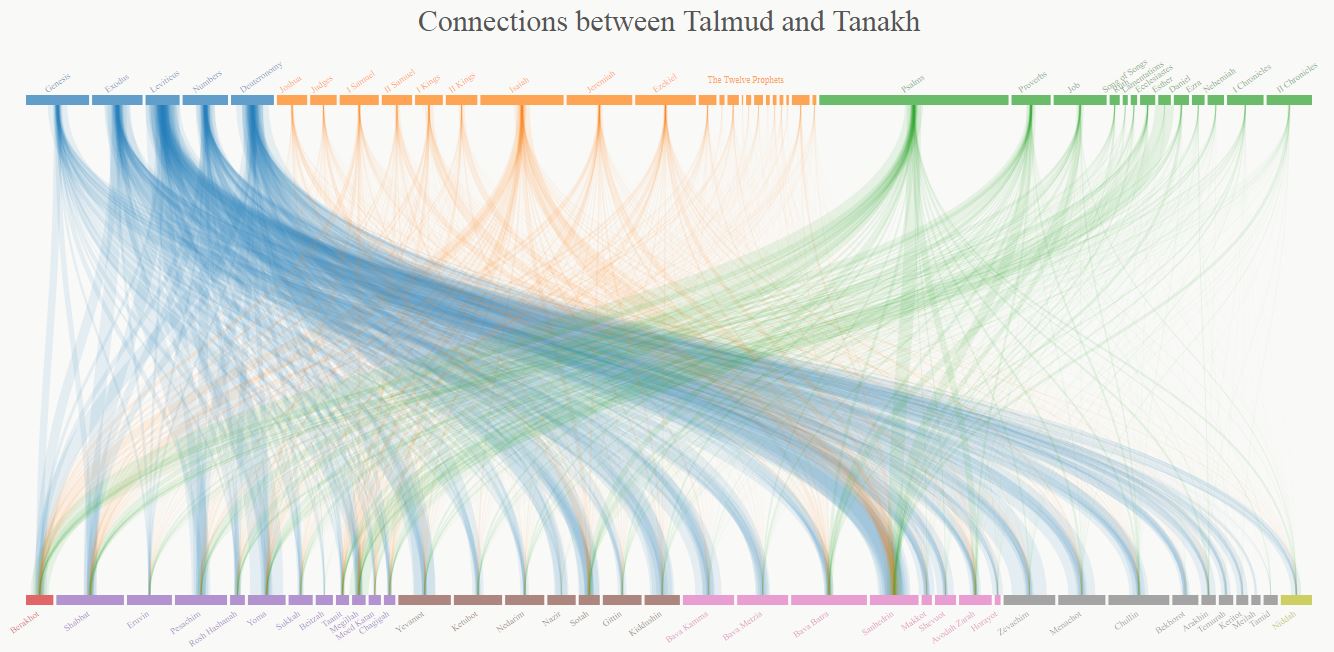
(Credit: Sefaria.org) It is said of the Vilna Gaon (Rabbi Eliyahu Kramer, 1720-1797) that past a certain age he only studied Tanakh, as he knew how to derive all of Judaism, including all of the Talmud, from it.

Indeed, it is difficult to properly grasp the entire Tanakh (which has its own host of apparent contradictions and perplexing passages) without the commentary of the Talmud. Once again, it is the Talmud that brings the Tanakh to life.

Partly because of this, Jews have been falsely accused in the past of abandoning Scripture in favour of the Talmud. This was a popular accusation among Christians in Europe. It is not without a grain of truth, for Ashkenazi Jews did tend to focus on Talmudic studies and less on other aspects of Judaism, Tanakh included. Meanwhile, the Sephardic Jewish world was known to be a bit better-rounded, incorporating more Scriptural, halachic, and philosophical study. Sephardic communities also tended to be more interested in mysticism, producing the bulk of early Kabbalistic literature. Ashkenazi communities eventually followed suit.

Ironically, so did many Christian groups, which eagerly embraced Jewish mysticism. Christian Knorr von Rosenroth (1636-1689) translated portions of the Zohar and Arizal into Latin, publishing the best-selling Kabbalah Denudata. Long before him, the Renaissance philosopher Pico della Mirandola (1463-1494), one of Michelangelo’s teachers, styled himself a “Christian Kabbalist”, as did the renowned scholar Johann Reuchlin (1455-1522). Meanwhile, Isaac Newton’s copy of the Zohar can be still found at Cambridge University. It is all the more ironic because Kabbalah itself is based on Talmudic principles, as derived from the Tanakh. For example, the central Kabbalistic concept of the Ten Sefirot is first mentioned in the Talmudic tractate of Chagigah (see page 12a), which also outlines the structure of the Heavenly realms. The Talmud is first to speak of the mystical study of Ma’aseh Beresheet (“Mysteries of Creation”) and Ma’aseh Merkavah (“Mysteries of the Divine Chariot”), of Sefer Yetzirah, of spiritual ascent, of how angels operate, and the mechanics of souls.

Having said all that, the Talmud is far from easy to navigate. While it contains vast riches of profound wisdom and divine information, it also has much that appears superfluous and sometimes outright boring. In fact, the Talmud (Sanhedrin 24a) itself admits that it is not called Talmud Bavli because it was composed in Babylon (since it really wasn’t) but because it is so mebulbal, “confused”, the root of Bavli, or Babel.

Of course, the Written Torah, too, at times appears superfluous, boring, or confused. The Midrash (another component of the Oral Torah) explains why: had the Torah been given in the correct order, with clear language, then anyone who read it would be “able to raise the dead and work miracles” (see Midrash Tehillim 3). The Torah—both Written and Oral—is put together in such a way that mastering it requires a lifetime of study, contemplation, and meditation. One must, as the sage Ben Bag Bag said (Avot 5:21), “turn it and turn it, for everything is in it; see through it, grow old with it, do not budge from it, for there is nothing better than it.”

Defending the Talmud

There is one more accusation commonly directed at the Talmud. This is that the Talmud contains racist or xenophobic language, or perhaps immoral directives, or that it has many flaws and inaccuracies, or that it contains demonology and sorcery. Putting aside deliberate mistranslations and lies (which the internet is full of), the truth is that, taken out of context, certain rare passages in the vastness of the Talmud may be read that way. Again, the same is true for the Written Torah itself, where Scripture also speaks of demons and sorcery, has occasional xenophobic overtones, apparent contradictions, or directives that we today recognize as immoral.

First of all, it is important that things are kept in their historical and textual context. Secondly, it is just as important to remember that the Talmud is not the code of Jewish law. (That would be the Shulchan Arukh, and others.) The Talmud presents many opinions, including non-Jewish sayings of various Roman figures, Greek philosophers, and Persian magi. Just because there is a certain strange statement in the Talmud does not mean that its origin is Jewish, and certainly does not mean that Jews necessarily subscribe to it. Even on matters of Jewish law and custom, multiple opinions are presented, most of which are ultimately rejected. The Talmud’s debates are like a transcript of a search for truth. False ideas will be encountered along the way. The Talmud presents them to us so that we can be aware of them, and learn from them.

And yes, there are certain things in the Talmud—which are not based on the Torah itself—that may have become outdated and disproven. This is particularly the case with the Talmud’s scientific and medical knowledge. While much of this has incredibly stood the test of time and has been confirmed correct by modern science, there are others which we know today are inaccurate. This isn’t a new revelation. Long ago, Rav Sherira Gaon (c. 906-1006) stated that the Talmudic sages were not doctors, nor were they deriving medical remedies from the Torah. They were simply giving advice that was current at the time. The Rambam held the same (including Talmudic astronomy and mathematics under this category, see Moreh Nevuchim III, 14), as well as the Magen Avraham (Rabbi Avraham Gombiner, c. 1635-1682, on Orach Chaim 173:1) and Rav Shimshon Raphael Hirsch. One of the major medieval commentaries on the Talmud, Tosfot, admits that nature changes over time, which is why the Talmud’s science and medicine may not be accurate anymore. Nonetheless, there are those who maintain that we simply do not understand the Talmud properly—and this is probably true as well.

Whatever the case, the Talmud is an inseparable part of the Torah, and an integral aspect of Judaism. Possibly the greatest proof of its significance and divine nature is that it has kept the Jewish people alive and flourishing throughout the difficult centuries, while those who rejected the Oral Torah have mostly faded away. The Talmud remains among the most enigmatic texts of all time, and perhaps it is this mystique that brings some people to fear it. Thankfully, knowledge of the Talmud is growing around the world, and more people than ever before are taking an interest in, and benefitting from, its ancient wisdom.
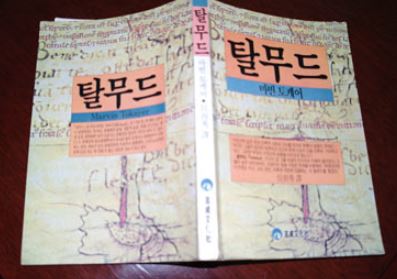
A bestselling Korean book about the Talmud. Fascination with the Talmud is particularly strong in the Far East. A Japanese book subtitled “Secrets of the Talmud Scriptures” (written by Rabbi Marvin Tokayer in 1971) sold over half a million copies in that country, and was soon exported to China and South Korea. More recently, a Korean reverend founded the “Shema Education Institute” and published a six-volume set of “Korean Talmud”, with plans to translate it into Chinese and Hindi. A simplified “Talmud” digest book became a bestseller, leading Korea’s ambassador to Israel to declare in 2011 that every Korean home has one. With the Winter Olympics coming up in Korea, it is appropriate to mention that Korean star speed skater Lee Kyou-Hyuk said several years ago: “I read the Talmud every time I am going through a hard time. It helps to calm my mind.”
 

The Kabbalah of Moses’ Divine Staff

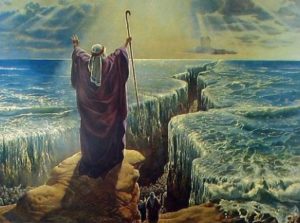
In this week’s parasha, Va’era, we read about the first seven plagues to strike Egypt. These were brought about through the Staff of Moses, as were the later Splitting of the Sea, the victory over Amalek (Exodus 17) and the water brought forth from a rock. What was so special about this particular staff, and what was the source of its power?

Pirkei Avot (5:6) famously states that the Staff was one of ten special things to be created in the twilight between the Sixth Day and the first Shabbat. The Midrash (Pirkei d’Rabbi Eliezer, ch. 40) elaborates:

Rabbi Levi said: That staff which was created in the twilight was delivered to the first man out of the Garden of Eden. Adam delivered it to Enoch, and Enoch delivered it to Noah, and Noah to Shem. Shem passed it on to Abraham, Abraham to Isaac, and Isaac to Jacob, and Jacob brought it down to Egypt and passed it on to his son Joseph, and when Joseph died and they pillaged his household goods, it was placed in the palace of Pharaoh.

And Jethro was one of the magicians of Egypt, and he saw the staff and the letters which were upon it, and he desired it in his heart, and he took it and brought it, and planted it in the midst of the garden of his house. No one was able to approach it any more.

When Moses came to his house, he went into Jethro’s garden, and saw the staff and read the letters which were upon it, and he put forth his hand and took it. Jethro watched Moses, and said: “This one in the future will redeem Israel from Egypt.” Therefore, he gave him Tzipporah his daughter to be his wife…

God gave the staff to Adam, who gave it to Enoch (Hanokh)—who later transformed into the angel Metatron—and Enoch passed it on further until it got to Joseph in Egypt. The Pharaoh confiscated it after Joseph’s death. The passage then alludes to another Midrashic teaching that Jethro (Yitro), Moses’ future father-in-law, was once an advisor to Pharaoh, along with Job and Bila’am (see Sanhedrin 106a). The wicked Bila’am was the one who advised Pharaoh to drown the Israelite male-born in the Nile. While Job remained silent (for which he was so severely punished later), Jethro protested the cruel decree, and was forced to resign and flee because of it. As he fled, he grabbed the divine staff with him. Arriving in Midian, his new home, Jethro stuck the staff in the earth, at which point it seemingly gave forth deep roots and was immovable.

A related Midrash states that all the suitors that sought the hand of his wise and beautiful Tzipporah were asked to take the staff out of the earth, and should they succeed, could marry Jethro’s daughter. None were worthy. (Not surprisingly, some believe that this Midrash may have been the source for the Arthurian legend of the sword Excalibur.) Ultimately, Moses arrived and effortlessly pulled the staff out of the ground.

The passage above states that Moses was mesmerized by the letters engraved upon the staff, as was Jethro before him. What were these letters?

The 72 Names

Targum Yonatan (on Exodus 4:20) explains:

And Moses took the rod which he had brought away from the chamber of his father-in-law, made from the sapphire Throne of Glory; its weight forty se’ah; and upon it was engraved and set forth the Great and Glorious Name by which the signs should be wrought before Hashem by his hand…

God’s Ineffable Name was engraved upon the sapphire staff, which was itself carved out of God’s Heavenly Throne. The staff weighed a whopping 40 se’ah, equivalent to the minimum volume of a kosher mikveh, which is roughly 575 litres (or 575 kilograms) of water. (This might explain why none could dislodge the staff, except he who had God’s favour.)

A parallel Midrash (Shemot Rabbah, 8:3) also confirms that the staff was of pure sapphire, weighing forty se’ah, but says it was engraved with the letters that stand for the Ten Plagues, as we recite at the Passover seder: datzach, adash, b’achav (דצ״ך עד״ש באח״ב).

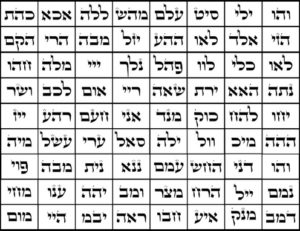
A final possibility is that the “Great and Glorious Name by which the signs should be wrought” refers to the mystical 216-letter Name of God (or 72-word Name of God). This Name is actually 72 linked names, each composed of three letters. The names are derived from the three verses Exodus 14:19-21:

And the angel of God, who went before the camp of Israel, removed and went behind them; and the pillar of cloud removed from before them, and stood behind them; and it came between the camp of Egypt and the camp of Israel; and there was the cloud and the darkness here, yet it gave light by night there; and the one came not near the other all the night. And Moses stretched out his hand over the sea; and Hashem caused the sea to go back by a strong east wind all the night, and made the sea into dry land, and the waters were divided.

The 72 Three-Letter Names of God

Each of these verses has exactly 72 letters. Hidden within them is this esoteric Name of God, the most powerful, through which came about the miracle of the Splitting of the Sea as the verses themselves describe. The Name (or 72 Names) is derived by combining the first letter of the first verse, then the last letter of the second verse, and then the first letter of the third verse. The same is done for the next letter, and so on, for all 72 Names.

Since the Splitting of the Sea and the plagues were brought about through these Names, the Midrash above may be referring not to the Ineffable Name, but to these 72 Names as being engraved upon the Staff. In fact, it may be both.

Staff from Atzilut

The 72 Names are alluded to by another mystical 72-Name of God. The Arizal taught that God’s Ineffable Name can be expanded in four ways. This refers to a practice called milui,* where the letters of each word are themselves spelled out to express the inner value and meaning of the word. God’s Ineffable Name can be expanded in these ways, with the corresponding values:

יוד הא ואו הא = 45

יוד הה וו הה = 52

יוד הי ואו הי = 63

יוד הי ויו הי = 72

The Name with the 72 value is the highest, not just numerically, but according to the sefirot, partzufim, and universes laid out in Kabbalah. The 52-Name corresponds to Malkhut and the world of Asiyah; the 45-Name to Zeir Anpin (the six “masculine” sefirot) and the world of Yetzirah; and the 63-Name to Binah and the world of Beriah. The 72-Name—which is, of course, tied to the above 72 Names of God—corresponds to the highest universe, Atzilut, the level of God’s Throne, where there is nothing but His Emanation and Pure Light. Here we come full circle, for the Midrash states that the Staff of Moses was itself carved out of God’s Throne. This otherworldly staff came down to this world from the highest Heavenly realm!

Where is the Staff Today?

What happened to Moses’ staff after his passing? Another Midrash (Yalkut Shimoni, Psalms 869) answers:

…the staff with which Jacob crossed the Jordan is identical with that which Judah gave to his daughter-in-law, Tamar. It is likewise the holy staff with which Moses worked, and with which Aaron performed wonders before Pharaoh, and with which, finally, David slew the giant Goliath. David left it to his descendants, and the Davidic kings used it as a sceptre until the destruction of the Temple, when it miraculously disappeared. When the Messiah comes it will be given to him for a sceptre as a sign of his authority over the heathens.

This incredible passage contains a great deal of novel insight. Firstly, Jacob used this divine staff to split the Jordan and allow his large family to safely cross back to Israel, just as the Israelites would later cross the Jordan in miraculous fashion under the leadership of Joshua. It seems Joshua himself, as Moses’ rightful successor, held on to the staff, and passed it down through the Judges and Prophets until it came to the hand of David. Unlike the traditional account of David slaying Goliath with the giant’s own sword (after the slingshot), the Midrash here says he slew Goliath with the staff!

The staff remained in the Davidic dynasty until the kingdom’s end with the destruction of the First Temple. At this point a lot of things mysteriously disappeared, most famously the Ark of the Covenant. It is believed that the Ark was hidden in a special chamber built for it by Solomon, who envisioned the day that the Temple would be destroyed. It is likely that the staff is there, too, alongside the Ark.

Mashiach will restore both of these, and will once again wield the sceptre of the Davidic dynasty. As the staff is forged from God’s own Heavenly Throne, it is fitting that Mashiach—God’s appointed representative, who sits on His corresponding earthly throne—should hold a piece of it. And this symbol, the Midrash concludes, will be what makes even the heathens accept Mashiach’s—and God’s—authority. Jacob prophesied this on his deathbed (Genesis 49:10), in his blessing to Judah:

The sceptre shall not depart from Judah, nor the ruler’s staff from between his feet, until the coming of Shiloh; and unto him shall the obedience of all the peoples be.

Shiloh is one of the titles for Mashiach (see Sanhedrin 98b), and his wielding of the staff will bring about the obedience of all the world’s people to God’s law. We can now also solve a classic problem with the above verse:

The verse states that the sceptre will not depart from Judah until the coming of Mashiach, as if it will depart from Judah when Mashiach comes. This makes no sense, since Mashiach is a descendent of Judah! It should have simply said that the sceptre shall never depart from Judah, from whom the messiah will come. Rather, Jacob is hinting that the Staff will one day be hidden in the land of Judah, deep below “between his feet”, and won’t budge from there for millennia until Mashiach comes and finally restores it.

May we merit to see it soon.

*Interestingly, using the same milui method, one can expand the word staff (מטה) like this: מאם טאת הה, which is 501, equivalent to דצ״ך עד״ש באח״ב, the acronym for the Ten Plagues which the Staff brought about!


The above is an excerpt from Garments of Light, Volume Two. Get the book here

Mashiach and the Mysterious 13th Zodiac Sign

When Jacob blesses his children before his passing, he begins by telling his sons that he wishes to reveal to them what will happen b’acharit hayamim, “in the End of Days”. Yet, the text we read does not appear to say anything about the End of Days! The Talmud (Pesachim 56a) states that the Shekhinah withdrew from Jacob at that moment so he was unable to reveal those secrets. If that’s the case, how was he able to properly bless his children?

The Talmud states that when the Shekhinah left him, Jacob worried one of his children was unworthy to hear those secrets. His sons then recited the Shema in unison and said, “just as there is only One in your heart, so is there in our heart only One.” Jacob was comforted to know they are all indeed righteous, and it seems the Shekhinah returned to him at this point, allowing him to bless his children in holiness. Nonetheless, Jacob reasoned that to reveal the secret of the End in explicit fashion would be unwise, so he encoded these mysteries within the blessings he recited. In fact, Jacob not only encrypted what will happen in the End, but summarized the breadth of Jewish history (see ‘How Jacob Prophesied All of Jewish History’ in Volume One of Garments of Light).

One place where Jacob appears to make an explicit reference to the End is in blessing Dan, when he says, “I hope for Your salvation, Hashem” (Genesis 49:18). Jacob says Dan will be the one to judge his people—alluding to the great Judgement Day—and wage the final battles like a “snake upon the road… who bites the horse’s heel so that its rider falls backwards”. Jacob is speaking of Mashiach. Although Mashiach is a descendent of David and from the tribe of Judah, the Midrash states that this is only through his father, while through his mother’s lineage Mashiach hails from the tribe of Dan.

Why does Jacob compare Mashiach to a snake?

Snakes of Divination

In cultures around the world, there is a peculiar connection between snakes and prophecy. In ancient Greece, for example, the Oracle went into a prophetic trance when supposedly breathing in the fumes (or spirit) of the dead python upon which the Temple in Delphi was built. According to myth, this great python (a word which has a Hebrew equivalent in the Tanakh, פתן) was slain by Apollo. The Temple was built upon its carcass. For this reason, the Greek prophetess was known as Pythia.

Similarly, the Romans had their sacred hill on the Vatican (later adopted as the centre of Christianity). The second-century Latin author Aulus Gellius explained that the root of the word Vatican is vates, Latin for “prophet”. Others explain that vatican refers more specifically to a “divining serpent”. Meanwhile, on the other side of the world the Aztecs had Quetzalcoatl and the Mayans had Kukulkan, the “feathered serpent” god of wisdom and learning. And such mystical dragons appear just about everywhere else, from Scandinavia to China.

Incredibly, the Torah makes the same connection, where Joseph is described as a diviner who uses a special goblet to nachesh inachesh (Genesis 44:5). This term for divination is identical to nachash, “snake”. In Modern Hebrew, too, the term for guessing or predicting is lenachesh. Why is the snake associated with otherworldly wisdom and prophecy?

Primordial Serpent

Back in the Garden of Eden, it was the Nachash, “Serpent”, who encouraged Eve to consume of the Forbidden Fruit. This was the fruit of the Tree of Knowledge. The Serpent is the one who unlocked the minds of Adam and Eve to higher wisdom so that they could “be like God”. Jewish tradition maintains that Adam and Eve were eventually supposed to eat of the Tree of Knowledge (for otherwise why would God put it there to begin with?) but they simply rushed to do so when they were not yet ready. They transgressed God’s command, and knew not what to do with all of this tremendous information, resulting in the shameful descent of man into sin. The one who instigated it all was the Nachash.

It appears that ever since then, the snake has been a symbol of forbidden wisdom. Such divination and mysticism can be quite dangerous, and most are unable to either grasp or properly use this knowledge. The Talmud cautions as much in its famous story of the four sages who entered “Pardes” (Chagigah 14b). Pardes is an acronym for the depths of Jewish wisdom, from the simple (pshat) and sub-textual (remez) to the metaphorical (drash) and esoteric (sod). The result of entering the mystical dimensions was that Ben Azzai died, Ben Zoma detached from this world, and Elisha ben Avuya became a heretic. Only Rabbi Akiva was able to “enter in peace and depart in peace.” It is important to remember that Rabbi Akiva was the teacher of Rabbi Shimon bar Yochai, the originator of the Zohar. (Still, the Zohar, like most mystical texts, does not speak explicitly of esoteric matters, but cloaks them in layers of garments and complex language which only the most astute can unravel.)

Long before, Joseph was a master of this wisdom, surprising even the Pharaoh and his best mystics, who proclaimed: “Can there be such a man in whom the spirit of God rests?” (Genesis 41:38). Joseph, of course, is a prototype of Mashiach. The sages state that Mashiach is a great prophet and sage in his own right, but can he really surpass the unparalleled prophecy of Moses or the wisdom of Solomon? The Alter Rebbe (Rabbi Schneur Zalman of Liadi, 1745-1812) solved the issue thus:

After the resurrection all will rise… the Patriarchs and Matriarchs, Moses and Aaron, all the righteous ones and the prophets, tens of thousands beyond number. Is it possible that Mashiach will teach them the same Torah that is revealed to us today? …Will all who knew the whole Torah be required to learn new laws from Mashiach? We must therefore say that Mashiach will instruct them in the “good of discernment and knowledge of the secrets of the esoteric teachings of Torah” that the “eyes will not have seen”—Moses and the Patriarchs not having been privileged to that knowledge, for only to Mashiach will it be revealed as it is written of him [Isaiah 52:13] “and he shall be very high.” (Likkutei Torah, Tzav)

Mashiach is the greatest of mystics, the holder of “forbidden” knowledge which will soon no longer be forbidden. The time will come when, as God originally intended, man will eat from the Tree of Knowledge and be “like God”. That first requires a return of mankind to the Garden of Eden, which is the very task of Mashiach. Beautifully, the gematria of Mashiach (משיח)—the one who brings us back into Eden—is 358, the same as Nachash (נחש)—the one who forced us out to begin with. And so, as Jacob foresaw, the snake symbolizes Mashiach himself.

While Mashiach is likened to a serpent, he must also defeat the Primordial Serpent which embodies all evil. Indeed, the Sages speak of two serpents (based on Isaiah 27:1): the “straight” serpent (nachash bariach) and the “twisted” serpent (nachash ‘akalaton). Mashiach is the straight serpent that devours the twisted one. This was all alluded to in Moses’ staff-turned-serpent consuming the Pharaoh’s staff-turned-serpent. In fact, another serpent staff, the nachash nechoshet, is later used by Moses to heal the nation. This healing staff found its way into Greek myth as well, where it was wielded by the healer god Asclepius, and eventually into the modern internationally-recognized medical symbol.

And that brings us back to the End of Days.

The 13th Zodiac

In recent years, there have been whispers of a necessity to change the current 12-sign horoscope to include a 13th zodiac sign. This was featured in the media on a number of occasions, with flashy headlines suggesting that some people’s astrological sign may now have changed. It is based on the fact that there is a “precession of the equinoxes”: Earth’s axis changes very slowly over time, meaning that the constellations which are visible in the night sky change, too.

The astrological signs are based on the 12 major constellations (out of 88 constellations total) that align with the sun and “rule” for about a month’s time every year (each making up 30º of the total 360º). The argument is that due to the precession of the equinoxes, a 13th sign has crept in which we can no longer ignore. The majority of astrologers have rejected this argument, mainly because astrology isn’t really based on the stars but fixed to the vernal equinox. While some in the East (namely Hindus) use “sidereal astrology”, which is based on shifting star positions, the system used in the West (“tropical astrology”) has 12 signs roughly corresponding to the 12 months.

The same is true in traditional Jewish thought, where each sign corresponds to a month on the Hebrew calendar, as well as to one of the twelve tribes of Israel. Having said that, including a 13th month for the Jewish system is not a problem at all. In fact, it is actually a solution, since the Jewish calendar has a 13th month in a leap year. The extra month has an astrological sign, too! Similarly, although we always speak of twelve tribes of Israel, there are really thirteen since, as we read in this week’s parasha, Jacob made Joseph count as two separate tribes: Ephraim and Menashe.

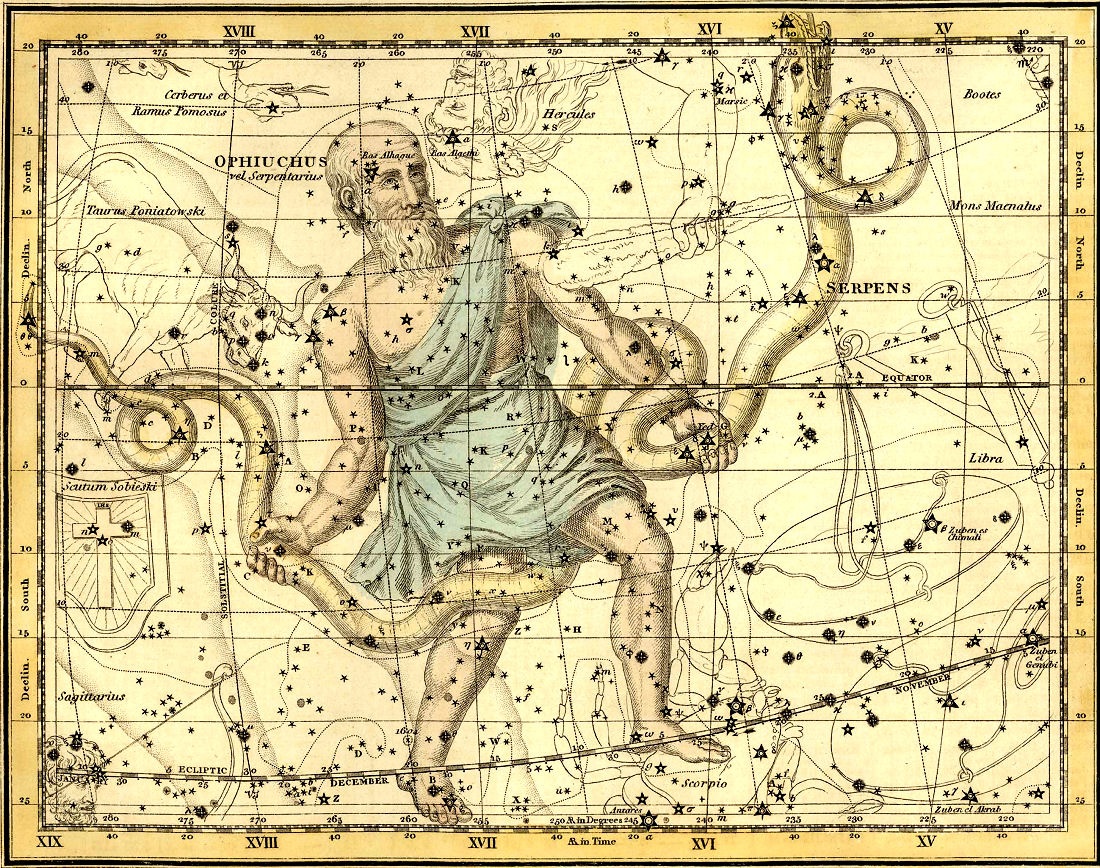
Whatever the case, whether the horoscope requires modification or not is irrelevant to Judaism, which denies any astrological effect on Israel (see ‘Should Jews Believe in Astrology’ in Volume One of Garments of Light). Besides, unlike astrologers, astronomers both ancient and modern have always been aware of this thirteenth constellation. To the ancient Babylonians it was the snake-like Nirah, while to the ancient Greeks it was known as Ophiuchus, the “serpent-bearer”. This constellation is in the shape of a man firmly grasping a twisted snake (the interlinked constellation Serpens). This is, of course, the very symbol of Mashiach, that serpentine saviour who defeats the primordial snake and all of its evil. After being an astrological footnote for a very long time, Ophiuchus has entered the spotlight, as if the cosmos itself is reminding us of Mashiach’s impending arrival.

The constellation Ophiuchus (or Serpentarius) grasping the constellation Serpens, from Alexander Jamieson’s Celestial Atlas of 1822. It is interesting to note that Mashiach must be a direct descendant of King David, whose own father Yishai (Jesse) was also called Nachash! (See Talmud, Shabbat 55b.)


The above is an excerpt from Garments of Light, Volume Two. Get the book here