Tag Archives: Seleucids

Who is Ahashverosh?

This Wednesday evening marks the start of Purim. The events of Purim, as described in the Book of Esther, take place in the Persian Empire during the time of King Ahashverosh. Who is this king? Is there a historical figure that matches up with what we know of the Biblical Ahashverosh? And when exactly did the Purim story happen?
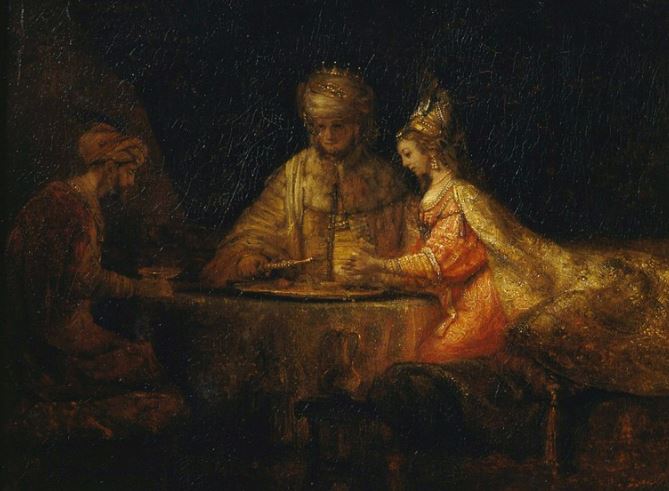
Ahaseurus and Haman at Esther’s Feast, by Rembrandt

Not long after Jerusalem was destroyed by Nebuchadnezzar and the Jews exiled to Babylon, the Babylonian Empire itself fell to the Persians. This was prophesied by Isaiah (45:1), who went so far as to describe the liberating Persian King Cyrus as “mashiach”! In one place (Megillah 12a), the Talmud states that he was obviously not the messiah—though perhaps a potential one—while in another (Rosh Hashanah 3b) it admits that he was “kosher”, and this is why his name (Koresh in Hebrew and Old Persian) is an anagram of kosher.

According to the accepted historical chronology, Cyrus took over the Babylonian Empire in 539 BCE. The Temple was destroyed some five decades earlier in 586 BCE. Our Sages, too, knew that the Babylonian Captivity lasted less than the seventy years prophesied by Jeremiah. They explained that although Cyrus freed the Jews before seventy years, they were unable to actually rebuild the Temple until seventy years had elapsed. In secular chronology, its rebuilding thus took place in 516 BCE. This was in the reign of the next great Persian king, Darius (r. 522-486 BCE). His son and successor was the famous Xerxes I (485-465 BCE), or in Old Persian Khshayarsha, ie. Ahashverosh.

Despite the name, many believe that the Ahashverosh of Purim is not Xerxes I. Scholars have suggested other possibilities, including one of several kings named Artaxerxes. The problem with Artaxerxes is that first of all the name does not match at all, being Artashacha in Old Persian, and second of all the name actually appears elsewhere in Scripture, in the books of Ezra and Nehemiah, as Artachshashta (אַרְתַּחְשַׁשְׂתָּא). This is clearly not Ahashverosh (אֲחַשְׁוֵרוֹשׁ). Having said that, Ezra 6:14 may imply that Artachshashta and Ahashverosh are one and the same. This verse lists Cyrus, then Darius, then Artachshashta, whereas we know from historical sources that following Cyrus was Cambyses, then the more famous Darius, followed by Xerxes I.

The Book of Daniel complicates things further. Daniel speaks of a Darius that conquers Babylon. Yet we know for a fact that it was Cyrus who conquered Babylon. Some scholars therefore say that Daniel is confusing Darius with Cyrus. Others say this “Darius the Mede” conquered Babylon alongside Cyrus, and this version has been accepted by many in the Jewish tradition. Later, Daniel 9:1 says that Darius was a son of Ahashverosh! Hence, some Jewish sources state that the Persian king Darius was the son of Esther. This suggests an entirely different Darius, and historical sources do speak of three Dariuses, the last one being defeated by Alexander the Great.

Perhaps the only way to find the real Ahashverosh is to ignore the other Biblical books and focus solely on Megillat Esther. In this case, the name Ahashverosh only fits Xerxes. There were two Xerxeses in ancient Persia. Xerxes II, though, ruled for just 45 days before being assassinated. That leaves us with Xerxes I. Does the Purim Ahashverosh match the historical Xerxes?

Xerxes the Great

Xerxes was born around 518 BCE to King Darius I and his wife Atossa, who was the daughter of Cyrus the Great. Xerxes was thus a grandson of the first Persian emperor. When Darius I died, his eldest son Artobazan claimed the throne. Xerxes argued that he should be king since he was the son of Atossa, the daughter of Cyrus. Ultimately, it was Xerxes that was crowned, thanks to his mother’s influence. This may be related to the Talmud’s suggestion that Ahashverosh claimed his authority through his wife Vashti, who was the daughter of a previous emperor, while Ahashverosh was just a usurper.

Xerxes immediately solidified his rule and crushed a number of rebellions. He melted down the massive idolatrous statue of Bel, or Marduk, the chief Babylonian god, triggering a number of rebellions by the Babylonians. Xerxes thus removed “king of Babylon” from his official title in an attempt to wipe out any mention of the former Babylon. He remained as “king of Persia and Media, great king, king of kings, and king of nations”.*

Xerxes is undoubtedly most famous for his massive invasion of Greece in 480 BCE, and particularly the difficulties he experienced at the Battle of Thermopylae (where he faced off against “300” Spartans). Returning home without victory, he focused on large construction projects. The ancient Greek historian (and contemporary of Xerxes) Herodotus (c. 485-425 BCE) notes that Xerxes built a palace in Susa. This is, of course, the Shushan HaBirah, “Susa the Capital” mentioned multiple times in the Megillah. Herodotus further states that Xerxes ruled from his capital in Susa over many provinces “from India to Ethiopia”, just as the Megillah says.
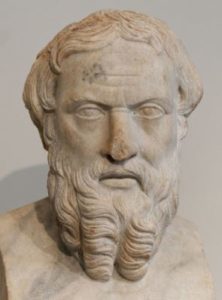
Bust of Herodotus

Herodotus also writes how Xerxes loved women and regularly threw parties where the wine never stopped flowing. Indeed, Megillat Esther speaks of the mishteh, literally “drinking party” that Ahashverosh threw. More specifically, Herodotus wrote how Xerxes returned to Persia from his failed Greek invasion in the “tenth month of his seventh year” and spent a lot of time sulking with his large harem of women. Incredibly, the Megillah also states that “Esther was taken unto king Ahashverosh into his palace in the tenth month, which is the month Tevet, in the seventh year of his reign” (Esther 2:16). This is unlikely to be a coincidence.

More amazing still, among the historical records from the time of Xerxes I that have been found we find the name of a court official named Marduka. Interestingly, this Marduka is given no other titles. It isn’t hard to see the connection to Mordechai, also an untitled official in the court of Ahashverosh.

Xerxes’ reign came to an end in 465 BCE when he was unceremoniously assassinated. His eldest son Darius, who should have succeeded him, was killed, too. This once again may relate to the Jewish tradition of Ahashverosh having a son with Esther called Darius.

However, Xerxes’ son Darius was the child of his queen Amestris, or Amastri, the daughter of a Persian nobleman. Historical sources speak of her in the most negative of terms. Herodotus writes that she buried people alive, and she apparently brutally tortured and mutilated a relative she wanted to punish. She was jealous of her husband’s extramarital affairs, and power-hungry in her own right. Although the name Amestris may sound more similar to the name Esther, Amestris’ character fits the profile of a cruel Queen Vashti quite well (see Megillah 12b).**

A Historical Nightmare

One of the greatest issues in Biblical chronology is the problem of the so-called “missing years”. As mentioned, secular scholarship has 586 BCE (or 587 BCE) as the year of the Temple’s destruction and 516 BCE as its rebuilding. Traditional Jewish dating has around 424 BCE (or 423 or even 421 BCE) for the destruction and 354 BCE (or 349 BCE) for the reconstruction. That’s a discrepancy of some 160 years!

Generally, it is concluded that the Jewish traditional dating is simply wrong, as the Sages did not have access to all the historical and archaeological sources that we have today. As we wrote in the past, the Talmud and other ancient Jewish sources do have occasional historical errors, and this has already been noted by rabbis like the Ibn Ezra and Azariah dei Rossi (c. 1511-1578). Still, the traditional Jewish dating need not be thrown out the door just yet.

In his The Challenge of Jewish History: The Bible, The Greeks, and The Missing 168 Years, Rabbi Alexander Hool makes a compelling case for rethinking the accepted chronology. He brings an impressive amount of evidence suggesting that Alexander the Great did not defeat Darius III, but rather Darius I! After Alexander, the Seleucids did not rule over all of Persia, but only the former Babylonian provinces, while the Persian Empire continued to co-exist alongside the Greek. Interestingly, there is another version of Megillat Esther (sometimes called the Apocryphal Book of Esther) which may support the theory. While the apocryphal version is certainly a later edition and not the authentic one, it still provides some additional information which may be useful. This Book of Esther actually says Haman was a Macedonian, like Alexander the Great, which fits neatly with Hool’s theory. Having said that, Hool’s theory is very difficult to accept, and would require rewriting a tremendous amount of history while ignoring large chunks of opposing evidence. Elsewhere, though, he may be right on point.

Hool suggests that Cyrus and the mysterious “Darius the Mede” are one and the same person, with evidence showing “Darius” is a title rather than a proper name. He argues that “Ahashverosh” may be a title, too, and concludes that the Ahashverosh of Purim is none other than Cambyses II (r. 530-522 BCE), the son of Cyrus. This suggestion fits well with the chronology presented in Jewish sources (especially Seder Olam) and with the Tanakh (where, for example, Darius I is the son of Ahashverosh in the Book of Daniel). It also fits with the description of Cambyses given by Herodotus, who says Cambyses was a madman with wild mood swings, much like the Ahashverosh in the Megillah. The timing is excellent, too, fitting inside the seventy year period before the Second Temple was rebuilt and while the Jews were still in exile mode.

Identifying Cambyses with Ahashverosh opens up a host of other problems though. The Megillah has Ahashverosh reigning for at least a dozen years, whereas Cambyses only reigned for about seven and a half. The other details that we know of Cambyses’ life and love interests do not match Ahashverosh either. Point for point, it seems that Xerxes I still fits the bill of Ahashverosh much better than anyone else, despite the chronological mess.

At the end of the day, history before the Common Era is so frustratingly blurry that it is difficult to conclude much with certainty. Without a doubt, there are historical errors and miscalculations in both secular scholarship and in ancient Jewish sources. It seems the identity of Ahashverosh and the exact chronology between the destruction of the First and Second Temples is one mystery that can’t be solved at the moment.


*Perhaps Xerxes’ father Darius is the one called “Darius the Mede” (being unrelated to Cyrus). This makes more sense chronologically if Daniel was one of the original Jewish exiles, as the Tanakh suggests. The Book of Daniel should have said that Ahashverosh was the son of Darius, and not vice versa. In fact, the Talmud (Megillah 12a) admits that Daniel erred in some chronological details. This may be why the Book of Daniel is not always considered an authoritative prophetic book, and is included in the Ketuvim, not the Nevi’im. In Jewish tradition, Daniel is typically excluded from the list of official prophets.

**The Talmud suggests that Vashti was the daughter of Nebuchadnezzar (Megillah 10b) or Belshazzar (Megillah 12b), while Ahashverosh was only the son of their stable-master. This makes little sense chronologically or historically. Scholars have pointed out that this extra-Biblical suggestion in the Talmud may have been adapted from the popular Persian story of the king Ardashir I (180-242 CE), which would have been well-known in Talmudic times.


The above essay is adapted from Garments of Light, Volume Three.
Get the book here! 

An Honest Look at the Talmud

Earlier this week we discussed the necessity of the Talmud, and of an oral tradition in general, to Judaism. We presented an overview of the Talmud, and a brief description of its thousands of pages. And we admitted that, yes, there are some questionable verses in the Talmud (very few when considering the vastness of it). Here, we want to go through some of these, particularly those that are most popular on anti-Semitic websites and publications.

An illustration of Rabbi Akiva from the Mantua Haggadah of 1568

By far the most common is that the Talmud is racist or advocates for the destruction of gentiles. This is based on several anecdotes comparing non-Jews to animals, or the dictum of Rabbi Shimon bar Yochai that “the best of gentiles should be killed”. First of all, we have to be aware of the linguistic style of the Talmud, which often uses strong hyperbole that is not to be taken literally (more on this below). More importantly, we have to remember that these statements were made in a time where Jews were experiencing a tremendous amount of horrible persecution. Rabbi Shimon’s teacher, Rabbi Akiva was tortured to death by being flayed with iron combs. This is a man who never hurt anyone, who raised the status of women, sought to abolish servitude, preached that the most important law is “to love your fellow as yourself”, and taught that all men are made in God’s image (Avot 3:14). For no crime of his own, he was grotesquely slaughtered by the Romans. Rabbi Shimon himself had to hide from the Romans in a cave for 13 years with his son, subsisting off of nothing but carobs. The Jews in Sassanid Persia didn’t fare too much better. So, the anger and resentment of the Sages to their gentile oppressors sometimes come out in the pages of Talmud. Yet, the same Talmud insists “Before the throne of the Creator there is no difference between Jews and gentiles.” (TY Rosh Hashanah 57a). Moreover, a non-Jew who is righteous, and occupies himself with law and spirituality, is likened to a kohen gadol, the high priest (Bava Kamma 38a).

In fact, the contempt that the Sages sometimes had for gentiles is not simply because they were not Jewish, for we see that the Sages had the same contempt, if not more so, for certain other Jews! The Talmud (Pesachim 49b) warns never to marry an ‘am ha’aretz, an unlearned or non-religious Jew, and even compares such Jews to beasts. In the same way that gentiles are sometimes compared to animals, and in the same way Rabbi Shimon said they should “be killed”, Rabbi Shmuel said that the ‘am ha’aretz should be “torn like a fish”! Why such harsh words for other Jews? Because they, too, do not occupy themselves with moral development, with personal growth, or with the law. Therefore, they are more likely to be drawn to sin and immorality. After all, the very purpose of man in this world “is to perfect himself”, as Rabbi Akiva taught (Tanchuma on Tazria 5), and how can one do so without study? Still, the Sages conclude (Avot d’Rabbi Natan, ch. 16) that

A man should not say, “Love the pupils of the wise but hate the ‘am ha’aretẓ,” but one should love all, and hate only the heretics, the apostates, and informers, following David, who said: “Those that hate You, O Lord, I hate” [Psalms 139:21]

Rabbi Akiva is a particularly interesting case, because he was an ‘am ha’aretz himself in the first forty years of his life. Of this time, he says how much he used to hate the learned Jews, with all of their laws and apparent moral superiority, and that he wished to “maul the scholar like a donkey”. Rabbi Akiva’s students asked why he said “like a donkey” and not “like a dog”, to which Akiva replied that while a dog’s bite hurts, a donkey’s bite totally crushes the bones! We can learn a lot from Rabbi Akiva: it is easy to hate those you do not understand. Once Akiva entered the realm of the Law, he saw how beautiful and holy the religious world is. It is fitting that Rabbi Akiva, who had lived in both worlds, insisted so much on loving your fellow. And loving them means helping them find God and live a holy, righteous life, which is why Rabbi Shmuel bar Nachmani (the same one who said that the ‘am ha’aretz should be devoured like a fish) stated that:

He who teaches Torah to his neighbour’s son will be privileged to sit in the Heavenly Academy, for it is written, “If you will cause [Israel] to repent, then will I bring you again, and you shall stand before me…” [Jeremiah 15:19] And he who teaches Torah to the son of an ‘am ha’aretz, even if the Holy One, blessed be He, pronounces a decree against him, He annuls it for his sake, as it is written, “… and if you shall take forth the precious from the vile, you shall be as My mouth…” [Bava Metzia 85a]

Promiscuity in the Talmud

Another horrible accusation levelled against the rabbis of the Talmud is that they were (God forbid) promiscuous and allowed all sorts of sexual indecency. Anyone who makes such a claim clearly knows nothing of the Sages, who were exceedingly modest and chaste. They taught in multiple places how important it is to guard one’s eyes, even suggesting that looking at so much as a woman’s pinky finger is inappropriate (Berakhot 24a). Sexual intercourse should be done only at night or in the dark, and in complete privacy—so much so that some sages would even get rid of any flies in the room! (Niddah 17a) Most would avoid touching their private parts at all times, even while urinating (Niddah 13a). The following page goes so far as to suggest that one who only fantasizes and gives himself an erection should be excommunicated. The Sages cautioned against excessive intercourse, spoke vehemently against wasting seed, and taught that “there is a small organ in a man—if he starves it, it is satisfied; if he satisfies it, it remains starved.” (Sukkah 52b)

Anti-Semitic and Anti-Talmudic websites like to bring up the case of Elazar ben Durdya, of whom the Talmud states “there was not a prostitute in the world” that he did not sleep with (Avodah Zarah 17a). Taking things out of context, what these sites fail to bring up is that the Talmud, of course, does not at all condone Elazar’s actions. In fact, the passage ends with Elazar realizing his terribly sinful ways, and literally dying from shame.

Another disgusting accusation is that the Talmud permits pederasty (God forbid). In reality, what the passage in question (Sanhedrin 54b) is discussing is when the death penalty for pederasty should be applied, and at which age a child is aware of sexuality. Nowhere does it say that such a grotesque act is permitted. The Sages are debating a sensitive issue of when a death penalty should be used. Shmuel insists that any child over the age of three is capable of accurately “throwing guilt” upon another, and this would be valid grounds for a death penalty. Elsewhere, the Talmud states that not only do pederasts deserve to be stoned to death, but they “delay the coming of the Messiah” (Niddah 13b).

The Talmud is similarly accused of allowing a three year old girl to be married. This is also not the whole picture. A father is allowed to arrange a marriage for his daughter, but “it is forbidden for one to marry off his daughter when she is small, until she grows up and says ‘this is the one I want to marry.’” (Kiddushin 41a) Indeed, we don’t see a single case of any rabbi in the Talmud marrying a minor, or marrying off their underage daughter. Related discussions appear in a number of other pages of the Talmud. In one of these (Yevamot 60b), Rabbi Shimon bar Yochai states that a girl who was converted to Judaism before three years of age is permitted to marry a kohen, although kohanim are generally forbidden from marrying converts. This, too, has been twisted as if Rabbi Shimon allowed a kohen to marry a three-year old. He did not say this at all, rather stating that a girl under three who is converted to Judaism (presumably by her parents, considering her young age) is actually not considered a convert but likened to a Jew from birth. Once again we see the importance of proper context.

Science in the Talmud

Last week we already addressed that scientific and medical statements in the Talmud are not based on the Torah, and are simply a reflection of the contemporary knowledge of that time period. As we noted, just a few hundred years after the Talmud’s completion, Rav Sherira Gaon already stated that its medical advice should not be followed, nor should its (sometimes very strange) healing concoctions be made. The Rambam (Moreh Nevuchim III, 14) expanded this to include the sciences, particularly astronomy and mathematics, which had come a long way by the time of the Rambam (Rabbi Moshe ben Maimon, 1135-1204). The Rambam did not state that the Sages are necessarily wrong on scientific matters—for indeed we see that they are often quite precise—nonetheless:

You must not expect that everything our Sages say respecting astronomical matters should agree with observation, for mathematics were not fully developed in those days: and their statements were not based on the authority of the Prophets, but on the knowledge which they either themselves possessed or derived from contemporary men of science.

Some scientific statements of the Talmud which have been proven wrong include: The earth’s crust is 1000 cubits thick (Sukkot 53b)—today we have mines that go down four kilometres, which is well over 5000 cubits at least! Lions, bears, and elephants have a gestation period of three years (Bekhorot 8a)—while the Talmud is right by previously stating that cows have a nine-month gestation period, lions actually have gestation of 110 days, bears of 95-220 days depending on the species, and elephants of 22 months.

On the other hand, the Talmud is accurate, for example, when describing the water cycle (Ta’anit 9a), with Rabbi Eliezer explaining that water evaporates from the seas, condenses into clouds, and rains back down. It is also surprisingly close when calculating the number of stars in the universe (Berakhot 32b), with God declaring:

… twelve constellations have I created in the firmament, and for each constellation I have created thirty hosts, and for each host I have created thirty legions, and for each legion I have created thirty cohorts, and for each cohort I have created thirty maniples, and for each maniple I have created thirty camps, and to each camp I have attached three hundred and sixty-five thousands of myriads of stars, corresponding to the days of the solar year, and all of them I have created for your sake.

Doing the math brings one to 1018 stars. This number was hard to fathom in Talmudic times, and even more recently, too (I personally own a book published in the 1930s which states that scientists estimate there are about a million stars in the universe), yet today scientists calculate similar numbers, with one estimate at 1019 stars.

History in the Talmud

When it comes to historical facts the Talmud, like most ancient books, is not always accurate. Historical knowledge was extremely limited in those days. There was no archaeology, no linguistics, and no historical studies departments; neither were there printing presses or books to easily preserve or disseminate information. This was a time of fragile and expensive scrolls, typically reserved for Holy Scriptures.

All in all, the Talmud doesn’t speak too much of history. Some of its reckonings of kings and dynasties are certainly off, and this was recognized even before modern scholarship. For example, Abarbanel (1437-1508) writes of the Talmud’s commentaries on the chronology in Daniel that “the commentators spoke falsely because they did not know the history of the monarchies” (Ma’ayanei HaYeshua 11:4).

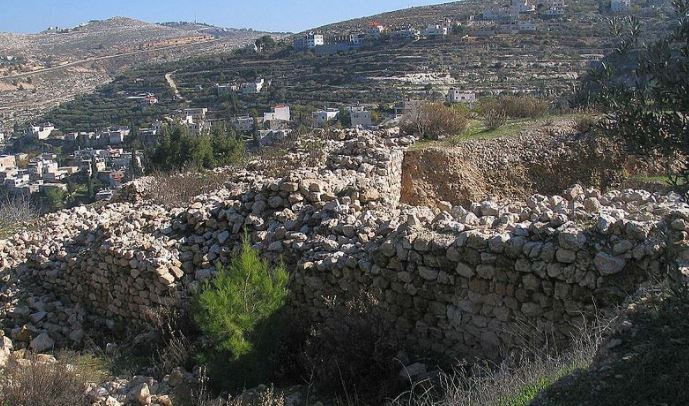
The Talmud has also been criticised for exaggerating historical events. In one place (Gittin 57b), for instance, the Talmud suggests that as many as four hundred thousand myriads (or forty billion) Jews were killed by the Romans in Beitar. This is obviously impossible, and there is no doubt the rabbis knew that. It is possible they did not use the word “myriads” to literally refer to 10,000 (as is usually accepted) but simply to mean “a great many”, just as the word is commonly used in English. If so, then the Talmud may have simply meant 400,000 Jews, which is certainly reasonable considering that Beitar was the last stronghold and refuge of the Jews during the Bar Kochva Revolt.

Archaeological remains of the Beitar fortress.

Either way, as already demonstrated the Talmud is known to use highly exaggerated language as a figure of speech. It is not be taken literally. This is all the more true for the stories of Rabbah Bar Bar Chanah, which are ridiculed for their embellishment. Bar Bar Chanah’s own contemporaries knew it, too, with Rabbi Shimon ben Lakish even refusing to take his helping hand while nearly drowning in the Jordan River! (Yoma 9b) Nonetheless, the Talmud preserves his tall tales probably because they carry deeper metaphorical meanings.

Having said that, there are times when the Talmud is extremely precise in its historical facts. For example, it records (Avodah Zarah 9a) the historical eras leading up to the destruction of the Second Temple:

…Greece ruled for one hundred and eighty years during the existence of the Temple, the Hasmonean rule lasted one hundred and three years during Temple times, the House of Herod ruled one hundred and three years. Henceforth, one should go on counting the years as from the destruction of the Temple. Thus we see that [Roman rule over the Temple] was two hundred and six years…

We know from historical sources that Alexander conquered Israel around 331 BCE. The Maccabees threw off the yoke of the Greeks around 160 BCE, and Simon Maccabee officially began the Hasmonean dynasty in 142 BCE. That comes out to between 171 and 189 years of Greek rule, depending on where one draws the endpoint, right in line with the Talmud’s 180 years. The Hasmoneans went on to rule until 37 BCE, when Herod took over—that’s 105 years, compared to the Talmud’s 103 years. And the Temple was destroyed in 70 CE, making Herodian rule over the Temple last about 107 years. We also know that Rome recognized the Hasmonean Jewish state around 139 BCE, taking a keen interest in the Holy Land thereafter, and continuing to be involved in its affairs until officially taking over in 63 BCE. They still permitted the Hasmoneans and Herodians to “rule” in their place until 92 CE. Altogether, the Romans loomed over Jerusalem’s Temple for about 209 years; the Talmud states 206 years. Considering that historians themselves are not completely sure of the exact years, the Talmud’s count is incredibly precise.

Understanding the Talmud

Lastly, it is important never to forget that the Talmud is not the code of Jewish law, and that Judaism is far, far more than just the Talmud. There are literally thousands of other holy texts. Jews do not just study Talmud, and even centuries ago, a Jew who focused solely on Talmud was sometimes disparagingly called a hamor d’matnitin, “Mishnaic donkey”. The Talmud itself states (Kiddushin 30a) that one should spend a third of their time studying Tanakh, a third studying Mishnah (and Jewish law), and a third studying Gemara (and additional commentary). The Arizal prescribes a study routine that begins with the weekly parasha from the Five Books of Moses, then progresses to the Nevi’im (Prophets) and Ketuvim, then to Talmud, and finally to Kabbalah (see Sha’ar HaMitzvot on Va’etchanan). He also states emphatically that one who does not study all aspects of Judaism has not properly fulfilled the mitzvah of Torah study.

A Torah scroll in its Sephardic-style protective case, with crown.

Those who claim that Jews have replaced the Tanakh with the Talmud are entirely mistaken: When Jews gather in the synagogue, we do not take out the Talmud from the Holy Ark, but a scroll of Torah. It is this Torah which is so carefully transcribed by hand, which is adorned with a crown to signify its unceasing authority, and before which every Jew rises. After the Torah reading, we further read the Haftarah, a selection from the Prophets. At no point is there a public reading of Talmud. As explained previously, the Talmud is there to help us understand the Tanakh, and bring it to life.

Ultimately, one has to remember that the Talmud is a continuing part of the evolution of Judaism. We wrote before how we were never meant to blindly follow the Torah literally, but rather to study it, develop it, grow together with it, and extract its deeper truths. The same is true of the Talmud—the “Oral” Torah—and of all others subjects within Judaism, including Midrash, Kabbalah, and Halacha. Judaism is constantly evolving and improving, and that’s the whole point.

For more debunking of lies and myths about the Talmud, click here.

When Jews and Greeks Were Brothers: The Untold Story of Chanukah

As we celebrate the festive holiday of Chanukah, it is important to remember that not all of the Greeks were wicked and immoral. The enemies of the Chanukah narrative were the Seleucids, or Syrian-Greeks, not the mainland Greeks of Europe. In fact, the Book of Maccabees (I, 12:6-18) records an alliance between Jonathan Maccabee—the kohen gadol and righteous leader of Israel after the deaths of Matityahu and Judah Maccabee—and the famous Spartans of mainland Greece:

Jonathan, the high priest, and the council of the nation and the priests and the rest of the Jewish people send greetings to their brothers, the Spartans. In former times, a letter was sent to the high priest Onias, from Areus who was then king among you, to say that you are our kinsman… And Onias showed honour to the man who was sent to him, and accepted the letter, which contained a declaration of alliance and friendliness.

So, although we are in no need of these, since we find our encouragement in the sacred books that are in our keeping, we have undertaken to send to renew relations of brotherhood and friendliness with you, so that we may not become entirely estranged from you…

Jonathan points out that Israel does not need the help of the Spartans to defeat the Seleucids, as God’s help is all they need. Nonetheless, Israel and Sparta were always good friends, and Israel wants to keep it that way. In his letter, Jonathan mentions an earlier letter sent by King Areus of Sparta to Onias the kohen gadol (Onias is the Hellenized name for Choniyahu or Chonio, the son of Yadua the high priest, mentioned in Nehemiah 12:11). This letter is recorded in the Book of Maccabees (I, 12:20-23), as well as in the writings of Josephus, opening with the words:

Areus, king of the Spartans, sends greetings to Onias the high priest. It is found in writing that the Spartans and Jews are kinsman, and that they are both of the stock of Abraham…

Incredibly, the Spartan king suggests that the Spartans are descendants of Abraham, too! Where does this bizarre belief come from?

Greek Sons of Abraham

Sometime in the 2nd century BCE lived a Greek historian and sage named Cleodemus, sometimes referred to as Cleodemus the Prophet. He also went by the name Malchus which, because of its Semitic origins, makes some scholars believe he could have been Jewish. Cleodemus wrote an entire history of the Jewish people in Greek. While this text appears to have been lost, it is cited by others, including Josephus (Antiquities, i. 15).

Cleodemus commented on Abraham’s marriage to Keturah (typically identified with Hagar), and their children. This is recorded in Genesis 25, which begins:

And Abraham took another wife, and her name was Keturah. And she bore him Zimran, and Yokshan, and Medan, and Midian, and Ishbak, and Shuach. And Yokshan begot Sheva and Dedan. And the sons of Dedan were Ashurim, and Letushim, and Leumim. And the sons of Midian were Ephah, and Epher, and Chanokh, and Avidah, and Elda’ah. All these were the children of Keturah. And Abraham gave all that he had to Isaac, while to the sons of the concubines that Abraham had, Abraham gave gifts, and he sent them away from Isaac, while he was still alive, to the east country.

Abraham had six children with Keturah, from which came at least seven grandchildren, and three great-grandchildren which the Torah names explicitly. The Torah then makes it clear that Abraham gave everything that he had to Isaac—including the Covenant with God and the land of Israel—while the others received gifts and were sent away from the Holy Land.

Cleodemus suggests that Epher (or another child named Yaphran), the great-grandson of Abraham, migrated to Africa—which is where the term “Africa” comes from! (This is particularly interesting because Epher was the son of Midian, and Tziporah the wife of Moses was a Midianite, and is described as a Cushite, or African/Ethiopian.) Cleodemus states that Epher, Yaphran, and Ashurim assisted the Greek hero Hercules in one of his battles. Following this, Hercules married one of their daughters—a great granddaughter of Abraham—and had a son with her. This son was Diodorus, one of the legendary founders of Sparta!

It appears that the Spartan king Areus was aware of this possible historical connection, and accepted it as fact. This connection may explain why the Spartans were so similar to ancient Israelites. (Others have suggested that because the Israelite tribe of Shimon—known for being fierce warriors—did not receive a set portion in the Holy Land, many of them moved elsewhere and ended up in Sparta, or ended up in Sparta after being expelled from Israel by the Assyrians alongside the other lost tribes.) In his book Sparta, renowned historian Hugo Jones writes that the Spartans held in the highest regard a certain ancient law-giver, much like Moses the law-giver of Israel. The Spartans celebrated new moons (Rosh Chodesh), and unlike their Greek counterparts, even a seventh day of rest! Of course, the Spartans themselves were very different from other Greeks, particularly those in Athens, whom Sparta often battled. The Spartan form of government was different, too, not an Athenian-style democracy but a monarchy that governed alongside a “council of elders”, much like Israel’s king and Sanhedrin.

Perhaps most similarly, the Spartans were known for their “stoic” way of life. The later Greek school of stoicism was modeled on the ancient way of the Spartans. This meant living simply and modestly, being happy with what one has, and most importantly, putting mind above body, and logic above emotion. This almost sounds like something out of Pirkei Avot, and is a teaching echoed across Jewish texts both ancient and modern. In fact, when Josephus tried to explain who the rabbis were to his Roman audience, he said that they were Jewish stoic philosophers!

Gideon and Leonidas

Undoubtedly, the most famous story of the Spartans is the Battle of Thermopylae. Around 480 BCE, the Persian emperor Xerxes invaded Greece with a massive force. Xerxes first sent messengers to the Greek city-states to offer peaceful surrender. According to the historian Herodotus, Sparta’s King Leonidas told the messenger:

A slave’s life is all you understand, you know nothing of freedom. For if you did, you would have encouraged us to fight on, not only with our spear, but with everything we have.

Spoken like a true Maccabee. The messenger then told Leonidas and his men to bow down, to which Leonidas, like his historical contemporary Mordechai, said: “We bow down before no man.” Later, when the Persian boasted that his empire was the wealthiest in the world, with gold reserves the likes of which Leonidas could only dream of, Leonidas replied: “Ares is lord. Greece has no fear of gold.”

This statement almost makes Leonidas seem like a monotheist. Indeed, the Spartans worshiped Ares—the god of war—above all others. Interestingly, the Torah commonly describes Hashem in similar military terms, like a great warrior riding a merkavah or chariot, as a “God of Legions” (Hashem Tzva’ot), and even as a “Man of War” (Ish Milchamah, see Exodus 15:3). Of course, the Spartans had their abominable statues and idols, which is perhaps the greatest distinction (and a critical one) between them and ancient Israel.

King Leonidas went on to assemble just three hundred brave men to face off against the massive Persian invasion. Although they ultimately lost, the Spartans fought valiantly, inspired their fellow Greeks, and did enough damage to hamper Persian victory. This story of three hundred, too, has a Biblical parallel. The Book of Judges records a nearly-identical narrative, with the judge Gideon assembling three hundred brave men and miraculously defeating a massive foreign invasion.

Which came first? The earliest complete Greek mythological texts date back only to the 3rd century BCE. By then, the Tanakh had long been completed, and in that same century was first translated into the Greek Septuagint. It isn’t hard to imagine Greek scholars and historians of the 3rd century getting their hands on the first Greek copies of Tanakh and incorporating those narratives into their own. In fact, the Greek-Jewish philosopher Aristobulus of Alexandria (181-124 BCE) admitted that all of Greek wisdom comes from earlier Jewish sources. The later Greek philosopher Numenius of Apamea said it best: “What is Plato but Moses speaking Greek?”

Greece and the Exodus

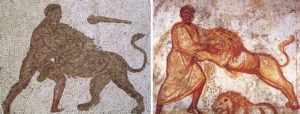
The similarities between Greek myth and more ancient Jewish texts are uncanny. Hercules was a mighty warrior whose first task (of twelve) was to slay a lion, like the mighty Shimshon who first slays a lion in Judges. Deucalion survives a great flood that engulfs the whole world as punishment from an angry Zeus. Like Noah before him, Deucalion has a wife and three sons, and like Noah, Deucalion is associated with wine-making (the root of his name, deukos). Pandora’s curiosity brings about evil just like Eve’s, while Asclepius carries a healing serpent-staff like Moses. Aristophanes even taught that Zeus first made man as male and female in one body, and later split them in half, just as the Torah and Talmud do.

Roman mosaic of Hercules and the Nemean Lion, and a Roman fresco of Samson and the lion, from the same time period.

In Jewish tradition, the Greeks come from the Biblical Yavan, son of Yafet (or Yefet or Japheth), son of Noah (Genesis 10:2). Yavan is the same as the Greek Ion (or Iawones), one of the Greek gods, and Ionia, referring to one of its most important regions, and the dialect of the great Greek poets Homer and Hesiod, as well as the scholars Herodotus and Hippocrates. Meanwhile, the Greeks worshipped Iapetus (same as Yafet) as a major god. Iapetus was the father of Prometheus, the god who supposedly fashioned man from the mud of the earth. So, not surprisingly, the Biblical Yavan and Yafet are firmly in the Greek tradition as well.

In his Was Achilles a Jew? (pgs. 465-468), Larry S. Milner points out many other similarities between Greek myth and the narratives of the Torah. The Greek story of Orion, where his birth was a gift from three deities to an old, childless couple, is nearly identical to the prophesied birth of Isaac, which came with the arrival of three angels. Key aspects of the tales of Odysseus resemble the adventures of Jacob, while the legend of Orpheus and Eurydice is reminiscent of Lot and his wife. The abduction of Helen (leading to the destruction of Troy through an infamous ruse) is strangely similar to the abduction of Dinah (leading to the decimation of Shechem through an infamous ruse). And there are many more.

The Greeks held that the ancient heroes and founders Danaus and Cadmus originally came from Egypt. Milner posits, and eloquently argues, that Danaus and Cadmus were not Egyptians, but Hebrews who had been enslaved in Egypt! They escaped Egypt and settled in Greece. Their names have Semitic origins, and it is possible they were the ones that introduced the Semitic alphabet to the Greeks, as scholars have long ago concluded that the Greeks adapted their alphabet from the Semitic one. The only question among scholars is whether it was the Phoenicians or Hebrews who introduced the alphabet to the Greeks. Milner strongly argues on behalf of the latter. Finally, he notes how ancient Greece was organized by an amphictyony, a “league of neighbours” that consisted of twelve city-states in a loose confederacy. The amphictyony very closely mirrored the organization of, and relationship between, the Twelve Tribes of Israel. In short, we find that not only did the Greeks adopt many of our Biblical narratives and ideas, but even our ancient written language and political structure, too.

In Volume One of Garments of Light (‘Did the Jews Really Defeat the Greeks?’), we saw how Greece had a huge influence on Judaism. Now, we see how tremendous an influence Judaism had on Greece. The two civilizations go hand-in-hand, and between them gave rise to the world we live in. Indeed, this was prophesied by Noah, who blessed his sons: “May God make Yefet great, and he will dwell in the tents of Shem” (Genesis 9:27). Shem is the earliest forefather of Israel, and Yefet of Greece. The two dwell in one tent.

On Chanukah, we celebrate the Jewish victory over the Seleucids. Not of the Greeks as a whole, but of a relatively small faction of Syrian Greeks, far from the Greek heartland which enjoyed a good relationship with Israel, starting with Alexander the Great and through to the Spartans and Maccabees.

[This is part two of a three-part series. See here for part one, and here for part three.]


The above is an excerpt from Garments of Light, Volume Two. Get the book here