Category Archives: Mysteries & Origins

The Mystical Meaning of Exile and Terrorism

This week we read the parasha of Bechukotai, famous for its list of blessings, and curses, should Israel faithfully follow God’s law, or not. In Leviticus 26:33, God warns that “I will scatter you among the nations, and I will draw out the sword after you; and your land shall be a desolation, and your cities shall be a waste.” These prophetic words have, of course, come true in Jewish history. Israel has indeed been exiled to the four corners of the world, and experienced just about every kind of persecution. Yet, within every curse there is a hidden blessing.
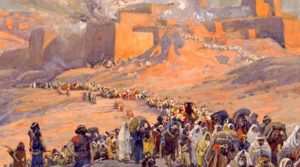
‘The Flight of the Prisoners’ by James Tissot, depicting the Jewish people being exiled to Babylon.

The Talmud (Pesachim 87b) states that the deeper purpose of exile is for the Jews to spread Godliness to the rest of the world. After all, our very mandate was to be a “light unto the nations” (Isaiah 42:6) and to spread knowledge of Hashem and His Torah. How could we ever accomplish this if we were always isolated in the Holy Land? It was absolutely necessary for Israel to be spread all over the globe in order to introduce people to Hashem, to be a model of righteousness, and to fulfil the various spiritual rectifications necessary to repair this broken world.

The Arizal explains that by praying, reciting blessings, and fulfilling mitzvot, a Jew frees the spiritual sparks trapped within the kelipot, literally “husks”. This idea hearkens back to the concept of Shevirat haKelim, the “Shattering of the Vessels”. The Arizal taught that God initially crafted an entirely perfect universe. Unfortunately, this world couldn’t contain itself and shattered into a multitude of pieces, spiritual “sparks” trapped in this material reality. While God had rebuilt most of the universe, He left it to Adam and Eve to complete the rectification through their own free will. They, too, could not affect that tikkun, and the cosmos shattered yet again. The process repeated itself on a number of occasions, the last major one being at the time of the Golden Calf.

Nonetheless, with each passing phase in history, more and more of those lost, trapped sparks are rediscovered and restored to their rightful place. The mystical mission of every Jew is to free those sparks wherever they go. The Arizal speaks of this at great length, and it permeates every part of his teachings. Eating, for example, serves the purpose of freeing sparks trapped within food—which is why it is so important to consume only kosher food, and to carefully recite blessings (which are nothing but fine-tuned formulas for spiritual rectification) before and after. The same is true with every mitzvah that we do, and every prayer we recite.

Thus, while exile is certainly difficult and unpleasant, it serves an absolutely vital spiritual purpose. This is why the Midrash states that exile is one of four things God created regretfully (Yalkut Shimoni on Isaiah, passage 424). It is why God already prophesied that we would be exiled—even though we hadn’t yet earned such a punishment! And it is why God also guaranteed that we would one day return to our Promised Land, as we have miraculously begun to do in recent decades.

Four, Five, or Eight Exiles?

In Jewish tradition, it is said that there are four major exiles: the Babylonian, the Persian, the Greek, and the Roman. We are still considered to be within the “Roman” or Edomite (European/Christian) exile. Indeed, the Roman Empire never really ended, and just morphed from one phase into another, from the Byzantine Empire to the Holy Roman Empire, and so forth.
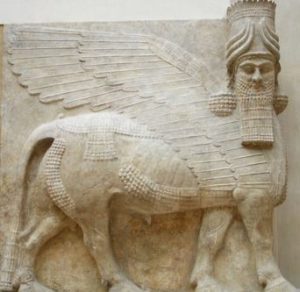
Babylonian Shedu

This idea of four exiles originated with Daniel’s vision of four great beasts (Daniel 7:3-7). The first was a lion with eagle wings—a well-known symbol of ancient Babylon. Then came a fierce bear, an animal which the Talmud always likens to the Persians. The swift leopard represents the Greeks that conquered the known world in lightning speed under Alexander the Great. The final and most devastating beast is unidentified, representing the longest and cruelest exile of Edom.

The Midrash states that Jacob himself foresaw these exiles in his vision of the ladder (Genesis 28). There he saw four angels, each going up a number of rungs on the ladder equal to the number of years Israel would be oppressed by that particular nation. The last angel continued to climb ever higher, with Jacob unable to see its conclusion, alluding to the current seemingly never-ending exile.  The big question is: why are these considered the four exiles. Haven’t the Jewish people been exiled all around the world? Have we not been oppressed by other nations besides these?

The Arizal explains (Sha’ar HaMitzvot on Re’eh) that while Jews have indeed been exiled among all seventy root nations, it is only in these four that all Jews were exiled in. Yet, he maintains that any place where even a single Jew has been exiled is considered as if the entire nation was exiled there. The Arizal further explains that these four exiles were already alluded to in Genesis 2:10-14, where the Torah describes the four rivers that emerged from Eden. Each river corresponds to one exile. The head river of Eden that gives rise to the other four corresponds to the very first exile of the Jews, the exile within which the Jewish people were forged: Egypt, the mother of all exiles.

Elsewhere, the Arizal adds that there is actually a fifth exile, that of Ishmael (Etz Ha’Da’at Tov, ch. 62). History makes this plainly evident, of course, as the Jewish people have suffered immensely under Arab and Muslim oppression to this very day. The idea of Ishmael being the final exile was known long before the Arizal, and is mentioned by earlier authorities. In fact, one tradition holds that each exile has two components:

We know that before the Babylonians came to destroy the Kingdom of Judah and its capital Jerusalem, the Assyrians had destroyed the northern Kingdom of Israel with the majority of the Twelve Tribes. We also know that the Persians were united with the Medians. Technically speaking, Alexander the Great was not a mainstream Greek, but a Macedonian. While he was the one who conquered Israel, his treatment of the Jews was mostly fair. It was only long after that the Seleucid Greeks in Syria really tried to extinguish the Jews. Thus, the doublets are Assyria-Babylon (Ashur-Bavel), Persia-Media (Paras-Madai), Macedon-Greece (Mokdon-Yavan), with the final doublet being Edom-Ishmael. The latter has a clear proof-text in the Torah itself, where we read how Esau (ie. Edom) married a daughter of Ishmael (Genesis 28:9). The Sages suggest that this is an allusion to the joint union between Edom and Ishmael to oppress Israel in its final exile.

The Arizal certainly knew the above, so why does he speak of a fifth exile under Ishmael, as well as a fifth (original) exile under Egypt?

The End is Wedged in the Beginning

One of the most well-known principles in Kabbalah is that “the end is wedged in the beginning, and the beginning in the end”. What the Arizal may have been hinting at is that the final Ishmaelite exile is a reflection of the original Egyptian exile. Indeed, the Arizal often speaks of how the final generation at the End of Days is a reincarnation of the Exodus generation. (According to one tradition, there were 15 million Jews in ancient Egypt, just as there are roughly 15 million in the world today.) The first redeemer Moses took us out of the Egyptian exile, and we await Moses’ successor, the final redeemer Mashiach, to free us from the Ishmaelite exile.

In highly symbolic fashion, the land of ancient Egypt is currently occupied by Muslim Arabs. The Ishmaelites have quite literally taken the place of ancient Egypt. Come to think of it, the lands of all the four traditional nations of exile are now Ishmaelite: Bavel is Iraq, Paras is Iran, Seleucid Greece is Syria, and the Biblical land of Edom overlaps Jordan. The four rivers of Eden would have run through these very territories. It is quite ironic that Saddam Hussein openly spoke of himself as a reincarnated Nebuchadnezzar, seeking to restore a modern-day Babylonian Empire. Meanwhile, each day in the news we hear of the looming Syria-Iran threat. Just as Egypt was the mother of all four “beasts”, it appears that the four beasts converge under a new Ishmaelite banner for one final End of Days confrontation.

There is one distinction however. In the ancient land of Egypt, all Jews were physically trapped. We do not see this at all today, where very few Jews remain living in Muslim states. Nonetheless, every single Jew around the world, wherever they may be, is living under an Ishmaelite threat. Muslims in France, for example, have persistently attacked innocent Jews in horrific acts—so much so that recently 250 French intellectuals, politicians, and even former presidents banded together to demand action against this absurd violence and anti-Semitism. Similar acts of evil have taken place all over the world. This has been greatly exacerbated by the recent influx of Muslim refugees to the West, as admitted by Germany’s chancellor Angel Merkel who recently stated: “We have refugees now… or people of Arab origin, who bring a different type of anti-Semitism into the country…”

In 2017, Swedish police admitted that there are at least 23 “no-go” Sharia Law zones in their country.

It is important to note that when Scripture speaks of the End of Days, it is not describing a regional conflict, but an international one. The House of Ishmael is not a local threat to Israel alone, or only to Jewish communities, but to the entire globe. Every continent has felt the wrath of Islamist terrorism, and whole communities in England, France, and even America have become cordoned off as “sharia law” zones. Ishmael is even a threat to himself. Muslims kill each other far more than they kill non-Muslims. In 2011, the National Counter-Terrorism Center reported that between 82% and 97% of all Islamist terror victims are actually Muslim. All but three civil wars between 2011 and 2014 were in Muslim countries, and all six civil wars that raged in 2012 were in Muslim countries. In 2013, the U.S. Commission on International Religious Freedom showed that 10 of the 15 most intolerant and oppressive states in the world were Muslim ones.

The Torah wasn’t wrong when it prophesied (Genesis 16:12) that Ishmael would be a “wild man; his hand against every man, and every man’s hand against him, and upon all of his brothers he will dwell.” Every Jew—and every human being for that matter—is experiencing an Ishmaelite exile at present.

The Exile Within

There is one more way of looking at the four exiles: not as specific nations under whom we were once oppressed, but as four oppressive forces that have always constrained Israel, and continue to do so today. These are the four root issues plaguing the Jews, and keeping us in “exile” mode.

The first is Edom, that spirit of materialism and physicality embodied by Esau. Unfortunately, such greed and gluttony has infiltrated just about every Jewish community, including those that see themselves as the most spiritual. The second, Bavel, literally means “confusion”, that inexplicable madness within the Jewish nation; the incessant infighting, the divisiveness, and the sinat chinam. Yavan is Hellenism, or secularism. In Hebrew, the word for a secular Jew is hiloni, literally a “Hellene”. Just as this week’s parasha clearly elucidates, abandoning the Torah is a root cause of many ills that befall the Jews. Finally, there is Paras. It was because the Jews had assimilated in ancient Persia that the events of Purim came about. Paras represents that persistent problem of assimilation.

It is important to point out that assimilation is different from secularism. There are plenty of secular Jews that are also very proud Jews. They openly sport a magen David around their neck, worry every day about Israel, want their kids to marry only other Jews, and though they don’t want to be religious, still try to connect to their heritage, language, and traditions. The assimilated Jew is not that secular Jew, but the one that no longer cares about their Jewish identity. It is the Jew that entirely leaves the fold. Sometimes, it is the one that becomes a “self-hating” Jew, or converts to another religion. Such Jews have been particularly devastating to the nation, and often caused tremendous grief. Some of the worst Spanish inquisitors were Jewish converts to Catholicism. Karl Marx and the Soviet Communists that followed are more recent tragedies. Not only do they leave their own people behind, they bring untold suffering to their former compatriots.

While there may be literal Babylonians, Persians, Greeks, and Edomites out there, the bigger problem for the Jewish people is the spiritual Bavel, Paras, Yavan, and Edom that infects the hearts and minds of the nation: infighting, assimilation, secularism, materialism. It is these issues that we should be spending the most time meditating upon, and expending the most effort to solve. Only when we put these problems behind us can we expect to see the long-awaited end to exile.

The Mysterious Custom of Upsherin

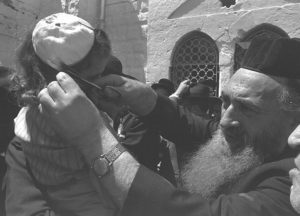
In this week’s double Torah portion (Acharei-Kedoshim) we read that “when you will have planted all manner of trees for food, its fruit shall be forbidden; three years shall it be forbidden to you, it shall not be eaten.” (Leviticus 19:23) This refers to the mitzvah of orlah, where a newly-planted tree must be left unharvested for its first three years. Seemingly based on this, a custom has developed to leave the hair of newborn boys uncut until age three. On or around the boy’s third birthday, a special celebration is held (called upsherin or halakeh), often with family and friends taking turns to cut a bit of the boy’s hair. Henceforth, the boy is encouraged to wear a kippah and tzitzit, and his formal Jewish education will begin. It is said that just as a tree needs the first three years to establish itself firmly in the ground before it can flourish and its fruit be used in divine service, so too does a child.

Lag B’Omer 1970 in Meron. Photo from Israel’s National Photo Collection

Indeed, the Torah makes a comparison between trees and humans in other places. Most famously, Deuteronomy 20:19 states that fruit trees should not be harmed during battle, “for is the tree of the field a man?” The tree is not an enemy combatant, so it should be left alone. Although the plain meaning of the verse is that the tree is not a man, an alternate way of reading it is that “man is a tree of the field”. Elsewhere, God compares the righteous man to a tree firmly rooted in the ground (Jeremiah 17:8), and in another place compares the entire Jewish nation to a tree (Isaiah 65:22).

Having said that, the custom of upsherin is essentially unknown in ancient Jewish sources. It is not mentioned anywhere in the Talmud, nor in any early halakhic codes, including the authoritative Shulchan Arukh of the 16th century. Where did this very recent practice originate?

Lag b’Omer and the Arizal

The first Jews to take up this custom were those living in Israel and surrounding lands under Arab Muslim dominion in the Middle Ages. We see that Sephardic Jews in Spain and Morocco did not have such a custom, nor did the Yemenite Jews. (In fact, Yemenite Jews did not even have a custom to abstain from haircuts during Sefirat HaOmer at all.) This is particularly relevant because the upsherin ceremony is often connected with the Sefirat HaOmer period, with many waiting until Lag b’Omer for their child’s first haircut, and taking the boy to the grave of Rashbi (Rabbi Shimon bar Yochai) in Meron for the special ceremony.

It appears that the earliest textual reference to upsherin is from Rabbi Chaim Vital (1543-1620), the primary disciple of the Arizal (Rabbi Isaac Luria, 1534-1572). Because of this, many believe that upsherin is a proper Kabbalistic custom that was instituted by, or at least sanctioned by, the great Arizal. In reality, the text in question says no such thing. The passage (Sha’ar HaKavanot, Inyan HaPesach, Derush 12) states the following:

ענין מנהג שנהגו ישראל ללכת ביום ל”ג לעומר על קברי רשב”י ור”א בנו אשר קבורים בעיר מירון כנודע ואוכלים ושותי’ ושמחים שם אני ראיתי למוז”ל שהלך לשם פ”א ביום ל”ג לעומר הוא וכל אנשי ביתו וישב שם שלשה ימים ראשו’ של השבוע ההו’ וזה היה פעם הא’ שבא ממצרים אבל אין אני יודע אם אז היה בקי ויודע בחכמה הזו הנפלאה שהשיג אח”כ. והה”ר יונתן שאגי”ש העיד לי שבשנה הא’ קודם שהלכתי אני אצלו ללמוד עם מוז”ל שהוליך את בנו הקטן שם עם כל אנשי ביתו ושם גילחו את ראשו כמנהג הידוע ועשה שם יום משתה ושמחה

On the custom of Israel going on Lag b’Omer to the grave of Rabbi Shimon bar Yochai and Rabbi Elazar his son (who are buried in the town of Meron as is known) and to eat and drink and rejoice there—I saw that my teacher, of blessed memory [the Arizal], that he went there once on Lag b’Omer with his whole family and remained there for three days, until the start of the sixth week [of the Omer]. And this was that one time, when he came from Egypt, but I do not know if he was then knowledgeable in this wisdom that he would later attain. And Rav Yonatan Sagis related to me that in the first year before I went to him to learn with my teacher of blessed memory, he took his small son with his whole family and there they cut his hair according to the known custom, and he held a feast and celebration there.

First, what we see in this passage is that the Arizal apparently only visited Meron on Lag b’Omer once, when he just made aliyah from Egypt, and before he had become the pre-eminent Kabbalist in Tzfat. (Some say this was actually before he made aliyah, and was simply on a trip to Israel.) Lag b’Omer is the 5th day of the 5th week of the Omer, and the Arizal stayed there for the remainder of the fifth week. Rav Chaim Vital wonders whether the Arizal was already an expert mystic at the time or not. Once he became the leader of the Tzfat Kabbalists, the Arizal apparently never made it a point to pilgrimage to Meron on Lag b’Omer. Rabbi Vital notes just that one time in the past, and it almost seems like once the Arizal was a master mystic, he understood there was nothing particularly mystical about it. In any case, nothing is said here of cutting hair.

The next part of the passage is more problematic. To start, it is unclear whether Rabbi Vital means that he and the Arizal went to study with Rav Yonatan Sagis, or that he and Rav Sagis went to study with the Arizal. We know that Rabbis Sagis and Vital were later both students of the Ari. However, when the Ari first came to Tzfat he was essentially unknown, and was briefly a disciple of other Kabbalists, namely the Ramak (Rabbi Moshe Cordovero, 1522-1570). In fact, the Arizal only spent a couple of years in Tzfat before suddenly passing away at a very young age. Whatever the case, it is unclear from the passage whether it was the Arizal or Rav Sagis who was the one to take his son for a haircut on Lag b’Omer. Based on the context, it would appear that it was Rav Sagis who did so, not the Arizal, since we already learned that the Arizal did not make it a point to pilgrimage to Meron.

The nail on the coffin may come from an earlier passage in the same section of Sha’ar HaKavanot, where we read:

ענין הגילוח במ”ט ימים אלו לא היה מוז”ל מגלח ראשו אלא בערב פסח ובערב חג השבועות ולא היה מגלח לא ביום ר”ח אייר ולא ביום ל”ג לעומר בשום אופן

On the matter of shaving during these forty-nine days [of the Omer], my teacher of blessed memory did not shave his head [hair], except for the evening of Passover and the evening of Shavuot, and would not shave his hair at all [in between], not on Rosh Chodesh Iyar, and not on Lag b’Omer.

According to the Arizal, one should not shave at all during the entire Omer period, including Lag b’Omer! If that’s the case, then the Ari certainly wouldn’t take his child to Meron for a haircutting on Lag b’Omer. It must be that the previous passage is referring to Rav Sagis. Nowhere else in the vast teachings of the Arizal is the custom of waiting until a boy’s third birthday (whether on Lag b’Omer or not) mentioned. Thus, the Arizal was not the custom’s originator, did not expound upon it, and most likely did not even observe it.

So where did it come from?

A Far-Eastern Custom

While no ancient Jewish mystical or halakhic text before the 17th century appears to mention upsherin, a similar custom is discussed in much older non-Jewish sources. The Kalpa Sutras of the ancient Hindu Vedic schools speak of a ceremony called Chudakarana or Mundana, literally “haircutting”. It is supposed to be done before a child turns three, usually at a Hindu temple. It is explained that the hair a child is born with it connected to their past life, and all the negative things which that may entail. Removing this hair is symbolic of leaving the past life behind and starting anew. Interestingly, a small lock of hair is usually left behind, called a sikha, “flame” or “ray of light”, as a sign of devotion to the divine. This is surprisingly similar to the Chassidic custom of leaving behind the long peyos at the upsherin.

Hindu Sikha and Chassidic Peyos

From India, the custom seemingly moved across Asia to Arabia. One Muslim tradition called Aqiqah requires shaving the head of a newborn. Of this practice, Muhammad had apparently stated that “sacrifice is made for him on the seventh day, his head is shaved, and a name is given him.” An alternate practice had Muslims take their boys to the graves of various holy people for their first haircut. The Arabic for “haircut” is halaqah, which is precisely what the Mizrachi Jews of Israel called upsherin. Thus, it appears that Jews in Muslim lands adopted the custom from their neighbours. However, many of them waited not until the child is three, but five, which is when the Mishnah (Avot 5:22) says a child must start learning Torah. (In this case, the practice has nothing to do with the mitzvah of orlah or any connection to a sapling.)

In the early 19th century, Rabbi Yehudah Leibush Horenstein made aliyah to Israel and first encountered this practice of “the Sephardim in Jerusalem… something unknown to the Jews in Europe.” He was a Hasid, and in that time period many more Hasidim were migrating to Israel—a trend instigated by Rabbi Menachem Mendel of Vitebsk (c. 1730-1788), the foremost student of the Maggid of Mezeritch (Rabbi Dov Ber, d. 1772), who in turn was the foremost student of the Baal Shem Tov (Rabbi Israel ben Eliezer, 1698-1760) the founder of Hasidism. These hasidim in Israel adopted the practice from the local Sephardim, and spread it to the rest of the Hasidic world over the past century and a half.

While it has become more popular in recent decades, and has been adopted by other streams within Orthodoxy, and even many secular Israelis and Jews, upsherin is far from universally accepted. The Steipler (Rabbi Yaakov Yisrael Kanievsky, 1899-1985) was particularly upset about this practice (see Orchos Rabbeinu, Vol. I, pg. 233). When a child was brought before Rav Yitzchok Zev Soloveitchik of Brisk (1886-1959) for an upsherin, he frustratingly replied: “I am not a barber.” Other than the fact that it is not an established or widespread Jewish custom, there is a serious issue of it being in the category of darkei Emori, referring to various non-Jewish (and potentially idolatrous) practices.

Not So Fast

While there is no mention of the upsherin that we know today in ancient Jewish mystical or halakhic texts, there is mention of something very much related. In one of his responsa, the great Radbaz (Rabbi David ibn Zimra, c. 1479-1573) speaks of a practice where some people take upon themselves a “vow to shave their son in the resting place of Samuel the Prophet” (see She’elot v’Teshuvot haRadbaz, siman 608).

Recall that Samuel was born after the heartfelt prayer of his mother Hannah who was barren for many years. She came to the Holy Tabernacle in Shiloh and vowed that if God gave her a son, she would dedicate him to divine service from his very birth, and he would be a nazir his entire life (I Samuel 1:11). This means that he would never be allowed to shave or trim the hair of his head, just as the Torah instructs for anyone taking on a nazirite vow. There is something particularly holy about this, and we see earlier in Scripture how an angel comes to declare the birth of the judge Samson and instructs the parents to ensure he would be a nazirite for life, and that no blade ever come upon his head (Judges 13:5).

The Tanakh goes on to state that once Samuel was weaned, Hannah took him to the Tabernacle and left him in the care of the holy priests so that he could serve God his entire life. How old was he when he was weaned? While it doesn’t say so here, there is an earlier case where the Torah speaks of a child being weaned. This is in Genesis 21:8, where we read how Abraham through a great feast upon the weaning of his son Isaac. Rashi comments here (drawing from the Midrash and Talmud) that Isaac was two years old at the time. For this reason, many Hasidic groups actually perform the upsherin at age two, not three.

Back to the Radbaz, he was born in Spain but was exiled with his family in the Expulsion of 1492. The family settled in Tzfat, where the Radbaz was tutored by Rabbi Yosef Saragossi, the holy “White Saint” credited with transforming Tzfat from a small town of 300 unlearned Jews to a holy Jewish metropolis and the capital of Kabbalistic learning. In adulthood, the Radbaz settled in Fes, Egypt and his fame as a tremendous scholar and posek spread quickly. In 1517, he moved to Cairo and was appointed Hakham Bashi, the Chief Rabbi of Egypt. There, he founded a world-class yeshiva that attracted many scholars. Coming full circle, it was here in the yeshiva of the Radbaz that the Arizal began his scholarly career. In the last years of his life, the Radbaz wished to return to the Holy Land, and made his way back to Tzfat. It is possible that the Arizal left Egypt for Tzfat in the footsteps of his former rosh yeshiva. Ironically, the Radbaz (who lived to age 94, or even 110 according to some sources) would outlive the Arizal (who died at just 38 years of age).

While neither the Arizal nor his old teacher the Radbaz discuss cutting a three-year-old’s hair in particular (or doing it at the tomb of Rashbi), the Radbaz does speak of a personal vow that one may take to cut their child’s hair at the tomb of Samuel the Prophet. This practice comes from emulating Hannah, who took a vow with regards to her son Samuel. Samuel went on to be compared in Scripture to Moses and Aaron (and the Sages say Moses and Aaron combined!) Of course, Hannah never cut her child’s hair at all, but perhaps there is something spiritual in treating the child like a nazirite until the child is “weaned”.

In any case, the question that the Radbaz was addressing is what one must do if they took up such a haircutting vow but are unable to fulfil it because the authorities prohibit Jews from going to the grave sites of their ancestors. From here, some scholars conclude that the Ottoman authorities at the time really must have prohibited Jews from going to the grave of Samuel, near Jerusalem. Thus, it is possible that those Jerusalem Jews who had a custom of going to Samuel’s grave decided to journey to another famous grave instead. Perhaps it was in these years of the early 16th century that the custom to go to Rashbi in Meron (instead of Shmuel near Jerusalem) evolved.

So, there may be something to the upsherin custom after all. Of course, we still don’t know when the practice of going to Samuel’s grave emerged. That appears to have been a local custom (or possibly not a custom at all, but a personal vow) of Jerusalem’s medieval Jewish community. It, too, may have been influenced by neighbouring Muslims who went to the graves of their saints to cut their children’s hair.

Whatever the case, we see that foundations of upsherin are not so clear-cut. Contrary to popular belief, it is neither a universally accepted Jewish custom, nor a mandatory halakhic requirement. It did not originate with the Arizal either, although we do see some basis for it in the writings of the Radbaz. For those who wish to uphold this custom, they have upon whom to rely, and should meditate foremost upon the holy figures of Hannah and Samuel, who appear to be the spiritual originators of this mysterious practice.


The above is an excerpt from Garments of Light, Volume Two. Get the book here

The First Pesach: Did the Patriarchs Celebrate Passover?

The holiday of Passover commemorates the Exodus of the Israelites out of Egypt over three thousand years ago. The Torah tells us that because of their hasty departure, the dough of the Israelites did not have time to rise, hence the consumption of matzah. Yet, the term matzah appears in the Torah long before the Exodus! We read in Genesis 19:3 that Lot welcomed the angels into his home and “made them a feast, and baked matzot, and they ate.” Since the angels came to Lot immediately after visiting Abraham and Sarah to announce the birth of Isaac at that time next year (Genesis 18:10), the Sages learn from this that Isaac was born on Passover. Of course, the Exodus only took place four hundred years after Isaac’s birth! How is it that the patriarchs are already eating matzah?
An Eternal Torah

Although the Torah was given to the Israelites following the Exodus, Jewish tradition affirms that the Torah is eternal, and even predates existence. A famous verse in the Zohar (II, 161a) states that “God looked into the Torah and created the universe.” Adam knew the whole Torah, and was taught its deepest secrets by the angel Raziel. Many of these teachings were passed on by Adam to future generations, down to Noah, then his son Shem, and eventually to the Patriarchs who, according to tradition, studied at Shem’s academy. So, while the Torah tradition officially dates back to Sinai, in some ways it dates back all the way to Creation! It’s also important to keep in mind that the Patriarchs were prophets, which means that even though they did not have a physical, written Torah, there is no reason why they could not have received the Torah’s wisdom directly from God.

As such, it is said that the Patriarchs kept the entire Torah and fulfilled all the mitzvot. When Jacob sends a message to Esau after his sojourn in Charan he tells him “I have lived [garti] with Laban” (Genesis 32:5). On this, Rashi says that garti (גרתי) is an anagram of taryag (תרי״ג), the 613 commandments, meaning that despite living under the oppressive Laban for twenty years, Jacob still observed all 613 commandments. Yet, this is impossible since Jacob married two sisters—a clear Torah prohibition! Similarly, when Abraham meets Melchizedek (ie. Shem) following his victory over the Mesopotamian kings, he tells him that he will not take any reward whatsoever, not even “a thread or strap” (Genesis 14:23). For this, the Sages say, Abraham’s descendants merited the mitzvah of tzitzit (the threads) and tefillin (the straps). In that case, Abraham himself did not wear tefillin or tzitzit. From such instances we see that the patriarchs did not keep the Torah completely, at least not the Torah as we know it.

Emanations of Torah

While Kabbalistic texts often point out that the Torah is eternal and served as the very blueprint of Creation, they also go into more detail to explain that this primordial Torah was not quite the same as the Torah we have today. Each of the four mystical universes (Asiyah, Yetzirah, Beriah, Atzilut) has an ever-more refined level of Torah, with the highest being the Torah of Atzilut. Our Torah is the one of Asiyah, and is full of mitzvot only due to Adam’s sin and the corruption of mankind. In Olam HaBa, the Torah of Atzilut will finally be revealed, which is why Jewish tradition holds that many mitzvot will no longer apply in that future time. This is said to be the meaning of Isaiah 51:4 where God proclaims that in the messianic times “a Torah will go forth from Me”; and of Jeremiah 31:30 where God says He will forge a brit chadashah, a “new covenant”, with Israel. (This latter term was usurped by Christians for their “New Testament”.)

An even more intriguing idea is that the “New Torah” will be composed of the exact same letters as the current one we possess, just rearranged to form new words! Yet another is based on the well-known principle that the Heavenly Torah is composed of “black fire on white fire”. This is often used to explain the fact that the Torah actually has 304,805 letters, even though it is always described as having 600,000 letters (one for each Israelite at Mt. Sinai)—there are 304,805 letters of “black fire” and the rest are the invisible letters of “white fire”. Gershom Scholem cites a number of Kabbalistic and Hasidic texts suggesting that these currently-invisible “white fire” letters are the true eternal Torah! (See Scholem’s Kabbalah, pgs. 171-174, for a complete analysis of these concepts.)

It is this primordial Torah that was originally taught to Adam, and was passed down through his descendants to the Patriarchs, who carefully observed it. As such, it appears that eating matzah is an eternal mitzvah that already appeared in the primordial Torah before the Exodus and the revelation of the current Torah of Asiyah. What was the meaning behind that consumption of matzah?

Bread of Faith

Matzah is called the “bread of faith”. It symbolizes our faithfulness to God, who took us out of Egypt to be His people: “Let My people go so that they may serve Me” (Exodus 7:16, 26). Further emphasizing this point, the word matzot is spelled exactly like mitzvot. This simple, “humble” bread symbolizes our subservience to God’s commands. We are His faithful servants, just as the Patriarchs were His faithful servants. So they, too, ate matzah as a sign of their faith. They ate matzah because God had liberated them, too, from various hardships.

The very first Patriarch, Abraham, was miraculously saved from Nimrod’s furnace. He also dwelled in Egypt for a time before God miraculously brought him out of there with great wealth, just as his descendants would do centuries later. And then came his greatest test of faith: the Akedah. Amazingly, the apocryphal Book of Jubilees connects this event with the future Passover holiday. In chapter 18, it suggests that God commanded the Akedah to Abraham on the 15th of Nisan. As the Torah states, Abraham journeyed for three days before the Akedah happened and then, naturally, it took him three days to return home. Thus, the whole ordeal spanned seven days, and when Abraham returned, he established a seven-day “festival to Hashem” from the 15th of Nisan. The future seven-day Passover holiday would happen on those same days in that same month.

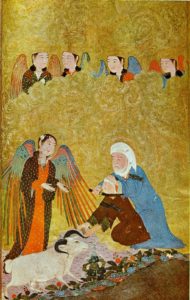
“Abraham’s Sacrifice”, a 15th century piece of Timurid-Mongolian art

While the Sages do debate whether some of the Torah’s major events (including Creation itself) happened in the month of Tishrei or Nisan, the accepted Jewish tradition is that the Akedah happened in Tishrei. Nonetheless, it is quite fitting that the Binding of Isaac should happen on Passover, when Isaac was born. In this case, the ram that Abraham ultimately offered in place of Isaac would serve as a proto-Pesach offering. After all, the ram is nothing but a male sheep, and it is the ram that is the astrological sign of Nisan, and it was those ram-headed gods that the Egyptians worshipped that needed to be slaughtered by the Israelites (as discussed last week). Whatever the case, the Book of Jubilees offers an intriguing possibility for the spiritual origins of Passover, and for why the Patriarchs themselves ate matzot long before the Exodus.