Tag Archives: Rabbi Shimon bar Yochai

How Esau Became Rome

In this week’s parasha, Toldot, we are introduced to the twin sons of Isaac: Jacob and Esau. The Torah tells us that the boys grew up and Esau became a “man of the field” while Jacob was “an innocent man sitting in tents” (Genesis 25:27). In rabbinic literature, Esau takes on a very negative aura. Although the Torah doesn’t really portray him as such a bad guy, extra-Biblical texts depict him as the worst kind of person.
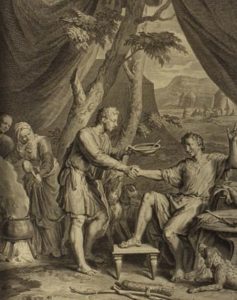
A 1728 Illustration of Esau selling his birthright.

Take, for instance, the first interaction between Jacob and Esau that the Torah relates. Esau comes back from the field extremely tired. At that moment, Jacob is cooking a stew. Esau asks his brother for some food, and Jacob demands in exchange that Esau give up his birthright (ie. his status as firstborn, and the privileges that come with that). Esau agrees because “behold, I am going to die” (Genesis 25:32). The plain text of the Torah makes it seem like Jacob took advantage of Esau’s near-fatal weariness and tricked him into selling his birthright. This is later confirmed when Esau says that Jacob had deceived him (Genesis 27:36), implying that Esau never really wished to rid of it.

Yet, the Torah commentaries appear to flip the story upside down. When Esau comes back from the field exhausted, it isn’t because he just returned from a difficult hunt, but rather because, as Rashi comments, he had just come back from committing murder! When Esau says “I am going to die”, it isn’t because he was on the verge of death at that moment, but because he didn’t care about the birthright at all, choosing to live by the old adage of “eat, drink, and be merry, for tomorrow we die”. This is a very different perspective on the same narrative.

Another example is when, many years later, Jacob returns to the Holy Land and Esau comes to meet him. Jacob assumes Esau wants to kill him, and prepares for battle. Instead, Esau genuinely seems to have missed his brother, and runs towards him, “embracing him, falling upon his neck, and kissing him” (Genesis 33:4). Again, some of the commentaries turn these words upside down, saying that Esau didn’t really lovingly kiss his brother, but actually bit him! Rashi’s commentary on this verse cites both versions. He concludes by citing Rabbi Shimon bar Yochai in stating that although Esau, as a rule, hates Jacob, at that moment he really did love his brother.

So, how bad was Esau really?

Seeing the Good in Esau

Occasionally, we read about Esau’s good qualities. The Midrash (Devarim Rabbah 1:15) famously states that no one honoured their parents better than Esau did. This is clear from a simple reading of the Torah, too, where Esau is always standing by to fulfil his parents’ wishes. For instance, as soon as he learns that his parents are unhappy with his choice of wives, he immediately goes off to marry someone they might approve of (Genesis 28:8-9).

We should be asking why his parents didn’t simply tell him from the start that his original wives were no good? Why did they allow him to marry them in the first place? If Esau really was the person who most honours his parents, he would have surely listened to them! We may learn from this that Esau’s parents didn’t put too much effort into him. It’s almost like Rebecca gave up on her son from the moment she heard the prophecy about the twins in her belly. The Torah says as much when it states, right after the birth of the twins, that “Isaac loved Esau because his game-meat was in his mouth, but Rebecca loved Jacob.” (Genesis 25:28) Rebecca showed affection to Jacob alone, while Isaac’s love for Esau was apparently conditional. Of course, children always feel their parents’ inner sentiments, and there is no doubt Esau felt his parents’ lack of concern for him. Is it any wonder he tried so hard to please them?

From this perspective, one starts to feel a great deal of pity for Esau. How can anyone read Esau’s heartfelt words after being tricked out of his blessing and not be filled with empathy?:

When Esau heard his father’s words, he cried out a great and bitter cry, and he said to his father, “Bless me, too, O my father! …Do you not have a blessing left for me?” (Genesis 27:34-36)

Esau was handed a bad deal right from the start. He was born different, not just in appearance, but with a serious life challenge. He was gifted (or cursed) with a particularly strong yetzer hara, from birth. His fate was already foretold, and his parents believed it. They invested little into him. And it seems all he ever wanted was to make them proud.

Incidentally, this is one of the major problems with fortune-telling, and why the Torah is so adamant about not consulting any kind of psychic. The psychic’s words, even if entirely wrong, will shape the person’s views. It is very much like the Talmud’s statement (Berakhot 55b) that a dream is fulfilled according to how it is interpreted. A person believes the interpreter, and inadvertently brings about that interpretation upon themselves. It’s a self-fulfilling prophecy.

Who knows what might have happened if Rebecca never bothered to consult a prophet about her pregnancy? After all, Jewish tradition is clear on the fact that negative prophecies do not have to come true. God relays such a prophecy in order to inspire people to change, and thus avert the negative decree. Such was precisely the case with Jonah and his prophecy regarding Nineveh. The people heard the warning, repented, and the prophecy was averted.

Perhaps this is what Isaac and Rebecca should have done. Instead of giving up on Esau, they should have worked extra hard to guide him in the right direction. (Isaac indirectly did the opposite, motivating his son’s hunting since he loved the “game-meat in his mouth”.) The Sages affirm that Esau was not a lost case, and state that had Jacob allowed his daughter Dinah to marry Esau, she would have reformed him (see, for example, Beresheet Rabbah 76:9).

At the end, Jacob returns to the Holy Land and, instead of the war with Esau that he was expecting, his brother welcomes him back with open arms. He weeps, and genuinely misses him. Esau has forgiven his brother, yet again, and buries the past. He hopes to live with his brother in peace henceforth, and invites him to live together in Seir. Esau offers to safely escort Jacob and his family. Jacob rejects the offer, and tells Esau to go along and he will join him later (Genesis 33:14). This never happens. Jacob has no intention to live with Esau, and as soon as his brother leaves, Jacob a completely different course. Esau is tricked one last time.

We only hear about Esau once more in the Torah. When Isaac dies, Esau is there to give his father a proper burial (Genesis 35:29). In fact, the Book of Jubilees, which doesn’t portray Esau too kindly either, nonetheless suggests that Esau had repented at the end of his life. There we read that it was his sons that turned evil, and even coerced him into wrongdoing (37:1-5). In Jubilees, Esau tells his parents that he has no interest in killing Jacob, and loves his brother wholeheartedly, more than anyone else (35:22). He admits that Jacob is the one that deserves the birthright, and a double portion as the assumed firstborn (36:12).

The Torah never tells us what ends up happening to Esau. The Midrash states that he was still there when Jacob’s sons came to bury their father in the Cave of the Patriarchs. Esau tried to stop them, at which point Jacob’s deaf grandson Hushim decapitated him. (A slightly different version is found in the Talmud as well, Sotah 13a.) Esau’s head rolled down into the Cave of the Patriarchs, while the rest of his body was buried elsewhere. Perhaps what this is meant to teach us is that while Esau’s body was indeed mired in sin, his head was completely sound, and he certainly had the potential to be a righteous man—maybe even one of the forefathers, hence his partial burial in the Cave of the Patriarchs.

At the end of the day, Esau is not so much a villain as he is a tragically failed hero.

Why Did Esau Become so Evil?
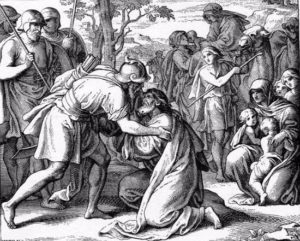
Esau meets Jacob, by Charles Foster (1897)

As we’ve seen, the Torah itself doesn’t portray Esau as such a bad person. Conversely, one of the 613 mitzvot is “not to despise an Edomite, for he is your brother.” (Deuteronomy 23:8) The Torah reminds us that the children of Israel and the children of Esau (known as Edomites) are siblings, and should treat each other as such.

Nearly a millennium later, the prophet Malachi—generally considered the last prophet and, according to one tradition, identified with Ezra the Scribe—says (Malachi 1:2-3):

“I have loved you,” says Hashem, “Yet you say: ‘How have You loved us?’ Was not Esau a brother to Jacob?” says Hashem, “yet I loved Jacob, but Esau I hated…”

The text goes on to differentiate between Israel and Edom, stating that while Israel will be restored, Edom will be permanently extinguished. We have seen this prophecy fulfilled in history; Israel is still here, of course, while Edom has long disappeared from the historical record. Jacob’s descendants continue to thrive, while Esau’s are long gone.

By the times of the Talmud, there were no real Edomites left, so the Sages began to associate Edom with a new entity: the Roman Empire. The Sages certainly didn’t believe that the Romans were the direct genetic descendants of Esau, but rather that they were their spiritual heirs. Why did the Sages make this connection?

I believe the answers lies with King Herod the Great.

Recall that approximately two thousand years ago Herod ruled as the Roman-approved puppet king of Judea. He was a tremendous tyrant, and is vilified in both Jewish and Christian tradition. The Talmud (Bava Batra 3b-4a) relates how Herod slaughtered all the rabbis in his day, leaving only Bava ben Buta, whom he had blinded. Later, Herod had an exchange with Bava and realized how wise the rabbis were:

Herod then said: “I am Herod. Had I known that the Rabbis were so circumspect, I should not have killed them. Now tell me what amends I can make.”

Bava ben Buta replied: “As you have extinguished the light of the world, [for so the Torah Sages are called] as it is written, ‘For the commandment is a light and the Torah a lamp’ (Proverbs 6:23), go now and attend to the light of the world [which is the Temple] as it is written, ‘And all the nations become enlightened by it.’” (Isaiah 2:2)
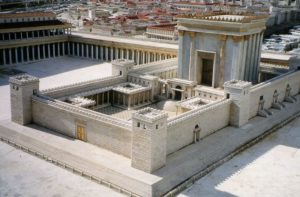
A model of Herod’s version of the Second Temple in Jerusalem

Herod did just that, and renovated the Temple to be the most beautiful building of all time, according to the Talmud. It wouldn’t last long, as that same Temple would be destroyed by his Roman overlords within about a century.

What many forget is that Herod was not a native Jew, but an Idumean. And “Idumea” was simply the Roman name for Edom. Herod was a real, red-blooded Edomite. (Though it should be noted that the Idumeans had loosely, or perhaps forcibly, converted to Judaism in the time of the Hasmoneans.) Herod took over the Jewish monarchy, and began the horrible persecutions that the Roman Empire—of which he was a part—was all too happy to continue. It seems quite likely, therefore, that the association between Edom and Rome began at that point. The people resented that Roman-Edomite tyrant Herod that persecuted them so harshly.

Henceforth, it was easy for the Sages to spill their wrath upon Edom, and their progenitor Esau. Esau became a symbol of the Roman oppressor. “Esau” and “Edom” were code words, used for speaking disparagingly about Rome to avoid alarming the authorities. Indeed, when the Sages speak about the evils of Esau, they are often really referring to the evils of the Roman Empire. It is therefore not surprising that Esau becomes possibly the most reviled figure in the Torah—as the Romans were unquestionably the most reviled entity in Talmudic times.


The above is an excerpt from Garments of Light, Volume Two. To continue reading, get the book here

The Mysterious Custom of Upsherin

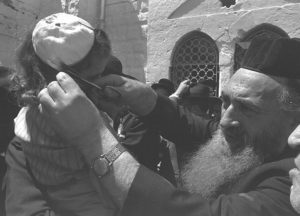
In this week’s double Torah portion (Acharei-Kedoshim) we read that “when you will have planted all manner of trees for food, its fruit shall be forbidden; three years shall it be forbidden to you, it shall not be eaten.” (Leviticus 19:23) This refers to the mitzvah of orlah, where a newly-planted tree must be left unharvested for its first three years. Seemingly based on this, a custom has developed to leave the hair of newborn boys uncut until age three. On or around the boy’s third birthday, a special celebration is held (called upsherin or halakeh), often with family and friends taking turns to cut a bit of the boy’s hair. Henceforth, the boy is encouraged to wear a kippah and tzitzit, and his formal Jewish education will begin. It is said that just as a tree needs the first three years to establish itself firmly in the ground before it can flourish and its fruit be used in divine service, so too does a child.

Lag B’Omer 1970 in Meron. Photo from Israel’s National Photo Collection

Indeed, the Torah makes a comparison between trees and humans in other places. Most famously, Deuteronomy 20:19 states that fruit trees should not be harmed during battle, “for is the tree of the field a man?” The tree is not an enemy combatant, so it should be left alone. Although the plain meaning of the verse is that the tree is not a man, an alternate way of reading it is that “man is a tree of the field”. Elsewhere, God compares the righteous man to a tree firmly rooted in the ground (Jeremiah 17:8), and in another place compares the entire Jewish nation to a tree (Isaiah 65:22).

Having said that, the custom of upsherin is essentially unknown in ancient Jewish sources. It is not mentioned anywhere in the Talmud, nor in any early halakhic codes, including the authoritative Shulchan Arukh of the 16th century. Where did this very recent practice originate?

Lag b’Omer and the Arizal

The first Jews to take up this custom were those living in Israel and surrounding lands under Arab Muslim dominion in the Middle Ages. We see that Sephardic Jews in Spain and Morocco did not have such a custom, nor did the Yemenite Jews. (In fact, Yemenite Jews did not even have a custom to abstain from haircuts during Sefirat HaOmer at all.) This is particularly relevant because the upsherin ceremony is often connected with the Sefirat HaOmer period, with many waiting until Lag b’Omer for their child’s first haircut, and taking the boy to the grave of Rashbi (Rabbi Shimon bar Yochai) in Meron for the special ceremony.

It appears that the earliest textual reference to upsherin is from Rabbi Chaim Vital (1543-1620), the primary disciple of the Arizal (Rabbi Isaac Luria, 1534-1572). Because of this, many believe that upsherin is a proper Kabbalistic custom that was instituted by, or at least sanctioned by, the great Arizal. In reality, the text in question says no such thing. The passage (Sha’ar HaKavanot, Inyan HaPesach, Derush 12) states the following:

ענין מנהג שנהגו ישראל ללכת ביום ל”ג לעומר על קברי רשב”י ור”א בנו אשר קבורים בעיר מירון כנודע ואוכלים ושותי’ ושמחים שם אני ראיתי למוז”ל שהלך לשם פ”א ביום ל”ג לעומר הוא וכל אנשי ביתו וישב שם שלשה ימים ראשו’ של השבוע ההו’ וזה היה פעם הא’ שבא ממצרים אבל אין אני יודע אם אז היה בקי ויודע בחכמה הזו הנפלאה שהשיג אח”כ. והה”ר יונתן שאגי”ש העיד לי שבשנה הא’ קודם שהלכתי אני אצלו ללמוד עם מוז”ל שהוליך את בנו הקטן שם עם כל אנשי ביתו ושם גילחו את ראשו כמנהג הידוע ועשה שם יום משתה ושמחה

On the custom of Israel going on Lag b’Omer to the grave of Rabbi Shimon bar Yochai and Rabbi Elazar his son (who are buried in the town of Meron as is known) and to eat and drink and rejoice there—I saw that my teacher, of blessed memory [the Arizal], that he went there once on Lag b’Omer with his whole family and remained there for three days, until the start of the sixth week [of the Omer]. And this was that one time, when he came from Egypt, but I do not know if he was then knowledgeable in this wisdom that he would later attain. And Rav Yonatan Sagis related to me that in the first year before I went to him to learn with my teacher of blessed memory, he took his small son with his whole family and there they cut his hair according to the known custom, and he held a feast and celebration there.

First, what we see in this passage is that the Arizal apparently only visited Meron on Lag b’Omer once, when he just made aliyah from Egypt, and before he had become the pre-eminent Kabbalist in Tzfat. (Some say this was actually before he made aliyah, and was simply on a trip to Israel.) Lag b’Omer is the 5th day of the 5th week of the Omer, and the Arizal stayed there for the remainder of the fifth week. Rav Chaim Vital wonders whether the Arizal was already an expert mystic at the time or not. Once he became the leader of the Tzfat Kabbalists, the Arizal apparently never made it a point to pilgrimage to Meron on Lag b’Omer. Rabbi Vital notes just that one time in the past, and it almost seems like once the Arizal was a master mystic, he understood there was nothing particularly mystical about it. In any case, nothing is said here of cutting hair.

The next part of the passage is more problematic. To start, it is unclear whether Rabbi Vital means that he and the Arizal went to study with Rav Yonatan Sagis, or that he and Rav Sagis went to study with the Arizal. We know that Rabbis Sagis and Vital were later both students of the Ari. However, when the Ari first came to Tzfat he was essentially unknown, and was briefly a disciple of other Kabbalists, namely the Ramak (Rabbi Moshe Cordovero, 1522-1570). In fact, the Arizal only spent a couple of years in Tzfat before suddenly passing away at a very young age. Whatever the case, it is unclear from the passage whether it was the Arizal or Rav Sagis who was the one to take his son for a haircut on Lag b’Omer. Based on the context, it would appear that it was Rav Sagis who did so, not the Arizal, since we already learned that the Arizal did not make it a point to pilgrimage to Meron.

The nail on the coffin may come from an earlier passage in the same section of Sha’ar HaKavanot, where we read:

ענין הגילוח במ”ט ימים אלו לא היה מוז”ל מגלח ראשו אלא בערב פסח ובערב חג השבועות ולא היה מגלח לא ביום ר”ח אייר ולא ביום ל”ג לעומר בשום אופן

On the matter of shaving during these forty-nine days [of the Omer], my teacher of blessed memory did not shave his head [hair], except for the evening of Passover and the evening of Shavuot, and would not shave his hair at all [in between], not on Rosh Chodesh Iyar, and not on Lag b’Omer.

According to the Arizal, one should not shave at all during the entire Omer period, including Lag b’Omer! If that’s the case, then the Ari certainly wouldn’t take his child to Meron for a haircutting on Lag b’Omer. It must be that the previous passage is referring to Rav Sagis. Nowhere else in the vast teachings of the Arizal is the custom of waiting until a boy’s third birthday (whether on Lag b’Omer or not) mentioned. Thus, the Arizal was not the custom’s originator, did not expound upon it, and most likely did not even observe it.

So where did it come from?

A Far-Eastern Custom

While no ancient Jewish mystical or halakhic text before the 17th century appears to mention upsherin, a similar custom is discussed in much older non-Jewish sources. The Kalpa Sutras of the ancient Hindu Vedic schools speak of a ceremony called Chudakarana or Mundana, literally “haircutting”. It is supposed to be done before a child turns three, usually at a Hindu temple. It is explained that the hair a child is born with it connected to their past life, and all the negative things which that may entail. Removing this hair is symbolic of leaving the past life behind and starting anew. Interestingly, a small lock of hair is usually left behind, called a sikha, “flame” or “ray of light”, as a sign of devotion to the divine. This is surprisingly similar to the Chassidic custom of leaving behind the long peyos at the upsherin.

Hindu Sikha and Chassidic Peyos

From India, the custom seemingly moved across Asia to Arabia. One Muslim tradition called Aqiqah requires shaving the head of a newborn. Of this practice, Muhammad had apparently stated that “sacrifice is made for him on the seventh day, his head is shaved, and a name is given him.” An alternate practice had Muslims take their boys to the graves of various holy people for their first haircut. The Arabic for “haircut” is halaqah, which is precisely what the Mizrachi Jews of Israel called upsherin. Thus, it appears that Jews in Muslim lands adopted the custom from their neighbours. However, many of them waited not until the child is three, but five, which is when the Mishnah (Avot 5:22) says a child must start learning Torah. (In this case, the practice has nothing to do with the mitzvah of orlah or any connection to a sapling.)

In the early 19th century, Rabbi Yehudah Leibush Horenstein made aliyah to Israel and first encountered this practice of “the Sephardim in Jerusalem… something unknown to the Jews in Europe.” He was a Hasid, and in that time period many more Hasidim were migrating to Israel—a trend instigated by Rabbi Menachem Mendel of Vitebsk (c. 1730-1788), the foremost student of the Maggid of Mezeritch (Rabbi Dov Ber, d. 1772), who in turn was the foremost student of the Baal Shem Tov (Rabbi Israel ben Eliezer, 1698-1760) the founder of Hasidism. These hasidim in Israel adopted the practice from the local Sephardim, and spread it to the rest of the Hasidic world over the past century and a half.

While it has become more popular in recent decades, and has been adopted by other streams within Orthodoxy, and even many secular Israelis and Jews, upsherin is far from universally accepted. The Steipler (Rabbi Yaakov Yisrael Kanievsky, 1899-1985) was particularly upset about this practice (see Orchos Rabbeinu, Vol. I, pg. 233). When a child was brought before Rav Yitzchok Zev Soloveitchik of Brisk (1886-1959) for an upsherin, he frustratingly replied: “I am not a barber.” Other than the fact that it is not an established or widespread Jewish custom, there is a serious issue of it being in the category of darkei Emori, referring to various non-Jewish (and potentially idolatrous) practices.

Not So Fast

While there is no mention of the upsherin that we know today in ancient Jewish mystical or halakhic texts, there is mention of something very much related. In one of his responsa, the great Radbaz (Rabbi David ibn Zimra, c. 1479-1573) speaks of a practice where some people take upon themselves a “vow to shave their son in the resting place of Samuel the Prophet” (see She’elot v’Teshuvot haRadbaz, siman 608).

Recall that Samuel was born after the heartfelt prayer of his mother Hannah who was barren for many years. She came to the Holy Tabernacle in Shiloh and vowed that if God gave her a son, she would dedicate him to divine service from his very birth, and he would be a nazir his entire life (I Samuel 1:11). This means that he would never be allowed to shave or trim the hair of his head, just as the Torah instructs for anyone taking on a nazirite vow. There is something particularly holy about this, and we see earlier in Scripture how an angel comes to declare the birth of the judge Samson and instructs the parents to ensure he would be a nazirite for life, and that no blade ever come upon his head (Judges 13:5).

The Tanakh goes on to state that once Samuel was weaned, Hannah took him to the Tabernacle and left him in the care of the holy priests so that he could serve God his entire life. How old was he when he was weaned? While it doesn’t say so here, there is an earlier case where the Torah speaks of a child being weaned. This is in Genesis 21:8, where we read how Abraham through a great feast upon the weaning of his son Isaac. Rashi comments here (drawing from the Midrash and Talmud) that Isaac was two years old at the time. For this reason, many Hasidic groups actually perform the upsherin at age two, not three.

Back to the Radbaz, he was born in Spain but was exiled with his family in the Expulsion of 1492. The family settled in Tzfat, where the Radbaz was tutored by Rabbi Yosef Saragossi, the holy “White Saint” credited with transforming Tzfat from a small town of 300 unlearned Jews to a holy Jewish metropolis and the capital of Kabbalistic learning. In adulthood, the Radbaz settled in Fes, Egypt and his fame as a tremendous scholar and posek spread quickly. In 1517, he moved to Cairo and was appointed Hakham Bashi, the Chief Rabbi of Egypt. There, he founded a world-class yeshiva that attracted many scholars. Coming full circle, it was here in the yeshiva of the Radbaz that the Arizal began his scholarly career. In the last years of his life, the Radbaz wished to return to the Holy Land, and made his way back to Tzfat. It is possible that the Arizal left Egypt for Tzfat in the footsteps of his former rosh yeshiva. Ironically, the Radbaz (who lived to age 94, or even 110 according to some sources) would outlive the Arizal (who died at just 38 years of age).

While neither the Arizal nor his old teacher the Radbaz discuss cutting a three-year-old’s hair in particular (or doing it at the tomb of Rashbi), the Radbaz does speak of a personal vow that one may take to cut their child’s hair at the tomb of Samuel the Prophet. This practice comes from emulating Hannah, who took a vow with regards to her son Samuel. Samuel went on to be compared in Scripture to Moses and Aaron (and the Sages say Moses and Aaron combined!) Of course, Hannah never cut her child’s hair at all, but perhaps there is something spiritual in treating the child like a nazirite until the child is “weaned”.

In any case, the question that the Radbaz was addressing is what one must do if they took up such a haircutting vow but are unable to fulfil it because the authorities prohibit Jews from going to the grave sites of their ancestors. From here, some scholars conclude that the Ottoman authorities at the time really must have prohibited Jews from going to the grave of Samuel, near Jerusalem. Thus, it is possible that those Jerusalem Jews who had a custom of going to Samuel’s grave decided to journey to another famous grave instead. Perhaps it was in these years of the early 16th century that the custom to go to Rashbi in Meron (instead of Shmuel near Jerusalem) evolved.

So, there may be something to the upsherin custom after all. Of course, we still don’t know when the practice of going to Samuel’s grave emerged. That appears to have been a local custom (or possibly not a custom at all, but a personal vow) of Jerusalem’s medieval Jewish community. It, too, may have been influenced by neighbouring Muslims who went to the graves of their saints to cut their children’s hair.

Whatever the case, we see that foundations of upsherin are not so clear-cut. Contrary to popular belief, it is neither a universally accepted Jewish custom, nor a mandatory halakhic requirement. It did not originate with the Arizal either, although we do see some basis for it in the writings of the Radbaz. For those who wish to uphold this custom, they have upon whom to rely, and should meditate foremost upon the holy figures of Hannah and Samuel, who appear to be the spiritual originators of this mysterious practice.


The above is an excerpt from Garments of Light, Volume Two. Get the book here

An Honest Look at the Talmud

Earlier this week we discussed the necessity of the Talmud, and of an oral tradition in general, to Judaism. We presented an overview of the Talmud, and a brief description of its thousands of pages. And we admitted that, yes, there are some questionable verses in the Talmud (very few when considering the vastness of it). Here, we want to go through some of these, particularly those that are most popular on anti-Semitic websites and publications.

An illustration of Rabbi Akiva from the Mantua Haggadah of 1568

By far the most common is that the Talmud is racist or advocates for the destruction of gentiles. This is based on several anecdotes comparing non-Jews to animals, or the dictum of Rabbi Shimon bar Yochai that “the best of gentiles should be killed”. First of all, we have to be aware of the linguistic style of the Talmud, which often uses strong hyperbole that is not to be taken literally (more on this below). More importantly, we have to remember that these statements were made in a time where Jews were experiencing a tremendous amount of horrible persecution. Rabbi Shimon’s teacher, Rabbi Akiva was tortured to death by being flayed with iron combs. This is a man who never hurt anyone, who raised the status of women, sought to abolish servitude, preached that the most important law is “to love your fellow as yourself”, and taught that all men are made in God’s image (Avot 3:14). For no crime of his own, he was grotesquely slaughtered by the Romans. Rabbi Shimon himself had to hide from the Romans in a cave for 13 years with his son, subsisting off of nothing but carobs. The Jews in Sassanid Persia didn’t fare too much better. So, the anger and resentment of the Sages to their gentile oppressors sometimes come out in the pages of Talmud. Yet, the same Talmud insists “Before the throne of the Creator there is no difference between Jews and gentiles.” (TY Rosh Hashanah 57a). Moreover, a non-Jew who is righteous, and occupies himself with law and spirituality, is likened to a kohen gadol, the high priest (Bava Kamma 38a).

In fact, the contempt that the Sages sometimes had for gentiles is not simply because they were not Jewish, for we see that the Sages had the same contempt, if not more so, for certain other Jews! The Talmud (Pesachim 49b) warns never to marry an ‘am ha’aretz, an unlearned or non-religious Jew, and even compares such Jews to beasts. In the same way that gentiles are sometimes compared to animals, and in the same way Rabbi Shimon said they should “be killed”, Rabbi Shmuel said that the ‘am ha’aretz should be “torn like a fish”! Why such harsh words for other Jews? Because they, too, do not occupy themselves with moral development, with personal growth, or with the law. Therefore, they are more likely to be drawn to sin and immorality. After all, the very purpose of man in this world “is to perfect himself”, as Rabbi Akiva taught (Tanchuma on Tazria 5), and how can one do so without study? Still, the Sages conclude (Avot d’Rabbi Natan, ch. 16) that

A man should not say, “Love the pupils of the wise but hate the ‘am ha’aretẓ,” but one should love all, and hate only the heretics, the apostates, and informers, following David, who said: “Those that hate You, O Lord, I hate” [Psalms 139:21]

Rabbi Akiva is a particularly interesting case, because he was an ‘am ha’aretz himself in the first forty years of his life. Of this time, he says how much he used to hate the learned Jews, with all of their laws and apparent moral superiority, and that he wished to “maul the scholar like a donkey”. Rabbi Akiva’s students asked why he said “like a donkey” and not “like a dog”, to which Akiva replied that while a dog’s bite hurts, a donkey’s bite totally crushes the bones! We can learn a lot from Rabbi Akiva: it is easy to hate those you do not understand. Once Akiva entered the realm of the Law, he saw how beautiful and holy the religious world is. It is fitting that Rabbi Akiva, who had lived in both worlds, insisted so much on loving your fellow. And loving them means helping them find God and live a holy, righteous life, which is why Rabbi Shmuel bar Nachmani (the same one who said that the ‘am ha’aretz should be devoured like a fish) stated that:

He who teaches Torah to his neighbour’s son will be privileged to sit in the Heavenly Academy, for it is written, “If you will cause [Israel] to repent, then will I bring you again, and you shall stand before me…” [Jeremiah 15:19] And he who teaches Torah to the son of an ‘am ha’aretz, even if the Holy One, blessed be He, pronounces a decree against him, He annuls it for his sake, as it is written, “… and if you shall take forth the precious from the vile, you shall be as My mouth…” [Bava Metzia 85a]

Promiscuity in the Talmud

Another horrible accusation levelled against the rabbis of the Talmud is that they were (God forbid) promiscuous and allowed all sorts of sexual indecency. Anyone who makes such a claim clearly knows nothing of the Sages, who were exceedingly modest and chaste. They taught in multiple places how important it is to guard one’s eyes, even suggesting that looking at so much as a woman’s pinky finger is inappropriate (Berakhot 24a). Sexual intercourse should be done only at night or in the dark, and in complete privacy—so much so that some sages would even get rid of any flies in the room! (Niddah 17a) Most would avoid touching their private parts at all times, even while urinating (Niddah 13a). The following page goes so far as to suggest that one who only fantasizes and gives himself an erection should be excommunicated. The Sages cautioned against excessive intercourse, spoke vehemently against wasting seed, and taught that “there is a small organ in a man—if he starves it, it is satisfied; if he satisfies it, it remains starved.” (Sukkah 52b)

Anti-Semitic and Anti-Talmudic websites like to bring up the case of Elazar ben Durdya, of whom the Talmud states “there was not a prostitute in the world” that he did not sleep with (Avodah Zarah 17a). Taking things out of context, what these sites fail to bring up is that the Talmud, of course, does not at all condone Elazar’s actions. In fact, the passage ends with Elazar realizing his terribly sinful ways, and literally dying from shame.

Another disgusting accusation is that the Talmud permits pederasty (God forbid). In reality, what the passage in question (Sanhedrin 54b) is discussing is when the death penalty for pederasty should be applied, and at which age a child is aware of sexuality. Nowhere does it say that such a grotesque act is permitted. The Sages are debating a sensitive issue of when a death penalty should be used. Shmuel insists that any child over the age of three is capable of accurately “throwing guilt” upon another, and this would be valid grounds for a death penalty. Elsewhere, the Talmud states that not only do pederasts deserve to be stoned to death, but they “delay the coming of the Messiah” (Niddah 13b).

The Talmud is similarly accused of allowing a three year old girl to be married. This is also not the whole picture. A father is allowed to arrange a marriage for his daughter, but “it is forbidden for one to marry off his daughter when she is small, until she grows up and says ‘this is the one I want to marry.’” (Kiddushin 41a) Indeed, we don’t see a single case of any rabbi in the Talmud marrying a minor, or marrying off their underage daughter. Related discussions appear in a number of other pages of the Talmud. In one of these (Yevamot 60b), Rabbi Shimon bar Yochai states that a girl who was converted to Judaism before three years of age is permitted to marry a kohen, although kohanim are generally forbidden from marrying converts. This, too, has been twisted as if Rabbi Shimon allowed a kohen to marry a three-year old. He did not say this at all, rather stating that a girl under three who is converted to Judaism (presumably by her parents, considering her young age) is actually not considered a convert but likened to a Jew from birth. Once again we see the importance of proper context.

Science in the Talmud

Last week we already addressed that scientific and medical statements in the Talmud are not based on the Torah, and are simply a reflection of the contemporary knowledge of that time period. As we noted, just a few hundred years after the Talmud’s completion, Rav Sherira Gaon already stated that its medical advice should not be followed, nor should its (sometimes very strange) healing concoctions be made. The Rambam (Moreh Nevuchim III, 14) expanded this to include the sciences, particularly astronomy and mathematics, which had come a long way by the time of the Rambam (Rabbi Moshe ben Maimon, 1135-1204). The Rambam did not state that the Sages are necessarily wrong on scientific matters—for indeed we see that they are often quite precise—nonetheless:

You must not expect that everything our Sages say respecting astronomical matters should agree with observation, for mathematics were not fully developed in those days: and their statements were not based on the authority of the Prophets, but on the knowledge which they either themselves possessed or derived from contemporary men of science.

Some scientific statements of the Talmud which have been proven wrong include: The earth’s crust is 1000 cubits thick (Sukkot 53b)—today we have mines that go down four kilometres, which is well over 5000 cubits at least! Lions, bears, and elephants have a gestation period of three years (Bekhorot 8a)—while the Talmud is right by previously stating that cows have a nine-month gestation period, lions actually have gestation of 110 days, bears of 95-220 days depending on the species, and elephants of 22 months.

On the other hand, the Talmud is accurate, for example, when describing the water cycle (Ta’anit 9a), with Rabbi Eliezer explaining that water evaporates from the seas, condenses into clouds, and rains back down. It is also surprisingly close when calculating the number of stars in the universe (Berakhot 32b), with God declaring:

… twelve constellations have I created in the firmament, and for each constellation I have created thirty hosts, and for each host I have created thirty legions, and for each legion I have created thirty cohorts, and for each cohort I have created thirty maniples, and for each maniple I have created thirty camps, and to each camp I have attached three hundred and sixty-five thousands of myriads of stars, corresponding to the days of the solar year, and all of them I have created for your sake.

Doing the math brings one to 1018 stars. This number was hard to fathom in Talmudic times, and even more recently, too (I personally own a book published in the 1930s which states that scientists estimate there are about a million stars in the universe), yet today scientists calculate similar numbers, with one estimate at 1019 stars.

History in the Talmud

When it comes to historical facts the Talmud, like most ancient books, is not always accurate. Historical knowledge was extremely limited in those days. There was no archaeology, no linguistics, and no historical studies departments; neither were there printing presses or books to easily preserve or disseminate information. This was a time of fragile and expensive scrolls, typically reserved for Holy Scriptures.

All in all, the Talmud doesn’t speak too much of history. Some of its reckonings of kings and dynasties are certainly off, and this was recognized even before modern scholarship. For example, Abarbanel (1437-1508) writes of the Talmud’s commentaries on the chronology in Daniel that “the commentators spoke falsely because they did not know the history of the monarchies” (Ma’ayanei HaYeshua 11:4).

The Talmud has also been criticised for exaggerating historical events. In one place (Gittin 57b), for instance, the Talmud suggests that as many as four hundred thousand myriads (or forty billion) Jews were killed by the Romans in Beitar. This is obviously impossible, and there is no doubt the rabbis knew that. It is possible they did not use the word “myriads” to literally refer to 10,000 (as is usually accepted) but simply to mean “a great many”, just as the word is commonly used in English. If so, then the Talmud may have simply meant 400,000 Jews, which is certainly reasonable considering that Beitar was the last stronghold and refuge of the Jews during the Bar Kochva Revolt.

Archaeological remains of the Beitar fortress.

Either way, as already demonstrated the Talmud is known to use highly exaggerated language as a figure of speech. It is not be taken literally. This is all the more true for the stories of Rabbah Bar Bar Chanah, which are ridiculed for their embellishment. Bar Bar Chanah’s own contemporaries knew it, too, with Rabbi Shimon ben Lakish even refusing to take his helping hand while nearly drowning in the Jordan River! (Yoma 9b) Nonetheless, the Talmud preserves his tall tales probably because they carry deeper metaphorical meanings.

Having said that, there are times when the Talmud is extremely precise in its historical facts. For example, it records (Avodah Zarah 9a) the historical eras leading up to the destruction of the Second Temple:

…Greece ruled for one hundred and eighty years during the existence of the Temple, the Hasmonean rule lasted one hundred and three years during Temple times, the House of Herod ruled one hundred and three years. Henceforth, one should go on counting the years as from the destruction of the Temple. Thus we see that [Roman rule over the Temple] was two hundred and six years…

We know from historical sources that Alexander conquered Israel around 331 BCE. The Maccabees threw off the yoke of the Greeks around 160 BCE, and Simon Maccabee officially began the Hasmonean dynasty in 142 BCE. That comes out to between 171 and 189 years of Greek rule, depending on where one draws the endpoint, right in line with the Talmud’s 180 years. The Hasmoneans went on to rule until 37 BCE, when Herod took over—that’s 105 years, compared to the Talmud’s 103 years. And the Temple was destroyed in 70 CE, making Herodian rule over the Temple last about 107 years. We also know that Rome recognized the Hasmonean Jewish state around 139 BCE, taking a keen interest in the Holy Land thereafter, and continuing to be involved in its affairs until officially taking over in 63 BCE. They still permitted the Hasmoneans and Herodians to “rule” in their place until 92 CE. Altogether, the Romans loomed over Jerusalem’s Temple for about 209 years; the Talmud states 206 years. Considering that historians themselves are not completely sure of the exact years, the Talmud’s count is incredibly precise.

Understanding the Talmud

Lastly, it is important never to forget that the Talmud is not the code of Jewish law, and that Judaism is far, far more than just the Talmud. There are literally thousands of other holy texts. Jews do not just study Talmud, and even centuries ago, a Jew who focused solely on Talmud was sometimes disparagingly called a hamor d’matnitin, “Mishnaic donkey”. The Talmud itself states (Kiddushin 30a) that one should spend a third of their time studying Tanakh, a third studying Mishnah (and Jewish law), and a third studying Gemara (and additional commentary). The Arizal prescribes a study routine that begins with the weekly parasha from the Five Books of Moses, then progresses to the Nevi’im (Prophets) and Ketuvim, then to Talmud, and finally to Kabbalah (see Sha’ar HaMitzvot on Va’etchanan). He also states emphatically that one who does not study all aspects of Judaism has not properly fulfilled the mitzvah of Torah study.

A Torah scroll in its Sephardic-style protective case, with crown.

Those who claim that Jews have replaced the Tanakh with the Talmud are entirely mistaken: When Jews gather in the synagogue, we do not take out the Talmud from the Holy Ark, but a scroll of Torah. It is this Torah which is so carefully transcribed by hand, which is adorned with a crown to signify its unceasing authority, and before which every Jew rises. After the Torah reading, we further read the Haftarah, a selection from the Prophets. At no point is there a public reading of Talmud. As explained previously, the Talmud is there to help us understand the Tanakh, and bring it to life.

Ultimately, one has to remember that the Talmud is a continuing part of the evolution of Judaism. We wrote before how we were never meant to blindly follow the Torah literally, but rather to study it, develop it, grow together with it, and extract its deeper truths. The same is true of the Talmud—the “Oral” Torah—and of all others subjects within Judaism, including Midrash, Kabbalah, and Halacha. Judaism is constantly evolving and improving, and that’s the whole point.

For more debunking of lies and myths about the Talmud, click here.