Tag Archives: Samson (Shimshon)

Is It Necessary to Have a Hebrew Name?

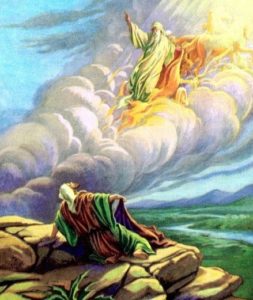
‘Elijah Taken Up to Heaven’

This week’s parasha is named after Pinchas, grandson of Aaron, who is commended for taking action during the sin with the Midianite women. Pinchas was blessed with an “eternal covenant”, and Jewish tradition holds that he never really died. Pinchas became Eliyahu, and as the Tanakh describes, Eliyahu was taken up to Heaven alive in a flaming chariot (II Kings 2). While we know what the name “Eliyahu” means, the name “Pinchas” is far more elusive. It doesn’t seem to have any meaning in Hebrew. Historical records show that there was a very similar name in ancient Egypt, “Pa-Nehasi”. Did Pinchas have a traditional Egyptian name?

When we look more closely, we find that multiple figures of the Exodus generation actually bore Egyptian names. For example, “Aaron” (or Aharon) doesn’t have a clear meaning in Hebrew, and appears to be adapted from the ancient Egyptian name “Aha-Rw”, meaning “warrior lion”. Even the origin of Moses’ name is not so clear.

Although the Torah tells us that Pharaoh’s daughter named him “Moshe” because she “drew him [meshitihu] from the water” (Exodus 2:10), it seems very unlikely that an Egyptian princess should know Hebrew so well and give her adopted child a Hebrew name. Our Sages noted this issue long ago, and grappled with the apparent problem. Chizkuni (Rabbi Hezekiah ben Manoach, c. 1250-1310) writes that it was actually Moses’ own mother Yocheved that named him “Moshe”, and then informed Pharaoh’s daughter of the name. Yet, the Midrash affirms that Yocheved called her son “Tuviah”, or just “Tov” (based on Exodus 2:2), and Moshe was the name given by Pharaoh’s daughter. Meanwhile, Ibn Ezra (Rabbi Abraham ben Meir ibn Ezra, 1089-1167) suggests that Pharaoh’s daughter called him “Munius”. Josephus takes an alternate approach entirely, saying that Pharaoh’s daughter (whose name was Thermuthis, before she became a righteous convert and was called Batya or Bitya in Jewish tradition) named him Moses because the Egyptian word for water is mo.

The most elegant solution might be that Pharaoh’s daughter called him “Mose” (spelled the same way, but pronounced with a sin instead of shin), which means “son” in Egyptian. This is most fitting, since Pharaoh’s daughter yearned for a child of her own, and finally had a “son”. In fact, we see this suffix (and its close variant mses, from which the English “Moses” comes) used frequently in Egyptian names of that time period, such as Ahmose, Thutmose, and Ramses. Thus, he would have been known as Mose (or Moses) during his upbringing, but later known to his nation as Moshe, with a more appropriate and meaningful Hebrew etymology, yet without having to change the spelling of the name (משה) at all.

All of this begs the question: is it important to have a Hebrew name? And is it okay to have a Hebrew name together with an English name, or a name in the local language of wherever a Jew may live?

Why Are So Many Sages Called “Shimon”?

When looking through the names of the many rabbis in Talmudic and Midrashic literature, we find something quite intriguing. Although we would expect the Sages to be named after great Biblical figures like Moses, David, or Abraham, in reality there are essentially no sages with such names! Instead, we find a multitude of names of lesser-known Biblical figures, and many names that have no Biblical or Hebrew origin at all.

One very common name is Yochanan: There’s Yochanan ben Zakkai and Yochanan haSandlar, Yochanan bar Nafcha, Yochanan ben Nuri, and Yochanan ben Beroka. Another popular name is Yehoshua. While we might not expect this name to be so popular (considering its association with Jesus), we still find Yehoshua ben Perachia, Yehoshua ben Levi, Yehoshua ben Chananiah, Yehoshua ben Korchah, and many others. There are also lots and lots of Yehudas like Yehuda haNasi (and his descendents, Yehuda II and Yehuda III), Yehuda ben Beteira, Yehuda bar Ilai, and Yehuda ben Tabbai. And there are tons of Elazars: Elazar ben Arach, Elazar ben Azariah, Elazar ben Pedat, and many more with the similar “Eliezer”.

Perhaps the most common name is “Shimon”. There is Shimon haTzadik and Shimon bar Yochai, Shimon bar Abba and Shimon ben Shetach, Shimon ben Gamaliel (both I and II), Shimon ben Lakish (“Reish Lakish”), and more. We would think this is a strange choice, considering that the Biblical Shimon was actually of somewhat poor character (at least compared to the other sons of Jacob). In fact, on his deathbed, Jacob did not bless Shimon at all, and instead said he wanted nothing to do with his violent nature. Moses, meanwhile, completely omits Shimon in his last blessings! So why would so many of our Sages be called “Shimon”?

A Good-Sounding Name

What might explain the strange selection of names among our ancient Sages? While no clear reason stands out, there is one plausible answer. It appears that the choice of names above was heavily influenced by the contemporary Greek society. Just as today many Jewish parents seek Hebrew names that also sound good in English, it seems parents back then wanted names that sounded good in Greek (since most Jews lived in the Greek part of the Roman, and later “Byzantine”, Empire).

We find that Greek names tend to end with an “n”: Platon (Greek for “Plato”), Jason, and Solon, for example. Numerous others end with “s”: Aristotles (Greek for “Aristotle”), Pythagoras, Philippos. Indeed, many of our Sages actually have such Greek names directly: Yinon, Hyrcanus, Pappus, Symmachus, Teradyon, and Onkelos. There is no indication that these great rabbis had some other “Hebrew” name.

Those that did want to bear Hebrew names could choose names already ending with an “n” like Shimon and Yochanan. Or, they could choose names where adding an “s” to the end would be easy: Yehoshua in Greek is Yeosuos (later giving rise to Yesus, ie. Jesus), while Yehuda is Yudas (Judas). Such names would be easy to convert between Hebrew and Greek. We know from historical sources that several people named Chananiah were simultaneously called “Ananias” in Greek.

The same is true for Elazar or Eliezer. Many Greek names transliterated into English and other languages simple lose their “s” and end with an “r”: Antipatros becomes Antipater, while Alexandros becomes Alexander. In reverse fashion, Elazar could easily become Elazaros (or Lazarus)—very palatable in the Greek-speaking world which our early Sages inhabited.

On that note, what do we make of “Alexander”? A great number of Jews both modern and ancient (there is Alexander Yannai and Rabbi Alexandri in the Talmud) have this name. Some cite a famous Midrashic account of Alexander the Great’s arrival in Jerusalem as being proof that while Alexander is not a Hebrew name, it is something of an “honorary” Jewish name. This requires a more careful analysis.

Is Alexander a Jewish name?

The Talmud (Yoma 69a) describes Alexander the Great’s conquest of Judea. As he is marching towards Jerusalem, intent on destroying the Temple, Shimon HaTzadik goes out to meet him in his priestly garments (he was the kohen gadol at the time). When Alexander sees him, he halts, gets off his horse, and bows down to the priest. Alexander’s shocked generals ask why he would do such a thing, to which Alexander responds that he would see the face of Shimon before each successful battle. Alexander proceeds to treat the Jews kindly, and leaves the Temple intact. The Talmud stops there, though it does mention that this event took place on the 25th of Tevet, which was instituted as a minor holiday on which mourning was forbidden. (The story is also attested to by Josephus, though with a different high priest—see here for more.)
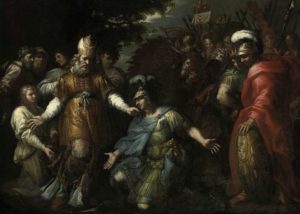
‘Alexander the Great and Jaddus the High Priest of Jerusalem’ by Pietro da Cortona (1596-1669)

According to one tradition, the priests at the time wanted to honour Alexander for his kindness, and named all the boys born that year “Alexander”. In another version, Alexander was given a tour of the Holy Temple and, naturally, wished to place a statue of himself inside. Since this was impossible (but they couldn’t refuse the emperor), Shimon haTzadik convinced him that it would be a greater honour for all the children born to be named “Alexander”. Either way, some like to say that “Alexander” has become a Jewish name ever since.

In truth, this suggestion looks more like a modern way of explaining why so many Jews were named Alexander. In reality, the Midrash clearly states that a Jew should not name his child Alexander. We read in Vayikra Rabbah 32:5:

In the merit of four things was Israel redeemed from Egypt: they did not change their names*, nor their language, they did not speak lashon hara, and not one among them committed sexually immoral sins… They did not call Yehuda “Rufus”, and not Reuben “Lullianus”, and not Yosef “Listus”, and not Benjamin “Alexander”…

Apparently, when Midrash Rabbah was composed—just like today—it was common for Jews to have a non-Jewish name that they would use regularly, together with a Hebrew name that they would use only in Jewish circles. The Hebrew name “Benjamin” was often paired with “Alexander”.

We see from the Midrash above that it is important to have a Hebrew or Jewish name. But what exactly counts as a “Jewish” name?

Non-Jewish “Jewish” Names

Although today most Jews insist on having Hebrew or Biblical names (and rightly so), it seems that our Sages weren’t so strict in this regard. Indeed, many of them bore Greek, Latin, or Aramaic names with no second Hebrew name. Akiva, Avtalyon, Nechunia, Mani, Nittai, Nehorai, Adda, Papa, Simlai, Tanhum, Tarfon, Ulla, and countless others are cited in rabbinic literature. As we saw earlier, those that did have Hebrew names naturally chose names that would be palatable to the surrounding Greeks, much like many Jews today choose names that have easy English homonyms.

This trend continued for centuries, all the way up to modern times. The result is that many seemingly “Jewish” names are actually adaptations of very non-Jewish names. For example, one popular name among Ashkenazi Jews in the past was Feivel or Feibush. This name, meaning “bright”, comes from Phoebus, one of the appellations for the Greco-Roman god of light, Apollo. With this in mind, there may actually be a big halachic problem of bearing this name, since it is forbidden to recite the names of idols. That said, the names Mordechai and Esther actually come from the Babylonian idols Marduk and Astarte, or Ishtar! Nonetheless, they became solid Jewish names, though this case is different because it comes with a clear source in Tanakh. Going back to Feivel, some say the name was only meant to substitute the Biblical name Shimshon, the root of which is “sun”, thus having a similar meaning to Phoebus or Apollo. Others link the name to Pavel, Paul, or Philipp, also not of Jewish origin.

Another appellation for Apollo was Lycegenes or Lukegenes, “born of a wolf” (possibly the source of the name “Luke”), which would be “Wolf” in Germanic countries, where the wolf was an important symbol in European mythology. Wolf also became very popular among Ashkenazis, who usually added the Hebrew translation Ze’ev to the name. The same is true for the classic German/Norse name Baer (“Bear”), to which Ashkenazis added Dov, its Hebrew translation. None of these names are Biblical or Talmudic, nor is their origin truly Hebrew. (Ironically, the name Ze’ev appears in the Tanakh [Judges 7:25] as the name of an enemy Midianite prince that the Israelites slayed!)

Having said that, many have linked these names to Biblical characters. For example, Benjamin is described in the Torah as a wolf (Genesis 49:27), so some carried the name “Binyamin Wolf”, where the former was their actual Jewish name while the latter was their social name. The same goes for “Yehuda Leib”, where Leib means “lion”, like Aryeh, the symbol of the Biblical Yehuda. It has even become common to combine all three to form “Yehuda Aryeh Leib”. Similarly, there’s “Naftali Tzvi Hirsch”, since the Biblical Naftali is described as a deer, ayalah or tzvi, and “Hirsch” is German for “deer”.
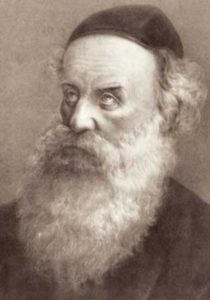
A portrait thought to be of Rabbi Schneur Zalman of Liadi, the “Alter Rebbe” (1745-1812). For more on the origins of this portrait, see here

“Schneur”, too, is of non-Jewish origin, and comes from the Spanish name Senor (and is sometimes a German equivalent for Seymour). Chassidim have since reinterpreted it in the Hebrew as Shnei Or, “two lights”. It probably didn’t have this meaning when it was given to Schneur Zalman of Liadi, the founder and first rebbe of Chabad. In his case, “Schneur” was likely meant to be his social name while “Zalman” (Solomon, or “Shlomo”) was his traditional Jewish or Hebrew name.

Sephardic Jews are just as culpable. Many have Arabic names like “Massoud” (which means “lucky”) or “Abdullah”. In fact, Rav Ovadia Yosef’s birth name was Yusuf Abdullah, and it was only when the family made aliyah to Israel that “Abdullah” was replaced with its Hebrew translation “Ovadia” (which is a Biblical name). At one point, a popular female Sephardic name was “Mercedes”. This one is highly problematic, as it happens to be a Spanish appellation for the Virgin Mary! (The automobile brand Mercedes is named after a Jewish girl of that name, the daughter of the company’s founder Emil Jellinek and his French-Sephardi wife.) A similar problem lies with the very popular “Natalie”, which literally means “Christmas” in Latin.

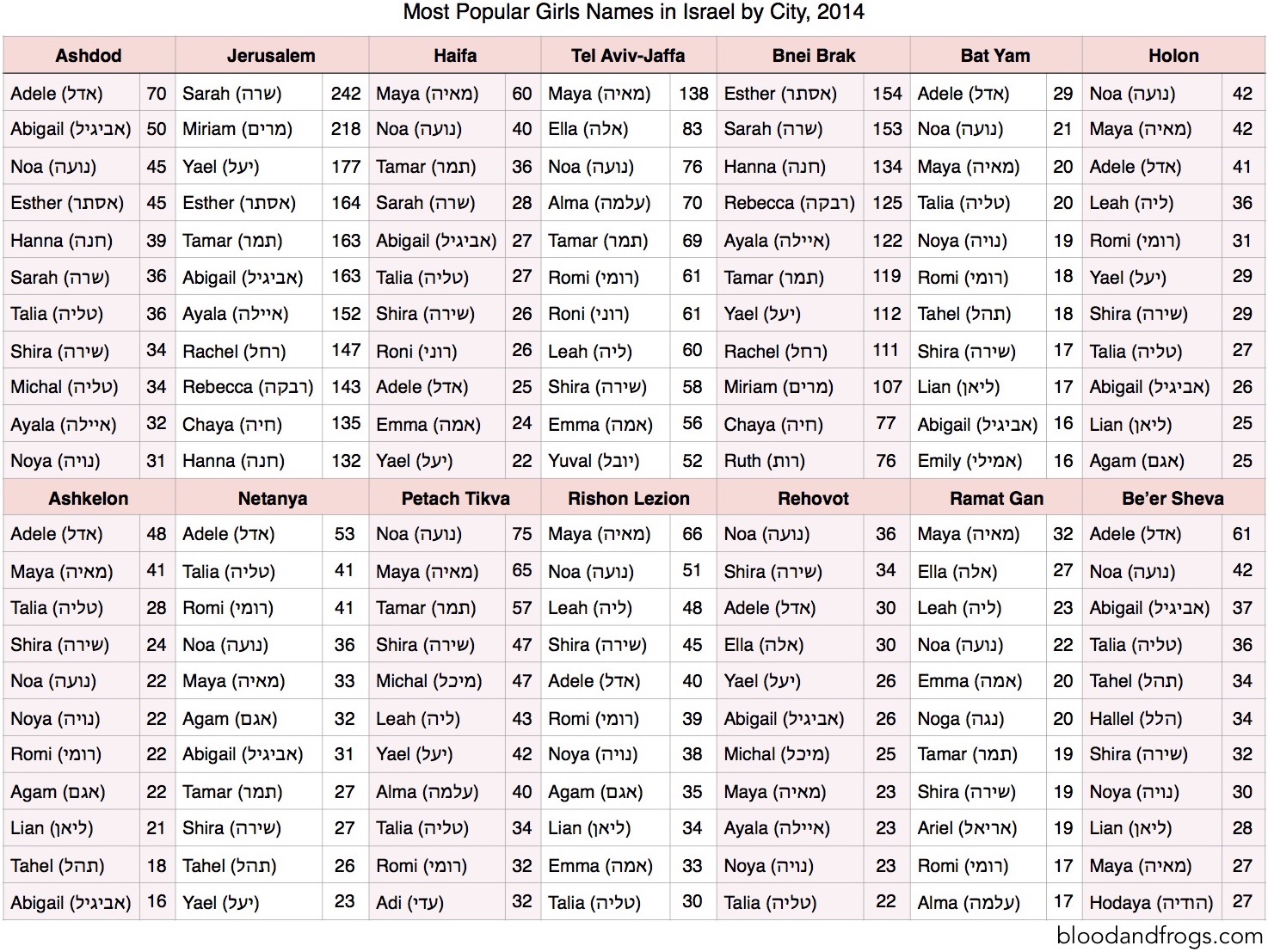
Is it okay to bear such names? A distinction must be made between those that clearly have an idolatrous origin versus those that were simply adapted from non-Jewish names but still carry a good meaning. The latter are certainly permissible, since many of our great Sages had such foreign names. Over time, many of these evolved a deeper, Jewish meaning. For instance, Adele was a classic German name (meaning “noble”) and yet the Baal Shem Tov chose it for his daughter. He explained to his chassidim that he received this name through divine inspiration, and that it is an acronym (אדל) for the important words in the Torah אש דת למו—that God gave His people “a fiery Torah” (Deuteronomy 33:2). The Torah, like fire, purifies all things. The Baal Shem Tov’s daughter went on to become a holy chassid of her own, imbued with so much Ruach haKodesh that she was nicknamed Adele HaNeviah, “Adele the Prophetess”.

Jewish “Non-Jewish” Names

The opposite case exists as well: names that appear to be non-Jewish but actually have a clear Jewish origin. Take “Elizabeth”, for example. While it may sound like a classic European name, it is actually the transliteration of “Elisheva” (אלישבע), the righteous wife of Aaron (Exodus 6:23). Some Jewish name sources incorrectly write that John is a non-Jewish name, associating it with the “New Testament” John. Yet, even that John was originally a Jewish man living in Israel, and “John” is simply a transliteration of the Hebrew name “Yochanan”. (It sounds closer in Germany and Eastern Europe, where “John” is “Johan”, or “Yohan”.)

There are numerous other examples. Susanna is Shoshana (שושנה), and Abigail is Avigayil (אביגיל). In the Tanakh, the latter makes an important comment about names, pointing out that because her first husband’s name was Naval (“abomination”) he acted abominably (I Samuel 25:25). She later married King David and is considered a prophetess in her own right.

Many are surprised to discover that “Jessica” comes from the Torah. It is an English adaptation of Iscah (יסכה), mentioned in Genesis 11:29 and, according to our Sages, the birth name of Sarah. Rashi comments:

Iscah. This is Sarah, because she would see [סוֹכָה] through divine inspiration, and because all gazed [סוֹכִין] at her beauty. Alternatively, יִסְכָּה is an expression denoting princedom [נְסִיכוּת], just as Sarah is an expression of dominion [שְׂרָרָה].

Interestingly, it appears that the earliest recorded use of the transliteration “Jessica” comes from Shakespeare’s play The Merchant of Venice. Here, Jessica is the Jewish daughter of the play’s Jewish villain, Shylock. Although many see The Merchant of Venice as an anti-Semitic work, others actually see it as Shakespeare’s cunning manipulation of that era’s rampant anti-Semitism and his own “plea for tolerance”. After all, Shylock’s most famous speech (Act III, Scene 1) reads:

Hath not a Jew eyes? Hath not a Jew hands, organs, dimensions, senses, affections, passions; fed with the same food, hurt with the same weapons, subject to the same diseases, heal’d by the same means, warm’d and cool’d by the same winter and summer as a Christian is? If you prick us, do we not bleed? If you tickle us, do we not laugh? If you poison us, do we not die? And if you wrong us, shall we not revenge? If we are like you in the rest, we will resemble you in that.

Shylock argues that his own villainy is nothing but a reflection of the villainy of the Christian world. Shakespeare recognized the cruelty that Jews had suffered, and tells his anti-Semitic audience that Jews are human, too.

Is It Necessary to Have a Hebrew Name?

Ultimately, it is certainly beneficial to have a Hebrew name of some sort, whether Biblical, Talmudic, adapted, or modern. After all, Hebrew is a holy language, and each of its letters carry profound meaning. The Hebrew term for “name” is shem (שם), which is a root of neshamah (נשמה), “soul”, and spelled the same as sham (שם), “there”, for it is there within a person’s name that his or her essence is found. For this reason, the Talmud (Yoma 83b) tells us that Rabbi Meir used to carefully analyze people’s name to determine their character. (This Talmudic passage was explored at length in Secrets of the Last Waters.)

The Talmud (Rosh Hashanah 16b) also notes that changing one’s name is one of five things a person can do to change their fate. Indeed, we see this multiple times in Scripture. Abraham and Sarah have their names changed (from Abram and Sarai) to allow them to finally have a child. Jacob becomes Israel, while Hoshea becomes Yehoshua (Joshua). At some point, Pinchas becomes Eliyahu, and even Yosef (Joseph) becomes Yehosef (Psalms 81:6). On that last name change, the Midrash explains that it was only because Yosef had an extra hei added to his name that he was able to ascend to Egyptian hegemony.

Thus, having a name with a deep meaning, in Hebrew letters, and one that is actually used regularly (as opposed to a secondary Hebrew name that no one calls you by) is of utmost significance. If you don’t yet have such a name, it isn’t too late to get one!

*This Midrash presents a possible contradiction: how can it say that the Israelites did not adopt Egyptian names when we see that some clearly did? Maybe most of the Israelites did not adopt Egyptian names, though some did. Thankfully, another Midrash (Pesikta Zutrati on parashat Ki Tavo) steps in to offer an alternate reason. Here, Israel was redeemed in the merit of three things: not changing their clothing, their food, and their language. Changing their names is conspicuously absent.


The above essay is adapted from Garments of Light, Volume Three.
Get the book here! 

The Mysterious Custom of Upsherin

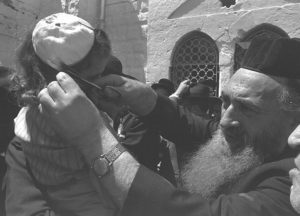
In this week’s double Torah portion (Acharei-Kedoshim) we read that “when you will have planted all manner of trees for food, its fruit shall be forbidden; three years shall it be forbidden to you, it shall not be eaten.” (Leviticus 19:23) This refers to the mitzvah of orlah, where a newly-planted tree must be left unharvested for its first three years. Seemingly based on this, a custom has developed to leave the hair of newborn boys uncut until age three. On or around the boy’s third birthday, a special celebration is held (called upsherin or halakeh), often with family and friends taking turns to cut a bit of the boy’s hair. Henceforth, the boy is encouraged to wear a kippah and tzitzit, and his formal Jewish education will begin. It is said that just as a tree needs the first three years to establish itself firmly in the ground before it can flourish and its fruit be used in divine service, so too does a child.

Lag B’Omer 1970 in Meron. Photo from Israel’s National Photo Collection

Indeed, the Torah makes a comparison between trees and humans in other places. Most famously, Deuteronomy 20:19 states that fruit trees should not be harmed during battle, “for is the tree of the field a man?” The tree is not an enemy combatant, so it should be left alone. Although the plain meaning of the verse is that the tree is not a man, an alternate way of reading it is that “man is a tree of the field”. Elsewhere, God compares the righteous man to a tree firmly rooted in the ground (Jeremiah 17:8), and in another place compares the entire Jewish nation to a tree (Isaiah 65:22).

Having said that, the custom of upsherin is essentially unknown in ancient Jewish sources. It is not mentioned anywhere in the Talmud, nor in any early halakhic codes, including the authoritative Shulchan Arukh of the 16th century. Where did this very recent practice originate?

Lag b’Omer and the Arizal

The first Jews to take up this custom were those living in Israel and surrounding lands under Arab Muslim dominion in the Middle Ages. We see that Sephardic Jews in Spain and Morocco did not have such a custom, nor did the Yemenite Jews. (In fact, Yemenite Jews did not even have a custom to abstain from haircuts during Sefirat HaOmer at all.) This is particularly relevant because the upsherin ceremony is often connected with the Sefirat HaOmer period, with many waiting until Lag b’Omer for their child’s first haircut, and taking the boy to the grave of Rashbi (Rabbi Shimon bar Yochai) in Meron for the special ceremony.

It appears that the earliest textual reference to upsherin is from Rabbi Chaim Vital (1543-1620), the primary disciple of the Arizal (Rabbi Isaac Luria, 1534-1572). Because of this, many believe that upsherin is a proper Kabbalistic custom that was instituted by, or at least sanctioned by, the great Arizal. In reality, the text in question says no such thing. The passage (Sha’ar HaKavanot, Inyan HaPesach, Derush 12) states the following:

ענין מנהג שנהגו ישראל ללכת ביום ל”ג לעומר על קברי רשב”י ור”א בנו אשר קבורים בעיר מירון כנודע ואוכלים ושותי’ ושמחים שם אני ראיתי למוז”ל שהלך לשם פ”א ביום ל”ג לעומר הוא וכל אנשי ביתו וישב שם שלשה ימים ראשו’ של השבוע ההו’ וזה היה פעם הא’ שבא ממצרים אבל אין אני יודע אם אז היה בקי ויודע בחכמה הזו הנפלאה שהשיג אח”כ. והה”ר יונתן שאגי”ש העיד לי שבשנה הא’ קודם שהלכתי אני אצלו ללמוד עם מוז”ל שהוליך את בנו הקטן שם עם כל אנשי ביתו ושם גילחו את ראשו כמנהג הידוע ועשה שם יום משתה ושמחה

On the custom of Israel going on Lag b’Omer to the grave of Rabbi Shimon bar Yochai and Rabbi Elazar his son (who are buried in the town of Meron as is known) and to eat and drink and rejoice there—I saw that my teacher, of blessed memory [the Arizal], that he went there once on Lag b’Omer with his whole family and remained there for three days, until the start of the sixth week [of the Omer]. And this was that one time, when he came from Egypt, but I do not know if he was then knowledgeable in this wisdom that he would later attain. And Rav Yonatan Sagis related to me that in the first year before I went to him to learn with my teacher of blessed memory, he took his small son with his whole family and there they cut his hair according to the known custom, and he held a feast and celebration there.

First, what we see in this passage is that the Arizal apparently only visited Meron on Lag b’Omer once, when he just made aliyah from Egypt, and before he had become the pre-eminent Kabbalist in Tzfat. (Some say this was actually before he made aliyah, and was simply on a trip to Israel.) Lag b’Omer is the 5th day of the 5th week of the Omer, and the Arizal stayed there for the remainder of the fifth week. Rav Chaim Vital wonders whether the Arizal was already an expert mystic at the time or not. Once he became the leader of the Tzfat Kabbalists, the Arizal apparently never made it a point to pilgrimage to Meron on Lag b’Omer. Rabbi Vital notes just that one time in the past, and it almost seems like once the Arizal was a master mystic, he understood there was nothing particularly mystical about it. In any case, nothing is said here of cutting hair.

The next part of the passage is more problematic. To start, it is unclear whether Rabbi Vital means that he and the Arizal went to study with Rav Yonatan Sagis, or that he and Rav Sagis went to study with the Arizal. We know that Rabbis Sagis and Vital were later both students of the Ari. However, when the Ari first came to Tzfat he was essentially unknown, and was briefly a disciple of other Kabbalists, namely the Ramak (Rabbi Moshe Cordovero, 1522-1570). In fact, the Arizal only spent a couple of years in Tzfat before suddenly passing away at a very young age. Whatever the case, it is unclear from the passage whether it was the Arizal or Rav Sagis who was the one to take his son for a haircut on Lag b’Omer. Based on the context, it would appear that it was Rav Sagis who did so, not the Arizal, since we already learned that the Arizal did not make it a point to pilgrimage to Meron.

The nail on the coffin may come from an earlier passage in the same section of Sha’ar HaKavanot, where we read:

ענין הגילוח במ”ט ימים אלו לא היה מוז”ל מגלח ראשו אלא בערב פסח ובערב חג השבועות ולא היה מגלח לא ביום ר”ח אייר ולא ביום ל”ג לעומר בשום אופן

On the matter of shaving during these forty-nine days [of the Omer], my teacher of blessed memory did not shave his head [hair], except for the evening of Passover and the evening of Shavuot, and would not shave his hair at all [in between], not on Rosh Chodesh Iyar, and not on Lag b’Omer.

According to the Arizal, one should not shave at all during the entire Omer period, including Lag b’Omer! If that’s the case, then the Ari certainly wouldn’t take his child to Meron for a haircutting on Lag b’Omer. It must be that the previous passage is referring to Rav Sagis. Nowhere else in the vast teachings of the Arizal is the custom of waiting until a boy’s third birthday (whether on Lag b’Omer or not) mentioned. Thus, the Arizal was not the custom’s originator, did not expound upon it, and most likely did not even observe it.

So where did it come from?

A Far-Eastern Custom

While no ancient Jewish mystical or halakhic text before the 17th century appears to mention upsherin, a similar custom is discussed in much older non-Jewish sources. The Kalpa Sutras of the ancient Hindu Vedic schools speak of a ceremony called Chudakarana or Mundana, literally “haircutting”. It is supposed to be done before a child turns three, usually at a Hindu temple. It is explained that the hair a child is born with it connected to their past life, and all the negative things which that may entail. Removing this hair is symbolic of leaving the past life behind and starting anew. Interestingly, a small lock of hair is usually left behind, called a sikha, “flame” or “ray of light”, as a sign of devotion to the divine. This is surprisingly similar to the Chassidic custom of leaving behind the long peyos at the upsherin.

Hindu Sikha and Chassidic Peyos

From India, the custom seemingly moved across Asia to Arabia. One Muslim tradition called Aqiqah requires shaving the head of a newborn. Of this practice, Muhammad had apparently stated that “sacrifice is made for him on the seventh day, his head is shaved, and a name is given him.” An alternate practice had Muslims take their boys to the graves of various holy people for their first haircut. The Arabic for “haircut” is halaqah, which is precisely what the Mizrachi Jews of Israel called upsherin. Thus, it appears that Jews in Muslim lands adopted the custom from their neighbours. However, many of them waited not until the child is three, but five, which is when the Mishnah (Avot 5:22) says a child must start learning Torah. (In this case, the practice has nothing to do with the mitzvah of orlah or any connection to a sapling.)

In the early 19th century, Rabbi Yehudah Leibush Horenstein made aliyah to Israel and first encountered this practice of “the Sephardim in Jerusalem… something unknown to the Jews in Europe.” He was a Hasid, and in that time period many more Hasidim were migrating to Israel—a trend instigated by Rabbi Menachem Mendel of Vitebsk (c. 1730-1788), the foremost student of the Maggid of Mezeritch (Rabbi Dov Ber, d. 1772), who in turn was the foremost student of the Baal Shem Tov (Rabbi Israel ben Eliezer, 1698-1760) the founder of Hasidism. These hasidim in Israel adopted the practice from the local Sephardim, and spread it to the rest of the Hasidic world over the past century and a half.

While it has become more popular in recent decades, and has been adopted by other streams within Orthodoxy, and even many secular Israelis and Jews, upsherin is far from universally accepted. The Steipler (Rabbi Yaakov Yisrael Kanievsky, 1899-1985) was particularly upset about this practice (see Orchos Rabbeinu, Vol. I, pg. 233). When a child was brought before Rav Yitzchok Zev Soloveitchik of Brisk (1886-1959) for an upsherin, he frustratingly replied: “I am not a barber.” Other than the fact that it is not an established or widespread Jewish custom, there is a serious issue of it being in the category of darkei Emori, referring to various non-Jewish (and potentially idolatrous) practices.

Not So Fast

While there is no mention of the upsherin that we know today in ancient Jewish mystical or halakhic texts, there is mention of something very much related. In one of his responsa, the great Radbaz (Rabbi David ibn Zimra, c. 1479-1573) speaks of a practice where some people take upon themselves a “vow to shave their son in the resting place of Samuel the Prophet” (see She’elot v’Teshuvot haRadbaz, siman 608).

Recall that Samuel was born after the heartfelt prayer of his mother Hannah who was barren for many years. She came to the Holy Tabernacle in Shiloh and vowed that if God gave her a son, she would dedicate him to divine service from his very birth, and he would be a nazir his entire life (I Samuel 1:11). This means that he would never be allowed to shave or trim the hair of his head, just as the Torah instructs for anyone taking on a nazirite vow. There is something particularly holy about this, and we see earlier in Scripture how an angel comes to declare the birth of the judge Samson and instructs the parents to ensure he would be a nazirite for life, and that no blade ever come upon his head (Judges 13:5).

The Tanakh goes on to state that once Samuel was weaned, Hannah took him to the Tabernacle and left him in the care of the holy priests so that he could serve God his entire life. How old was he when he was weaned? While it doesn’t say so here, there is an earlier case where the Torah speaks of a child being weaned. This is in Genesis 21:8, where we read how Abraham through a great feast upon the weaning of his son Isaac. Rashi comments here (drawing from the Midrash and Talmud) that Isaac was two years old at the time. For this reason, many Hasidic groups actually perform the upsherin at age two, not three.

Back to the Radbaz, he was born in Spain but was exiled with his family in the Expulsion of 1492. The family settled in Tzfat, where the Radbaz was tutored by Rabbi Yosef Saragossi, the holy “White Saint” credited with transforming Tzfat from a small town of 300 unlearned Jews to a holy Jewish metropolis and the capital of Kabbalistic learning. In adulthood, the Radbaz settled in Fes, Egypt and his fame as a tremendous scholar and posek spread quickly. In 1517, he moved to Cairo and was appointed Hakham Bashi, the Chief Rabbi of Egypt. There, he founded a world-class yeshiva that attracted many scholars. Coming full circle, it was here in the yeshiva of the Radbaz that the Arizal began his scholarly career. In the last years of his life, the Radbaz wished to return to the Holy Land, and made his way back to Tzfat. It is possible that the Arizal left Egypt for Tzfat in the footsteps of his former rosh yeshiva. Ironically, the Radbaz (who lived to age 94, or even 110 according to some sources) would outlive the Arizal (who died at just 38 years of age).

While neither the Arizal nor his old teacher the Radbaz discuss cutting a three-year-old’s hair in particular (or doing it at the tomb of Rashbi), the Radbaz does speak of a personal vow that one may take to cut their child’s hair at the tomb of Samuel the Prophet. This practice comes from emulating Hannah, who took a vow with regards to her son Samuel. Samuel went on to be compared in Scripture to Moses and Aaron (and the Sages say Moses and Aaron combined!) Of course, Hannah never cut her child’s hair at all, but perhaps there is something spiritual in treating the child like a nazirite until the child is “weaned”.

In any case, the question that the Radbaz was addressing is what one must do if they took up such a haircutting vow but are unable to fulfil it because the authorities prohibit Jews from going to the grave sites of their ancestors. From here, some scholars conclude that the Ottoman authorities at the time really must have prohibited Jews from going to the grave of Samuel, near Jerusalem. Thus, it is possible that those Jerusalem Jews who had a custom of going to Samuel’s grave decided to journey to another famous grave instead. Perhaps it was in these years of the early 16th century that the custom to go to Rashbi in Meron (instead of Shmuel near Jerusalem) evolved.

So, there may be something to the upsherin custom after all. Of course, we still don’t know when the practice of going to Samuel’s grave emerged. That appears to have been a local custom (or possibly not a custom at all, but a personal vow) of Jerusalem’s medieval Jewish community. It, too, may have been influenced by neighbouring Muslims who went to the graves of their saints to cut their children’s hair.

Whatever the case, we see that foundations of upsherin are not so clear-cut. Contrary to popular belief, it is neither a universally accepted Jewish custom, nor a mandatory halakhic requirement. It did not originate with the Arizal either, although we do see some basis for it in the writings of the Radbaz. For those who wish to uphold this custom, they have upon whom to rely, and should meditate foremost upon the holy figures of Hannah and Samuel, who appear to be the spiritual originators of this mysterious practice.


The above is an excerpt from Garments of Light, Volume Two. Get the book here

When Jews and Greeks Were Brothers: The Untold Story of Chanukah

As we celebrate the festive holiday of Chanukah, it is important to remember that not all of the Greeks were wicked and immoral. The enemies of the Chanukah narrative were the Seleucids, or Syrian-Greeks, not the mainland Greeks of Europe. In fact, the Book of Maccabees (I, 12:6-18) records an alliance between Jonathan Maccabee—the kohen gadol and righteous leader of Israel after the deaths of Matityahu and Judah Maccabee—and the famous Spartans of mainland Greece:

Jonathan, the high priest, and the council of the nation and the priests and the rest of the Jewish people send greetings to their brothers, the Spartans. In former times, a letter was sent to the high priest Onias, from Areus who was then king among you, to say that you are our kinsman… And Onias showed honour to the man who was sent to him, and accepted the letter, which contained a declaration of alliance and friendliness.

So, although we are in no need of these, since we find our encouragement in the sacred books that are in our keeping, we have undertaken to send to renew relations of brotherhood and friendliness with you, so that we may not become entirely estranged from you…

Jonathan points out that Israel does not need the help of the Spartans to defeat the Seleucids, as God’s help is all they need. Nonetheless, Israel and Sparta were always good friends, and Israel wants to keep it that way. In his letter, Jonathan mentions an earlier letter sent by King Areus of Sparta to Onias the kohen gadol (Onias is the Hellenized name for Choniyahu or Chonio, the son of Yadua the high priest, mentioned in Nehemiah 12:11). This letter is recorded in the Book of Maccabees (I, 12:20-23), as well as in the writings of Josephus, opening with the words:

Areus, king of the Spartans, sends greetings to Onias the high priest. It is found in writing that the Spartans and Jews are kinsman, and that they are both of the stock of Abraham…

Incredibly, the Spartan king suggests that the Spartans are descendants of Abraham, too! Where does this bizarre belief come from?

Greek Sons of Abraham

Sometime in the 2nd century BCE lived a Greek historian and sage named Cleodemus, sometimes referred to as Cleodemus the Prophet. He also went by the name Malchus which, because of its Semitic origins, makes some scholars believe he could have been Jewish. Cleodemus wrote an entire history of the Jewish people in Greek. While this text appears to have been lost, it is cited by others, including Josephus (Antiquities, i. 15).

Cleodemus commented on Abraham’s marriage to Keturah (typically identified with Hagar), and their children. This is recorded in Genesis 25, which begins:

And Abraham took another wife, and her name was Keturah. And she bore him Zimran, and Yokshan, and Medan, and Midian, and Ishbak, and Shuach. And Yokshan begot Sheva and Dedan. And the sons of Dedan were Ashurim, and Letushim, and Leumim. And the sons of Midian were Ephah, and Epher, and Chanokh, and Avidah, and Elda’ah. All these were the children of Keturah. And Abraham gave all that he had to Isaac, while to the sons of the concubines that Abraham had, Abraham gave gifts, and he sent them away from Isaac, while he was still alive, to the east country.

Abraham had six children with Keturah, from which came at least seven grandchildren, and three great-grandchildren which the Torah names explicitly. The Torah then makes it clear that Abraham gave everything that he had to Isaac—including the Covenant with God and the land of Israel—while the others received gifts and were sent away from the Holy Land.

Cleodemus suggests that Epher (or another child named Yaphran), the great-grandson of Abraham, migrated to Africa—which is where the term “Africa” comes from! (This is particularly interesting because Epher was the son of Midian, and Tziporah the wife of Moses was a Midianite, and is described as a Cushite, or African/Ethiopian.) Cleodemus states that Epher, Yaphran, and Ashurim assisted the Greek hero Hercules in one of his battles. Following this, Hercules married one of their daughters—a great granddaughter of Abraham—and had a son with her. This son was Diodorus, one of the legendary founders of Sparta!

It appears that the Spartan king Areus was aware of this possible historical connection, and accepted it as fact. This connection may explain why the Spartans were so similar to ancient Israelites. (Others have suggested that because the Israelite tribe of Shimon—known for being fierce warriors—did not receive a set portion in the Holy Land, many of them moved elsewhere and ended up in Sparta, or ended up in Sparta after being expelled from Israel by the Assyrians alongside the other lost tribes.) In his book Sparta, renowned historian Hugo Jones writes that the Spartans held in the highest regard a certain ancient law-giver, much like Moses the law-giver of Israel. The Spartans celebrated new moons (Rosh Chodesh), and unlike their Greek counterparts, even a seventh day of rest! Of course, the Spartans themselves were very different from other Greeks, particularly those in Athens, whom Sparta often battled. The Spartan form of government was different, too, not an Athenian-style democracy but a monarchy that governed alongside a “council of elders”, much like Israel’s king and Sanhedrin.

Perhaps most similarly, the Spartans were known for their “stoic” way of life. The later Greek school of stoicism was modeled on the ancient way of the Spartans. This meant living simply and modestly, being happy with what one has, and most importantly, putting mind above body, and logic above emotion. This almost sounds like something out of Pirkei Avot, and is a teaching echoed across Jewish texts both ancient and modern. In fact, when Josephus tried to explain who the rabbis were to his Roman audience, he said that they were Jewish stoic philosophers!

Gideon and Leonidas

Undoubtedly, the most famous story of the Spartans is the Battle of Thermopylae. Around 480 BCE, the Persian emperor Xerxes invaded Greece with a massive force. Xerxes first sent messengers to the Greek city-states to offer peaceful surrender. According to the historian Herodotus, Sparta’s King Leonidas told the messenger:

A slave’s life is all you understand, you know nothing of freedom. For if you did, you would have encouraged us to fight on, not only with our spear, but with everything we have.

Spoken like a true Maccabee. The messenger then told Leonidas and his men to bow down, to which Leonidas, like his historical contemporary Mordechai, said: “We bow down before no man.” Later, when the Persian boasted that his empire was the wealthiest in the world, with gold reserves the likes of which Leonidas could only dream of, Leonidas replied: “Ares is lord. Greece has no fear of gold.”

This statement almost makes Leonidas seem like a monotheist. Indeed, the Spartans worshiped Ares—the god of war—above all others. Interestingly, the Torah commonly describes Hashem in similar military terms, like a great warrior riding a merkavah or chariot, as a “God of Legions” (Hashem Tzva’ot), and even as a “Man of War” (Ish Milchamah, see Exodus 15:3). Of course, the Spartans had their abominable statues and idols, which is perhaps the greatest distinction (and a critical one) between them and ancient Israel.

King Leonidas went on to assemble just three hundred brave men to face off against the massive Persian invasion. Although they ultimately lost, the Spartans fought valiantly, inspired their fellow Greeks, and did enough damage to hamper Persian victory. This story of three hundred, too, has a Biblical parallel. The Book of Judges records a nearly-identical narrative, with the judge Gideon assembling three hundred brave men and miraculously defeating a massive foreign invasion.

Which came first? The earliest complete Greek mythological texts date back only to the 3rd century BCE. By then, the Tanakh had long been completed, and in that same century was first translated into the Greek Septuagint. It isn’t hard to imagine Greek scholars and historians of the 3rd century getting their hands on the first Greek copies of Tanakh and incorporating those narratives into their own. In fact, the Greek-Jewish philosopher Aristobulus of Alexandria (181-124 BCE) admitted that all of Greek wisdom comes from earlier Jewish sources. The later Greek philosopher Numenius of Apamea said it best: “What is Plato but Moses speaking Greek?”

Greece and the Exodus

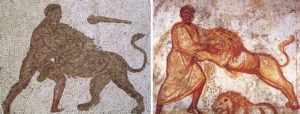
The similarities between Greek myth and more ancient Jewish texts are uncanny. Hercules was a mighty warrior whose first task (of twelve) was to slay a lion, like the mighty Shimshon who first slays a lion in Judges. Deucalion survives a great flood that engulfs the whole world as punishment from an angry Zeus. Like Noah before him, Deucalion has a wife and three sons, and like Noah, Deucalion is associated with wine-making (the root of his name, deukos). Pandora’s curiosity brings about evil just like Eve’s, while Asclepius carries a healing serpent-staff like Moses. Aristophanes even taught that Zeus first made man as male and female in one body, and later split them in half, just as the Torah and Talmud do.

Roman mosaic of Hercules and the Nemean Lion, and a Roman fresco of Samson and the lion, from the same time period.

In Jewish tradition, the Greeks come from the Biblical Yavan, son of Yafet (or Yefet or Japheth), son of Noah (Genesis 10:2). Yavan is the same as the Greek Ion (or Iawones), one of the Greek gods, and Ionia, referring to one of its most important regions, and the dialect of the great Greek poets Homer and Hesiod, as well as the scholars Herodotus and Hippocrates. Meanwhile, the Greeks worshipped Iapetus (same as Yafet) as a major god. Iapetus was the father of Prometheus, the god who supposedly fashioned man from the mud of the earth. So, not surprisingly, the Biblical Yavan and Yafet are firmly in the Greek tradition as well.

In his Was Achilles a Jew? (pgs. 465-468), Larry S. Milner points out many other similarities between Greek myth and the narratives of the Torah. The Greek story of Orion, where his birth was a gift from three deities to an old, childless couple, is nearly identical to the prophesied birth of Isaac, which came with the arrival of three angels. Key aspects of the tales of Odysseus resemble the adventures of Jacob, while the legend of Orpheus and Eurydice is reminiscent of Lot and his wife. The abduction of Helen (leading to the destruction of Troy through an infamous ruse) is strangely similar to the abduction of Dinah (leading to the decimation of Shechem through an infamous ruse). And there are many more.

The Greeks held that the ancient heroes and founders Danaus and Cadmus originally came from Egypt. Milner posits, and eloquently argues, that Danaus and Cadmus were not Egyptians, but Hebrews who had been enslaved in Egypt! They escaped Egypt and settled in Greece. Their names have Semitic origins, and it is possible they were the ones that introduced the Semitic alphabet to the Greeks, as scholars have long ago concluded that the Greeks adapted their alphabet from the Semitic one. The only question among scholars is whether it was the Phoenicians or Hebrews who introduced the alphabet to the Greeks. Milner strongly argues on behalf of the latter. Finally, he notes how ancient Greece was organized by an amphictyony, a “league of neighbours” that consisted of twelve city-states in a loose confederacy. The amphictyony very closely mirrored the organization of, and relationship between, the Twelve Tribes of Israel. In short, we find that not only did the Greeks adopt many of our Biblical narratives and ideas, but even our ancient written language and political structure, too.

In Volume One of Garments of Light (‘Did the Jews Really Defeat the Greeks?’), we saw how Greece had a huge influence on Judaism. Now, we see how tremendous an influence Judaism had on Greece. The two civilizations go hand-in-hand, and between them gave rise to the world we live in. Indeed, this was prophesied by Noah, who blessed his sons: “May God make Yefet great, and he will dwell in the tents of Shem” (Genesis 9:27). Shem is the earliest forefather of Israel, and Yefet of Greece. The two dwell in one tent.

On Chanukah, we celebrate the Jewish victory over the Seleucids. Not of the Greeks as a whole, but of a relatively small faction of Syrian Greeks, far from the Greek heartland which enjoyed a good relationship with Israel, starting with Alexander the Great and through to the Spartans and Maccabees.

[This is part two of a three-part series. See here for part one, and here for part three.]


The above is an excerpt from Garments of Light, Volume Two. Get the book here