Tag Archives: Christianity

How Esau Became Rome

In this week’s parasha, Toldot, we are introduced to the twin sons of Isaac: Jacob and Esau. The Torah tells us that the boys grew up and Esau became a “man of the field” while Jacob was “an innocent man sitting in tents” (Genesis 25:27). In rabbinic literature, Esau takes on a very negative aura. Although the Torah doesn’t really portray him as such a bad guy, extra-Biblical texts depict him as the worst kind of person.
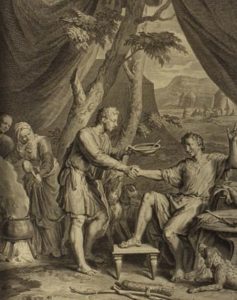
A 1728 Illustration of Esau selling his birthright.

Take, for instance, the first interaction between Jacob and Esau that the Torah relates. Esau comes back from the field extremely tired. At that moment, Jacob is cooking a stew. Esau asks his brother for some food, and Jacob demands in exchange that Esau give up his birthright (ie. his status as firstborn, and the privileges that come with that). Esau agrees because “behold, I am going to die” (Genesis 25:32). The plain text of the Torah makes it seem like Jacob took advantage of Esau’s near-fatal weariness and tricked him into selling his birthright. This is later confirmed when Esau says that Jacob had deceived him (Genesis 27:36), implying that Esau never really wished to rid of it.

Yet, the Torah commentaries appear to flip the story upside down. When Esau comes back from the field exhausted, it isn’t because he just returned from a difficult hunt, but rather because, as Rashi comments, he had just come back from committing murder! When Esau says “I am going to die”, it isn’t because he was on the verge of death at that moment, but because he didn’t care about the birthright at all, choosing to live by the old adage of “eat, drink, and be merry, for tomorrow we die”. This is a very different perspective on the same narrative.

Another example is when, many years later, Jacob returns to the Holy Land and Esau comes to meet him. Jacob assumes Esau wants to kill him, and prepares for battle. Instead, Esau genuinely seems to have missed his brother, and runs towards him, “embracing him, falling upon his neck, and kissing him” (Genesis 33:4). Again, some of the commentaries turn these words upside down, saying that Esau didn’t really lovingly kiss his brother, but actually bit him! Rashi’s commentary on this verse cites both versions. He concludes by citing Rabbi Shimon bar Yochai in stating that although Esau, as a rule, hates Jacob, at that moment he really did love his brother.

So, how bad was Esau really?

Seeing the Good in Esau

Occasionally, we read about Esau’s good qualities. The Midrash (Devarim Rabbah 1:15) famously states that no one honoured their parents better than Esau did. This is clear from a simple reading of the Torah, too, where Esau is always standing by to fulfil his parents’ wishes. For instance, as soon as he learns that his parents are unhappy with his choice of wives, he immediately goes off to marry someone they might approve of (Genesis 28:8-9).

We should be asking why his parents didn’t simply tell him from the start that his original wives were no good? Why did they allow him to marry them in the first place? If Esau really was the person who most honours his parents, he would have surely listened to them! We may learn from this that Esau’s parents didn’t put too much effort into him. It’s almost like Rebecca gave up on her son from the moment she heard the prophecy about the twins in her belly. The Torah says as much when it states, right after the birth of the twins, that “Isaac loved Esau because his game-meat was in his mouth, but Rebecca loved Jacob.” (Genesis 25:28) Rebecca showed affection to Jacob alone, while Isaac’s love for Esau was apparently conditional. Of course, children always feel their parents’ inner sentiments, and there is no doubt Esau felt his parents’ lack of concern for him. Is it any wonder he tried so hard to please them?

From this perspective, one starts to feel a great deal of pity for Esau. How can anyone read Esau’s heartfelt words after being tricked out of his blessing and not be filled with empathy?:

When Esau heard his father’s words, he cried out a great and bitter cry, and he said to his father, “Bless me, too, O my father! …Do you not have a blessing left for me?” (Genesis 27:34-36)

Esau was handed a bad deal right from the start. He was born different, not just in appearance, but with a serious life challenge. He was gifted (or cursed) with a particularly strong yetzer hara, from birth. His fate was already foretold, and his parents believed it. They invested little into him. And it seems all he ever wanted was to make them proud.

Incidentally, this is one of the major problems with fortune-telling, and why the Torah is so adamant about not consulting any kind of psychic. The psychic’s words, even if entirely wrong, will shape the person’s views. It is very much like the Talmud’s statement (Berakhot 55b) that a dream is fulfilled according to how it is interpreted. A person believes the interpreter, and inadvertently brings about that interpretation upon themselves. It’s a self-fulfilling prophecy.

Who knows what might have happened if Rebecca never bothered to consult a prophet about her pregnancy? After all, Jewish tradition is clear on the fact that negative prophecies do not have to come true. God relays such a prophecy in order to inspire people to change, and thus avert the negative decree. Such was precisely the case with Jonah and his prophecy regarding Nineveh. The people heard the warning, repented, and the prophecy was averted.

Perhaps this is what Isaac and Rebecca should have done. Instead of giving up on Esau, they should have worked extra hard to guide him in the right direction. (Isaac indirectly did the opposite, motivating his son’s hunting since he loved the “game-meat in his mouth”.) The Sages affirm that Esau was not a lost case, and state that had Jacob allowed his daughter Dinah to marry Esau, she would have reformed him (see, for example, Beresheet Rabbah 76:9).

At the end, Jacob returns to the Holy Land and, instead of the war with Esau that he was expecting, his brother welcomes him back with open arms. He weeps, and genuinely misses him. Esau has forgiven his brother, yet again, and buries the past. He hopes to live with his brother in peace henceforth, and invites him to live together in Seir. Esau offers to safely escort Jacob and his family. Jacob rejects the offer, and tells Esau to go along and he will join him later (Genesis 33:14). This never happens. Jacob has no intention to live with Esau, and as soon as his brother leaves, Jacob a completely different course. Esau is tricked one last time.

We only hear about Esau once more in the Torah. When Isaac dies, Esau is there to give his father a proper burial (Genesis 35:29). In fact, the Book of Jubilees, which doesn’t portray Esau too kindly either, nonetheless suggests that Esau had repented at the end of his life. There we read that it was his sons that turned evil, and even coerced him into wrongdoing (37:1-5). In Jubilees, Esau tells his parents that he has no interest in killing Jacob, and loves his brother wholeheartedly, more than anyone else (35:22). He admits that Jacob is the one that deserves the birthright, and a double portion as the assumed firstborn (36:12).

The Torah never tells us what ends up happening to Esau. The Midrash states that he was still there when Jacob’s sons came to bury their father in the Cave of the Patriarchs. Esau tried to stop them, at which point Jacob’s deaf grandson Hushim decapitated him. (A slightly different version is found in the Talmud as well, Sotah 13a.) Esau’s head rolled down into the Cave of the Patriarchs, while the rest of his body was buried elsewhere. Perhaps what this is meant to teach us is that while Esau’s body was indeed mired in sin, his head was completely sound, and he certainly had the potential to be a righteous man—maybe even one of the forefathers, hence his partial burial in the Cave of the Patriarchs.

At the end of the day, Esau is not so much a villain as he is a tragically failed hero.

Why Did Esau Become so Evil?
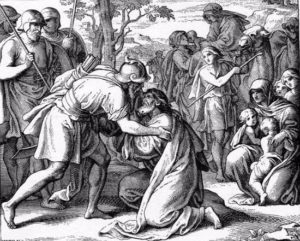
Esau meets Jacob, by Charles Foster (1897)

As we’ve seen, the Torah itself doesn’t portray Esau as such a bad person. Conversely, one of the 613 mitzvot is “not to despise an Edomite, for he is your brother.” (Deuteronomy 23:8) The Torah reminds us that the children of Israel and the children of Esau (known as Edomites) are siblings, and should treat each other as such.

Nearly a millennium later, the prophet Malachi—generally considered the last prophet and, according to one tradition, identified with Ezra the Scribe—says (Malachi 1:2-3):

“I have loved you,” says Hashem, “Yet you say: ‘How have You loved us?’ Was not Esau a brother to Jacob?” says Hashem, “yet I loved Jacob, but Esau I hated…”

The text goes on to differentiate between Israel and Edom, stating that while Israel will be restored, Edom will be permanently extinguished. We have seen this prophecy fulfilled in history; Israel is still here, of course, while Edom has long disappeared from the historical record. Jacob’s descendants continue to thrive, while Esau’s are long gone.

By the times of the Talmud, there were no real Edomites left, so the Sages began to associate Edom with a new entity: the Roman Empire. The Sages certainly didn’t believe that the Romans were the direct genetic descendants of Esau, but rather that they were their spiritual heirs. Why did the Sages make this connection?

I believe the answers lies with King Herod the Great.

Recall that approximately two thousand years ago Herod ruled as the Roman-approved puppet king of Judea. He was a tremendous tyrant, and is vilified in both Jewish and Christian tradition. The Talmud (Bava Batra 3b-4a) relates how Herod slaughtered all the rabbis in his day, leaving only Bava ben Buta, whom he had blinded. Later, Herod had an exchange with Bava and realized how wise the rabbis were:

Herod then said: “I am Herod. Had I known that the Rabbis were so circumspect, I should not have killed them. Now tell me what amends I can make.”

Bava ben Buta replied: “As you have extinguished the light of the world, [for so the Torah Sages are called] as it is written, ‘For the commandment is a light and the Torah a lamp’ (Proverbs 6:23), go now and attend to the light of the world [which is the Temple] as it is written, ‘And all the nations become enlightened by it.’” (Isaiah 2:2)
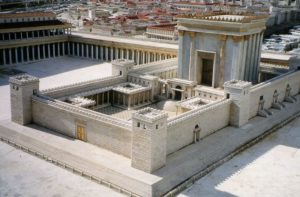
A model of Herod’s version of the Second Temple in Jerusalem

Herod did just that, and renovated the Temple to be the most beautiful building of all time, according to the Talmud. It wouldn’t last long, as that same Temple would be destroyed by his Roman overlords within about a century.

What many forget is that Herod was not a native Jew, but an Idumean. And “Idumea” was simply the Roman name for Edom. Herod was a real, red-blooded Edomite. (Though it should be noted that the Idumeans had loosely, or perhaps forcibly, converted to Judaism in the time of the Hasmoneans.) Herod took over the Jewish monarchy, and began the horrible persecutions that the Roman Empire—of which he was a part—was all too happy to continue. It seems quite likely, therefore, that the association between Edom and Rome began at that point. The people resented that Roman-Edomite tyrant Herod that persecuted them so harshly.

Henceforth, it was easy for the Sages to spill their wrath upon Edom, and their progenitor Esau. Esau became a symbol of the Roman oppressor. “Esau” and “Edom” were code words, used for speaking disparagingly about Rome to avoid alarming the authorities. Indeed, when the Sages speak about the evils of Esau, they are often really referring to the evils of the Roman Empire. It is therefore not surprising that Esau becomes possibly the most reviled figure in the Torah—as the Romans were unquestionably the most reviled entity in Talmudic times.


The above is an excerpt from Garments of Light, Volume Two. To continue reading, get the book here

The Origins and Kabbalah of Kaddish

This week’s parasha begins with the passing of Sarah, the first Matriarch. We read how Abraham “eulogized Sarah and bewailed her” (Genesis 23:2). Today, the ritual most associated with Jewish death and mourning is undoubtedly the recitation of Kaddish. This has become one of those quintessentially Jewish things that all Jews—regardless of background, denomination, or religious level—tend to be very careful about. It is quite common to see people who otherwise never come to the synagogue to show up regularly when a parent or spouse dies, only to never be seen again as soon as the mourning period is over. Kaddish has become so prevalent that it has gone mainstream, featured in film and on TV (as in Rocky III and in the popular Rugrats cartoon), on stage (in Angels in America and Leonard Bernstein’s Symphony no. 3), and in literature (with bestselling novels like Kaddish in Dublin, and Kaddish For an Unborn Child).


Sylvester Stallone, as Rocky Balboa, recites Kaddish for his beloved coach and mentor. 

And yet, the origins of Kaddish are entirely clouded in mystery. It isn’t mentioned in the Tanakh, nor is there any discussion of reciting Kaddish for the dead in the Mishnah or Talmud. Even in the Rambam’s monumental Jewish legal code, the Mishneh Torah—just over 800 years old—there is no discussion of a Mourner’s Kaddish. Where did it come from?

Praying for Redemption

The Talmud refers to Kaddish in a number of places (such as Berakhot 3a, for example), though not in association with mourning the dead. Around the same time, we see a prayer very similar to Kaddish in the New Testament (Matthew 6:9-13), which has since become known as the “Lord’s Prayer” among Christians. This suggests that Kaddish existed before the schism between Judaism and Christianity, and this is one reason scholars date the composition of Kaddish to the late Second Temple era.

Many believe that it was composed in response to Roman persecution. The text of the Kaddish makes it clear from the very beginning that it is a request for God to speedily bring about His great salvation. It certainly makes sense that such a prayer would be composed in those difficult Roman times. In fact, the first words of Kaddish are based on Ezekiel 38:23, in the midst of the Prophet’s description of the End of Days (the famous “Gog u’Magog”), where God says v’itgadalti v’itkadashti. The Sages hoped the travails they were struggling through were the last “birth pangs” of the End Times.

In Why We Pray What We Pray, Barry Freundel argues that Kaddish was originally recited at the end of a lecture or a Torah learning session—as continues to be done today. It likely came at a time when public Torah learning or preaching was forbidden, as we know was the case in the time of Rabbi Akiva. So, the Sages ended their secret learning sessions with a prayer hoping that the Redemption would soon come, and they would once more be able to safely preach in public.

If that’s the case, how did Kaddish become associated with mourning the dead?

The Mourner’s Kaddish

Freundel points out that the earliest connection between Kaddish and the souls of the dead is from the Heikhalot texts. These are the most ancient works of Jewish mystical literature, going as far back as the early post-Second Temple era. (Scholars date the earliest texts to the 3rd century CE). One of these texts reads:

In the future, the Holy One, blessed be He, will reveal the depths of Torah to Israel… and David will recite a song before God, and the righteous will respond after him: “Amen, yehe sheme rabba mevorach l’olam u’l’olmei olmaya itbarach” from the midst of the Garden of Eden. And the sinners of Israel will answer “Amen” from Gehinnom.

Immediately, God says to the angels: “Who are these that answer ‘Amen’ from Gehinnom?” [The angels] say before Him: “Master of the Universe, these are the sinners of Israel who, even though they are in great distress, they strengthen themselves and say ‘Amen’ before You.” Immediately, God says to the angels: “Open for them the gates of the Garden of Eden, so that they can come and sing before Me…”

The Heikhalot connect Kaddish (specifically its central verse, “May His great Name be blessed forever and for all eternity…”) to a Heavenly prayer that will be recited at the End of Days, when the souls in Gehinnom will finally have reprieve. We can already start to see how this might relate to mourning, or spiritually assisting, the recently deceased.

This is related to another well-known story that is by far the most-oft used as the origin of Kaddish. In this narrative, a certain great sage—usually Rabbi Akiva, but sometimes Rabbi Yochanan ben Zakkai—sees a person covered in ash and struggling with piles of lumber. The poor person explains that he is actually dead, and his eternal punishment (reminiscent of popular Greek mythology) is to forever gather wood, only to be burned in the flames of that wood, and to repeat it all over again. The Sage asks if there is anything he could do to help, to which the dead man replies that if only his son would say a particular prayer, he would be relieved of his eternal torment.

The nature of that prayer varies from one story to the next. In some, it is the Shema, in others it is Barchu, and in others it is a reading of the Haftarah (see, for example, Kallah Rabbati 2, Machzor Vitry 144, Zohar Hadash on Acharei Mot, and Tanna d’Vei Eliyahu Zuta 17). It is only in later versions of the story that the prayer the son must say is Kaddish. Whatever the case, between the Heikhalot texts, and these Midrashic accounts, we now have a firm connection linking Kaddish with the deceased.

I believe there is one more significant (yet overlooked) source to point out:

The most important part of the Kaddish is undoubtedly the verse yehe sheme rabba mevorach l’olam u’l’olmei olmaya. As we saw in the Heikhalot above, this is the part that especially arouses God’s mercy. The Talmud (Berakhot 3a) agrees when it says essentially the same thing about the entire congregation reciting aloud “yehe sheme hagadol mevorach”. These special words are based on several Scriptural verses, such as Psalm 113:2 and Daniel 2:20. It also appears in Job 1:21.

Here, Job suffers the death of all of his children. Upon hearing the tragic news, he famously says: “…naked I came out of my mother’s womb, and naked shall I return; the Lord giveth, and the Lord taketh away; blessed be the name of the Lord.” In Hebrew it reads: Adonai natan, v’Adonai lakach, yehi shem Adonai mevorach. The parallel is striking. The first person in history to recite the great “yehe sheme rabba” upon the death of a family member is none other than Job. In some way, Job may be the originator of the Mourner’s Kaddish.

Birth of a Custom

Officially, the earliest known mention of reciting Kaddish for the dead is Sefer HaRokeach, by Rabbi Elazar of Worms (c. 1176-1238). Shortly after, his student Rabbi Itzchak of Vienna (1200-1270) writes in his Ohr Zarua that Ashkenazim have a custom to recite Kaddish upon the dead. He explicitly states that Tzarfati Jews (and as an extension, Sephardic Jews) do not have such a custom.

That much is already clear from the Rambam (Rabbi Moshe ben Maimon, 1135-1204), the greatest of Sephardic sages in his day, who makes no mention of a Mourner’s Kaddish anywhere in his comprehensive Mishneh Torah. (The Rambam does speak about the regular Kaddish, unrelated to the dead, which is recited throughout the daily prayers.) We see that in his time, Kaddish was still a strictly Ashkenazi practice. Why is it that Ashkenazi Jews in particular began to say Kaddish for the dead?

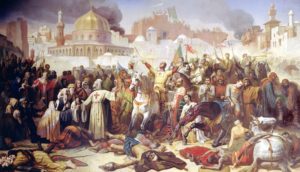
Most scholars believe the answer lies within the Crusades. The First Crusade (1095-1099) was a massive disaster for Europe’s Ashkenazi Jews. While the Crusades were meant to free the Holy Land from Muslim domination, many local Christians argued that there was no need to fight the heathen all the way in the Holy Land when there were so many local Jewish “heathens” among them. The result is what is referred to as “the Rhineland massacres”, described by some as “the First Holocaust”. Countless Jews were slaughtered.

‘Taking of Jerusalem by the Crusaders, 15th July 1099’ by Émile Signol

Like in the times of Roman persecution a millennium earlier, the Ashkenazi Sages sought comfort in the words of Kaddish, beseeching the coming of God’s Final Redemption, and at the same time seeking to honour the poor souls of the murdered. It therefore isn’t surprising that Rabbi Elazar of Worms is the first to speak of Kaddish for the dead, as his hometown of Worms (along with the town of Speyer) was among the first to be attacked, in May of 1096.

It is important to remember that Rabbi Elazar was a member of the Hasidei Ashkenaz, the “German Pietist” movement known for its mysticism and asceticism (not to be confused with the much later Hasidic movement). The Hasidei Ashkenaz would have been particularly well-versed in Heikhalot and Midrashim. Everything points to this group as being the true originators of reciting Kaddish for the dead.

The practice spread from there. Indeed, there was a great deal of Jewish migration in those turbulent times. For example, one of the greatest Ashkenazi sages, Rabbeinu Asher (c. 1250-1327), was born in Cologne, Germany, but fled persecution and settled in Toledo, Spain. His renowned sons, Rabbi Yakov ben Asher (Ba’al HaTurim, c. 1269-1343), and Rabbi Yehudah ben Asher (c. 1270-1349) continued to lead the Sephardic Jewish community of Toledo. And it was there in Toledo that was born one of the greatest of Sephardi sages, Rabbi Yosef Karo (1488-1575), author of the Shulchan Arukh, still the primary code of Jewish law.

In the Shulchan Arukh we are only told to recite Kaddish once at a funeral, following the burial (Yoreh De’ah 376:4). It is in the gloss to the Shulchan Arukh by the Ashkenazi Rama (Rabbi Moshe Isserles, 1530-1572) where we find that it is customary to continue reciting Kaddish for twelve months, though only for a parent, based on Midrashim that speak of reciting Kaddish for a father. The reasoning for the latter is that, since it is a father’s obligation to teach his son Torah, by reciting Kaddish the son demonstrates that the father had fulfilled the mitzvah, and left behind a proper Jewish legacy.

It is quite amazing to see that as late as 500 years ago, Mourner’s Kaddish was still defined in very narrow terms, and described as more of a custom (especially for Ashkenazim) based on Midrash than an absolute halachic necessity. How did it transform into a supreme Jewish prayer?

Enter the Arizal

As with many other Jewish practices we find so common today, it looks like it was the influence of the Arizal (Rabbi Isaac Luria, 1534-1572), history’s foremost Kabbalist, that made the Mourner’s Kaddish so universal, and so essential. Fittingly, he was the perfect candidate for the job, being the product of an Ashkenazi father and a Sephardi mother, and ending his life as the leader of the Sephardi sages of Tzfat.

The Arizal discussed the mysteries of Kaddish at great length. Like most of his teachings, they were put to paper by his primary disciple, Rabbi Chaim Vital (1543-1620). The latter devotes a dozen dense pages to Kaddish in Sha’ar HaKavanot. He first explains the various forms of Kaddish recited during the regular prayer services. In brief, we find that Kaddish is recited between the major prayer sections because each part of the prayer is associated with a different mystical universe, and a different Heavenly Palace, and Kaddish facilitates the migration from one world to the next.

Recall that Kabbalah describes Creation in four universes or dimensions: Asiyah, Yetzirah, Beriah, and Atzilut. The four sections of prayer correspond to the four ascending universes: the morning blessings and the first prayers up until Hodu correspond to Asiyah; the Pesukei d’Zimrah corresponds to Yetzirah; the Shema and its blessings parallel Beriah; and the climax of the prayer, the Amidah, is Atzilut, the level of pure Divine Emanation. For this reason, the Amidah is recited in complete silence and stillness, for at the level of Atzilut, one is entirely unified with God.

The Arizal delves in depth into the individual letters and gematrias of Kaddish, its words and phrases, and how they correspond to various names of God and Heavenly Palaces. He relays the proper meditations to have in mind when reciting the different types of Kaddish, at different stages of prayer. To simplify, the Arizal teaches that Kaddish helps us move ever higher from one world to the next, and more cosmically, serves to elevate the entire universe into higher dimensions. We can already see how this would be related to assisting the dead, spiritually escorting the soul of the deceased higher and higher through the Heavenly realms.

More intriguingly, Rabbi Vital writes that Kaddish is meant to prepare the soul for the Resurrection of the Dead. He goes on to cite his master in saying that Kaddish should be recited every single day, including Shabbat and holidays, for an entire year following the passing of a parent. He says that Kaddish not only helps to free a soul from Gehinnom, but more importantly to help it attain Gan Eden. It elevates all souls, even righteous ones. This is why one should say Kaddish for a righteous person just as much as for a wicked person, and this is why it should be said even on Shabbat (when souls in Gehinnom are given rest). Rabbi Vital then says how the Arizal would also say Kaddish every year on the anniversary of his father’s death, which is now the norm as well.

Ironically, while Kaddish began as an Ashkenazi custom, Rabbi Vital writes that the Arizal made sure to recite Kaddish according to the Sephardi text!

Repairing the World

Another interesting point that Rabbi Vital explains is why Kaddish is in Aramaic, and not Hebrew like the rest of the prayers. He reminds us the words of the Zohar that both Hebrew and Aramaic are written with the exact same letters because these are the Divine Letters of Creation, but Hebrew comes from the side of purity and holiness, while Aramaic is from the “other side” of impurity and darkness. Hebrew is the language of the angels, while Aramaic is the language of the impure spirits. The angels speak Hebrew, but do not understand Aramaic, while their antagonists speak Aramaic, and do not understand Hebrew. When we learn Torah and Mishnah, in Hebrew, we please the angels who take our words up to Heaven. When we learn Talmud and Zohar, in Aramaic, we destroy those dark spirits who cannot stand the fact that a person is using their tongue for words of light and holiness.

The same applies to our prayers. The bulk of our prayers are in holy Hebrew, the language of angels. Kaddish is in Aramaic because it is meant to elevate us, and the universe around us, into higher dimensions. In this vital task, we cannot risk elevating the impure spirits along with us, contaminating the upper worlds. Thus, by saying it in Aramaic, we push away the impure spirits who are unable to withstand us using their language in purity. Those evil forces are driven away, and we can ascend and rectify in complete purity.

This, in brief, is the tremendous power of Kaddish. This is why we recite it so many times over the course of the day. And this is why every Jew is so mysteriously drawn to this prayer and ritual, possibly above all others. Deep inside the soul of every Jew—regardless of background, denomination, or religious level—is a yearning to repair the world, to destroy the impure, to uplift the universe, and to recite loudly: “May His great Name be blessed forever and for all eternity…”

The Jewish View on Cards and Gambling

In this week’s parasha, Matot-Massei, we read how the Israelites were supposed to divide up the Holy Land between the Twelve Tribes:

And you shall inherit the land by lot according to your families; to the more [numerous] you shall give the more inheritance, and to the fewer you shall give the lesser inheritance; wherever the lot falls to any man, that shall be his…

We learn that the land of Israel was apportioned based on family size, with larger families logically receiving a larger share. Now, to determine which chunk of land a family would receive, the Israelites cast lots. The Talmud (Bava Batra 122a) describes how this was done: two urns were prepared, one containing the names of the Twelve Tribes, and the other containing the names of the various allotments of land. Elazar the High Priest would pick one name from each urn, thus designating a piece of land for a particular tribe.

Casting lots was very common in Biblical times, and is mentioned frequently in the Tanakh. For example, the Torah commands casting lots to determine which goat is sent to Azazel on Yom Kippur (Leviticus 16:8). In the Book of Jonah (1:7), the sailors on Jonah’s ship cast lots to determine who was guilty of causing the storm. In the time of King David, the kohanim were thus divided into 24 groups (I Chronicles 24). Haman cast lots to determine the best day to attack the Jews, and this is why the holiday is called “Purim”, since purim was the Persian word for “lots” (Esther 3:7).

Casting lots suggests a large degree of chance or randomness in the process. Yet, people of faith are naturally quite averse to the concept of random chance, for isn’t everything determined by God? Not surprisingly, the word “lot” (goral) also takes on the meaning of “fate” in the Tanakh. For instance, Isaiah (17:14) prophesies: “At evening there will be terror, and before morning they are not. This is the portion of them that spoil us, and the goral of them that rob us.” The ultimate fate of those that harm the Jewish people will be utter destruction. The Sages, too, were uncomfortable with the idea of dividing the Holy Land by seemingly random lots. They therefore stated (ibid.) that the lots were really just a show for the people to see what God intended. In reality:

Elazar was wearing the Urim and Tumim, while Joshua and all Israel stood before him… Animated by the Holy Spirit, he gave directions, exclaiming: “Zevulun” is coming up and the boundary lines of Acco are coming up with it. [Thereupon], he shook well the urn of the tribes and Zevulun came up in his hand. [Likewise] he shook well the urn of the boundaries and the boundary lines of Acco came up in his hand…

Elazar would prophetically see which tribe needed which land, and when he then shook the urns those exact pairs that he foresaw would emerge! So, the process was not random at all, but simply a materialization of the Divine Will. Still, the Sages insist that in the messianic era the Holy Land will not be apportioned through this method of casting lots, but rather “The Holy One, blessed be He, Himself, will divide it among them; for it is said [Ezekiel 48:29], ‘And these are their portions, says the Lord God.’”

If the Sages were not fond of casting random lots by chance, how would they feel about playing games of chance and gambling?

Gambling in the Talmud

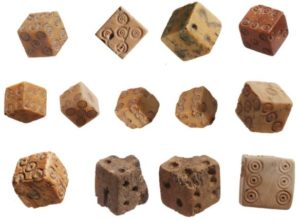
In 1999 and 2000, the Muslim Waqf (Temple Mount authority) dug up 9000 tons of Temple Mount soil and unceremoniously dumped it in the Kidron Valley, creating one of the largest archaeological catastrophes in history. Thankfully, archaeologists did not give up on this precious soil, and began the “Temple Mount Sifting Project”. Among the many incredible finds are these Second Temple-era playing dice.

In a list of people that are ineligible to serve as witnesses or as judges, the Mishnah includes a mesachek b’kubia, a person who plays with dice, and mafrichei yonim, “pigeon flyers”. According to the Talmud, the latter most likely refers to people who bet on pigeon races, which were apparently common in those days. We know from historical sources that gambling with various dice games was very popular in Greek and Roman times. The Talmud (Sanhedrin 24b) goes on to discuss what the problem with such people is.

Rami bar Hama teaches that the issue with gambling is that it is essentially built on a lie: each player agrees to pay a certain sum of money if they lose, yet they hope (and fully intend) not to lose at all! That means the initial agreement made by the players is not even valid. The losing gambler is entirely dejected, and gives up their money reluctantly, often with a nagging feeling of being robbed or cheated out of their money.

Rav Sheshet disagrees. After all, there may be some people who are not so sad to part with their money, or are simply addicted to the game itself. Whatever the case, Rav Sheshet holds that gambling is inappropriate because it is a terribly unproductive waste of time, and the gambler contributes nothing to “the welfare of the world”. This is why, Rav Sheshet says, the Mishnah above concludes by saying that only a full-time gambler is prohibited, but one who has an actual job and just plays for fun on the side is permitted.

Nonetheless, Rav Yehudah holds that regardless of whether the gambler has an occupation or not, or whether he is a full-time player or not, a gambler is disqualified from being a kosher witness or judge. Rav Yehudah bases his statement on a related teaching of Rabbi Tarfon, and on this Rashi comments that a gambler is likened to a thief. The Midrash is even more vocal, saying that gamblers “calculate with their left hand, and press with their right, and rob and wrong one another” (Midrash Tehillim on Psalm 26:10).

The Talmud (Sanhedrin 25b) goes on to state that the prohibitions above don’t only refer to a literal dice-player, but any kind of gambler, including one who plays with pebbles (or checkers), and even with nuts. The Sages state that such a person is only readmitted when they do a complete repentance, and refuse to play the game even just for fun without any money!

Halachically-speaking, the Shulchan Arukh (Choshen Mishpat 370:2-3) first states that any kind of gambling is like theft and is forbidden, but then suggests that while it may not exactly be theft it is certainly a waste of time and not something anyone should engage in.

A Ban on Gambling

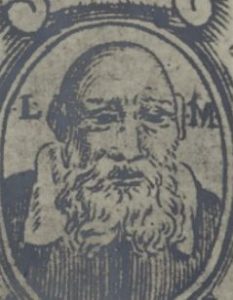
While the Talmud does not explicitly forbid gambling, later rabbis recognized its addictive nature and sought to ban the practice entirely. In 1628, for example, the rabbis of Venice issued a decree (to last six years) excommunicating any Jew who gambled. Part of the motivation for this decree was the case of Leon da Modena (Rabbi Yehudah Aryeh of Modena, 1571-1648).

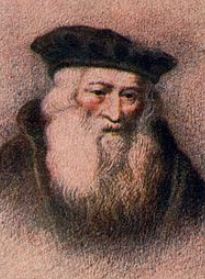
Rabbi Leon Yehudah Aryeh da Modena

Born in Venice to a family of Sephardic exiles, da Modena went on to become a respected rabbi and the hazzan of Venice’s main synagogue for forty years. A noted scholar, he wrote about a dozen important treatises. In Magen v’Herev, he systematically tore down the major tenets of Christianity, while in Ari Nohem he sought to discredit Kabbalah and prove that the Zohar has no ancient or divine origin. (The latter is probably why he isn’t as well-known in Jewish circles today as he should be.)

In 1637, he published Historia de’riti hebraici, an overview of Judaism for the European world, meant to dispel myths about Judaism and quell anti-Semitism. Historians credit this with being the first Jewish text written for the non-Jewish world in over a millennium, since the time of Josephus. The book was incredibly popular, and played a key role in England’s readmitting Jews to the country in the 1650s (after having being expelled in 1290).

More pertinent to the present discussion, Rabbi da Modena wrote Sur miRa (“Desist from Evil”), outlining the problems with gambling. He would know, since he was horribly addicted to gambling himself. He wrote of this problem in his own autobiography, Chayei Yehudah. And because such a high-profile sage was a gambler, his rabbinic colleagues in Venice issued that decree to ban any form of gambling.

Rabbi da Modena’s game of choice was cards. At that point in time, playing cards had become wildly popular in Europe. First invented in China in the 9th century, playing cards slowly made their way across Asia, and reached Europe around 1365. They have remained popular ever since, both for gambling and non-gambling games. While it is clear from an halachic standpoint that card games involving money (like Poker or Blackjack) should not be played, is it permissible to play non-gambling card games (like Crazy Eights or Go Fish)?

At first glance, it may not seem like there should be a problem with this. Yet, some rabbis have recently spoken out against all playing cards. Usually, this prohibition is connected not to gambling or wasting time, but rather to cards’ apparent origins in idolatry or the dark arts. Although it is true that some types of cards are used in divination and fortune-telling, it is important to examine the matter in depth and determine whether cards really are associated with forbidden practices.

The History of Playing Cards

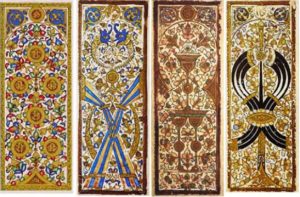
Mamluk Cards

The exact origins of cards are unclear. We do know that they come from China, where paper and printing were invented. Card games are attested to in Chinese texts as early as 868 CE. In the 12th and 13th centuries, the Muslims brought cards across Asia. They were particularly popular in Egypt during the Mamluk Sultanate (1250-1517). The Mamluks created the first modern-style deck of 52 cards with 4 suits. The suits were sticks, coins, swords, and cups. In the 15th century, Italians started to make cards of their own, with the suits being leaves, hearts, bells, and acorns. The French had three-leaf clovers for leaves, square tiles (or diamonds) for bells, and pikes for acorns. Although these suit symbols remained, the English names reflect the earlier suits of sticks (“clubs”) and swords (“spades”).

The Muslim Mamluks did not draw any faces on their court cards (since depicting faces in art is forbidden in Islam). The Europeans did not have this issue, and adapted the Muslim court cards of malik (king), malik na’ib (deputy king), and thani na’ib (second deputy) to king, queen, and prince or knight (“jack”). In 16th century France, the four kings were depicted as particular historical figures: the King of Spades was King David, the King of Clubs was Alexander the Great, the King of Hearts was Charlemagne, and the King of Diamonds was Julius (or Augustus) Caesar.
We see that playing cards have no origins in idolatry. The style of cards we know today were developed by staunchly monotheistic Muslims. They were further developed by mostly non-religious European renaissance printers, against the wishes of the Church which sought to ban cards on a number of occasions. Neither are playing cards known for being used in fortune-telling. However, a related type of card is used in divination today.

Tarot Cards and Kabbalah

In 15th century Italy, a different type of playing card developed. These were called trionfi, later tarocchi, and finally “tarot cards”. They, too, have four suits, but with 56 cards. These were, and still are, used for a number of different games, just like regular playing cards are. Outside of Europe, tarot cards are not well-known, and are generally associated with fortune-tellers.

In reality, the earliest mention of tarot cards being used in divination is only from 1750, and it was essentially unheard of until the late 19th century. Besides, most diviners actually use a different deck of 78 cards. Of course, such divination is entirely forbidden according to the Torah. So, it seems like some well-meaning rabbis have confused these tarot cards with regular playing cards. Ironically, many occultists actually claim that tarot cards come from Kabbalah!

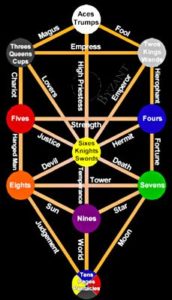
The Tarot “Tree of Life” (Credit: Byzant.com)

These occultists tie the 22 additional divination cards to the 22 letters of the Hebrew alphabet and the 22 paths on the mystical “Tree of Life”. The ten numeral cards (naturally) correspond to the Ten Sefirot, while the four suits correspond to the four olamot, or universes. Finally, the four court cards and the ace represent the five partzufim (with the king and queen appropriately being Aba and Ima). While these parallels are neat, there is absolutely no known historical or textual basis to support these claims. Tarot cards have nothing to do with traditional Kabbalah or Jewish mysticism. (There is a concept in Kabbalah of a negative set of Ten Sefirot belonging to the Sitra Achra, so perhaps there is some connection between these tarot cards and certain evil spiritual forces.)

Having said all that, to forbid playing with cards (or even standard tarot cards) just because some people recently started using them in divination is like forbidding drinking coffee because some people recently started divining with coffee (a practice called “tassology” or “tasseography”). While playing cards copiously is certainly a waste of time, there is nothing wrong with the occasional—no gambling—game.

Ba’al HaTurim

It is fitting to end with the words of the Ba’al HaTurim (Rabbi Yakov ben Asher, c. 1269-1343) who writes in his commentary on the Torah (Tur HaAroch on Deuteronomy 1:1) that Moses himself cautioned Israel about gambling in his final speech before passing away:

Before Moses got ready to relate all these various commandments, he used the present opportunity, a few weeks before his death, to admonish the people, and to remind them of past sins, and how they had caused Hashem a lot of grief during these years. He reminded them how God had treated them by invoking His attribute of mercy and loving kindness time and again. He warned them not to become corrupt again by gambling… They should not rely on the fact that because they were human they were bound to err and sin from time to time and that God, knowing this, would overlook their trespasses.


The above is adapted from Garments of Light, Volume Two. Get the book here