Tag Archives: Oral Torah

Time Travel in the Torah

This week’s parasha is Ki Tisa, in which we read of Moses’ return from Mt. Sinai where he had spent forty days with God. During that time, he had composed the first part of the Torah and received the Two Tablets. The Talmud (Menachot 29b) tells us of another incredible thing that happened:

…When Moses ascended on High, he found the Holy One, Blessed be He, sitting and tying crowns on the letters of the Torah. Moses said before God: “Master of the Universe, who is preventing You from giving the Torah [without these additions]?” God said to him: “There is a man who is destined to be born after many generations, and Akiva ben Yosef is his name. He is destined to derive from each and every tip of these crowns mounds upon mounds of halakhot.” [Moses] replied: “Master of the Universe, show him to me.” God said to him: “Return behind you.”

Moses went and sat at the end of the eighth row [in Rabbi Akiva’s classroom] and did not understand what they were saying. Moses’ strength waned, until [Rabbi Akiva] arrived at the discussion of one matter, and his students said to him: “My teacher, from where do you derive this?” [Rabbi Akiva] said to them: “It is an halakha transmitted to Moses from Sinai.” When Moses heard this, his mind was put at ease…
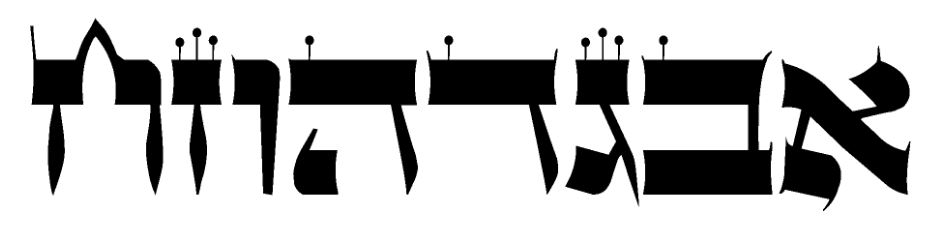
Up on Sinai, Moses saw a vision of God writing the Torah—this is how Moses himself composed the Torah, as he was shown what to inscribe by God—and he saw God adding the little tagim, the crowns that adorn certain Torah letters. Moses was puzzled by the crowns, and asked why there were necessary. God replied that in the future Rabbi Akiva would extract endless insights from these little crowns.

Moses then asked to see Rabbi Akiva, and was permitted to sit in on his class. Moses could not follow the discussion! In fact, the Talmud later says how Moses asked God: “You have such a great man, yet you choose to give the Torah through me?” At the end of the lesson, Rabbi Akiva’s students ask him where he got that particular law from, and he replied that it comes from Moses at Sinai. Moses was comforted to know that even what Rabbi Akiva would teach centuries later is based on the Torah that Moses would compose and deliver to Israel.

This amazing story is often told to affirm that all aspects of Torah, both Written and Oral, and those lessons extracted by the Sages and rabbis, stems from the Divine Revelation at Sinai, and from Moses’ own teachings. It is a central part of Judaism that everything is transmitted in a chain starting from Moses at Sinai, down through the prophets, to the Anshei Knesset HaGedolah, the “Men of the Great Assembly” and the earliest rabbis, all the way through to the present time.

What is usually not discussed about this story, though, is the deeper and far more perplexing notion that Moses travelled through time! The Talmud does not say that Moses saw a vision of Rabbi Akiva; it says that he literally went and sat in his classroom. He was there, sitting inconspicuously at the end of the eighth row. As a reminder, Moses received the Torah in the Hebrew year 2448 according to tradition, which is 3331 years ago. Rabbi Akiva, meanwhile, was killed during the Bar Kochva Revolt, 132-136 CE, less than 2000 years ago. How did Moses go 1400 years into the future?

Transcending Time and Space

In his commentary on Pirkei Avot (Magen Avot 5:21), Rabbi Shimon ben Tzemach Duran (1361-1444) explains:

Moshe Rabbeinu, peace be upon him, while standing on the mountain forty days and forty nights, from the great delight that he had learning Torah from the Mouth of the Great One, did not feel any movement, and time did not affect him at all.

As we read at the end of this week’s parasha, Moses “was there with God for forty days and forty nights; he ate no bread and drank no water, and He inscribed upon the tablets the words of the Covenant…” (Exodus 34:28) At Sinai, Moses had no need for any bodily functions. Rabbi Duran explains that from his Divine union with God, Moses transcended the physical realm. In such a God-like state, he was no longer subject to the limitations of time and space.

In this regard, Moses became like a photon of light. Modern physics has shown that light behaves in very strange ways, and does not appear to be subject to time and space. Fraser Cain of Universe Today explains how

From the perspective of a photon, there is no such thing as time. It’s emitted, and might exist for hundreds of trillions of years, but for the photon, there’s zero time elapsed between when it’s emitted and when it’s absorbed again. It doesn’t experience distance either.

Light transcends time and space. In this way, Moses was like light. And this is quite fitting, for this week’s parasha ends with the following (Exodus 34:29-33):

And it came to pass when Moses descended from Mount Sinai, and the Two Tablets of the Testimony were in Moses’ hand when he descended from the mountain, and Moses did not know that the skin of his face had become radiant while He had spoken with him. And Aaron and all the children of Israel saw Moses, and behold, the skin of his face had become radiant, and they were afraid to come near him… When Moses had finished speaking with them, he placed a covering over his face.

Moses glowed with a bright light, so much so that the people couldn’t look at him, and he would wear a mask over his face. Moses had become light. And light doesn’t experience time and space like we do. There is something divine about light. It therefore isn’t surprising that the Kabbalists referred to God as Or Ain Sof, “light without end”, an infinite light, or simply Ain Sof, the “Infinite One”. Beautifully, the gematria of Ain Sof (אין סוף) is 207, which is equal to light (אור)!

Travelling to the Future

While Moses was instantly teleported into the future, we currently have no scientifically viable way for doing so. However, the notion of travelling into the future is a regular fixture of modern science fiction, and the way it usually presents itself is through some form of “cryosleep”. This is when people are either frozen or placed into a state of deep sleep, or both, for a very long time (usually because they are flying to distant worlds many light years away), and are reanimated in the distant future. For this there is a good scientific foundation, as there are species of frogs in Siberia, for example, that are able to freeze themselves for the winter, and thaw in the spring. They can do this without compromising the integrity of their cellular structure, in a process not yet fully understood. If we could mimic this biological process, then humans, too, could potentially freeze themselves for long periods of time, “thawing” in the future. And this, too, has a precedent in the Talmud (Ta’anit 23a):

[Honi the Circle-Drawer] was throughout the whole of his life troubled about the meaning of the verse, “A song of ascents, when God brought back those that returned to Zion, we were like them that dream.” [Psalms 126:1] Is it possible for a man to dream continuously for seventy years? One day he was journeying on the road and he saw a man planting a carob tree. He asked him: “How long does it take [for this tree] to bear fruit?” The man replied: “Seventy years.” He then further asked him: “Are you certain that you will live another seventy years?” The man replied: “I found [ready-grown] carob trees in the world; as my forefathers planted these for me so I too plant these for my children.”

Honi sat down to have a meal and sleep overcame him. As he slept a rocky formation enclosed upon him which hid him from sight and he continued to sleep for seventy years. When he awoke he saw a man gathering the fruit of the carob tree and he asked him: “Are you the man who planted the tree?” The man replied: “I am his grandson.” Thereupon he exclaimed: “It is clear that I slept for seventy years!” He then caught sight of his donkey who had given birth to several generations of mules, and he returned home. He there enquired: “Is the son of Honi the Circle-Drawer still alive?” The people answered him: “His son is no more, but his grandson is still living.” Thereupon he said to them: “I am Honi the Circle-Drawer”, but no one would believe him.

He then went to the Beit Midrash and overheard the scholars say: “The law is as clear to us as in the days of Honi the Circle-Drawer”, for whenever he used to come to the Beit Midrash he would settle for the scholars any difficulty that they had. Whereupon he called out: “I am he!” but the scholars would not believe him nor did they give him the honour due to him. This hurt him greatly and he prayed [for death] and he died…
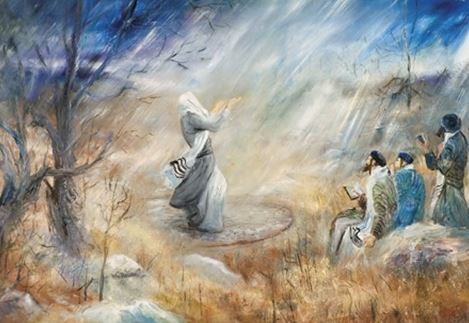
“Honi HaMeagel”, by Huvy. Honi is famous for drawing a circle in the ground around him and not moving away until God would make it rain. Josephus wrote that Honi was killed during the Hasmonean civil war, around 63 BCE. The Maharsha (Rabbi Shmuel Eidels, 1555-1631) said that people thought he was killed in the war, but actually fell into a deep sleep as the Talmud records.

Honi HaMa’agel, “the Circle-Drawer”, who was renowned for his ability to have his prayers answered, entered a state of deep sleep for seventy years and thereby journeyed to the future! This type of time travel is, of course, not true time travel, and he was unable to go back to his own generation. He prayed for death and was promptly answered.

Travelling back in time, meanwhile, presents far more interesting challenges.

Back to the Future

In 2000, scientists at Princeton University found evidence that it may be possible to exceed the speed of light. As The Guardian reported at the time, “if a particle could exceed the speed of light, the time warp would become negative, and the particle could then travel backwards in time.” This is one of several ways proposed to scientifically explain the possibility of journeying back in time.

The problem with this type of travel is as follows: what happens when a person from the future changes events in the past? The result may be what is often referred to as a “time paradox” or “time loop”. The classic example is a person who goes back to a time before they were born and kills their parent. If they do so, they would never be born, so how could they go back in time to do it?

Remarkably, just as I took a break from writing this, I saw that my son had brought a book from the library upstairs. Out of over 500 books to choose from, he happened to bring Harry Potter and the Prisoner of Azkaban. Now, he is far too young to have read it, or to even known who Harry Potter is. And yet, this is the one book in the Harry Potter series—and possibly the one book in our library—that presents a classic time paradox!

In Prisoner of Azkaban, we read how Harry is about to be killed by a Dementor when he is suddenly saved by a mysterious figure who is, unbeknownst to him, his own future self. After recovering from the attack, he later gets his hands on a “time turner” and goes back in time. It is then that he sees his past self about to be killed by a Dementor, and saves his past self. The big problem, of course, is that Harry could have never gone back in time to save himself had he not already gone back in time to save himself in the first place!

Perhaps a more famous example is James Cameron’s 1984 The Terminator. In this story, John Connor is a future saviour of humanity who is a thorn in the side of the evil, world-ruling robots. Those evil robots decide to send one of their own back to a time before John Connor was born in order to kill his mother—so that John could never be born. Aware of this, Connor sends one of his own soldiers back in time to protect his mother. The soldier and the mother fall in love, and the soldier impregnates her, giving birth to John Connor! In other words, future John Connor sent his own father back in time to protect his mother and conceive himself! This is a time paradox.

Could we find such a time paradox in the Torah? At first glance, there doesn’t appear to be anything like this. However, a deeper look reveals that there may be such a case after all.

When God Wanted to “Kill” Moses

In one of the most perplexing passages in the Torah, we read that when Moses took his family to head back to Egypt and save his people, “God encountered him and sought to kill him.” (Exodus 4:24) To save Moses, his wife Tziporah quickly circumcises their son, sparing her husband’s life. The standard explanation for this is that Moses’ son Eliezer was born the same day that he met God for the first time at the Burning Bush. Moses spent seven days communicating with God, then descended on the eighth day and gathered his things to go fulfil his mission.

However, the eighth day is when he needed to circumcise his son, as God had already commanded his forefather Abraham generations earlier. Moses intended to have the brit milah when they would stop at a hotel along the way, but got caught up with other things. An angel appeared, threatening Moses for failing to do this important mitzvah, so Tziporah took the initiative and circumcised her son. Alternatively, some say it was the baby whose life was at risk.

Whatever the case, essentially all the commentaries agree that God had sent an angel to remind Moses of the circumcision. Who was that angel? It may have been a persecuting angel, and some say he took the form of a frightening snake. Others, like the Malbim (Rabbi Meir Leibush Weisser, 1809-1879) say it was an “angel of mercy” as Moses was entirely righteous and meritorious. Under the circumstances, one’s natural inclination might point to it being the angel in charge of circumcision, as suggested by Sforno (Rabbi Ovadiah ben Yakov, 1475-1550). Who is the angel in charge of circumcision? Eliyahu! In fact, Sforno proposes that the custom of having a special kise kavod, chair of honour, or “chair of Eliyahu” (though Sforno doesn’t say “Eliyahu” by name), might originate in this very Torah passage. Every brit milah today has such an Eliyahu chair, for it is an established Jewish tradition that the prophet-turned-angel Eliyahu visits every brit.
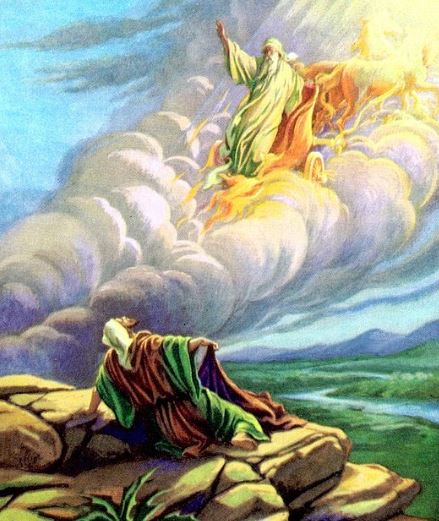
‘Elijah Taken Up to Heaven’

Yet, Eliyahu could not have been there at the brit of Moses’ son, for Eliyahu would not be born for many years! Eliyahu lived sometime in the 9th century BCE. He was a prophet during the reign of the evil king Ahab and his even-more-evil wife Izevel (Jezebel). The Tanakh tells us that Eliyahu never died, but was taken up to Heaven in a fiery chariot (II Kings 2). As is well-known, he transformed into an angel.

The Zohar (I, 93a) explains that when Eliyahu spoke negatively of his own people and told God that the Jews azvu britekha, “have forsaken Your covenant” (I Kings 19:10), God replied:

I vow that whenever My children make this sign in their flesh, you will be present, and the mouth which testified that the Jewish people have abandoned My covenant will testify that they are keeping it.

He henceforth became known as malakh habrit, “angel of the covenant” (Pirkei D’Rabbi Eliezer, 29), a term first used by the later prophet Malachi (3:1).

If Eliyahu is Malakh haBrit, and is present at every circumcision, does this only apply to future circumcisions after his earthly life, or all circumcisions, even those before his time? As an angel that is no longer bound by physical limitations, could he not travel back in time and be present at brits of the past, too? God certainly does transcend time and space, and exists in past, present, and future all at once. This is in God’s very name, a fusion of haya, hoveh, and ihyeh, “was, is, will be”, all in one (see Zohar III, 257b, as well as the Arizal’s Etz Chaim, at the beginning of Sha’ar Rishon, anaf 1). And we already saw how God could send Moses to the distant future and bring him right back to the past. Could He have sent Eliyahu back to the brit of Moses’ son? Such a scenario would result in a classic time loop. How could Eliyahu, a future Torah prophet, save Moses, the very first Torah prophet? Eliyahu could not exist without Moses!

It is important to note here that there were those Sages who believed that Eliyahu was always an angel, from Creation, and came down into bodily form for a short period of time during the reign of Ahab. This is why the Tanakh does not describe Eliyahu’s origins. It does not state who his parents were, or even which tribe he hailed from. Others famously state that “Pinchas is Eliyahu”, ie. that Eliyahu was actually Pinchas, the grandson of Aaron. Pinchas was blessed with eternal life, and after leaving the priesthood, reappeared many years later as Eliyahu to save the Jewish people at a difficult time. He was taken up to Heaven alive as God promised. In the Torah, we read how God blessed Pinchas with briti shalom (Numbers 25:12). Again, that key word “brit” appears—a clue that Pinchas would become Eliyahu, malakh habrit.

While it is hard to fathom, or accept, the possibility of an Eliyahu time paradox, there is one last time paradox that deserves mention. And on this time paradox, all of our Sages do agree…


The above essay is an excerpt from Garments of Light, Volume Three.
To continue reading, get the book here! 
What Does God Ask Of You?

In this week’s parasha, Ekev, we read: “And now, Israel, what does Hashem, your God, ask of you? Only to fear Hashem, your God, to walk in all of His ways, and to love Him, and to serve Hashem, your God, with all your heart and with all your soul.” (Deuteronomy 10:12) Moses instructs his people that they should sincerely love, fear, and serve God. We have written in the past how the Sages say that loving God and serving God is often best done by loving and serving His creations. The Midrash compares this to a servant who takes care of the king’s son. Surely, the king will love such a servant and wish to bestow goodness upon him, for the servant cares for the king’s beloved child. As the Torah calls us all children of Hashem, the King, it goes without saying that those who take care of God’s children are naturally beloved by God.

This is the quality that made Aaron so special, and, according to some, earned him the merit of being chosen the progenitor of the priestly lineage. Pirkei Avot (1:12) famously instructs us to be, above all else, like Aaron (and his disciples): “loving peace and pursuing peace, loving all people, and bringing them closer to Torah.” Elsewhere in Avot (3:10), we are told that “One with whom his fellows are pleased with, God is pleased with.” The Kabbalists beautifully point out that the gematria of the command to love God (ואהבת את יי אלהיך) is 907, the same as the command to love your fellow (ואהבת לרעך כמוך אני יי), for one is impossible without the other.

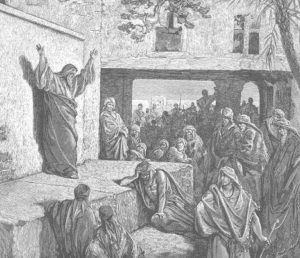
‘Micah Extorting the Israelites to Repentance’, by Gustave Doré

This is what the prophet Michah concluded when he, too, asked the same question as Moses did: “… And what does Hashem request of you? Only to act justly, and to love kindness, and to walk modestly with your God.” (Micah 6:8) Be just and treat everyone fairly; be kind and genuinely love to help others—and do it all humbly and modestly.

The Talmud (Shabbat 31a) takes a more literal approach, with Rava stating that God will ask each person six specific questions upon their death:

When man is led in for Judgment, he is asked: Did you deal faithfully? Did you fix times for learning? Did you engage in procreation? Did you hope for salvation? Did you engage in the dialectics of wisdom? Did you understand one thing from another?

The first question implies dealing honestly in business or in financial matters. Judaism has always taught the necessity of being scrupulously honest when it comes to money. The Kabbalists state that a person will be forced to reincarnate into this world if they so much as owe a single penny. They discuss how the value of shekel (שקל) is 430, equal to nefesh (נפש), “soul”, for each person’s material wealth is intricately tied to their spiritual nature. This is why giving money to charity can actually alter a person’s fate, as explained in the past. (See ‘How Charity Can Save Your Life’ in Garments of Light.)

Meanwhile, the Talmud holds that even though the Torah allows Jews to loan with interest to non-Jews, one shouldn’t charge interest from anyone, and a usurer might not even be a kosher witness in court (Sanhedrin 24b-25b). The same is true for someone who owes a lot of money. A person should not get themselves into great debt, and should ensure as much as possible that they will be able to repay a loan. This is why Rabbi Shimon, one of the five great students of Rabbi Yochanan ben Zakkai, held that the worst possible trait is that of a person who takes on debt and fails to repay (Avot 2:10). He bases himself on the words of King David: “The wicked man borrows and does not repay, but the righteous one is benevolent and gives.” (Psalms 37:21)

The wording of the Talmud is that a person will be asked if they took care of their finances b’emunah, “in faith”. Unfortunately, there are plenty of people who seem faithful, but engage in all kinds of financial tricks under the table. A person cannot be of great emunah if, at the same time, they cheat in financial matters, or are even a little bit dishonest with money. This includes gambling, stock market speculation, and all sorts of tax deceptions which have become so commonplace in our time.

Upholding Creation

The second question asked in the afterlife is whether a person set aside regular times to learn Torah. The Sages state that learning Torah is the most important mitzvah. Indeed, without learning Torah a person won’t know the right way to fulfil any mitzvah. The Torah is a “Tree of life for those who grasp it” (Proverbs 3:18), and the Sages quoted God stating: “I created the evil inclination, and I created the Torah as its antidote.” (Sifre Devarim 45) One who learns Torah is upholding the Covenant between God and Israel—since the Torah is the very text of that Covenant—and hence God states “If not for My covenant day and night, I would not have set the ordinances of Heaven and Earth.” (Jeremiah 33:25) God declares that He would not have created this universe were it not for His Torah—and His people upholding it day and night. (Some have therefore said that the world has time zones so that at any given moment, a Jew somewhere in the world is learning Torah.)

Similarly, the third question refers to procreation, for without it, too, humanity would cease to exist. More specifically, without Jewish procreation, there would be no Jews, and therefore no one to uphold that Covenant. The schools of Hillel and Shammai debated what it takes to fulfil the mitzvah of procreation (Yevamot 62a). According to Hillel, a person must have one boy and one girl, while according to Shammai, a person must have two boys and two girls. The reasoning of the latter is that Eve initially had four children: Cain, Abel, and the sisters each was born with. The first instance of pru u’rvu in the Torah resulted in two boys and two girls, so this is the standard for fulfilling the mitzvah.

However, the Talmud goes on to note another opinion that it was Shammai that taught one must have at least one boy and one girl, whereas Hillel taught that a person must simply have at least one child, whether boy or girl. The most lenient opinion, therefore, is that a person fulfils the mitzvah by having a single child, while the praiseworthy has at least two of each. A person who adopts a child or “raises an orphan” fulfils the mitzvah as well (Megillah 13a).

Of course, it isn’t enough just to have the kids. Parents need to invest their time and energy to ensure the children will be both righteous and successful. The Talmud (Kiddushin 29a) reminds us that, among other things, a parent is obligated to teach their child Torah, and also some kind of craft or career to ensure an honest livelihood. After all, “If there is no Torah, there is no flour; if there is no flour, there is no Torah.” (Avot 3:17) To raise children solely with Torah and assume a livelihood will come on its own, or to rely on the charity of others, is a gross sin. The Rambam (Hilkhot Talmud Torah 3:10) is particularly vocal about it:

Anyone who comes to the conclusion that he should involve himself in Torah study without doing work and derive his livelihood from charity, desecrates God’s Name, dishonors the Torah, extinguishes the light of faith, brings evil upon himself, and forfeits the life of the World to Come, for it is forbidden to derive benefit from the words of Torah in this world.

Our Sages declared: “Whoever benefits from the words of Torah forfeits his life in the world.” Also, they commanded and declared: “Do not make them a crown to magnify oneself, nor an axe to chop with.” Also, they commanded and declared: “Love work and despise rabbinic positions.” All Torah that is not accompanied by work will eventually be negated and lead to sin. Ultimately, such a person will steal from others.

Rabbi Moshe ben Maimon, the Rambam, aka. Maimonides, 1135-1204

Although the Rambam makes it clear that Torah study is of absolute importance, and should take precedence over one’s worldly occupation, he nonetheless reminds us that “the greatest sages of Israel were lumberjacks and water-drawers…” (ibid., 1:9) To be fair, there are other rabbinic authorities that allow for full-time Torah scholars who make learning their occupation, but this must only be for a minority of distinguished thinkers. It is certainly not a standard for everyone, for that would be completely unsustainable.

To get back to the third question, the Sages state that having children “hastens the Redemption”. There are a certain number of souls (in a Heavenly repository called “guf”) that must be born, and only when all of these souls have been born can Mashiach come. Thus, having children accelerates the time of Redemption.

This ties into the fourth question a person is asked: did they look forward to the Redemption? The wording is not if they waited for the Redemption, or hoped for it. Instead, whether they looked forward to it, suggesting a more active form. It isn’t enough to passively wait for the Redemption. Each person must do what they can to hasten it. This includes things like doing more acts of kindness and showing ahavat chinam, expressing baseless, non-judgemental love for all fellow Jews (Yoma 9b); engaging in kiruv; and, of course, repenting wholeheartedly (Sanhedrin 97b). Each person has to continue working on themselves to be ever-more righteous. Increasing one’s charitable donations hastens the Redemption, too (Isaiah 1:27 and Bava Batra 10a).

Garment for the Soul

The final two questions deal with one’s knowledge and understanding. It isn’t enough to engage in light learning here and there. A person must be steeped in dialectics (pilpul) and understand the depths of one thing from another (davar mitokh davar). The Arizal taught that a person must learn Torah on all four of its levels; pshat (simple), remez (sub-textual), drash (metaphorical), and sod (secret). These levels are collectively known by the acronym pardes, “orchard”—a word that is also the origin of the English “paradise”. One who doesn’t learn Torah on all four levels has not fulfilled the mitzvah of Torah study and will return in a reincarnation to do so (Sha’ar HaGilgulim, 16).

The Arizal also taught that Torah study not only strengthens a person spiritually, but literally creates a “garment” for the soul to be worn in the World to Come (Sha’ar HaPesukim, Tehillim). This is the meaning of the verse “The Torah of Hashem is perfect, it restores the soul” (Psalms 19:8). Meanwhile, the power of Torah study is so great that it creates angels, and these angels could eventually communicate with the student and bestow Ruach HaKodesh, divine inspiration, upon them (Sha’ar Ruach HaKodesh, 1).

The Talmud specifies that one should spend a third of their time studying Tanakh, then a third studying Mishnah, and a third studying Gemara (Kiddushin 30a). This was at a time when no other texts were available, so one should probably make another “third” for the many other areas of Jewish study we have today, including halachic and midrashic literature, mussar, hashkafa, various responsas and commentaries, as well as Kabbalah. The Arizal divided up his Torah study routine as follows (Sha’ar HaMitzvot, Va’etchanan):

First, he would read the weekly Torah portion. On Sunday, he would focus on the first six verses. On Monday, the next four. On Tuesday, the next five, and on Wednesday the next six. Another five on Thursday, making a total of 26 verses, and then the whole parasha on Friday. This was done in the traditional manner, shnaim mikra v’echad targum—reading each verse twice in Hebrew, and once in Aramaic.

Next, he would study a portion of Nevi’im, the Prophets, followed by Ketuvim, the other Holy Writings that make up the Tanakh. This, too, was done with shnaim mikra and a targum. The Arizal then studied the Mishnah, followed by Gemara, together with the various commentaries. Finally, he engaged in Kabbalah.

Yirat Hashem

Rava derived the six questions above from Isaiah 33:6, where the prophet declares, “And there shall be faith in your times; strength, salvation, wisdom and knowledge…” Faith refers to the first question regarding faithful business, times refers to the second question of setting times for Torah-learning, strength to procreation, salvation to the Redemption, wisdom and knowledge to the last two questions.

The Isaiah verse concludes with “… the fear of Hashem is His treasure.” One’s rewards (treasure) in the afterlife are contingent upon these six questions. Yet, what unifies them all is yirat Hashem, “fear” or “awe” of God.

One who is truly God-fearing will undoubtedly be scrupulously honest with financial matters, and strive to hasten the Redemption. It is doubtful that a Jew can be truly God-fearing without constantly meditating upon Torah and understanding its depths. Thus, complete yirat Hashem encompasses all of these things. Conversely, a person who does not live these ideals is probably not as God-fearing or faithful as they might believe themselves to be.

An Honest Look at the Talmud

Earlier this week we discussed the necessity of the Talmud, and of an oral tradition in general, to Judaism. We presented an overview of the Talmud, and a brief description of its thousands of pages. And we admitted that, yes, there are some questionable verses in the Talmud (very few when considering the vastness of it). Here, we want to go through some of these, particularly those that are most popular on anti-Semitic websites and publications.

An illustration of Rabbi Akiva from the Mantua Haggadah of 1568

By far the most common is that the Talmud is racist or advocates for the destruction of gentiles. This is based on several anecdotes comparing non-Jews to animals, or the dictum of Rabbi Shimon bar Yochai that “the best of gentiles should be killed”. First of all, we have to be aware of the linguistic style of the Talmud, which often uses strong hyperbole that is not to be taken literally (more on this below). More importantly, we have to remember that these statements were made in a time where Jews were experiencing a tremendous amount of horrible persecution. Rabbi Shimon’s teacher, Rabbi Akiva was tortured to death by being flayed with iron combs. This is a man who never hurt anyone, who raised the status of women, sought to abolish servitude, preached that the most important law is “to love your fellow as yourself”, and taught that all men are made in God’s image (Avot 3:14). For no crime of his own, he was grotesquely slaughtered by the Romans. Rabbi Shimon himself had to hide from the Romans in a cave for 13 years with his son, subsisting off of nothing but carobs. The Jews in Sassanid Persia didn’t fare too much better. So, the anger and resentment of the Sages to their gentile oppressors sometimes come out in the pages of Talmud. Yet, the same Talmud insists “Before the throne of the Creator there is no difference between Jews and gentiles.” (TY Rosh Hashanah 57a). Moreover, a non-Jew who is righteous, and occupies himself with law and spirituality, is likened to a kohen gadol, the high priest (Bava Kamma 38a).

In fact, the contempt that the Sages sometimes had for gentiles is not simply because they were not Jewish, for we see that the Sages had the same contempt, if not more so, for certain other Jews! The Talmud (Pesachim 49b) warns never to marry an ‘am ha’aretz, an unlearned or non-religious Jew, and even compares such Jews to beasts. In the same way that gentiles are sometimes compared to animals, and in the same way Rabbi Shimon said they should “be killed”, Rabbi Shmuel said that the ‘am ha’aretz should be “torn like a fish”! Why such harsh words for other Jews? Because they, too, do not occupy themselves with moral development, with personal growth, or with the law. Therefore, they are more likely to be drawn to sin and immorality. After all, the very purpose of man in this world “is to perfect himself”, as Rabbi Akiva taught (Tanchuma on Tazria 5), and how can one do so without study? Still, the Sages conclude (Avot d’Rabbi Natan, ch. 16) that

A man should not say, “Love the pupils of the wise but hate the ‘am ha’aretẓ,” but one should love all, and hate only the heretics, the apostates, and informers, following David, who said: “Those that hate You, O Lord, I hate” [Psalms 139:21]

Rabbi Akiva is a particularly interesting case, because he was an ‘am ha’aretz himself in the first forty years of his life. Of this time, he says how much he used to hate the learned Jews, with all of their laws and apparent moral superiority, and that he wished to “maul the scholar like a donkey”. Rabbi Akiva’s students asked why he said “like a donkey” and not “like a dog”, to which Akiva replied that while a dog’s bite hurts, a donkey’s bite totally crushes the bones! We can learn a lot from Rabbi Akiva: it is easy to hate those you do not understand. Once Akiva entered the realm of the Law, he saw how beautiful and holy the religious world is. It is fitting that Rabbi Akiva, who had lived in both worlds, insisted so much on loving your fellow. And loving them means helping them find God and live a holy, righteous life, which is why Rabbi Shmuel bar Nachmani (the same one who said that the ‘am ha’aretz should be devoured like a fish) stated that:

He who teaches Torah to his neighbour’s son will be privileged to sit in the Heavenly Academy, for it is written, “If you will cause [Israel] to repent, then will I bring you again, and you shall stand before me…” [Jeremiah 15:19] And he who teaches Torah to the son of an ‘am ha’aretz, even if the Holy One, blessed be He, pronounces a decree against him, He annuls it for his sake, as it is written, “… and if you shall take forth the precious from the vile, you shall be as My mouth…” [Bava Metzia 85a]

Promiscuity in the Talmud

Another horrible accusation levelled against the rabbis of the Talmud is that they were (God forbid) promiscuous and allowed all sorts of sexual indecency. Anyone who makes such a claim clearly knows nothing of the Sages, who were exceedingly modest and chaste. They taught in multiple places how important it is to guard one’s eyes, even suggesting that looking at so much as a woman’s pinky finger is inappropriate (Berakhot 24a). Sexual intercourse should be done only at night or in the dark, and in complete privacy—so much so that some sages would even get rid of any flies in the room! (Niddah 17a) Most would avoid touching their private parts at all times, even while urinating (Niddah 13a). The following page goes so far as to suggest that one who only fantasizes and gives himself an erection should be excommunicated. The Sages cautioned against excessive intercourse, spoke vehemently against wasting seed, and taught that “there is a small organ in a man—if he starves it, it is satisfied; if he satisfies it, it remains starved.” (Sukkah 52b)

Anti-Semitic and Anti-Talmudic websites like to bring up the case of Elazar ben Durdya, of whom the Talmud states “there was not a prostitute in the world” that he did not sleep with (Avodah Zarah 17a). Taking things out of context, what these sites fail to bring up is that the Talmud, of course, does not at all condone Elazar’s actions. In fact, the passage ends with Elazar realizing his terribly sinful ways, and literally dying from shame.

Another disgusting accusation is that the Talmud permits pederasty (God forbid). In reality, what the passage in question (Sanhedrin 54b) is discussing is when the death penalty for pederasty should be applied, and at which age a child is aware of sexuality. Nowhere does it say that such a grotesque act is permitted. The Sages are debating a sensitive issue of when a death penalty should be used. Shmuel insists that any child over the age of three is capable of accurately “throwing guilt” upon another, and this would be valid grounds for a death penalty. Elsewhere, the Talmud states that not only do pederasts deserve to be stoned to death, but they “delay the coming of the Messiah” (Niddah 13b).

The Talmud is similarly accused of allowing a three year old girl to be married. This is also not the whole picture. A father is allowed to arrange a marriage for his daughter, but “it is forbidden for one to marry off his daughter when she is small, until she grows up and says ‘this is the one I want to marry.’” (Kiddushin 41a) Indeed, we don’t see a single case of any rabbi in the Talmud marrying a minor, or marrying off their underage daughter. Related discussions appear in a number of other pages of the Talmud. In one of these (Yevamot 60b), Rabbi Shimon bar Yochai states that a girl who was converted to Judaism before three years of age is permitted to marry a kohen, although kohanim are generally forbidden from marrying converts. This, too, has been twisted as if Rabbi Shimon allowed a kohen to marry a three-year old. He did not say this at all, rather stating that a girl under three who is converted to Judaism (presumably by her parents, considering her young age) is actually not considered a convert but likened to a Jew from birth. Once again we see the importance of proper context.

Science in the Talmud

Last week we already addressed that scientific and medical statements in the Talmud are not based on the Torah, and are simply a reflection of the contemporary knowledge of that time period. As we noted, just a few hundred years after the Talmud’s completion, Rav Sherira Gaon already stated that its medical advice should not be followed, nor should its (sometimes very strange) healing concoctions be made. The Rambam (Moreh Nevuchim III, 14) expanded this to include the sciences, particularly astronomy and mathematics, which had come a long way by the time of the Rambam (Rabbi Moshe ben Maimon, 1135-1204). The Rambam did not state that the Sages are necessarily wrong on scientific matters—for indeed we see that they are often quite precise—nonetheless:

You must not expect that everything our Sages say respecting astronomical matters should agree with observation, for mathematics were not fully developed in those days: and their statements were not based on the authority of the Prophets, but on the knowledge which they either themselves possessed or derived from contemporary men of science.

Some scientific statements of the Talmud which have been proven wrong include: The earth’s crust is 1000 cubits thick (Sukkot 53b)—today we have mines that go down four kilometres, which is well over 5000 cubits at least! Lions, bears, and elephants have a gestation period of three years (Bekhorot 8a)—while the Talmud is right by previously stating that cows have a nine-month gestation period, lions actually have gestation of 110 days, bears of 95-220 days depending on the species, and elephants of 22 months.

On the other hand, the Talmud is accurate, for example, when describing the water cycle (Ta’anit 9a), with Rabbi Eliezer explaining that water evaporates from the seas, condenses into clouds, and rains back down. It is also surprisingly close when calculating the number of stars in the universe (Berakhot 32b), with God declaring:

… twelve constellations have I created in the firmament, and for each constellation I have created thirty hosts, and for each host I have created thirty legions, and for each legion I have created thirty cohorts, and for each cohort I have created thirty maniples, and for each maniple I have created thirty camps, and to each camp I have attached three hundred and sixty-five thousands of myriads of stars, corresponding to the days of the solar year, and all of them I have created for your sake.

Doing the math brings one to 1018 stars. This number was hard to fathom in Talmudic times, and even more recently, too (I personally own a book published in the 1930s which states that scientists estimate there are about a million stars in the universe), yet today scientists calculate similar numbers, with one estimate at 1019 stars.

History in the Talmud

When it comes to historical facts the Talmud, like most ancient books, is not always accurate. Historical knowledge was extremely limited in those days. There was no archaeology, no linguistics, and no historical studies departments; neither were there printing presses or books to easily preserve or disseminate information. This was a time of fragile and expensive scrolls, typically reserved for Holy Scriptures.

All in all, the Talmud doesn’t speak too much of history. Some of its reckonings of kings and dynasties are certainly off, and this was recognized even before modern scholarship. For example, Abarbanel (1437-1508) writes of the Talmud’s commentaries on the chronology in Daniel that “the commentators spoke falsely because they did not know the history of the monarchies” (Ma’ayanei HaYeshua 11:4).

The Talmud has also been criticised for exaggerating historical events. In one place (Gittin 57b), for instance, the Talmud suggests that as many as four hundred thousand myriads (or forty billion) Jews were killed by the Romans in Beitar. This is obviously impossible, and there is no doubt the rabbis knew that. It is possible they did not use the word “myriads” to literally refer to 10,000 (as is usually accepted) but simply to mean “a great many”, just as the word is commonly used in English. If so, then the Talmud may have simply meant 400,000 Jews, which is certainly reasonable considering that Beitar was the last stronghold and refuge of the Jews during the Bar Kochva Revolt.

Archaeological remains of the Beitar fortress.

Either way, as already demonstrated the Talmud is known to use highly exaggerated language as a figure of speech. It is not be taken literally. This is all the more true for the stories of Rabbah Bar Bar Chanah, which are ridiculed for their embellishment. Bar Bar Chanah’s own contemporaries knew it, too, with Rabbi Shimon ben Lakish even refusing to take his helping hand while nearly drowning in the Jordan River! (Yoma 9b) Nonetheless, the Talmud preserves his tall tales probably because they carry deeper metaphorical meanings.

Having said that, there are times when the Talmud is extremely precise in its historical facts. For example, it records (Avodah Zarah 9a) the historical eras leading up to the destruction of the Second Temple:

…Greece ruled for one hundred and eighty years during the existence of the Temple, the Hasmonean rule lasted one hundred and three years during Temple times, the House of Herod ruled one hundred and three years. Henceforth, one should go on counting the years as from the destruction of the Temple. Thus we see that [Roman rule over the Temple] was two hundred and six years…

We know from historical sources that Alexander conquered Israel around 331 BCE. The Maccabees threw off the yoke of the Greeks around 160 BCE, and Simon Maccabee officially began the Hasmonean dynasty in 142 BCE. That comes out to between 171 and 189 years of Greek rule, depending on where one draws the endpoint, right in line with the Talmud’s 180 years. The Hasmoneans went on to rule until 37 BCE, when Herod took over—that’s 105 years, compared to the Talmud’s 103 years. And the Temple was destroyed in 70 CE, making Herodian rule over the Temple last about 107 years. We also know that Rome recognized the Hasmonean Jewish state around 139 BCE, taking a keen interest in the Holy Land thereafter, and continuing to be involved in its affairs until officially taking over in 63 BCE. They still permitted the Hasmoneans and Herodians to “rule” in their place until 92 CE. Altogether, the Romans loomed over Jerusalem’s Temple for about 209 years; the Talmud states 206 years. Considering that historians themselves are not completely sure of the exact years, the Talmud’s count is incredibly precise.

Understanding the Talmud

Lastly, it is important never to forget that the Talmud is not the code of Jewish law, and that Judaism is far, far more than just the Talmud. There are literally thousands of other holy texts. Jews do not just study Talmud, and even centuries ago, a Jew who focused solely on Talmud was sometimes disparagingly called a hamor d’matnitin, “Mishnaic donkey”. The Talmud itself states (Kiddushin 30a) that one should spend a third of their time studying Tanakh, a third studying Mishnah (and Jewish law), and a third studying Gemara (and additional commentary). The Arizal prescribes a study routine that begins with the weekly parasha from the Five Books of Moses, then progresses to the Nevi’im (Prophets) and Ketuvim, then to Talmud, and finally to Kabbalah (see Sha’ar HaMitzvot on Va’etchanan). He also states emphatically that one who does not study all aspects of Judaism has not properly fulfilled the mitzvah of Torah study.

A Torah scroll in its Sephardic-style protective case, with crown.

Those who claim that Jews have replaced the Tanakh with the Talmud are entirely mistaken: When Jews gather in the synagogue, we do not take out the Talmud from the Holy Ark, but a scroll of Torah. It is this Torah which is so carefully transcribed by hand, which is adorned with a crown to signify its unceasing authority, and before which every Jew rises. After the Torah reading, we further read the Haftarah, a selection from the Prophets. At no point is there a public reading of Talmud. As explained previously, the Talmud is there to help us understand the Tanakh, and bring it to life.

Ultimately, one has to remember that the Talmud is a continuing part of the evolution of Judaism. We wrote before how we were never meant to blindly follow the Torah literally, but rather to study it, develop it, grow together with it, and extract its deeper truths. The same is true of the Talmud—the “Oral” Torah—and of all others subjects within Judaism, including Midrash, Kabbalah, and Halacha. Judaism is constantly evolving and improving, and that’s the whole point.

For more debunking of lies and myths about the Talmud, click here.