Tag Archives: Isaiah

What Does God Ask Of You?

In this week’s parasha, Ekev, we read: “And now, Israel, what does Hashem, your God, ask of you? Only to fear Hashem, your God, to walk in all of His ways, and to love Him, and to serve Hashem, your God, with all your heart and with all your soul.” (Deuteronomy 10:12) Moses instructs his people that they should sincerely love, fear, and serve God. We have written in the past how the Sages say that loving God and serving God is often best done by loving and serving His creations. The Midrash compares this to a servant who takes care of the king’s son. Surely, the king will love such a servant and wish to bestow goodness upon him, for the servant cares for the king’s beloved child. As the Torah calls us all children of Hashem, the King, it goes without saying that those who take care of God’s children are naturally beloved by God.

This is the quality that made Aaron so special, and, according to some, earned him the merit of being chosen the progenitor of the priestly lineage. Pirkei Avot (1:12) famously instructs us to be, above all else, like Aaron (and his disciples): “loving peace and pursuing peace, loving all people, and bringing them closer to Torah.” Elsewhere in Avot (3:10), we are told that “One with whom his fellows are pleased with, God is pleased with.” The Kabbalists beautifully point out that the gematria of the command to love God (ואהבת את יי אלהיך) is 907, the same as the command to love your fellow (ואהבת לרעך כמוך אני יי), for one is impossible without the other.
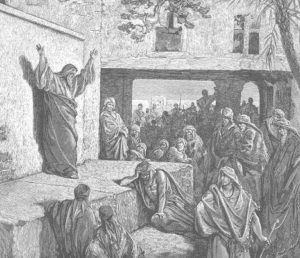
‘Micah Extorting the Israelites to Repentance’, by Gustave Doré

This is what the prophet Michah concluded when he, too, asked the same question as Moses did: “… And what does Hashem request of you? Only to act justly, and to love kindness, and to walk modestly with your God.” (Micah 6:8) Be just and treat everyone fairly; be kind and genuinely love to help others—and do it all humbly and modestly.

The Talmud (Shabbat 31a) takes a more literal approach, with Rava stating that God will ask each person six specific questions upon their death:

When man is led in for Judgment, he is asked: Did you deal faithfully? Did you fix times for learning? Did you engage in procreation? Did you hope for salvation? Did you engage in the dialectics of wisdom? Did you understand one thing from another?

The first question implies dealing honestly in business or in financial matters. Judaism has always taught the necessity of being scrupulously honest when it comes to money. The Kabbalists state that a person will be forced to reincarnate into this world if they so much as owe a single penny. They discuss how the value of shekel (שקל) is 430, equal to nefesh (נפש), “soul”, for each person’s material wealth is intricately tied to their spiritual nature. This is why giving money to charity can actually alter a person’s fate, as explained in the past. (See ‘How Charity Can Save Your Life’ in Garments of Light.)

Meanwhile, the Talmud holds that even though the Torah allows Jews to loan with interest to non-Jews, one shouldn’t charge interest from anyone, and a usurer might not even be a kosher witness in court (Sanhedrin 24b-25b). The same is true for someone who owes a lot of money. A person should not get themselves into great debt, and should ensure as much as possible that they will be able to repay a loan. This is why Rabbi Shimon, one of the five great students of Rabbi Yochanan ben Zakkai, held that the worst possible trait is that of a person who takes on debt and fails to repay (Avot 2:10). He bases himself on the words of King David: “The wicked man borrows and does not repay, but the righteous one is benevolent and gives.” (Psalms 37:21)

The wording of the Talmud is that a person will be asked if they took care of their finances b’emunah, “in faith”. Unfortunately, there are plenty of people who seem faithful, but engage in all kinds of financial tricks under the table. A person cannot be of great emunah if, at the same time, they cheat in financial matters, or are even a little bit dishonest with money. This includes gambling, stock market speculation, and all sorts of tax deceptions which have become so commonplace in our time.

Upholding Creation

The second question asked in the afterlife is whether a person set aside regular times to learn Torah. The Sages state that learning Torah is the most important mitzvah. Indeed, without learning Torah a person won’t know the right way to fulfil any mitzvah. The Torah is a “Tree of life for those who grasp it” (Proverbs 3:18), and the Sages quoted God stating: “I created the evil inclination, and I created the Torah as its antidote.” (Sifre Devarim 45) One who learns Torah is upholding the Covenant between God and Israel—since the Torah is the very text of that Covenant—and hence God states “If not for My covenant day and night, I would not have set the ordinances of Heaven and Earth.” (Jeremiah 33:25) God declares that He would not have created this universe were it not for His Torah—and His people upholding it day and night. (Some have therefore said that the world has time zones so that at any given moment, a Jew somewhere in the world is learning Torah.)

Similarly, the third question refers to procreation, for without it, too, humanity would cease to exist. More specifically, without Jewish procreation, there would be no Jews, and therefore no one to uphold that Covenant. The schools of Hillel and Shammai debated what it takes to fulfil the mitzvah of procreation (Yevamot 62a). According to Hillel, a person must have one boy and one girl, while according to Shammai, a person must have two boys and two girls. The reasoning of the latter is that Eve initially had four children: Cain, Abel, and the sisters each was born with. The first instance of pru u’rvu in the Torah resulted in two boys and two girls, so this is the standard for fulfilling the mitzvah.

However, the Talmud goes on to note another opinion that it was Shammai that taught one must have at least one boy and one girl, whereas Hillel taught that a person must simply have at least one child, whether boy or girl. The most lenient opinion, therefore, is that a person fulfils the mitzvah by having a single child, while the praiseworthy has at least two of each. A person who adopts a child or “raises an orphan” fulfils the mitzvah as well (Megillah 13a).

Of course, it isn’t enough just to have the kids. Parents need to invest their time and energy to ensure the children will be both righteous and successful. The Talmud (Kiddushin 29a) reminds us that, among other things, a parent is obligated to teach their child Torah, and also some kind of craft or career to ensure an honest livelihood. After all, “If there is no Torah, there is no flour; if there is no flour, there is no Torah.” (Avot 3:17) To raise children solely with Torah and assume a livelihood will come on its own, or to rely on the charity of others, is a gross sin. The Rambam (Hilkhot Talmud Torah 3:10) is particularly vocal about it:

Anyone who comes to the conclusion that he should involve himself in Torah study without doing work and derive his livelihood from charity, desecrates God’s Name, dishonors the Torah, extinguishes the light of faith, brings evil upon himself, and forfeits the life of the World to Come, for it is forbidden to derive benefit from the words of Torah in this world.

Our Sages declared: “Whoever benefits from the words of Torah forfeits his life in the world.” Also, they commanded and declared: “Do not make them a crown to magnify oneself, nor an axe to chop with.” Also, they commanded and declared: “Love work and despise rabbinic positions.” All Torah that is not accompanied by work will eventually be negated and lead to sin. Ultimately, such a person will steal from others.

Rabbi Moshe ben Maimon, the Rambam, aka. Maimonides, 1135-1204

Although the Rambam makes it clear that Torah study is of absolute importance, and should take precedence over one’s worldly occupation, he nonetheless reminds us that “the greatest sages of Israel were lumberjacks and water-drawers…” (ibid., 1:9) To be fair, there are other rabbinic authorities that allow for full-time Torah scholars who make learning their occupation, but this must only be for a minority of distinguished thinkers. It is certainly not a standard for everyone, for that would be completely unsustainable.

To get back to the third question, the Sages state that having children “hastens the Redemption”. There are a certain number of souls (in a Heavenly repository called “guf”) that must be born, and only when all of these souls have been born can Mashiach come. Thus, having children accelerates the time of Redemption.

This ties into the fourth question a person is asked: did they look forward to the Redemption? The wording is not if they waited for the Redemption, or hoped for it. Instead, whether they looked forward to it, suggesting a more active form. It isn’t enough to passively wait for the Redemption. Each person must do what they can to hasten it. This includes things like doing more acts of kindness and showing ahavat chinam, expressing baseless, non-judgemental love for all fellow Jews (Yoma 9b); engaging in kiruv; and, of course, repenting wholeheartedly (Sanhedrin 97b). Each person has to continue working on themselves to be ever-more righteous. Increasing one’s charitable donations hastens the Redemption, too (Isaiah 1:27 and Bava Batra 10a).

Garment for the Soul

The final two questions deal with one’s knowledge and understanding. It isn’t enough to engage in light learning here and there. A person must be steeped in dialectics (pilpul) and understand the depths of one thing from another (davar mitokh davar). The Arizal taught that a person must learn Torah on all four of its levels; pshat (simple), remez (sub-textual), drash (metaphorical), and sod (secret). These levels are collectively known by the acronym pardes, “orchard”—a word that is also the origin of the English “paradise”. One who doesn’t learn Torah on all four levels has not fulfilled the mitzvah of Torah study and will return in a reincarnation to do so (Sha’ar HaGilgulim, 16).

The Arizal also taught that Torah study not only strengthens a person spiritually, but literally creates a “garment” for the soul to be worn in the World to Come (Sha’ar HaPesukim, Tehillim). This is the meaning of the verse “The Torah of Hashem is perfect, it restores the soul” (Psalms 19:8). Meanwhile, the power of Torah study is so great that it creates angels, and these angels could eventually communicate with the student and bestow Ruach HaKodesh, divine inspiration, upon them (Sha’ar Ruach HaKodesh, 1).

The Talmud specifies that one should spend a third of their time studying Tanakh, then a third studying Mishnah, and a third studying Gemara (Kiddushin 30a). This was at a time when no other texts were available, so one should probably make another “third” for the many other areas of Jewish study we have today, including halachic and midrashic literature, mussar, hashkafa, various responsas and commentaries, as well as Kabbalah. The Arizal divided up his Torah study routine as follows (Sha’ar HaMitzvot, Va’etchanan):

First, he would read the weekly Torah portion. On Sunday, he would focus on the first six verses. On Monday, the next four. On Tuesday, the next five, and on Wednesday the next six. Another five on Thursday, making a total of 26 verses, and then the whole parasha on Friday. This was done in the traditional manner, shnaim mikra v’echad targum—reading each verse twice in Hebrew, and once in Aramaic.

Next, he would study a portion of Nevi’im, the Prophets, followed by Ketuvim, the other Holy Writings that make up the Tanakh. This, too, was done with shnaim mikra and a targum. The Arizal then studied the Mishnah, followed by Gemara, together with the various commentaries. Finally, he engaged in Kabbalah.

Yirat Hashem

Rava derived the six questions above from Isaiah 33:6, where the prophet declares, “And there shall be faith in your times; strength, salvation, wisdom and knowledge…” Faith refers to the first question regarding faithful business, times refers to the second question of setting times for Torah-learning, strength to procreation, salvation to the Redemption, wisdom and knowledge to the last two questions.

The Isaiah verse concludes with “… the fear of Hashem is His treasure.” One’s rewards (treasure) in the afterlife are contingent upon these six questions. Yet, what unifies them all is yirat Hashem, “fear” or “awe” of God.

One who is truly God-fearing will undoubtedly be scrupulously honest with financial matters, and strive to hasten the Redemption. It is doubtful that a Jew can be truly God-fearing without constantly meditating upon Torah and understanding its depths. Thus, complete yirat Hashem encompasses all of these things. Conversely, a person who does not live these ideals is probably not as God-fearing or faithful as they might believe themselves to be.

The Spiritual Significance of Israel Turning 70

This week we commemorate Yom Ha’Atzmaut, the State of Israel’s Independence Day, marking seventy years since its founding. Although the State is certainly far from perfect, its establishment and continued existence is without a doubt one of the greatest developments in Jewish history. Many have seen it as the first steps towards the final redemption, and even among Haredi rabbis (which are generally opposed to the secular State) there were those who bravely admitted Israel’s significance and validity. Rav Shlomo Zalman Auerbach (1910-1995), for example, considered the State as Malkhut Israel, a valid Jewish “kingdom”—at least for halakhic purposes—while the recently deceased Rav Shteinman unceasingly supported the Nachal Haredi religious IDF unit despite the great deal of controversy it brought him. Rav Ovadia Yosef permitted saying Hallel without a blessing on Yom Ha’Atzmaut, and some have even composed an Al HaNissim text to be recited. While we have already written in the past about the significance of the State’s founding (along with one perspective to bridge together the secular and the religious on this issue), there is something particularly special about Israel’s 70th birthday.
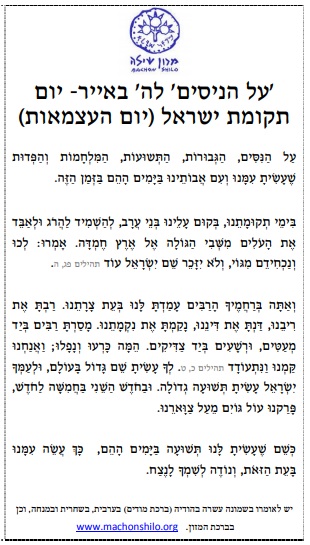
Al HaNissim for the Amidah and Birkat HaMazon provided by Rav David Bar-Hayim of Machon Shilo

The number 70 holds tremendous significance in Judaism. It is the number of root languages and root nations in the world (with Israel traditionally described as “a sheep among seventy wolves”). It is the number of Jacob’s family that descended to Egypt and from whom sprung up the entire nation. The number of elders that assisted Moses, and parallel to them the number of sages that sat on the Sanhedrin. Although Moses lived 120 years, he wrote in his psalm that 70 years is considered a complete lifespan (Psalms 90:10), and King David, who put the final edit on that psalm and incorporated it into his book, lived precisely 70 years. As is well-known, David was granted those 70 years by Adam, which is why the Torah says Adam lived 930 years instead of the expected 1000 years. (See here for how he may have been able to live so long.)

The Arizal taught that Adam (אדם) stands for Adam, David, and Mashiach, for the final redeemer is both a reflection of the first man, and the scion of David. More amazingly, as we wrote earlier this year it is said that David is literally the middle-point in history between Adam and Mashiach, and as such, if one counts the years elapsed between Adam and David then it is possible to find the start of the messianic era—which just happens to be our current year 5778. In this year, the State of Israel itself turns 70, and our Sages speak of “seventy cries of the soul during labour”, and parallel to these, “seventy cries of the birthpangs of Mashiach”. It is possible to interpret these seventy birthpangs preceding the arrival of the messiah as the seventy years leading up to the redemption. Thus, Israel’s seventy years potentially bear great significance.

Just as Psalms says that seventy years is one complete lifespan, for the State of Israel these past seventy years can be likened to the end of one “lifetime”, with Israel now standing at the cusp of a new era. Indeed, with all that has happened in the Middle East in recent years and months, Israel has undoubtedly emerged stronger and more secure than ever before. In this seventieth year, the world has begun to recognize Israel’s permanence, and affirm its unwavering right to Jerusalem the Eternal. We see more and more nations formally recognizing Jerusalem as Israel’s rightful capital, and the United States plans to open its new Jerusalem embassy on May 14, which is Yom Ha’Atzmaut according to the secular calendar.

These seemingly disparate points—David’s seventy years, the completion of Israel’s first seventy year lifespan, and the recognition of Jerusalem—are actually intricately connected, for it was King David who established the first official, unified, Jewish state in the Holy Land, with Jerusalem as its capital. In fact, David’s kingdom was the only fully independent, unified Jewish state until the modern State of Israel! (Other Jewish entities, including the Maccabean and Herodian, were essentially always vassals to some greater power like Greece or Rome.) It is therefore quite fitting that the State of Israel has the Star of David on its flag, and it is this Davidic symbol that has become emblematic of not just Israel itself but all of modern Judaism.*

Living Prophecy

Perhaps the most famous seventy in Scripture is the seventy year period of exile in Babylon, between the First and Second Temples. It is said that God decreed a seventy year exile in particular because Israel failed to keep seventy Sabbatical and Jubilee years between the settling of Israel under Joshua and the destruction of the First Temple. While the Exile was certainly a “punishment”, we know that God never truly “punishes” Israel, and out of each devastation (which is nothing more than a just measure-for-measure retribution) emerges something greater.

As we’ve written before, it is in Babylon that the vibrant Judaism that we know was born. (See ‘The First Jewish Holiday’ in Garments of Light.)  Unable to journey to the Temple, the Sages reworked each holiday to become more than a pilgrimage; unable to offer sacrifices, the Sages established prayers instead, “paying the cows with our lips” (Hosea 14:3); unable to fulfil the many agricultural laws, the Sages taught that learning the laws was as good as observing them. The Judaism of study, prayer, and mysticism was born out of the difficulty of the seventy-year Babylonian Exile. These past seventy years for Israel—also of great difficulty, and coming on the heels of another great devastation—was similarly one where Judaism has evolved considerably, and instead of dying out as some feared, has actually flourished.

Many have pointed out another modern “Babylonian Exile”, too. This is the communist regime of the Soviet Union, where millions of Jews were trapped for some seventy years. (The officially accepted start and end dates for the USSR are December 30, 1922 to December 26, 1991.) The histories of Russia and Israel are tightly bound, for many of Israel’s founders came directly from the Russian Empire, including Ze’ev Jabotinsky, Golda Meir, and the Netanyahus. Some even argue that the severe persecution by the Russians—unrivaled until the Nazis—is what gave the greatest motivation for the founding of Israel. The Kishinev Pogrom of 1903 was the final straw for the Zionists. The description of that pogrom by Bialik (another Russian Jew, and later Israel’s national poet) aroused the masses to take up the call and make aliyah, and convinced many more of the necessity of an independent Jewish state.

Russia’s involvement is all the more significant when we consider the possibility of Moscow as the prophesied “Third Rome”. As explored in the past, the “Red Army” headquartered in Moscow’s Red Square brings to mind the villainous Edom. Just as Rabbi Yose ben Kisma taught long ago in the Talmud (Sanhedrin 98a-b) that Mashiach will come when Rome/Edom falls for the third time, and there will not be a fourth, the Russian monk Filofey of Pskov (1465-1542) wrote of Moscow that “Two Romes have fallen, the third stands, and there will be no fourth.” This is all the more interesting in light of what we see in the news today about the growing conflict between the West and the Russia-Syria-Iran axis. It is important to keep in mind that Iran (Paras or Persia) is explicitly mentioned in Ezekiel’s prophecy of the great wars of the End of Days, the wars referred to as Gog u’Magog. The Midrash (Yalkut Shimoni on Isaiah 60, siman 499) comments on this that

In the year that Mashiach will be revealed, all the kings of the nations of the world will provoke each other. The king of Persia will threaten the king of Arabia, and the king of Arabia will go to Aram for advice. The king of Persia will then destroy the world, and all the nations will tremble and fall upon their faces, and they will be grasped by birthpangs like the birthpangs of labour, and Israel, too, will tremble and falter, and they will ask: “Where will we go?” And [God] will answer: “My children, do not fear, for all that I have done, I have done for you… the time of your salvation has come.”

Those who follow geopolitics will immediately identify this midrashic passage with current events. The war in Syria is very much a proxy war between Saudi Arabia and Iran, just as is the war currently raging in Yemen. Saudi Arabia has joined the Western (Aram?) camp, and has even begun to speak positively of Israel in public. The prophet Jeremiah (49:27) further details that Syria will be the epicenter of the war, and the “end” will come when Damascus has fallen. Amazingly, Jeremiah calls the king of Damascus Ben Hadad (בן הדד), the gematria of which happens to equal Assad (אסד). And it also happens that the value of Gog u’Magog (גוג ומגוג) is 70.

Top right: Arab Coalition forces led by Saudi Arabia (and backed by the US, UK, and France) fighting in Yemen to defeat Iran-backed Houthi rebels. Bottom right: Today in the news we read about Saudi Arabia considering sending ground forces into Syria, where Iranian Revolutionary Guards are deeply entrenched. Some say Saudi Arabia secretly has forces in Syria already. It is highly likely that there are Russian and American paramilitary groups in Syria as well. Turkish and Israeli forces are heavily involved, too, and the US, UK, and France recently launched a missile strike on Syrian facilities.

Thus, Israel turning 70 carries remarkable symbolic meaning. The Midrash states that Israel has 70 names, and these correspond to the 70 names of the Torah (and the Torah’s 70 layers of meaning, to be revealed in full with Mashiach’s coming), as well as the 70 Names of God, and the 70 names for the holy city of Jerusalem. The last of these names, the Midrash says (based on Isaiah 62:2), is “a new name that God will reveal in the End of Days.” The struggle over Jerusalem and the Holy Land will soon end, with a new city and a new name to be reborn in its place.

May we merit to see it soon.

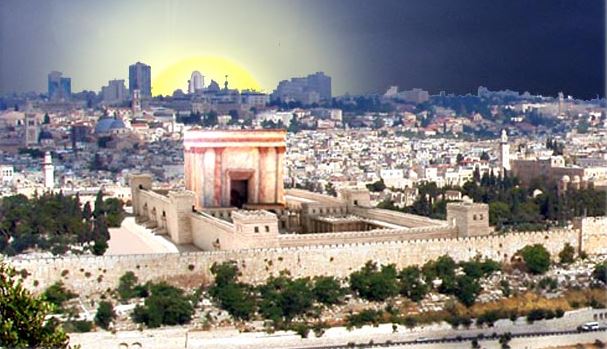
Courtesy: Temple Institute

*Judaism began with Abraham. In an amazing “coincidence” of numbers, Jewish tradition holds that Abraham was born in the Hebrew year 1948. The State of Israel was, of course, born in the secular year 1948. Jewish tradition also holds that Abraham was 70 years old at the “Covenant Between the Parts”, when God officially appointed Abraham as His chosen one. This means the Covenant took place in the Jewish year 2018, paralleling Israel’s 70th birthday in this secular year of 2018.

Should You Wear a Red String on Your Wrist?

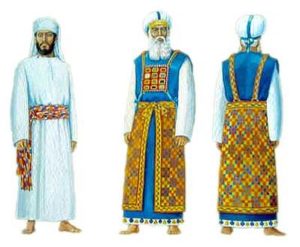
Vestments of the kohen and kohen gadol

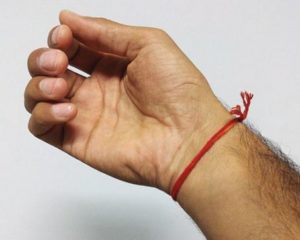
This week’s parasha, Tetzave, continues to outline the items necessary for the Mishkan, or Tabernacle, starting with the Menorah and going into a detailed description of the priestly vestments. One of the materials necessary for the holy garments is tola’at shani, commonly translated as “crimson wool”. This was a deep red fabric apparently derived from some kind of insect or worm (which is what the Hebrew “tola’at” means). The Torah speaks of this material in multiple places and in multiple contexts. Today, wearing a “tola’at shani”-like red string on the wrist has become very popular among those calling themselves “Kabbalists” and even by secular Jews and non-Jews. What is the significance of the red fibre, and is there any real spiritual meaning to the red string bracelet?

The First Red String

The earliest mention of a red string is in Genesis 38:27-30, where Tamar gives birth to her twin sons Peretz and Zerach:

And it came to pass in the time of her labour that, behold, twins were in her womb. And in her labour, one hand emerged, and the midwife took a red string [shani] and tied it to his hand saying, “This one came out first.” And he drew back his hand, and behold, his brother came out, and she said: “With what strength have you breached [paratz] yourself?” so his name was called Peretz. And afterward came out his brother that had the red string upon his hand, and his name was called Zerach.

Here, the red string is simply used to designate the firstborn. It didn’t work out as planned, for the other twin ended up coming first. The strong Peretz would go on to be the forefather of King David, and therefore Mashiach, who is sometimes called Ben Partzi. Clearly, wearing the red string wasn’t much of an effective charm for Zerach.

Temple Rituals

In addition to being used in the garments of the priests and various Temple vessels, tola’at shani was employed in a number of sacrificial rituals. In Leviticus 14 we read how someone who had healed from tzara’at, loosely translated as “leprosy”, would bring an offering of two birds which were dipped in a mixture containing the red dye. From this we see that tola’at shani (or shni tola’at, as it appears here) is not necessarily the string itself, but simply the red dye extracted from the insect. Similarly, the red dye was used in the preparation of the parah adumah, “Red Cow”, mixture (Numbers 19) which was used to purify the nation from the impurity of death.

The Talmud (Yoma 67a) describes how a red string was tied to the scapegoat on Yom Kippur. Recall that on Yom Kippur two goats were selected, one being slaughtered and the other being sent off into the wilderness, “to Azazel”. This “scapegoat” had a red string attached to it, and if the string turned white the people would know that their sins had been forgiven, as Isaiah 1:18 states: “…though your sins be as scarlet, they shall be as white as snow; though they be red like crimson, they shall be as wool.” Here, then, the red string represents the sin of the people, bound to the scapegoat going to Azazel. If it turned white, it was a good sign, whereas if the string remained red it meant God was unhappy with the nation. Indeed, the Talmud (Yoma 39b) states that in the last forty years before the Second Temple was destroyed, the red string never once turned white.

Red in Kabbalah

In mystical texts, red is typically the colour of Gevurah or Din, severity and judgement. It was therefore generally discouraged to wear red. The Kabbalists often wore garments of all white, and this is still the custom during the High Holidays, a time of particularly great judgement. It was only centuries later that the Chassidic rebbe known as Minchat Eliezer (Rabbi Chaim Elazar Spira of Munkacz, 1868-1937) wrote how having a red cloth may serve to ward off judgement and severity. Another Chassidic rebbe, the Be’er Moshe (Rabbi Moshe Stern of Debreczin, 1890-1971) wrote that he remembered seeing people wear red strings as a child, but did not know why. Still, this does not appear to have been a very popular practice then, nor is it much of a custom among Chassidim now.

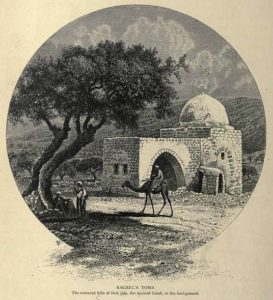
1880 Illustration of Rachel’s Tomb

Rather, the red string today has been popularized by The Kabbalah Centre and similar “neo-Kabbalah” movements that cater as much to non-Jews as to secular Jews. The Kabbalah Centre explains that the bracelets are made by taking a long red thread and winding it around Rachel’s Tomb seven times. The thread is then cut into wrist-size lengths, and if worn on the “left wrist, we can receive a vital connection to the protective energies surrounding the tomb of Rachel.” It is not clear where The Kabbalah Centre took this practice from. They claim that the red string wards off the evil eye. While they cite certain passages from the Zohar regarding the evil eye, there doesn’t seem to be any connection to a red string specifically.

The Zohar (II, 139a) does state in one place that the blue tekhelet represents God’s Throne, as is well-known, which means judgement, whereas the red shani is what emerges from the Throne and overpowers the judgement, thus bringing protection upon Israel. The Zohar relates shani to Michael, the guardian angel of Israel, and uses the metaphor of a worm eating through everything to explain the tola’at shani as eating up negative judgement. This is why the famous song Eshet Chayil (Proverbs 31) states that a “woman of valour” has her whole house dressed in shanim (v. 21). She guards her household in this way. (It should be noted that in this passage the Zohar states it is gold which represents Gevurah, and silver represents Chessed. White and red, meanwhile, appear to be aspects within the sefirah of Yesod.)

So, perhaps there is something to wearing a red string.

Bringing Back Shani

The Zohar does not speak of any red string at all, and instead explains the mystical power of the red dye called shani. It is the dye itself that has power, as we see from the Temple rituals noted above. It is well-known that the blue tekhelet dye comes from a certain mollusc or sea snail called chilazon. From where does shani come?

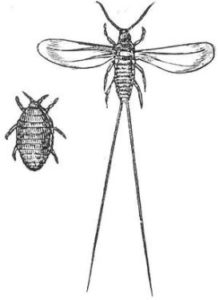
A female and male cochineal bug.

Professor Zohar Amar of Bar Ilan University researched the subject in depth and concluded that tola’at shani is similar to the cochineal insect, famous for producing the red dye carmine (E120) which is extensively used in the food industry. After a round-the-world search, it turned out that a cochineal-like insect is found in Israel as well, and grows on oak trees.

While the cochineal insect is native to South America (where most of the carmine is still produced), its Mediterranean cousin is the oak-dwelling kermes insect. Indeed, kermes was used across the Mediterranean world for millennia, being particularly prized in Greek, Roman, and medieval society. It is best known for its ability to dye wool extremely well. Jerusalem’s Temple Institute was convinced of the professor’s findings, and has begun harvesting the bugs and their red dye in order to produce authentic priestly vestments, as outlined in the Torah.

In light of this, a genuine red string “kabbalah” bracelet—with the protective powers mentioned in the Zohar—would undoubtedly have to be made of wool dyed with kermes red. And according to the Zohar, it probably shouldn’t be worn on the left wrist at all, but instead on the right leg, the body part which the Zohar (II, 148a) states that shani corresponds to.

Imitating Pagans

Judaism is very sensitive about not imitating the ways of the pagans, or darkei Emori. One example of this, as we wrote in the past, is kapparot, which the Ramban (among others) called an idolatrous practice. The Tosefta (Shabbat, ch. 7) has a list of practices that are considered darkei Emori, and one of them is “tying a red string on one’s finger”. So, already two millennia ago it seems there were Jews tying red strings on their body, and the Tosefta (which is essentially equivalent to the Mishnah) forbids it.

The Hindu kalava looks suspiciously similar to the “kabbalah” red string.

In fact, Hinduism has a custom to wear a red string called kalava around one’s wrist in order to ward off evil. This is precisely what The Kabbalah Centre claims their red string accomplishes. Based on this alone it would be best to avoid wearing such a red string. The Lubavitcher Rebbe was one of the recent authorities who stated that the red string should not be worn due to darkei Emori. Factoring in that the red string has no basis in the Zohar or any traditional Jewish mystical text is all the more reason to stay away from this practice.


The above is an excerpt from Garments of Light, Volume Two. Get the book here