Category Archives: Jewish Law & Life Cycle

How the Priestly Garments Atoned for the People

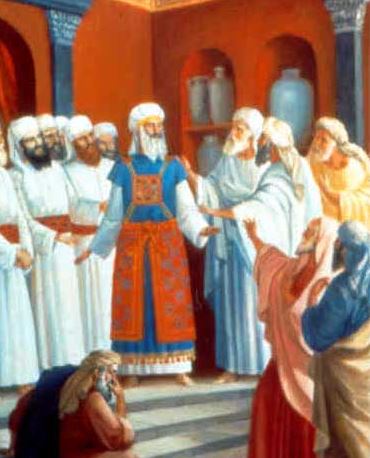
Priests in the Temple (Courtesy: Temple Institute)

This week’s parasha, Pekudei, describes how the Mishkan and all of its vessels were created, together with the special priestly garments. The parasha ends with the formal initiation of Aaron and his sons into the priesthood through their ritual purification, anointment, and donning of the sacred vestments. Our Sages famously state (Zevachim 88b) that the vestments of the Kohen Gadol, the High Priest, atoned for the sins of the people:

The tunic atoned for bloodshed… the breeches atoned for lewdness… the turban made atonement for arrogance… the belt atoned for [impure] meditations of the heart… the breastplate atoned for neglect of civil laws… the apron atoned for idolatry… the cloak atoned for slander… and the crown, worn on the forehead, atoned for brazenness.

The tunic (kutonet) was a simple white garment worn over the body which all of the priests (not only the High Priest) wore. The Talmud says it atoned for bloodshed, and proves it through a gzerah shavah, a form of interpretation where the exact same word (or root of a word) appears in two different contexts, thus allowing a connection between the two to be made. In Genesis 37:31 we read how, following the sale of Joseph, his brothers slaughtered a goat and dipped Joseph’s special robe in the goat’s blood. They used the bloodied robe as proof to show their father Jacob that Joseph had been murdered or devoured by an animal. The word used for Joseph’s robe is kutonet, too, that same word used for the Kohen’s garment. From this we can learn that the kutonet atoned for bloodshed.

The breeches (michnasei bad) were white pants worn to cover up the lower half of the body, and atoned for sexual immorality. The Talmud proves it from an explicit verse in the Torah (Exodus 28:42) where God commanded that the pants be made “to cover up the flesh of their nakedness”. The Hebrew term here is precisely the one used to denote sexual indecency (‘ervah, or gilui arayot).

The white turban (mitznefet) atones for arrogance. Rabbi Hanina explains here that the turban was worn on the head at the very top of the body, and thus atoned for people who similarly put themselves “at the head” above other people.

The last of the four garments worn by the regular priest is the avnet, a sash or belt. Made of red, blue, and purple wool, it was the only multi-coloured garment worn by the regular priest. It atoned for impure thoughts, and the Talmud says we know this from the fact that the sash was worn tied around the heart. Contrary to what we may expect, this was not a belt to hold up the pants, but rather an independent garment wrapped around the upper body.

In Jewish thought, the heart is the seat of the yetzer hara, the evil inclination, which tries to make a person sin by throwing improper thoughts into their head. The heart is also the seat of the yetzer hatov, the good inclination. These two opposing forces both reside in one’s heart. Because of this, the term for “heart” used in the daily Shema is levavecha, and not the more grammatically consistent libecha. The former has an extra letter beit, the doubled language alluding to the two inclinations in the heart.

Our Sages teach that one should always keep their mind above their heart, in full control of their inclinations. The brain should dominate the heart, and the heart should dominate the liver. The Hebrew word for liver, kaved (כבד), is directly related to kavod (כבוד), “honour”. Thus, the liver is the source of pride and arrogance. These organs are arranged physiologically in the body the way they are to teach us a lesson: the brain (or intellect) should be on top, then the emotions of the heart below it, and the ego at the very bottom.

If one accomplishes this, with their brain, moach (מוח) in Hebrew, being above their heart, lev (לב), and their heart being above their liver, kaved (כבד)—then they become a melekh (מלך), “king”. If the letters are reversed, where one’s honour trumps their emotions, which in turn overrule their reasoning, then they are klum (כלם), “nothing”.

The Four Garments of the High Priest
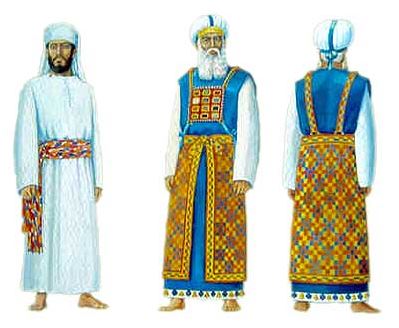
Garments of the regular priest and the high priest (Courtesy: Temple Institute)

The High Priest wore an additional four unique garments. On his forehead was the golden plate known as the tzitz, which atoned for brazenness. This is proven by another gzerah shavah between Exodus 28:38, which commands the priest to wear the plate upon his metzach, “forehead”, and Jeremiah 3:3 which speaks of the brazen “forehead” (again metzach) of a licentious woman.

On top of the regular white tunic, the High Priest wore a meil, a “coat” made entirely of fine blue (tekhelet) wool. The coat atoned for lashon hara, evil speech. Since the Torah states that the coat had bells along its bottom, which jingled as the Kohen walked, Rabbi Hanina explains: “Let an article of sound come and atone for an offence of sound.”

Rav Yitzchak Ginsburgh points out that the term for bell, pa’amon (פעמן) refers to something that resonates, and the same root is used, for example, in describing how the Spirit of God resonated within—l’fa’amo (לפעמו)—the Biblical judge Samson (Judges 13:25). Rav Ginsburgh beautifully notes how the gematria of “Spirit of God” (רוח ה׳) is 240, equal to that of pa’amon (פעמן). It is also equal to meil ha’ephod (מעיל האפד), the full title of the garment, as in Exodus 29:5 or 39:22. He concludes that if one wishes to have the Spirit of God rest upon them, the key is to refrain from any evil speech.

The ephod, or apron, atoned for idolatry. This is derived from Hosea 3:4: “For the children of Israel shall sit solitary many days without king, and without prince, and without sacrifice, and without pillar, and without ephod or teraphim.” The verse is taken to mean that where there is no ephod, there will be teraphim—various implements of idol worship. The word “teraphim” appears multiple times in the Tanakh (as in Genesis 31:19 and Judges 17:5), nearly always in relation to idolatry.

Upon the ephod was the famous choshen, the breastplate that, according to tradition, allowed for communication with the Heavens. The breastplate atoned for violations of dinin, civil law. We know this from the fact that the Torah calls the breastplate choshen mishpat (Exodus 28:15), literally “breastplate of judgement”, with the term mishpat typically referring to court cases and civil law (whereas chukim and edot refer to religious-based, historical, or ritual laws).

In this way, even the very clothes of the Kohen helped him fulfill his main duty of bringing atonement for the people. Yet, in the past two thousand years, there has been no Temple and no priestly service. Might there be something in its stead?

Every Jew is a Priest

When the Temple was destroyed, our Sages instituted a number of practices in place of those Temple rituals. They declared that “as long as the Temple stood, the altar atoned for Israel, but now a man’s table atones for him” (Berakhot 55a). Just as the priests would wash their hands in a special basin before starting their services (and before eating terumah), the Rabbis instituted netilat yadayim, the ritual washing of the hands before starting a meal. Just as the sacrificial meat was required to be brought with salt, it became customary to dip the bread in salt before eating it. In place of the Temple menorah we have the Chanukah menorah, and in place of the Temple showbread we have two challahs, each traditionally braided with six strands to represent the twelve loaves once displayed in the Temple.

In many ways, the Talmudic sages and rabbis saw themselves filling the role once held by the ancient priests. More importantly, they taught that every righteous Jew should see himself as a priest. After all, God intended for all of Israel to be a “kingdom of priests and a holy nation” (Exodus 19:6). In fact, many commentaries agree that it is only because of the Golden Calf incident that the tribe of Levi was appointed to take over the priesthood. Were it not for that tragedy, every firstborn male would be a priest, and any other Jewish male could voluntarily enter the priesthood. To this effect, the Talmud (Bava Kamma 38a) goes so far as to state that “even a non-Jew who occupies himself with Torah is comparable to the High Priest.” A person who lives in Torah and refines himself to the highest degree is likened to the greatest of priests, at least in a spiritual sense.

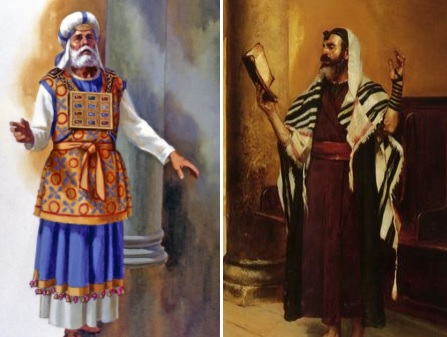
In a wonderful affirmation of this, we see that every Torah-observing Jewish man is wearing “holy garments” that parallel the priestly vestments. Everyone generally wears a shirt and pants with a belt, along with their head-covering, corresponding to the four vestments of the regular priest (kutonet, michnasei bad, avnet, mitznefet). And there are four additional special items that a Jew wears that parallel those unique garments of the High Priest:

The “bells” along the hem of the tallit.

The tzitz headplate worn on the top of the forehead is like the head tefillin worn “between the eyes”, while the choshen breastplate worn over the heart is like the arm tefillin which is supposed to be worn in line with the heart. The ephod that was worn over the shoulders and stretched down below the waist is like the tzitzit katan garment worn over the shoulders with its fringes hanging down below the waist. The woolen tallit with which we wrap ourselves, with its customary blue stripes to remember tekhelet, is like the special blue meil that was made of fine tekhelet wool. And just as the meil had pa’amonim bells along its hem, the tallit, too, customarily has bell-like knots along its hem.

In this way, every Jew has the ability to elevate to a priest-like status, especially in lieu of a Temple, and in light of the Torah’s statement that all of Israel is a “nation of priests” (Exodus 19:6). Each Jew can bring about atonement, not only for himself but for his people as a whole, and each Jew can spread evermore divine light into the world.
Wasting Seed: Minor Taboo or Grave Sin?

In this week’s parasha, Vayeshev, we read about the incident of Yehuda and Tamar. Yehuda’s eldest son, Er, marries a beautiful woman named Tamar. Unfortunately, Er “was evil in the eyes of God, and God put him to death.” (Genesis 38:7) As was customary in those days, since Er died without a son, it was expected that his brother, Onan, would perform levirate marriage and take Tamar as his wife. As the Torah describes, the purpose of this is to essentially provide a sort of heir for his childless brother. Onan was happy to marry Tamar, but

knew that the progeny would not be his, and it came about, when he came to his brother’s wife, he wasted [his semen] on the ground, in order not to give seed to his brother. And what he did was evil in the eyes of God, and He put him to death also. (Genesis 38:9-10)

As we know, Yehuda would end up being with Tamar himself, and out of that union would come Peretz, the ancestor of King David.

‘Judah and Tamar’

The big question is: what was it that Er and Onan did that was so despicable to God? The classic answer is that they wasted their seed (as the Torah states above), which is why they were punished so severely. This narrative is then used as proof from the Torah that wasting seed is among the gravest of prohibitions.

And yet, the Torah itself does not actually prohibit wasting seed anywhere, at least not explicitly. Considering how strictly the Sages spoke about not wasting seed, we might be surprised to find that it is not one of the 613 commandments. So, what is the true extent of this prohibition? Where did it come from? And what was really going on with Er and Onan?

A Closer Look at Er and Onan

While the Torah tells us that Er was evil in God’s eyes, it does not explain why. Many commentators (including Rashi and Rabbeinu Bechaye) assume that he must have been evil for the same reason his brother Onan was: for wasting seed. Rabbeinu Bechaye (1255-1340) clarifies that the sin was not the act of wasting seed itself, but rather for an ulterior motive. Er did not want to impregnate Tamar so that her beauty would not be ruined. He wanted her solely for physical pleasure. This is what was despicable to God.

Similarly, a careful look at the Torah makes it clear that Onan’s sin was not wasting seed either. What the Torah says is that Onan did not want to fulfil the mitzvah of levirate marriage. He avoided impregnating Tamar because he “knew the progeny would not be his”, and the reason he spilled his seed on the ground was “in order not to give seed to his brother”. The sin here was not the act of wasting seed, but rather disrespecting his own brother, and refusing to fulfil the mitzvah of levirate marriage.

Such is the opinion of Tzror haMor (Rabbi Abraham Saba, 1440-1508), and we see similar comments by Sforno (Rabbi Ovadiah ben Yakov, 1475-1550). Chizkuni (Rabbi Hezekiah ben Manoach, c. 1250-1310) goes even further, saying that Onan was really out to increase his share of land, for if he would have fulfilled the mitzvah, the child would receive Er’s portion of land, and if not, then Onan would be the inheritor. From these commentaries, and the Torah’s own simple reading, we can definitively conclude that the sin was not the wasting of seed itself but the evil ulterior motives behind it, especially greed and disrespect for a brother.

All of this is right in line with the Torah’s persistent theme of brothers failing to love each other, starting with Cain and Abel and continuing through Isaac and Ishmael, Jacob and Esau, Joseph and his brothers, and Yehuda’s sons. The Torah takes every possible opportunity to remind us to love each other wholeheartedly (as we are all brothers), and that tragedies always befall the Jewish people when we lack brotherly love—as our Sages explicitly state countless times.

Going back to the subject at hand, nowhere else in the Torah is wasting seed an issue. The Torah does state that a man who has an “emission” is impure for purposes of going to the Temple. What he must do is immerse in water, and wait until the evening for the impurity to go away (Leviticus 15:16). No other punishment is prescribed, irrespective of why the man might have the emission.

Spilling Seed, or Spilling Blood?

It is in the Talmud where wasting seed takes on its grave overtones. The Sages compare one who wastes seed to a murderer, an idolater, and an adulterer (Niddah 13a-b). This is quite shocking, considering that murder, idolatry, and adultery are the three “cardinal sins” of Judaism. These are the things one must give up their life for in order to avoid, even if coerced. The Sages are equating wasting seed with the worst possible sins.

In the same pages, we read how Rav Yochanan holds that one who wastes seed “deserves death”. Interestingly, he bases himself on the verses in the Torah concerning the deaths of Er and Onan! Yet, as we’ve seen, their sin was not the act of wasting seed, but their evil ulterior motives. In reality, the Sages are hard-pressed to find a good source for the prohibition. They resort to various colourful interpretations of Scriptural verses in an attempt to illustrate the evils of wasting seed. For example, Isaiah 1:15 says “And when you spread forth your hands, I will hide My eyes from you; when you make many prayers, I will not hear, [because] your hands are full of blood.” Rabbi Elazar says that “hands are full of blood” is referring to those who masturbate, since spilling seed is like spilling blood! This is far from the plain meaning of the verse, which is obviously talking about actual bloodshed.

We should keep in mind that in these Talmudic pages, the Sages are not just prohibiting masturbation or wasting seed, but even for a man to simply touch their “member”—even to urinate! “Rabbi Eliezer said: Whoever holds his member when he urinates is as though he had brought a flood on the world.” Rabbi Tarfon later adds that his hand should be cut off! It goes without saying that the Sages were exceedingly careful to avoid any sexual transgressions, and raised many “fences” to ensure that no one should even come close to sinning so gravely. We must remember that the Talmud often uses hyperbole to get a point across and it isn’t always wise to take statements literally. The Sages themselves question Rabbi Eliezer, and say that not holding one’s member would be very impractical, for “would not the spray splatter on his feet…?”

The point, rather, is to teach us that “such is the art of the evil inclination: Today it incites man to do one wrong thing, and tomorrow it incites him to worship idols and he proceeds to worship them.” (Niddah 13b) The Sages are specifically referring to one who fantasizes to “give himself an erection”, and that such a person “should be expelled”. After all, the yetzer hara works in such a way that it gets a person to make a tiny sin, and slowly leads them to greater transgressions. It might start with a small thought, grow into a consuming fantasy, and eventually leads one to grossly misbehave. In short, the fear is that a person will get accustomed to bad habits, and it will end up leading to more severe transgressions.

Halacha & Kabbalah of Spilling Seed

The Rambam (Rabbi Moshe ben Maimon, 1135-1204) codifies as law the prohibition of wasting seed, whether with one’s partner or on their own (Mishneh Torah, Issurei Biah 21:18):

It is forbidden to release semen wastefully. Therefore a person should not enter his wife and release outside of her… Those who release semen with their hands, beyond the fact that they commit a great transgression, a person who does this will abide under a ban of ostracism. Concerning them, it is said: “Your hands are filled with blood.” It is as if they killed a person.

The Rambam makes a distinction between a situation of husband and wife versus a man doing it on his own, which is far worse and likened to “murder”. Having said that, many other great authorities in Jewish law were more lenient when it comes to wasting seed, especially when the intention is not evil. The Rambam’s contemporary, Rabbi Yehuda haHasid (1150-1217), wrote in his Sefer Hasidim that while masturbation is forbidden, and requires a great deal of penance to repair, it is occasionally permitted if it will prevent a person from a more serious sin. On that note, the Rambam himself wrote elsewhere (Commentary on the Mishnah, Sanhedrin 7:4) that wasting seed is not an explicit Torah prohibition, and carries no actual punishment of any kind. However, he writes in the same place that although many things are permitted when done consensually between husband and wife, it is nonetheless important to be exceedingly modest when it comes to sexuality.

The later Kabbalists understood that the Torah carries no explicit punishment for wasting seed, but found an allusion to a more mystical punishment. They taught that wasting seed produces banim shovavim, literally “wayward children” (a term that comes from Jeremiah 3:14 and 3:22). These impure spirits—potential souls that are brought into this world without a body—attach to a man’s neck and cause him great damage, and can harm his children, too. There is no doubt that the Rambam, being a strict rationalist and staying away from anything “Kabbalistic”, would disagree with this approach. The Rambam did not believe in demons or evil spirits, and refused to accept the validity of many Kabbalistic ideas and practices.

The Arizal (Rabbi Isaac Luria, 1534-1572), perhaps the greatest of Kabbalists, was a major proponent of the banim shovavim notion. Since his time, it has become customary in some communities to focus on purifying from sexual sins and from wasted seed during the weeks when we read the consecutive parashas of Shemot, Va’era, Bo, Beshalach, Yitro, and Mishpatim. Since the initials of these parashas spell “shovavim”, it is thought to be an auspicious time for such repentance. Yet even the Arizal taught that wasting seed is primarily a problem when a person does so on their own, for selfish, lustful reasons. If one is married, and there is genuine loving intimacy between husband and wife, the prohibition is no longer so clear cut. (See, for example, Sha’ar HaMitzvot on Noach).

Indeed, many authorities permitted wasting seed in the context of a husband and wife being together—as long as they are not like Er or Onan, and have pure intentions coming out of true love and passion. Among those that held this opinion include the tosafist Rabbi Isaac ben Shmuel (c. 1115-1184, in his comments to Yevamot 34b) and the Maharsha (Rabbi Shmuel Eidels, 1555-1631, in his comments on Nedarim 20a). The tosafist Rabbi Isaiah di Trani (c. 1180-1250) stated it most emphatically: “one whose intention is to satisfy his desires [for his wife] does not transgress, for anything that a man wants to do with his wife he can do, and it is not considered wasting seed”! (מי שכונתו להשלים תאות יצרו אינו עובר, שכל מה שאדם רוצה לעשות באשתו עושה ולא יקרא משחית זרעו, see Tosfot Rid on Yevamot 12b.)

In fact, even the Arizal taught that, in certain special cases, wasted seed can serve a positive purpose. In Sha’ar HaGilgulim (ch. 26), we read how the ten drops of wasted seed that unintentionally emerged out of Joseph (as per the famous Midrash) resulted in levushim, protective “garments” for the soul. The seed wasted indirectly by tzaddikim may similarly produce such protective garments, especially when it happens during proper, loving, holy zivug (union) between husband and wife. Such union, while not fruitful in this world, corresponds to “heavenly unions” that are spiritually fruitful. It is important to repeat that this entails being an actual tzaddik—being righteous, just, observant, modest, humble, selfless—and being intimate in a holy, loving, kosher, monogamous union.

On that note, it is worth mentioning that a couple that is childless, or already pregnant, is absolutely allowed to continue to be intimate, and this is not at all considered “wasting seed”. (The Talmud adds that intimacy during the third trimester is particularly healthy for both mother and baby, see Niddah 31a.) At the very start of Sha’ar HaMitzvot, the Arizal explains that such unions might not produce physical children, but they produce many spiritual children. This is one meaning for the verse in the Torah that says Abraham and Sarah “made souls” in Charan (Genesis 12:5)—although they were physically childless, they had produced many souls in Heaven, and these souls later came down into human form. In fact, there are those who say these souls are given to converts, who receive a Jewish soul upon their successful conversion. The souls that Abraham and Sarah made all those years come down into the bodies of converts, which is the deeper reason why all converts are referred to as “ben Avraham” and “bat Sarah”.

To summarize and conclude, the issue of spilled seed could indeed be a serious one. There is room to be lenient in certain situations, such as the case of a young, unmarried gentleman, whose frustration might reach a point where he might be led to worse sins. The Sages recognized how incredibly difficult the latter case can be, and stated that a young bachelor who lives in the city and can still hold himself back from sexual sins is so praiseworthy that God personally calls out his name in Heaven every day (Pesachim 113a). In the case of a married couple with loving intentions, many authorities state there is no issue of “wasting seed” at all, and any form of intimacy is permitted. That helps to explain why Rabbi Chiya said it is best to stay married no matter what, and to always treat one’s wife exceedingly well—even if she is the worst kind of wife—because wives “save us from sin” (Yevamot 63a). It is fitting to end with another famous adage from the Talmud (Sukkah 52b): אבר קטן יש לו לאדם מרעיבו שבע משביעו רעב “There is a small organ in a man’s body—if he starves it, he is satisfied; if he satisfies it, he starves.”

The Origins and Kabbalah of Kaddish

This week’s parasha begins with the passing of Sarah, the first Matriarch. We read how Abraham “eulogized Sarah and bewailed her” (Genesis 23:2). Today, the ritual most associated with Jewish death and mourning is undoubtedly the recitation of Kaddish. This has become one of those quintessentially Jewish things that all Jews—regardless of background, denomination, or religious level—tend to be very careful about. It is quite common to see people who otherwise never come to the synagogue to show up regularly when a parent or spouse dies, only to never be seen again as soon as the mourning period is over. Kaddish has become so prevalent that it has gone mainstream, featured in film and on TV (as in Rocky III and in the popular Rugrats cartoon), on stage (in Angels in America and Leonard Bernstein’s Symphony no. 3), and in literature (with bestselling novels like Kaddish in Dublin, and Kaddish For an Unborn Child).


Sylvester Stallone, as Rocky Balboa, recites Kaddish for his beloved coach and mentor. 

And yet, the origins of Kaddish are entirely clouded in mystery. It isn’t mentioned in the Tanakh, nor is there any discussion of reciting Kaddish for the dead in the Mishnah or Talmud. Even in the Rambam’s monumental Jewish legal code, the Mishneh Torah—just over 800 years old—there is no discussion of a Mourner’s Kaddish. Where did it come from?

Praying for Redemption

The Talmud refers to Kaddish in a number of places (such as Berakhot 3a, for example), though not in association with mourning the dead. Around the same time, we see a prayer very similar to Kaddish in the New Testament (Matthew 6:9-13), which has since become known as the “Lord’s Prayer” among Christians. This suggests that Kaddish existed before the schism between Judaism and Christianity, and this is one reason scholars date the composition of Kaddish to the late Second Temple era.

Many believe that it was composed in response to Roman persecution. The text of the Kaddish makes it clear from the very beginning that it is a request for God to speedily bring about His great salvation. It certainly makes sense that such a prayer would be composed in those difficult Roman times. In fact, the first words of Kaddish are based on Ezekiel 38:23, in the midst of the Prophet’s description of the End of Days (the famous “Gog u’Magog”), where God says v’itgadalti v’itkadashti. The Sages hoped the travails they were struggling through were the last “birth pangs” of the End Times.

In Why We Pray What We Pray, Barry Freundel argues that Kaddish was originally recited at the end of a lecture or a Torah learning session—as continues to be done today. It likely came at a time when public Torah learning or preaching was forbidden, as we know was the case in the time of Rabbi Akiva. So, the Sages ended their secret learning sessions with a prayer hoping that the Redemption would soon come, and they would once more be able to safely preach in public.

If that’s the case, how did Kaddish become associated with mourning the dead?

The Mourner’s Kaddish

Freundel points out that the earliest connection between Kaddish and the souls of the dead is from the Heikhalot texts. These are the most ancient works of Jewish mystical literature, going as far back as the early post-Second Temple era. (Scholars date the earliest texts to the 3rd century CE). One of these texts reads:

In the future, the Holy One, blessed be He, will reveal the depths of Torah to Israel… and David will recite a song before God, and the righteous will respond after him: “Amen, yehe sheme rabba mevorach l’olam u’l’olmei olmaya itbarach” from the midst of the Garden of Eden. And the sinners of Israel will answer “Amen” from Gehinnom.

Immediately, God says to the angels: “Who are these that answer ‘Amen’ from Gehinnom?” [The angels] say before Him: “Master of the Universe, these are the sinners of Israel who, even though they are in great distress, they strengthen themselves and say ‘Amen’ before You.” Immediately, God says to the angels: “Open for them the gates of the Garden of Eden, so that they can come and sing before Me…”

The Heikhalot connect Kaddish (specifically its central verse, “May His great Name be blessed forever and for all eternity…”) to a Heavenly prayer that will be recited at the End of Days, when the souls in Gehinnom will finally have reprieve. We can already start to see how this might relate to mourning, or spiritually assisting, the recently deceased.

This is related to another well-known story that is by far the most-oft used as the origin of Kaddish. In this narrative, a certain great sage—usually Rabbi Akiva, but sometimes Rabbi Yochanan ben Zakkai—sees a person covered in ash and struggling with piles of lumber. The poor person explains that he is actually dead, and his eternal punishment (reminiscent of popular Greek mythology) is to forever gather wood, only to be burned in the flames of that wood, and to repeat it all over again. The Sage asks if there is anything he could do to help, to which the dead man replies that if only his son would say a particular prayer, he would be relieved of his eternal torment.

The nature of that prayer varies from one story to the next. In some, it is the Shema, in others it is Barchu, and in others it is a reading of the Haftarah (see, for example, Kallah Rabbati 2, Machzor Vitry 144, Zohar Hadash on Acharei Mot, and Tanna d’Vei Eliyahu Zuta 17). It is only in later versions of the story that the prayer the son must say is Kaddish. Whatever the case, between the Heikhalot texts, and these Midrashic accounts, we now have a firm connection linking Kaddish with the deceased.

I believe there is one more significant (yet overlooked) source to point out:

The most important part of the Kaddish is undoubtedly the verse yehe sheme rabba mevorach l’olam u’l’olmei olmaya. As we saw in the Heikhalot above, this is the part that especially arouses God’s mercy. The Talmud (Berakhot 3a) agrees when it says essentially the same thing about the entire congregation reciting aloud “yehe sheme hagadol mevorach”. These special words are based on several Scriptural verses, such as Psalm 113:2 and Daniel 2:20. It also appears in Job 1:21.

Here, Job suffers the death of all of his children. Upon hearing the tragic news, he famously says: “…naked I came out of my mother’s womb, and naked shall I return; the Lord giveth, and the Lord taketh away; blessed be the name of the Lord.” In Hebrew it reads: Adonai natan, v’Adonai lakach, yehi shem Adonai mevorach. The parallel is striking. The first person in history to recite the great “yehe sheme rabba” upon the death of a family member is none other than Job. In some way, Job may be the originator of the Mourner’s Kaddish.

Birth of a Custom

Officially, the earliest known mention of reciting Kaddish for the dead is Sefer HaRokeach, by Rabbi Elazar of Worms (c. 1176-1238). Shortly after, his student Rabbi Itzchak of Vienna (1200-1270) writes in his Ohr Zarua that Ashkenazim have a custom to recite Kaddish upon the dead. He explicitly states that Tzarfati Jews (and as an extension, Sephardic Jews) do not have such a custom.

That much is already clear from the Rambam (Rabbi Moshe ben Maimon, 1135-1204), the greatest of Sephardic sages in his day, who makes no mention of a Mourner’s Kaddish anywhere in his comprehensive Mishneh Torah. (The Rambam does speak about the regular Kaddish, unrelated to the dead, which is recited throughout the daily prayers.) We see that in his time, Kaddish was still a strictly Ashkenazi practice. Why is it that Ashkenazi Jews in particular began to say Kaddish for the dead?

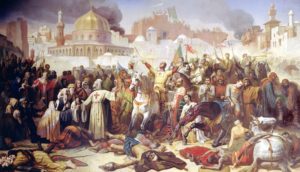
Most scholars believe the answer lies within the Crusades. The First Crusade (1095-1099) was a massive disaster for Europe’s Ashkenazi Jews. While the Crusades were meant to free the Holy Land from Muslim domination, many local Christians argued that there was no need to fight the heathen all the way in the Holy Land when there were so many local Jewish “heathens” among them. The result is what is referred to as “the Rhineland massacres”, described by some as “the First Holocaust”. Countless Jews were slaughtered.

‘Taking of Jerusalem by the Crusaders, 15th July 1099’ by Émile Signol

Like in the times of Roman persecution a millennium earlier, the Ashkenazi Sages sought comfort in the words of Kaddish, beseeching the coming of God’s Final Redemption, and at the same time seeking to honour the poor souls of the murdered. It therefore isn’t surprising that Rabbi Elazar of Worms is the first to speak of Kaddish for the dead, as his hometown of Worms (along with the town of Speyer) was among the first to be attacked, in May of 1096.

It is important to remember that Rabbi Elazar was a member of the Hasidei Ashkenaz, the “German Pietist” movement known for its mysticism and asceticism (not to be confused with the much later Hasidic movement). The Hasidei Ashkenaz would have been particularly well-versed in Heikhalot and Midrashim. Everything points to this group as being the true originators of reciting Kaddish for the dead.

The practice spread from there. Indeed, there was a great deal of Jewish migration in those turbulent times. For example, one of the greatest Ashkenazi sages, Rabbeinu Asher (c. 1250-1327), was born in Cologne, Germany, but fled persecution and settled in Toledo, Spain. His renowned sons, Rabbi Yakov ben Asher (Ba’al HaTurim, c. 1269-1343), and Rabbi Yehudah ben Asher (c. 1270-1349) continued to lead the Sephardic Jewish community of Toledo. And it was there in Toledo that was born one of the greatest of Sephardi sages, Rabbi Yosef Karo (1488-1575), author of the Shulchan Arukh, still the primary code of Jewish law.

In the Shulchan Arukh we are only told to recite Kaddish once at a funeral, following the burial (Yoreh De’ah 376:4). It is in the gloss to the Shulchan Arukh by the Ashkenazi Rama (Rabbi Moshe Isserles, 1530-1572) where we find that it is customary to continue reciting Kaddish for twelve months, though only for a parent, based on Midrashim that speak of reciting Kaddish for a father. The reasoning for the latter is that, since it is a father’s obligation to teach his son Torah, by reciting Kaddish the son demonstrates that the father had fulfilled the mitzvah, and left behind a proper Jewish legacy.

It is quite amazing to see that as late as 500 years ago, Mourner’s Kaddish was still defined in very narrow terms, and described as more of a custom (especially for Ashkenazim) based on Midrash than an absolute halachic necessity. How did it transform into a supreme Jewish prayer?

Enter the Arizal

As with many other Jewish practices we find so common today, it looks like it was the influence of the Arizal (Rabbi Isaac Luria, 1534-1572), history’s foremost Kabbalist, that made the Mourner’s Kaddish so universal, and so essential. Fittingly, he was the perfect candidate for the job, being the product of an Ashkenazi father and a Sephardi mother, and ending his life as the leader of the Sephardi sages of Tzfat.

The Arizal discussed the mysteries of Kaddish at great length. Like most of his teachings, they were put to paper by his primary disciple, Rabbi Chaim Vital (1543-1620). The latter devotes a dozen dense pages to Kaddish in Sha’ar HaKavanot. He first explains the various forms of Kaddish recited during the regular prayer services. In brief, we find that Kaddish is recited between the major prayer sections because each part of the prayer is associated with a different mystical universe, and a different Heavenly Palace, and Kaddish facilitates the migration from one world to the next.

Recall that Kabbalah describes Creation in four universes or dimensions: Asiyah, Yetzirah, Beriah, and Atzilut. The four sections of prayer correspond to the four ascending universes: the morning blessings and the first prayers up until Hodu correspond to Asiyah; the Pesukei d’Zimrah corresponds to Yetzirah; the Shema and its blessings parallel Beriah; and the climax of the prayer, the Amidah, is Atzilut, the level of pure Divine Emanation. For this reason, the Amidah is recited in complete silence and stillness, for at the level of Atzilut, one is entirely unified with God.

The Arizal delves in depth into the individual letters and gematrias of Kaddish, its words and phrases, and how they correspond to various names of God and Heavenly Palaces. He relays the proper meditations to have in mind when reciting the different types of Kaddish, at different stages of prayer. To simplify, the Arizal teaches that Kaddish helps us move ever higher from one world to the next, and more cosmically, serves to elevate the entire universe into higher dimensions. We can already see how this would be related to assisting the dead, spiritually escorting the soul of the deceased higher and higher through the Heavenly realms.

More intriguingly, Rabbi Vital writes that Kaddish is meant to prepare the soul for the Resurrection of the Dead. He goes on to cite his master in saying that Kaddish should be recited every single day, including Shabbat and holidays, for an entire year following the passing of a parent. He says that Kaddish not only helps to free a soul from Gehinnom, but more importantly to help it attain Gan Eden. It elevates all souls, even righteous ones. This is why one should say Kaddish for a righteous person just as much as for a wicked person, and this is why it should be said even on Shabbat (when souls in Gehinnom are given rest). Rabbi Vital then says how the Arizal would also say Kaddish every year on the anniversary of his father’s death, which is now the norm as well.

Ironically, while Kaddish began as an Ashkenazi custom, Rabbi Vital writes that the Arizal made sure to recite Kaddish according to the Sephardi text!

Repairing the World

Another interesting point that Rabbi Vital explains is why Kaddish is in Aramaic, and not Hebrew like the rest of the prayers. He reminds us the words of the Zohar that both Hebrew and Aramaic are written with the exact same letters because these are the Divine Letters of Creation, but Hebrew comes from the side of purity and holiness, while Aramaic is from the “other side” of impurity and darkness. Hebrew is the language of the angels, while Aramaic is the language of the impure spirits. The angels speak Hebrew, but do not understand Aramaic, while their antagonists speak Aramaic, and do not understand Hebrew. When we learn Torah and Mishnah, in Hebrew, we please the angels who take our words up to Heaven. When we learn Talmud and Zohar, in Aramaic, we destroy those dark spirits who cannot stand the fact that a person is using their tongue for words of light and holiness.

The same applies to our prayers. The bulk of our prayers are in holy Hebrew, the language of angels. Kaddish is in Aramaic because it is meant to elevate us, and the universe around us, into higher dimensions. In this vital task, we cannot risk elevating the impure spirits along with us, contaminating the upper worlds. Thus, by saying it in Aramaic, we push away the impure spirits who are unable to withstand us using their language in purity. Those evil forces are driven away, and we can ascend and rectify in complete purity.

This, in brief, is the tremendous power of Kaddish. This is why we recite it so many times over the course of the day. And this is why every Jew is so mysteriously drawn to this prayer and ritual, possibly above all others. Deep inside the soul of every Jew—regardless of background, denomination, or religious level—is a yearning to repair the world, to destroy the impure, to uplift the universe, and to recite loudly: “May His great Name be blessed forever and for all eternity…”