Tag Archives: Pirkei Avot

What Does God Ask Of You?

In this week’s parasha, Ekev, we read: “And now, Israel, what does Hashem, your God, ask of you? Only to fear Hashem, your God, to walk in all of His ways, and to love Him, and to serve Hashem, your God, with all your heart and with all your soul.” (Deuteronomy 10:12) Moses instructs his people that they should sincerely love, fear, and serve God. We have written in the past how the Sages say that loving God and serving God is often best done by loving and serving His creations. The Midrash compares this to a servant who takes care of the king’s son. Surely, the king will love such a servant and wish to bestow goodness upon him, for the servant cares for the king’s beloved child. As the Torah calls us all children of Hashem, the King, it goes without saying that those who take care of God’s children are naturally beloved by God.

This is the quality that made Aaron so special, and, according to some, earned him the merit of being chosen the progenitor of the priestly lineage. Pirkei Avot (1:12) famously instructs us to be, above all else, like Aaron (and his disciples): “loving peace and pursuing peace, loving all people, and bringing them closer to Torah.” Elsewhere in Avot (3:10), we are told that “One with whom his fellows are pleased with, God is pleased with.” The Kabbalists beautifully point out that the gematria of the command to love God (ואהבת את יי אלהיך) is 907, the same as the command to love your fellow (ואהבת לרעך כמוך אני יי), for one is impossible without the other.
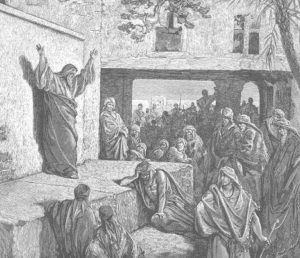
‘Micah Extorting the Israelites to Repentance’, by Gustave Doré

This is what the prophet Michah concluded when he, too, asked the same question as Moses did: “… And what does Hashem request of you? Only to act justly, and to love kindness, and to walk modestly with your God.” (Micah 6:8) Be just and treat everyone fairly; be kind and genuinely love to help others—and do it all humbly and modestly.

The Talmud (Shabbat 31a) takes a more literal approach, with Rava stating that God will ask each person six specific questions upon their death:

When man is led in for Judgment, he is asked: Did you deal faithfully? Did you fix times for learning? Did you engage in procreation? Did you hope for salvation? Did you engage in the dialectics of wisdom? Did you understand one thing from another?

The first question implies dealing honestly in business or in financial matters. Judaism has always taught the necessity of being scrupulously honest when it comes to money. The Kabbalists state that a person will be forced to reincarnate into this world if they so much as owe a single penny. They discuss how the value of shekel (שקל) is 430, equal to nefesh (נפש), “soul”, for each person’s material wealth is intricately tied to their spiritual nature. This is why giving money to charity can actually alter a person’s fate, as explained in the past. (See ‘How Charity Can Save Your Life’ in Garments of Light.)

Meanwhile, the Talmud holds that even though the Torah allows Jews to loan with interest to non-Jews, one shouldn’t charge interest from anyone, and a usurer might not even be a kosher witness in court (Sanhedrin 24b-25b). The same is true for someone who owes a lot of money. A person should not get themselves into great debt, and should ensure as much as possible that they will be able to repay a loan. This is why Rabbi Shimon, one of the five great students of Rabbi Yochanan ben Zakkai, held that the worst possible trait is that of a person who takes on debt and fails to repay (Avot 2:10). He bases himself on the words of King David: “The wicked man borrows and does not repay, but the righteous one is benevolent and gives.” (Psalms 37:21)

The wording of the Talmud is that a person will be asked if they took care of their finances b’emunah, “in faith”. Unfortunately, there are plenty of people who seem faithful, but engage in all kinds of financial tricks under the table. A person cannot be of great emunah if, at the same time, they cheat in financial matters, or are even a little bit dishonest with money. This includes gambling, stock market speculation, and all sorts of tax deceptions which have become so commonplace in our time.

Upholding Creation

The second question asked in the afterlife is whether a person set aside regular times to learn Torah. The Sages state that learning Torah is the most important mitzvah. Indeed, without learning Torah a person won’t know the right way to fulfil any mitzvah. The Torah is a “Tree of life for those who grasp it” (Proverbs 3:18), and the Sages quoted God stating: “I created the evil inclination, and I created the Torah as its antidote.” (Sifre Devarim 45) One who learns Torah is upholding the Covenant between God and Israel—since the Torah is the very text of that Covenant—and hence God states “If not for My covenant day and night, I would not have set the ordinances of Heaven and Earth.” (Jeremiah 33:25) God declares that He would not have created this universe were it not for His Torah—and His people upholding it day and night. (Some have therefore said that the world has time zones so that at any given moment, a Jew somewhere in the world is learning Torah.)

Similarly, the third question refers to procreation, for without it, too, humanity would cease to exist. More specifically, without Jewish procreation, there would be no Jews, and therefore no one to uphold that Covenant. The schools of Hillel and Shammai debated what it takes to fulfil the mitzvah of procreation (Yevamot 62a). According to Hillel, a person must have one boy and one girl, while according to Shammai, a person must have two boys and two girls. The reasoning of the latter is that Eve initially had four children: Cain, Abel, and the sisters each was born with. The first instance of pru u’rvu in the Torah resulted in two boys and two girls, so this is the standard for fulfilling the mitzvah.

However, the Talmud goes on to note another opinion that it was Shammai that taught one must have at least one boy and one girl, whereas Hillel taught that a person must simply have at least one child, whether boy or girl. The most lenient opinion, therefore, is that a person fulfils the mitzvah by having a single child, while the praiseworthy has at least two of each. A person who adopts a child or “raises an orphan” fulfils the mitzvah as well (Megillah 13a).

Of course, it isn’t enough just to have the kids. Parents need to invest their time and energy to ensure the children will be both righteous and successful. The Talmud (Kiddushin 29a) reminds us that, among other things, a parent is obligated to teach their child Torah, and also some kind of craft or career to ensure an honest livelihood. After all, “If there is no Torah, there is no flour; if there is no flour, there is no Torah.” (Avot 3:17) To raise children solely with Torah and assume a livelihood will come on its own, or to rely on the charity of others, is a gross sin. The Rambam (Hilkhot Talmud Torah 3:10) is particularly vocal about it:

Anyone who comes to the conclusion that he should involve himself in Torah study without doing work and derive his livelihood from charity, desecrates God’s Name, dishonors the Torah, extinguishes the light of faith, brings evil upon himself, and forfeits the life of the World to Come, for it is forbidden to derive benefit from the words of Torah in this world.

Our Sages declared: “Whoever benefits from the words of Torah forfeits his life in the world.” Also, they commanded and declared: “Do not make them a crown to magnify oneself, nor an axe to chop with.” Also, they commanded and declared: “Love work and despise rabbinic positions.” All Torah that is not accompanied by work will eventually be negated and lead to sin. Ultimately, such a person will steal from others.

Rabbi Moshe ben Maimon, the Rambam, aka. Maimonides, 1135-1204

Although the Rambam makes it clear that Torah study is of absolute importance, and should take precedence over one’s worldly occupation, he nonetheless reminds us that “the greatest sages of Israel were lumberjacks and water-drawers…” (ibid., 1:9) To be fair, there are other rabbinic authorities that allow for full-time Torah scholars who make learning their occupation, but this must only be for a minority of distinguished thinkers. It is certainly not a standard for everyone, for that would be completely unsustainable.

To get back to the third question, the Sages state that having children “hastens the Redemption”. There are a certain number of souls (in a Heavenly repository called “guf”) that must be born, and only when all of these souls have been born can Mashiach come. Thus, having children accelerates the time of Redemption.

This ties into the fourth question a person is asked: did they look forward to the Redemption? The wording is not if they waited for the Redemption, or hoped for it. Instead, whether they looked forward to it, suggesting a more active form. It isn’t enough to passively wait for the Redemption. Each person must do what they can to hasten it. This includes things like doing more acts of kindness and showing ahavat chinam, expressing baseless, non-judgemental love for all fellow Jews (Yoma 9b); engaging in kiruv; and, of course, repenting wholeheartedly (Sanhedrin 97b). Each person has to continue working on themselves to be ever-more righteous. Increasing one’s charitable donations hastens the Redemption, too (Isaiah 1:27 and Bava Batra 10a).

Garment for the Soul

The final two questions deal with one’s knowledge and understanding. It isn’t enough to engage in light learning here and there. A person must be steeped in dialectics (pilpul) and understand the depths of one thing from another (davar mitokh davar). The Arizal taught that a person must learn Torah on all four of its levels; pshat (simple), remez (sub-textual), drash (metaphorical), and sod (secret). These levels are collectively known by the acronym pardes, “orchard”—a word that is also the origin of the English “paradise”. One who doesn’t learn Torah on all four levels has not fulfilled the mitzvah of Torah study and will return in a reincarnation to do so (Sha’ar HaGilgulim, 16).

The Arizal also taught that Torah study not only strengthens a person spiritually, but literally creates a “garment” for the soul to be worn in the World to Come (Sha’ar HaPesukim, Tehillim). This is the meaning of the verse “The Torah of Hashem is perfect, it restores the soul” (Psalms 19:8). Meanwhile, the power of Torah study is so great that it creates angels, and these angels could eventually communicate with the student and bestow Ruach HaKodesh, divine inspiration, upon them (Sha’ar Ruach HaKodesh, 1).

The Talmud specifies that one should spend a third of their time studying Tanakh, then a third studying Mishnah, and a third studying Gemara (Kiddushin 30a). This was at a time when no other texts were available, so one should probably make another “third” for the many other areas of Jewish study we have today, including halachic and midrashic literature, mussar, hashkafa, various responsas and commentaries, as well as Kabbalah. The Arizal divided up his Torah study routine as follows (Sha’ar HaMitzvot, Va’etchanan):

First, he would read the weekly Torah portion. On Sunday, he would focus on the first six verses. On Monday, the next four. On Tuesday, the next five, and on Wednesday the next six. Another five on Thursday, making a total of 26 verses, and then the whole parasha on Friday. This was done in the traditional manner, shnaim mikra v’echad targum—reading each verse twice in Hebrew, and once in Aramaic.

Next, he would study a portion of Nevi’im, the Prophets, followed by Ketuvim, the other Holy Writings that make up the Tanakh. This, too, was done with shnaim mikra and a targum. The Arizal then studied the Mishnah, followed by Gemara, together with the various commentaries. Finally, he engaged in Kabbalah.

Yirat Hashem

Rava derived the six questions above from Isaiah 33:6, where the prophet declares, “And there shall be faith in your times; strength, salvation, wisdom and knowledge…” Faith refers to the first question regarding faithful business, times refers to the second question of setting times for Torah-learning, strength to procreation, salvation to the Redemption, wisdom and knowledge to the last two questions.

The Isaiah verse concludes with “… the fear of Hashem is His treasure.” One’s rewards (treasure) in the afterlife are contingent upon these six questions. Yet, what unifies them all is yirat Hashem, “fear” or “awe” of God.

One who is truly God-fearing will undoubtedly be scrupulously honest with financial matters, and strive to hasten the Redemption. It is doubtful that a Jew can be truly God-fearing without constantly meditating upon Torah and understanding its depths. Thus, complete yirat Hashem encompasses all of these things. Conversely, a person who does not live these ideals is probably not as God-fearing or faithful as they might believe themselves to be.

The Mysterious Custom of Upsherin

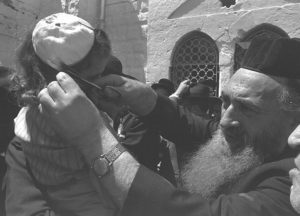
In this week’s double Torah portion (Acharei-Kedoshim) we read that “when you will have planted all manner of trees for food, its fruit shall be forbidden; three years shall it be forbidden to you, it shall not be eaten.” (Leviticus 19:23) This refers to the mitzvah of orlah, where a newly-planted tree must be left unharvested for its first three years. Seemingly based on this, a custom has developed to leave the hair of newborn boys uncut until age three. On or around the boy’s third birthday, a special celebration is held (called upsherin or halakeh), often with family and friends taking turns to cut a bit of the boy’s hair. Henceforth, the boy is encouraged to wear a kippah and tzitzit, and his formal Jewish education will begin. It is said that just as a tree needs the first three years to establish itself firmly in the ground before it can flourish and its fruit be used in divine service, so too does a child.

Lag B’Omer 1970 in Meron. Photo from Israel’s National Photo Collection

Indeed, the Torah makes a comparison between trees and humans in other places. Most famously, Deuteronomy 20:19 states that fruit trees should not be harmed during battle, “for is the tree of the field a man?” The tree is not an enemy combatant, so it should be left alone. Although the plain meaning of the verse is that the tree is not a man, an alternate way of reading it is that “man is a tree of the field”. Elsewhere, God compares the righteous man to a tree firmly rooted in the ground (Jeremiah 17:8), and in another place compares the entire Jewish nation to a tree (Isaiah 65:22).

Having said that, the custom of upsherin is essentially unknown in ancient Jewish sources. It is not mentioned anywhere in the Talmud, nor in any early halakhic codes, including the authoritative Shulchan Arukh of the 16th century. Where did this very recent practice originate?

Lag b’Omer and the Arizal

The first Jews to take up this custom were those living in Israel and surrounding lands under Arab Muslim dominion in the Middle Ages. We see that Sephardic Jews in Spain and Morocco did not have such a custom, nor did the Yemenite Jews. (In fact, Yemenite Jews did not even have a custom to abstain from haircuts during Sefirat HaOmer at all.) This is particularly relevant because the upsherin ceremony is often connected with the Sefirat HaOmer period, with many waiting until Lag b’Omer for their child’s first haircut, and taking the boy to the grave of Rashbi (Rabbi Shimon bar Yochai) in Meron for the special ceremony.

It appears that the earliest textual reference to upsherin is from Rabbi Chaim Vital (1543-1620), the primary disciple of the Arizal (Rabbi Isaac Luria, 1534-1572). Because of this, many believe that upsherin is a proper Kabbalistic custom that was instituted by, or at least sanctioned by, the great Arizal. In reality, the text in question says no such thing. The passage (Sha’ar HaKavanot, Inyan HaPesach, Derush 12) states the following:

ענין מנהג שנהגו ישראל ללכת ביום ל”ג לעומר על קברי רשב”י ור”א בנו אשר קבורים בעיר מירון כנודע ואוכלים ושותי’ ושמחים שם אני ראיתי למוז”ל שהלך לשם פ”א ביום ל”ג לעומר הוא וכל אנשי ביתו וישב שם שלשה ימים ראשו’ של השבוע ההו’ וזה היה פעם הא’ שבא ממצרים אבל אין אני יודע אם אז היה בקי ויודע בחכמה הזו הנפלאה שהשיג אח”כ. והה”ר יונתן שאגי”ש העיד לי שבשנה הא’ קודם שהלכתי אני אצלו ללמוד עם מוז”ל שהוליך את בנו הקטן שם עם כל אנשי ביתו ושם גילחו את ראשו כמנהג הידוע ועשה שם יום משתה ושמחה

On the custom of Israel going on Lag b’Omer to the grave of Rabbi Shimon bar Yochai and Rabbi Elazar his son (who are buried in the town of Meron as is known) and to eat and drink and rejoice there—I saw that my teacher, of blessed memory [the Arizal], that he went there once on Lag b’Omer with his whole family and remained there for three days, until the start of the sixth week [of the Omer]. And this was that one time, when he came from Egypt, but I do not know if he was then knowledgeable in this wisdom that he would later attain. And Rav Yonatan Sagis related to me that in the first year before I went to him to learn with my teacher of blessed memory, he took his small son with his whole family and there they cut his hair according to the known custom, and he held a feast and celebration there.

First, what we see in this passage is that the Arizal apparently only visited Meron on Lag b’Omer once, when he just made aliyah from Egypt, and before he had become the pre-eminent Kabbalist in Tzfat. (Some say this was actually before he made aliyah, and was simply on a trip to Israel.) Lag b’Omer is the 5th day of the 5th week of the Omer, and the Arizal stayed there for the remainder of the fifth week. Rav Chaim Vital wonders whether the Arizal was already an expert mystic at the time or not. Once he became the leader of the Tzfat Kabbalists, the Arizal apparently never made it a point to pilgrimage to Meron on Lag b’Omer. Rabbi Vital notes just that one time in the past, and it almost seems like once the Arizal was a master mystic, he understood there was nothing particularly mystical about it. In any case, nothing is said here of cutting hair.

The next part of the passage is more problematic. To start, it is unclear whether Rabbi Vital means that he and the Arizal went to study with Rav Yonatan Sagis, or that he and Rav Sagis went to study with the Arizal. We know that Rabbis Sagis and Vital were later both students of the Ari. However, when the Ari first came to Tzfat he was essentially unknown, and was briefly a disciple of other Kabbalists, namely the Ramak (Rabbi Moshe Cordovero, 1522-1570). In fact, the Arizal only spent a couple of years in Tzfat before suddenly passing away at a very young age. Whatever the case, it is unclear from the passage whether it was the Arizal or Rav Sagis who was the one to take his son for a haircut on Lag b’Omer. Based on the context, it would appear that it was Rav Sagis who did so, not the Arizal, since we already learned that the Arizal did not make it a point to pilgrimage to Meron.

The nail on the coffin may come from an earlier passage in the same section of Sha’ar HaKavanot, where we read:

ענין הגילוח במ”ט ימים אלו לא היה מוז”ל מגלח ראשו אלא בערב פסח ובערב חג השבועות ולא היה מגלח לא ביום ר”ח אייר ולא ביום ל”ג לעומר בשום אופן

On the matter of shaving during these forty-nine days [of the Omer], my teacher of blessed memory did not shave his head [hair], except for the evening of Passover and the evening of Shavuot, and would not shave his hair at all [in between], not on Rosh Chodesh Iyar, and not on Lag b’Omer.

According to the Arizal, one should not shave at all during the entire Omer period, including Lag b’Omer! If that’s the case, then the Ari certainly wouldn’t take his child to Meron for a haircutting on Lag b’Omer. It must be that the previous passage is referring to Rav Sagis. Nowhere else in the vast teachings of the Arizal is the custom of waiting until a boy’s third birthday (whether on Lag b’Omer or not) mentioned. Thus, the Arizal was not the custom’s originator, did not expound upon it, and most likely did not even observe it.

So where did it come from?

A Far-Eastern Custom

While no ancient Jewish mystical or halakhic text before the 17th century appears to mention upsherin, a similar custom is discussed in much older non-Jewish sources. The Kalpa Sutras of the ancient Hindu Vedic schools speak of a ceremony called Chudakarana or Mundana, literally “haircutting”. It is supposed to be done before a child turns three, usually at a Hindu temple. It is explained that the hair a child is born with it connected to their past life, and all the negative things which that may entail. Removing this hair is symbolic of leaving the past life behind and starting anew. Interestingly, a small lock of hair is usually left behind, called a sikha, “flame” or “ray of light”, as a sign of devotion to the divine. This is surprisingly similar to the Chassidic custom of leaving behind the long peyos at the upsherin.

Hindu Sikha and Chassidic Peyos

From India, the custom seemingly moved across Asia to Arabia. One Muslim tradition called Aqiqah requires shaving the head of a newborn. Of this practice, Muhammad had apparently stated that “sacrifice is made for him on the seventh day, his head is shaved, and a name is given him.” An alternate practice had Muslims take their boys to the graves of various holy people for their first haircut. The Arabic for “haircut” is halaqah, which is precisely what the Mizrachi Jews of Israel called upsherin. Thus, it appears that Jews in Muslim lands adopted the custom from their neighbours. However, many of them waited not until the child is three, but five, which is when the Mishnah (Avot 5:22) says a child must start learning Torah. (In this case, the practice has nothing to do with the mitzvah of orlah or any connection to a sapling.)

In the early 19th century, Rabbi Yehudah Leibush Horenstein made aliyah to Israel and first encountered this practice of “the Sephardim in Jerusalem… something unknown to the Jews in Europe.” He was a Hasid, and in that time period many more Hasidim were migrating to Israel—a trend instigated by Rabbi Menachem Mendel of Vitebsk (c. 1730-1788), the foremost student of the Maggid of Mezeritch (Rabbi Dov Ber, d. 1772), who in turn was the foremost student of the Baal Shem Tov (Rabbi Israel ben Eliezer, 1698-1760) the founder of Hasidism. These hasidim in Israel adopted the practice from the local Sephardim, and spread it to the rest of the Hasidic world over the past century and a half.

While it has become more popular in recent decades, and has been adopted by other streams within Orthodoxy, and even many secular Israelis and Jews, upsherin is far from universally accepted. The Steipler (Rabbi Yaakov Yisrael Kanievsky, 1899-1985) was particularly upset about this practice (see Orchos Rabbeinu, Vol. I, pg. 233). When a child was brought before Rav Yitzchok Zev Soloveitchik of Brisk (1886-1959) for an upsherin, he frustratingly replied: “I am not a barber.” Other than the fact that it is not an established or widespread Jewish custom, there is a serious issue of it being in the category of darkei Emori, referring to various non-Jewish (and potentially idolatrous) practices.

Not So Fast

While there is no mention of the upsherin that we know today in ancient Jewish mystical or halakhic texts, there is mention of something very much related. In one of his responsa, the great Radbaz (Rabbi David ibn Zimra, c. 1479-1573) speaks of a practice where some people take upon themselves a “vow to shave their son in the resting place of Samuel the Prophet” (see She’elot v’Teshuvot haRadbaz, siman 608).

Recall that Samuel was born after the heartfelt prayer of his mother Hannah who was barren for many years. She came to the Holy Tabernacle in Shiloh and vowed that if God gave her a son, she would dedicate him to divine service from his very birth, and he would be a nazir his entire life (I Samuel 1:11). This means that he would never be allowed to shave or trim the hair of his head, just as the Torah instructs for anyone taking on a nazirite vow. There is something particularly holy about this, and we see earlier in Scripture how an angel comes to declare the birth of the judge Samson and instructs the parents to ensure he would be a nazirite for life, and that no blade ever come upon his head (Judges 13:5).

The Tanakh goes on to state that once Samuel was weaned, Hannah took him to the Tabernacle and left him in the care of the holy priests so that he could serve God his entire life. How old was he when he was weaned? While it doesn’t say so here, there is an earlier case where the Torah speaks of a child being weaned. This is in Genesis 21:8, where we read how Abraham through a great feast upon the weaning of his son Isaac. Rashi comments here (drawing from the Midrash and Talmud) that Isaac was two years old at the time. For this reason, many Hasidic groups actually perform the upsherin at age two, not three.

Back to the Radbaz, he was born in Spain but was exiled with his family in the Expulsion of 1492. The family settled in Tzfat, where the Radbaz was tutored by Rabbi Yosef Saragossi, the holy “White Saint” credited with transforming Tzfat from a small town of 300 unlearned Jews to a holy Jewish metropolis and the capital of Kabbalistic learning. In adulthood, the Radbaz settled in Fes, Egypt and his fame as a tremendous scholar and posek spread quickly. In 1517, he moved to Cairo and was appointed Hakham Bashi, the Chief Rabbi of Egypt. There, he founded a world-class yeshiva that attracted many scholars. Coming full circle, it was here in the yeshiva of the Radbaz that the Arizal began his scholarly career. In the last years of his life, the Radbaz wished to return to the Holy Land, and made his way back to Tzfat. It is possible that the Arizal left Egypt for Tzfat in the footsteps of his former rosh yeshiva. Ironically, the Radbaz (who lived to age 94, or even 110 according to some sources) would outlive the Arizal (who died at just 38 years of age).

While neither the Arizal nor his old teacher the Radbaz discuss cutting a three-year-old’s hair in particular (or doing it at the tomb of Rashbi), the Radbaz does speak of a personal vow that one may take to cut their child’s hair at the tomb of Samuel the Prophet. This practice comes from emulating Hannah, who took a vow with regards to her son Samuel. Samuel went on to be compared in Scripture to Moses and Aaron (and the Sages say Moses and Aaron combined!) Of course, Hannah never cut her child’s hair at all, but perhaps there is something spiritual in treating the child like a nazirite until the child is “weaned”.

In any case, the question that the Radbaz was addressing is what one must do if they took up such a haircutting vow but are unable to fulfil it because the authorities prohibit Jews from going to the grave sites of their ancestors. From here, some scholars conclude that the Ottoman authorities at the time really must have prohibited Jews from going to the grave of Samuel, near Jerusalem. Thus, it is possible that those Jerusalem Jews who had a custom of going to Samuel’s grave decided to journey to another famous grave instead. Perhaps it was in these years of the early 16th century that the custom to go to Rashbi in Meron (instead of Shmuel near Jerusalem) evolved.

So, there may be something to the upsherin custom after all. Of course, we still don’t know when the practice of going to Samuel’s grave emerged. That appears to have been a local custom (or possibly not a custom at all, but a personal vow) of Jerusalem’s medieval Jewish community. It, too, may have been influenced by neighbouring Muslims who went to the graves of their saints to cut their children’s hair.

Whatever the case, we see that foundations of upsherin are not so clear-cut. Contrary to popular belief, it is neither a universally accepted Jewish custom, nor a mandatory halakhic requirement. It did not originate with the Arizal either, although we do see some basis for it in the writings of the Radbaz. For those who wish to uphold this custom, they have upon whom to rely, and should meditate foremost upon the holy figures of Hannah and Samuel, who appear to be the spiritual originators of this mysterious practice.


The above is an excerpt from Garments of Light, Volume Two. Get the book here

Are “Torah Codes” Legit?

This week’s Torah portion, Tzav, has a total of 96 verses. It just so happens that the numerical value of the world “Tzav” (צו) is also 96. This is a good example of a classic gematria, the Jewish numerology technique which the Mishnah describes as a “condiment to wisdom” (Avot 3:18). Over the centuries, gematria has become more and more common, and is now an inseparable part of Judaism. Rabbi Aaron Kornfeld (1795-1881) even elucidated 300 laws using the gematrias of their corresponding Torah verses (see his Tziunim l’Divrei HaKabbalah). Indeed, the ancient Baraita of Rabbi Eliezer lists gematria as one of the 32 valid principles of Torah interpretation. The Ba’al HaTurim (Rabbi Yakov ben Asher, 1269-1343), who uses gematria extensively in his commentary on the Torah, points out on the verse כִּי לֹא-דָבָר רֵק הוּא מִכֶּם, “it is not an empty thing for you” (Deuteronomy 32:47), that it equals the value of גימטריות, “gematrias”. In other words, gematria is not an empty or meaningless practice! Gematriot are the original “Torah codes” dating back to millennia-old teachings.

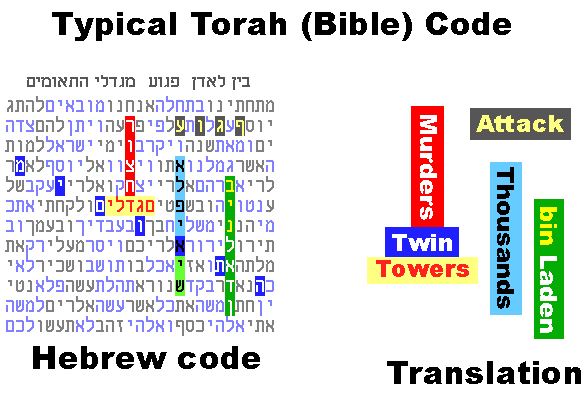
Meanwhile, in recent decades a new phenomenon has emerged and usurped the title of “Torah codes”. Today, when people think of “Torah codes” they are referring to the so-called “equidistant letter sequences” (ELS) method, often called in Hebrew (perhaps erroneously, as we shall see below) dilug, “skipping”. This method involves searching the Torah text for words that appear spaced out across large intervals. Here is one “Torah code”, courtesy of www.torahcodes.net:

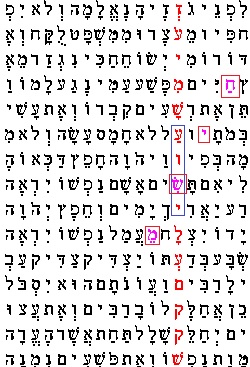
Codes found in Moby Dick. Click here for more Moby Dick “codes”.

Apparently, the Torah encoded within it the terrible events of September 11, 2001. Such “codes” have been found for just about everything. Indeed, those who use the method claim that this just proves that the Torah really does literally encode all of human history within it, as per tradition. The reality, though, is that you can find everything in Torah codes because the method is inherently flawed, and when you have a text with so many letters, you will naturally be able to find just about anything you look for. Similar “prophecies” have been found in Moby Dick, and in English translations of the Bible. Worse yet, the code has been used to “prove” that Jesus is the messiah:

Professor A.M. Hasofer has pointed out that the word “Yeshua” appears hundreds of times when using ELS, and twice appears overlapped with “navi sheker”, or “false prophet”! (See Hasofer’s article in B’Or Ha’Torah #11, “Torah Code Abuse”, for a thorough analysis and debunking of Torah codes.)

This alone should be enough to debunk Torah codes for good. (See here for why Jesus is not the messiah.) Yet, such codes are still widely spread and taught by well-meaning people. Just weeks ago on Purim I received one that claims skipping 12,196 letters from the mem in the term מור דרור (which our Sages say hints to Mordechai) will spell out מרדכי, “Mordechai”; and skipping the same 12,196 letters from the aleph in the term אסתיר פני (which our Sages say hints to Esther), will spell out אסתר, “Esther”. The kicker at the end is that supposedly Megillat Esther has exactly 12,196 letters. Immediately I went on the computer to check if this is true. Opening up a “Torah code” program, I found that if one skips 12,196 letters from either of the above, they will not get the claimed words. As I did more research, I found that the Megillah may not even have 12,196 letters. I found a similar claim that says the Megillah actually has 12,110 letters, and that the codes are from different words entirely. This one, too, did not work out in the search program! Finally, an article on Chabad.org explained the origin of the claim, dating it back to Rabbi Chaim Michoel Dov Weissmandl, “the Father of Torah Codes”, who is equally famous for his heroic efforts to save Jews in the Holocaust. According to the anecdote here, Rabbi Weissmandel taught that one gets “Esther” if they count from the Torah’s first aleph, and “Mordechai” from מור דרור. Funny enough, in a footnote at the very end, Chabad.org admits that they were

not able to duplicate the above results from the same starting places, but they did find “Esther” and “Mordechai” at the cited interval in different locations. Also, some “codes” programs yield a different number of letters for Megilat Esther, such as 13,408 and 12,110. “Esther” and “Mordechai” can be found at these intervals too.

In other words, the code is completely bogus. (Why Chabad.org—otherwise a terrific resource—would publish a story and admit at the end that it is based on something false eludes me.)

True Torah Codes

In his Pardes Rimonim, the great Ramak (Rabbi Moshe Cordovero, 1522-1570) does mention a practice called dilug, along with similar practices like gematria, roshei and sofei tevot, and letter permutations. Of course, he is not at all speaking about the ELS method, which is essentially impossible without a computer, and would have been unknown to the Ramak. The dilug he speaks of is where a word emerges from letter skipping within a verse or short passage—not hundreds of letters apart, or across different chapters, parashas, or even books, as is common in ELS.

For example, there is the old story of the apostate Avner, a former student of the Ramban (which we’ve discussed before). The story ends with the Ramban showing that Avner’s name is embedded within a verse in parashat Ha’azinu; a verse that speaks specifically of God destroying the memory of those who oppose Him, like Avner.* Such small codes—with short skips in verses that actually relate to the topic at hand—may certainly be valid. Still, the Ramban himself points out (in the first gate of Sefer haGeulah) that these kinds of practices must be based on a proper tradition going back to Sinai; a person should not conjure their own gematrias and codes, for in such a way a person will be able to “prove” just about anything.

When Barack Obama was elected, many pointed out that his name appears when skipping to every seventh letter from the aleph in the word “nasi” or “president” in the famous apocalyptic passage of Gog u’Magog (Ezekiel 38:2-3). Apparently, Obama did not fulfil his “prophesied” role of bringing the apocalypse.

“Bible Codes” abound on YouTube. This video has a code suggesting Mashiach would come during Chanukah of 5778 (ie. December 2017). The same YouTube channel still has videos going back to at least 5774 with codes proving each year to be an auspicious time for Mashiach to come!

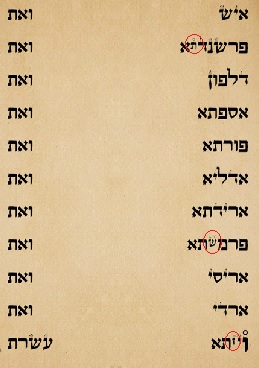
Having debunked one supposed “Purim code”, let’s conclude with a better-known Purim code. This one actually does work quite well and would be valid in the time of the Ramak, too (since it appears within one small passage, requires no computers, and is in context). It was Rabbi Weissmandl who once again first pointed it out. At the end of Megillat Esther, we read how Haman’s ten sons were hanged. The scroll shifts to a unique appearance here in listing the names of the ten sons. Traditionally, three letters in this list are written smaller than normal. Such smaller or larger letters always carry great significance wherever they appear in Scripture. The three here make up תש״ז, as if alluding to the year 5707, corresponding to the year 1946-47.

Amazingly, it was right at that time that the Nuremberg Trials concluded with the hanging of ten of the Nazi elite. In the Scroll itself we read how Esther was asked what to do with the hanged sons of Haman, and she responded: “If it please the king, let it be granted to the Jews that are in Shushan to do tomorrow also according to this day’s decree, and let Haman’s ten sons be hanged upon the gallows.” (9:13) Esther perplexingly asks for the ten sons to be hanged again!

Centuries later, ten of Hitler’s “sons”—some of his closest confidantes and co-conspirators—were hanged on the gallows, forbidden to go by firing squad as would be normal for military men.** And it’s almost as if they were aware of it all: it was reported that among the last words of the despicable Julius Streicher were: “Purimfest 1946”.

The cover of the October 28, 1946 edition of Newsweek. In its coverage of the Nuremberg executions, it states: “Only Julius Streicher went without dignity. He had to be pushed across the floor, wild-eyed and screaming: ‘Heil Hitler!’ Mounting the steps he cried out: ‘And now I go to God.’ He stared at the witnesses facing the gallows and shouted” ‘Purimfest, 1946.’ (Purim is a Jewish feast) … A groan came from inside the scaffold. Critics suggested afterward that Streicher was clumsily hanged and that the rope may have strangled him instead of breaking his neck.”


*The Avner code is actually not an ELS at all. Rather, the Ramban said that the third letter of each word spells “Avner”. These letters are not equidistant.

**The Talmud (Megillah 16a) states that Haman also had a daughter who committed suicide. In 1946, Hermann Göring was sentenced to death as well, but committed suicide the night before. Interestingly, Göring was known to be a cross-dresser. The hangings took place on October 16, 1946, just days after Rosh Hashanah 5707 (תש״ז) and fittingly, on the holiday of Hoshana Rabbah, the “Great Salvation”.