Tag Archives: Arizal

The Origins and Kabbalah of Kaddish

This week’s parasha begins with the passing of Sarah, the first Matriarch. We read how Abraham “eulogized Sarah and bewailed her” (Genesis 23:2). Today, the ritual most associated with Jewish death and mourning is undoubtedly the recitation of Kaddish. This has become one of those quintessentially Jewish things that all Jews—regardless of background, denomination, or religious level—tend to be very careful about. It is quite common to see people who otherwise never come to the synagogue to show up regularly when a parent or spouse dies, only to never be seen again as soon as the mourning period is over. Kaddish has become so prevalent that it has gone mainstream, featured in film and on TV (as in Rocky III and in the popular Rugrats cartoon), on stage (in Angels in America and Leonard Bernstein’s Symphony no. 3), and in literature (with bestselling novels like Kaddish in Dublin, and Kaddish For an Unborn Child).


Sylvester Stallone, as Rocky Balboa, recites Kaddish for his beloved coach and mentor. 

And yet, the origins of Kaddish are entirely clouded in mystery. It isn’t mentioned in the Tanakh, nor is there any discussion of reciting Kaddish for the dead in the Mishnah or Talmud. Even in the Rambam’s monumental Jewish legal code, the Mishneh Torah—just over 800 years old—there is no discussion of a Mourner’s Kaddish. Where did it come from?

Praying for Redemption

The Talmud refers to Kaddish in a number of places (such as Berakhot 3a, for example), though not in association with mourning the dead. Around the same time, we see a prayer very similar to Kaddish in the New Testament (Matthew 6:9-13), which has since become known as the “Lord’s Prayer” among Christians. This suggests that Kaddish existed before the schism between Judaism and Christianity, and this is one reason scholars date the composition of Kaddish to the late Second Temple era.

Many believe that it was composed in response to Roman persecution. The text of the Kaddish makes it clear from the very beginning that it is a request for God to speedily bring about His great salvation. It certainly makes sense that such a prayer would be composed in those difficult Roman times. In fact, the first words of Kaddish are based on Ezekiel 38:23, in the midst of the Prophet’s description of the End of Days (the famous “Gog u’Magog”), where God says v’itgadalti v’itkadashti. The Sages hoped the travails they were struggling through were the last “birth pangs” of the End Times.

In Why We Pray What We Pray, Barry Freundel argues that Kaddish was originally recited at the end of a lecture or a Torah learning session—as continues to be done today. It likely came at a time when public Torah learning or preaching was forbidden, as we know was the case in the time of Rabbi Akiva. So, the Sages ended their secret learning sessions with a prayer hoping that the Redemption would soon come, and they would once more be able to safely preach in public.

If that’s the case, how did Kaddish become associated with mourning the dead?

The Mourner’s Kaddish

Freundel points out that the earliest connection between Kaddish and the souls of the dead is from the Heikhalot texts. These are the most ancient works of Jewish mystical literature, going as far back as the early post-Second Temple era. (Scholars date the earliest texts to the 3rd century CE). One of these texts reads:

In the future, the Holy One, blessed be He, will reveal the depths of Torah to Israel… and David will recite a song before God, and the righteous will respond after him: “Amen, yehe sheme rabba mevorach l’olam u’l’olmei olmaya itbarach” from the midst of the Garden of Eden. And the sinners of Israel will answer “Amen” from Gehinnom.

Immediately, God says to the angels: “Who are these that answer ‘Amen’ from Gehinnom?” [The angels] say before Him: “Master of the Universe, these are the sinners of Israel who, even though they are in great distress, they strengthen themselves and say ‘Amen’ before You.” Immediately, God says to the angels: “Open for them the gates of the Garden of Eden, so that they can come and sing before Me…”

The Heikhalot connect Kaddish (specifically its central verse, “May His great Name be blessed forever and for all eternity…”) to a Heavenly prayer that will be recited at the End of Days, when the souls in Gehinnom will finally have reprieve. We can already start to see how this might relate to mourning, or spiritually assisting, the recently deceased.

This is related to another well-known story that is by far the most-oft used as the origin of Kaddish. In this narrative, a certain great sage—usually Rabbi Akiva, but sometimes Rabbi Yochanan ben Zakkai—sees a person covered in ash and struggling with piles of lumber. The poor person explains that he is actually dead, and his eternal punishment (reminiscent of popular Greek mythology) is to forever gather wood, only to be burned in the flames of that wood, and to repeat it all over again. The Sage asks if there is anything he could do to help, to which the dead man replies that if only his son would say a particular prayer, he would be relieved of his eternal torment.

The nature of that prayer varies from one story to the next. In some, it is the Shema, in others it is Barchu, and in others it is a reading of the Haftarah (see, for example, Kallah Rabbati 2, Machzor Vitry 144, Zohar Hadash on Acharei Mot, and Tanna d’Vei Eliyahu Zuta 17). It is only in later versions of the story that the prayer the son must say is Kaddish. Whatever the case, between the Heikhalot texts, and these Midrashic accounts, we now have a firm connection linking Kaddish with the deceased.

I believe there is one more significant (yet overlooked) source to point out:

The most important part of the Kaddish is undoubtedly the verse yehe sheme rabba mevorach l’olam u’l’olmei olmaya. As we saw in the Heikhalot above, this is the part that especially arouses God’s mercy. The Talmud (Berakhot 3a) agrees when it says essentially the same thing about the entire congregation reciting aloud “yehe sheme hagadol mevorach”. These special words are based on several Scriptural verses, such as Psalm 113:2 and Daniel 2:20. It also appears in Job 1:21.

Here, Job suffers the death of all of his children. Upon hearing the tragic news, he famously says: “…naked I came out of my mother’s womb, and naked shall I return; the Lord giveth, and the Lord taketh away; blessed be the name of the Lord.” In Hebrew it reads: Adonai natan, v’Adonai lakach, yehi shem Adonai mevorach. The parallel is striking. The first person in history to recite the great “yehe sheme rabba” upon the death of a family member is none other than Job. In some way, Job may be the originator of the Mourner’s Kaddish.

Birth of a Custom

Officially, the earliest known mention of reciting Kaddish for the dead is Sefer HaRokeach, by Rabbi Elazar of Worms (c. 1176-1238). Shortly after, his student Rabbi Itzchak of Vienna (1200-1270) writes in his Ohr Zarua that Ashkenazim have a custom to recite Kaddish upon the dead. He explicitly states that Tzarfati Jews (and as an extension, Sephardic Jews) do not have such a custom.

That much is already clear from the Rambam (Rabbi Moshe ben Maimon, 1135-1204), the greatest of Sephardic sages in his day, who makes no mention of a Mourner’s Kaddish anywhere in his comprehensive Mishneh Torah. (The Rambam does speak about the regular Kaddish, unrelated to the dead, which is recited throughout the daily prayers.) We see that in his time, Kaddish was still a strictly Ashkenazi practice. Why is it that Ashkenazi Jews in particular began to say Kaddish for the dead?

Most scholars believe the answer lies within the Crusades. The First Crusade (1095-1099) was a massive disaster for Europe’s Ashkenazi Jews. While the Crusades were meant to free the Holy Land from Muslim domination, many local Christians argued that there was no need to fight the heathen all the way in the Holy Land when there were so many local Jewish “heathens” among them. The result is what is referred to as “the Rhineland massacres”, described by some as “the First Holocaust”. Countless Jews were slaughtered.
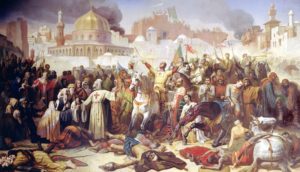
‘Taking of Jerusalem by the Crusaders, 15th July 1099’ by Émile Signol

Like in the times of Roman persecution a millennium earlier, the Ashkenazi Sages sought comfort in the words of Kaddish, beseeching the coming of God’s Final Redemption, and at the same time seeking to honour the poor souls of the murdered. It therefore isn’t surprising that Rabbi Elazar of Worms is the first to speak of Kaddish for the dead, as his hometown of Worms (along with the town of Speyer) was among the first to be attacked, in May of 1096.

It is important to remember that Rabbi Elazar was a member of the Hasidei Ashkenaz, the “German Pietist” movement known for its mysticism and asceticism (not to be confused with the much later Hasidic movement). The Hasidei Ashkenaz would have been particularly well-versed in Heikhalot and Midrashim. Everything points to this group as being the true originators of reciting Kaddish for the dead.

The practice spread from there. Indeed, there was a great deal of Jewish migration in those turbulent times. For example, one of the greatest Ashkenazi sages, Rabbeinu Asher (c. 1250-1327), was born in Cologne, Germany, but fled persecution and settled in Toledo, Spain. His renowned sons, Rabbi Yakov ben Asher (Ba’al HaTurim, c. 1269-1343), and Rabbi Yehudah ben Asher (c. 1270-1349) continued to lead the Sephardic Jewish community of Toledo. And it was there in Toledo that was born one of the greatest of Sephardi sages, Rabbi Yosef Karo (1488-1575), author of the Shulchan Arukh, still the primary code of Jewish law.

In the Shulchan Arukh we are only told to recite Kaddish once at a funeral, following the burial (Yoreh De’ah 376:4). It is in the gloss to the Shulchan Arukh by the Ashkenazi Rama (Rabbi Moshe Isserles, 1530-1572) where we find that it is customary to continue reciting Kaddish for twelve months, though only for a parent, based on Midrashim that speak of reciting Kaddish for a father. The reasoning for the latter is that, since it is a father’s obligation to teach his son Torah, by reciting Kaddish the son demonstrates that the father had fulfilled the mitzvah, and left behind a proper Jewish legacy.

It is quite amazing to see that as late as 500 years ago, Mourner’s Kaddish was still defined in very narrow terms, and described as more of a custom (especially for Ashkenazim) based on Midrash than an absolute halachic necessity. How did it transform into a supreme Jewish prayer?

Enter the Arizal

As with many other Jewish practices we find so common today, it looks like it was the influence of the Arizal (Rabbi Isaac Luria, 1534-1572), history’s foremost Kabbalist, that made the Mourner’s Kaddish so universal, and so essential. Fittingly, he was the perfect candidate for the job, being the product of an Ashkenazi father and a Sephardi mother, and ending his life as the leader of the Sephardi sages of Tzfat.

The Arizal discussed the mysteries of Kaddish at great length. Like most of his teachings, they were put to paper by his primary disciple, Rabbi Chaim Vital (1543-1620). The latter devotes a dozen dense pages to Kaddish in Sha’ar HaKavanot. He first explains the various forms of Kaddish recited during the regular prayer services. In brief, we find that Kaddish is recited between the major prayer sections because each part of the prayer is associated with a different mystical universe, and a different Heavenly Palace, and Kaddish facilitates the migration from one world to the next.

Recall that Kabbalah describes Creation in four universes or dimensions: Asiyah, Yetzirah, Beriah, and Atzilut. The four sections of prayer correspond to the four ascending universes: the morning blessings and the first prayers up until Hodu correspond to Asiyah; the Pesukei d’Zimrah corresponds to Yetzirah; the Shema and its blessings parallel Beriah; and the climax of the prayer, the Amidah, is Atzilut, the level of pure Divine Emanation. For this reason, the Amidah is recited in complete silence and stillness, for at the level of Atzilut, one is entirely unified with God.

The Arizal delves in depth into the individual letters and gematrias of Kaddish, its words and phrases, and how they correspond to various names of God and Heavenly Palaces. He relays the proper meditations to have in mind when reciting the different types of Kaddish, at different stages of prayer. To simplify, the Arizal teaches that Kaddish helps us move ever higher from one world to the next, and more cosmically, serves to elevate the entire universe into higher dimensions. We can already see how this would be related to assisting the dead, spiritually escorting the soul of the deceased higher and higher through the Heavenly realms.

More intriguingly, Rabbi Vital writes that Kaddish is meant to prepare the soul for the Resurrection of the Dead. He goes on to cite his master in saying that Kaddish should be recited every single day, including Shabbat and holidays, for an entire year following the passing of a parent. He says that Kaddish not only helps to free a soul from Gehinnom, but more importantly to help it attain Gan Eden. It elevates all souls, even righteous ones. This is why one should say Kaddish for a righteous person just as much as for a wicked person, and this is why it should be said even on Shabbat (when souls in Gehinnom are given rest). Rabbi Vital then says how the Arizal would also say Kaddish every year on the anniversary of his father’s death, which is now the norm as well.

Ironically, while Kaddish began as an Ashkenazi custom, Rabbi Vital writes that the Arizal made sure to recite Kaddish according to the Sephardi text!

Repairing the World

Another interesting point that Rabbi Vital explains is why Kaddish is in Aramaic, and not Hebrew like the rest of the prayers. He reminds us the words of the Zohar that both Hebrew and Aramaic are written with the exact same letters because these are the Divine Letters of Creation, but Hebrew comes from the side of purity and holiness, while Aramaic is from the “other side” of impurity and darkness. Hebrew is the language of the angels, while Aramaic is the language of the impure spirits. The angels speak Hebrew, but do not understand Aramaic, while their antagonists speak Aramaic, and do not understand Hebrew. When we learn Torah and Mishnah, in Hebrew, we please the angels who take our words up to Heaven. When we learn Talmud and Zohar, in Aramaic, we destroy those dark spirits who cannot stand the fact that a person is using their tongue for words of light and holiness.

The same applies to our prayers. The bulk of our prayers are in holy Hebrew, the language of angels. Kaddish is in Aramaic because it is meant to elevate us, and the universe around us, into higher dimensions. In this vital task, we cannot risk elevating the impure spirits along with us, contaminating the upper worlds. Thus, by saying it in Aramaic, we push away the impure spirits who are unable to withstand us using their language in purity. Those evil forces are driven away, and we can ascend and rectify in complete purity.

This, in brief, is the tremendous power of Kaddish. This is why we recite it so many times over the course of the day. And this is why every Jew is so mysteriously drawn to this prayer and ritual, possibly above all others. Deep inside the soul of every Jew—regardless of background, denomination, or religious level—is a yearning to repair the world, to destroy the impure, to uplift the universe, and to recite loudly: “May His great Name be blessed forever and for all eternity…”
The Guardian Angels of Israel

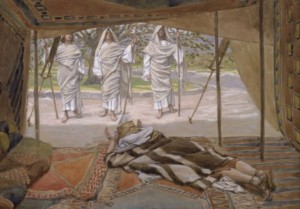
‘Abraham and the Three Angels’ by James Tissot

This week’s parasha, Vayera, begins with Abraham being visited by a trio of angels. Jewish tradition holds that these angels were Michael, Gabriel, and Raphael. The Ba’al HaTurim (Rabbi Yakov ben Asher, c. 1269-1343)—famous for his numerological commentary—points out that the words “And behold three…” (והנה שלשה), referring to the three angels, has the same gematria (701) as “these are Michael, Gabriel, and Raphael” (אלו מיכאל גבריאל ורפאל).

Rashi (Rabbi Shlomo ben Itzchak, 1040-1105) comments that each angel came for a specific mission: Michael to bless Abraham and Sarah with news of their impending child; Gabriel to destroy Sodom (which happens right after in the Torah); and Raphael to heal Abraham from his circumcision (which happened just before). The root of Gabriel is gevurah, “strength” or “restraint”, which is why Gabriel often appears in difficult situations, or acts of destruction. The root of Raphael is refuah, “healing”, so he appears whenever a recovery is required. Michael is the guardian angel of Israel, as we are told explicitly in Daniel 12:1.

These three angels regularly appear together. They were originally depicted as the highest of the angels in the Heavens. Later mystical literature would place others above them (namely Metatron). Still, the trio of Michael, Gabriel, and Raphael remain the most well-known. What else do we know about them?

Michael: Priest and Saviour

In one mystical passage, the Talmud (Chagigah 12b) outlines the Seven Heavens. The first is called Vilon (“curtain”) and simply refers to the atmosphere stretching over the Earth like a curtain. This is the place of clouds and weather, serving no particular spiritual purpose. Then comes the Rakia, the vast realm beyond Earth’s atmosphere that includes the Sun, moon, and all the stars and planets, ie. outer space. The third Heaven is called Shechakim, which we learn from other sources is the interface between this physical universe and the spiritual realms beyond. The Sages sometimes metaphorically describe it as being composed of millstones, or slabs of pure marble. The Talmud says this is the source of the manna that the Israelites ate in the Wilderness.

The fifth, sixth, and seventh Heavens are called Ma’on, Machon, and Aravot, but it is the fourth Heaven that is of particular interest for the present discussion. Here one will find the illustrious Yerushalaim shel Ma’alah, the Heavenly Jerusalem, a spiritual version of the Jerusalem below. Mirroring the one on Earth, there is a Temple up there, too, and it is Michael who serves as its High Priest.

Michael also serves as “Prince of Israel” and our Heavenly Guardian. In this role, he stands opposite Samael, the Heavenly “Accuser” who seeks to harm Israel. Hence, Michael stands at the gates of Heaven, admitting the righteous and guiding their souls. Similarly, he was Israel’s guide during their forty years in the Wilderness, being identified with the “angel that will go before you” (Exodus 23:20, 32:34), as God has promised (see Midrash haNe’elam, Beresheet 2).

Naturally, Michael is a great saviour for the Jews. It was he who saved Abraham from the fiery furnace (Beresheet Rabbah 44:16), and protected Sarah when she was abducted by Avimelech (Pirkei d’Rabbi Eliezer 26). In one intriguing Midrash (Yalkut Shimoni, Beresheet 134), we learn that Michael saved the baby that was born from Dinah’s rape by Shechem. Michael took the baby to Egypt, into the care of a wealthy childless couple. That wealthy man was Potiphar, and the adopted baby was Osnat, future wife of Joseph!

Gabriel and the Founding of Rome

When it comes to Joseph, it was Gabriel that helped him throughout his journey. According to the Talmud (Sotah 36b), Gabriel taught Joseph overnight (or perhaps “uploaded” into his brain) knowledge of the seventy languages, which allowed him to become viceroy of Egypt. Gabriel also taught Joseph all of the esoteric mystical wisdom of the Torah (while Raphael taught the same wisdom to Isaac; see Ravad on Sefer Yetzirah).

The Talmud credits Gabriel with setting the foundations of Ancient Rome (Shabbat 56b). This happened on the very same day that King Solomon married an Egyptian princess. Although Solomon’s intensions were certainly good, his many marriages spiralled out of control, and ultimately led to his downfall. In poetic fashion, King Solomon first builds Jerusalem’s Temple, and simultaneously sows the seeds of its destruction, for Rome would go on to destroy Jerusalem’s Temple for good, ushering in an endless exile which we are still in.

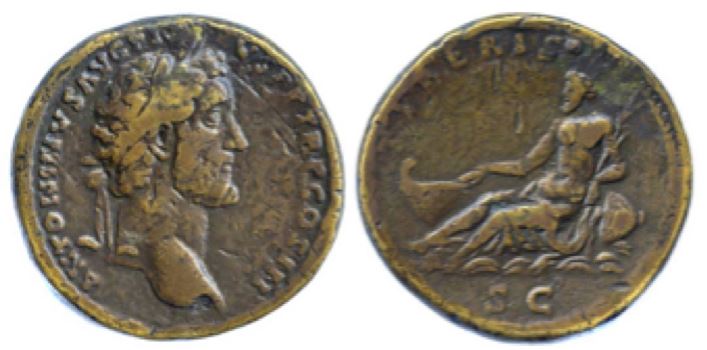
Interestingly, archaeologists have found coins bearing images depicting this version of Rome’s founding. The coins show a divine being of some sort planting reeds in the Tiber River to set the foundations of the “eternal city”, just as the Talmud describes. These coins were minted in the time of Emperor Antoninus Pius, which is most fitting because the Talmud tells us that a Roman emperor named Antoninus was good friends with Rabbi Yehudah haNasi, and the two engaged in many philosophical discussions.

Coins minted by Emperor Antoninus depicting the founding of Rome.


The above essay is an excerpt from Garments of Light, Volume Three.
To continue reading, get the book here! 

How Many Soulmates Do You Have?

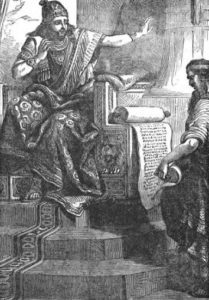
An 1873 illustration of King Josiah (Yoshiyahu) listening to a reading of the Torah

In this week’s parasha, Shoftim, the Torah relates the laws pertaining to Jewish kings. According to the Torah, the king of the Jews is not, and should not be, like the king of other nations. His primarily role is not to be a dictator or a conqueror. Rather, he must act like a divine messenger of God, and his duty is to ensure the observance of Torah law throughout the Holy Land. This is why we read across the Tanakh how the best Jewish kings—like Hezekiah and Josiah—were the ones that expunged idolatry from Israel and restored proper spirituality.

It is also why we see on several occasions in the Book of Shoftim (not to be confused with this week’s parasha of the same name) that the time before kings was lawless: “…there was no king in Israel; every man did that which was right in his own eyes.” (Judges 21:25) The Jewish king, therefore, is like God’s representative on Earth. In this regard, he is likened to an angel, which is why the term for a king, melekh (מלך), is nearly identical and shares the same root with the word for an angel, malakh (מלאך).

Not surprisingly, the Jewish king is held to a very high standard. The Torah (Deuteronomy 17:16-20) tells us that he:

may not acquire many horses for himself… And he shall not take many wives for himself, and his heart must not turn away, and he shall not acquire much silver and gold for himself. And it will be, when he sits upon his royal throne, that he shall write for himself two copies of this Torah on a scroll, before the priests. And it shall be with him, and he shall read it all the days of his life, so that he may learn to fear Hashem, his God, to keep all the words of this Torah and these statutes, to perform them, so that his heart will not be haughty over his brothers, and so that he will not turn away from the commandment, either to the right or to the left, in order that he may prolong [his] days in his kingdom, he and his sons, among Israel.

The Talmud discusses the finer points of these rules. One of the questions the Sages ask is: How many wives is too many? (Sanhedrin 21a) The Mishnah states the maximum is eighteen wives. Rav Yehuda then opines that a king can take more wives, as long as they will not “turn his heart astray”. Rabbi Shimon insists that even a single wife might turn her husband’s heart astray, and thus, the king must not take more than eighteen “even if they be women like Abigail”. Abigail, of course, was one of the righteous wives of King David, who is listed among the seven female prophetesses of Judaism.

In fact, the Talmud derives the maximum of eighteen wives from the case of King David:

Whence do we deduce the number eighteen? From the verse, “And unto David were sons born in Hebron; and his firstborn was Amnon of Ahinoam the Jezraelite; the second, Khilav of Abigail, the [former] wife of Naval the Carmelite; the third, Avshalom the son of Maacah; and the fourth, Adoniyah the son of Hagit; and the fifth, Shefatiah the son of Avital; and the sixth, Ithream of Eglah, David’s wife. These were born to David in Hebron.” (II Samuel 3:2-5) And of them the Prophet [Nathan] said: “And if that were too little, then would I add unto thee the like of these, and the like of these” (II Samuel 12:8), each “these” implying six, which, with the original six, makes eighteen in all.

Scripture tells us that David had six wives while he reigned from Hebron during his first seven years: Ahinoam, Abigail, Maacah, Hagit, Avital, and Eglah. When his court prophet Nathan recounted how he had once blessed him, he said he would multiply the king’s wealth (and wives) kahena v’kahena, more and more “like these”. This implies that David would have, or potentially could have, eighteen wives.

The Talmud continues to cite the opinion of Ravina, who believed that each kahena refers not to six, but twelve. He holds that David had six wives, the blessing was to double that to twelve, and “if that were too little”—as Nathan said—then he would multiple them kahena v’kahena. Thus, Ravina reasons that the maximum is twenty-four wives, not eighteen. The Talmud admits that there is an alternate Mishnaic teaching that 24 is the maximum, and yet another teaching that the maximum is 48. The latter comes from the fact that there is a letter vav in the term, meaning 24 and another 24! Nonetheless, the accepted tradition is a maximum of 18 wives, and no more.

The Talmud interestingly points out a potential flaw: wasn’t David also married to Michal, the daughter of King Saul, while in Hebron? The Sages conclude that Michal is the same person as Eglah. They then raise the following issue: how could Michal be Eglah if the Tanakh states Michal was childless while Eglah gave David a son? In a classic Talmudic interpretation, the Sages take the verse “Michal the daughter of Saul had no child until the day of her death” (II Samuel 6:23) to mean that she did not have children until her death, and died in childbirth. So, she finally had a child on the day of her death.

The Kabbalah of Soulmates

The Arizal (Rabbi Itzchak Luria, 1534-1572) gives a deeper, mystical answer to why the maximum number of wives for a king is eighteen. The implications of his teachings are not just relevant to kings, but to every Jew. While we generally think of a person as having a single soulmate, the Arizal explains that a person actually has eighteen soulmates (see, for example, Sha’ar HaMitzvot on this week’s parasha). Why would a person need eighteen soulmates?

The Talmud (Sotah 2a) famously states that “forty days before conception a Bat Kol [Heavenly Voice] proclaims: the daughter of so-and-so is destined for so-and-so…” The same passage states that pairing a person with their soulmate is “as difficult as the Splitting of the Sea”. The Midrash adds to this that ever since the Splitting of the Sea, God is busy making matches between people (Pesikta d’Rav Kahana 2:4). The Sages conclude that a person’s first match is pre-destined, while a second or subsequent match (if the first marriage fell through) becomes as difficult as splitting a sea.

The central issue that all of this rests on is free will. While a person does have a perfect, pre-destined match, free will can very easily get in the way and ruin things. For example, person A is destined to be with person B, but A makes some really poor decisions in life and ends up in a bad place (or dead). Does that mean B is now condemned to spend the rest of their life without their rightful soulmate? Must they now hopelessly struggle in search of the “right one” or be miserable in a series of failed relationships for the rest of their life, through no fault of their own? Surely, the Most Merciful God would not allow this to happen. And so, He spends all of His time “making matches”, finding alternate soulmates.

For this reason, a person has up to 18 different soulmates designated for them. If, due to free will, the match of A and B doesn’t work, there is always A and C. And if C, too, decides to move to the other side of the world, there’s a D behind them. Granted, the Arizal puts the soulmates in hierarchical fashion: D is not as good as C, nor is C as good as B—but they are all matching souls for A nonetheless. Of course, each of B, C, and D have 18 of their own soulmates, so one can see how complicated this matchmaking game becomes—“as difficult as the Splitting of the Sea”. The Arizal notes that 18 is a maximum, and not necessarily will there be 18 soulmates for a person alive all at once. Elsewhere, the Arizal explains that a person who does not find one of their soulmates will reincarnate to try again in a future life, as might one who needs to unite with a better soulmate, higher up on the chain of 18.

This brings us back to the first question: why is a king allowed up to, but no more than, 18 wives? A king, like every person, has up to 18 soulmates. He may choose to seek out and find all 18 of them, to unite with all of his soulmates. However, he must not take even a single wife more, for a nineteenth wife would certainly not be a soulmate. A king should not be taking a wife or concubine solely for pleasure. He may have more than one (and this may even be a political necessity), but only on the condition that she is one of his soulmates anyway.

The Kabbalah of David and Batsheva

The above discussion helps to explain the Talmudic dictum that one who believes David sinned with Batsheva is mistaken (Shabbat 56a). Recall that Batsheva was the wife of Uriah the Hittite, one of David’s generals. When Uriah was away in battle, David spotted Batsheva bathing and ended up sleeping with her. She would become pregnant, and to hide the sin, David ultimately placed Uriah in a situation where he would die in battle.

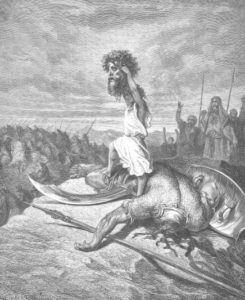
‘David and Goliath’ by Gustave Doré

From a mystical perspective, Batsheva was one of David’s 18 soulmates. In fact, she was his #1, and the two had been matched by God all the way back in the “six days of Creation” (Sanhedrin 107a). The Midrash relates that it was David’s own hubris that prevented him from marrying her. When David had defeated Goliath, he wanted (or needed) to decapitate the giant with his own sword. At the time, Uriah the Hittite happened to be the attendant of Goliath. David promised Uriah the best woman in Israel if Uriah would only provide him with Goliath’s sword. Uriah did so. He later became a righteous convert, and one of David’s greatest warriors. (This is why he is called a Hittite, for he was not originally Jewish.)

At the same time that David made the promise to Uriah, God made a decree in Heaven: Because of David’s haughty and immodest offer to distribute the daughters of Israel, God will mete out his punishment by giving away his very own soulmate to Uriah! What David did with Batsheva was certainly a sin, and the Talmud (ibid.) recounts how severely he was punished, including six months of intense leprosy in addition to the punishments already enumerated in Scripture. Yet, Batsheva was his rightful soulmate, and would go on to produce his rightful heir, King Solomon. The Talmud concludes that David simply rushed to be with her. Uriah was destined to die soon enough anyway, and then David could marry Batsheva with no issues.

The Kabbalists see David and Batsheva rushing to be with each other as a replay of Adam and Eve rushing to consume the Forbidden Fruit. Had Adam and Eve waited until Shabbat, they would have been permitted to eat from the Tree of Knowledge. David and Batsheva, too, needed only to wait a little longer. The connection between the two couples is deeper than that, for David and Batsheva were none other than the reincarnations of Adam and Eve. They had the opportunity to complete a great tikkun, a rectification for that primordial sin. (In some ways, so does every young couple that must wait until marriage to be intimate in holiness.) Alas, they failed, and the same souls will return one last time in Mashiach and his wife to finally fulfil the task.

(For more on the Adam-David-Mashiach connection, see here.)


The above essay is adapted from Garments of Light, Volume Three.
Get the book here!